 Your new post is loading...

|
Scooped by
Jeff Domansky
May 24, 2016 1:51 AM
|
The ongoing McDonald's creative review initially included all three of the ad industry's largest holding companies. But WPP made headlines earlier this month for bowing out (leaving incumbents Publicis and Omnicom in the running), and the alleged reasons behind its decision are even more intriguing. The client required competitors to complete their respective pitches in 60 days, with a June 30 deadline, and presented contracts forbidding future partners from turning a profit on base compensation, according to sources with direct knowledge of the matter. Agencies would allegedly operate at cost before meeting unspecified targets for performance-based pay. "Clients have always had the power," said Bryan Wiener, executive chairman of 360i. "And performance-based compensation is not a new topic either, but it's very hard to find ways to make it work so that all parties are aligned. "McDonald's did not respond to Adweek's requests for comment on the claims, which stirred controversy among creative agencies. One source who requested anonymity described the terms as "unheard of" and noted, "I don't know of any business that operates that way."...
|
|
Scooped by
Jeff Domansky
May 24, 2016 12:41 AM
|
Five years on, it's clear that Snapchat wasn't a gimmick. The company was recently valued at $16 billion and now has more than 100 million daily users who spend an average of half an hour on the app every day. And it's not just teens who love Snapchat. Although the service still skews toward the millennial set—60% of all 13- to 34-year-old smartphone users are on the platform—14% of Snapchat's user base is over 35. The fact that you know a snap is going to disappear makes you want to pay more attention to what you're watching. All of this results in 10 billion video views every single day. Many are personal messages sent and received between individuals, but these days, media companies and brands are competing for users' eyeballs as well. It might seem counterproductive for a company to invest in creating content that will be gone after 24 hours, but according to Bob Wolfley, who runs social media at the underwear company MeUndies, the fleetingness of these videos makes users more likely to be actively engaged with them. "We've been so trained by the constant rush of content on all these other social media networks that we mindlessly cycle through it to kill time," he says. "The fact that you know a snap is going to disappear makes you want to pay more attention to what you're watching. Snapchat does not have metrics for companies to track how effective their snaps have been for driving traffic and generating sales, but the brands Fast Company interviewed say that they have done their own little experiments. MeUndies, for instance, which has been on Snapchat for two years, has used a variety of methods to see how the audience is engaging with the brand. Wolfley has created vanity URLs to track if followers were going from Snapchat to the MeUndies website and has also launched several hidden sales campaigns to determine how many users used a specific promotion code. He is now convinced that Snapchat is the most impactful channel for introducing users to the brand and then getting them to make purchases. "We're getting more bang for our buck per follower than any other social media network," he says....
|
|
Scooped by
Jeff Domansky
May 23, 2016 9:24 AM
|
From LocalLabs to GoLocal24 to Everyblock, hyper-local news startups have consistently collided with foreboding economics: Narrow audiences tend to be small audiences, and small audiences are hard to monetize. But Ripple founder and CEO Razmig Hovaghimian, who previously made splashes with Embrace and Viki, thinks his latest project could build a more successful business model for hyper-local news — and several heavyweight funders are buying in. "I want [Ripple] to be a platform where storytellers get not only recognition and satisfaction from it, but compensation as well." -Razmig Hovaghimian EarlIer this month, Hovaghimian and his six-person team launched Ripple, a hyper-local news app that uses geo-location technology to help users discover the stories closest to them. Backed by Greylock Partners, Knight Foundation, MIT Media Lab director Joi Ito and other funders, Ripple has now launched in ten cities, including San Francisco and New York, and Hovaghimian says more locations are coming soon. source of enthusiasm for Ripple is two-fold: First, by combining geo-mapping technology with a voting system that allows stories to “ripple out” to a wider audience, Ripple creates an opportunity to produce hyper-local news at scale — a big step toward business viability....
|
|
Scooped by
Jeff Domansky
May 19, 2016 6:01 PM
|
It can be difficult to get a news release approved internally—even without thinking about search engine optimization.
However, if exposure, disclosure or page views are your goals, you must heed content discoverability and make your release SEO-friendly.
A list of search engine violations and penalties shows ways your content can fail to attract attention online. This applies to all your owned media content—including your website and news releases.
What makes some releases more successful than others in terms of drawing traffic? They’re written with healthy SEO features. These successful news releases appeal to Google’s latest algorithm, which rewards high-quality, unique and non-spam content.
Follow these five simple steps to create releases that can rank high in search results....
|
|
Scooped by
Jeff Domansky
May 19, 2016 5:44 PM
|
Light colors are easy on the eye, which means that they aren’t as likely to take attention away from the main goal or goals of a site. Negative space, on the other hand, makes websites look less cluttered and easier to navigate. Even though negative space can actually be filled with any color, white is typically the safest bet. For example, a brand like Best Buy is associated with the colors blue and yellow, but the company primarily uses these colors in the navigation menu of its site, which leaves plenty of whitespace to help guide visitors' eyes to calls-to-action (CTAs) like "Shop" and "Find out more."
Some brands, however, are okay with challenging the rules of Web design and are doing so with colorful designs that are pushing the best-practice boundaries. Although colorful designs are certainly not for everyone, they can be successful when they are executed correctly and used for the right brand. For some inspiration, check out the six colorful websites featured below...
|
|
Scooped by
Jeff Domansky
May 19, 2016 5:03 PM
|
Remember all those classic PSA posters showing fish, birds and other wildlife caught in the deadly clutches of bags, bottles and the deadly plastic rings that hold your beer and soda cans together? Research by Greenpeace found that 80 percent of sea turtles and 70 percent of seabirds are still ingesting plastic today.
Very little about beer packaging is environmentally friendly, but many brewers find six-packs to be a more efficient way of storing their product, despite the continuing danger to sea life.
New York agency We Believers and its client Saltwater Brewery came up with a solution—edible six-pack rings made of grains left over from the brewing process itself....
|
|
Scooped by
Jeff Domansky
May 19, 2016 4:46 PM
|
This kind of à la carte, short-form video content takes advantage of vertical's power. Successful videos on Snapchat turn the constraints of vertical into strengths. "Our viewers prefer vertical," Snapchat's head of content, Nick Bell, told USAToday last year. "We've seen a 9 times higher engagement rate with vertical rather than horizontal video."
The right mix garners video completions for National Geographic
With its rich, image-focused legacy, National Geographic might not be the first brand you'd expect to embrace vertical. Yet it already offers a mix of short-form video, articles and photo-driven stories about travel and adventure on Snapchat Discover. In fact, vertical can work even better for mountainscapes and animal close-ups—a short video of a baby sloth has been a major hit. As National Geographic social media vp Raj Mody told The Los Angeles Times: "From day one, we saw this as a great way to reach new young audiences and advance our mission. We definitely think it's showing promise."
Tal Chalozin, co-founder and CTO of video platform Innovid, finds Snapchat's video views and user engagement to be extremely high. He recommends publishers look at the completion rate to gauge impact, adding that many Snapchat videos are achieving 90 percent completion rates or above. "Snapchat is redefining the word premium," says Chalozin. "People are willing to give their time to watch, regardless of the production value. But that specific term—completion rate—can be a great gauge for quality."...
|
|
Scooped by
Jeff Domansky
May 18, 2016 1:05 PM
|
Native Insider: Part of the challenge with "native" is that each organization has a different understanding of what it is. For the purposes of the research, what is your definition of native advertising?
Wu: In our study, we defined native advertising as sponsored content, which features content that is similar and consistent with publishers’ content and is often consumed by readers like non-sponsored content. I agree that there are also other types of native advertising, such as sponsored social media posts or sponsored hyperlinks. We focused on sponsored content because it is widely adopted by many news organizations, including very reputable ones like The New York Times.
Native Insider: Your research found that when content was identified as native advertising, readers expressed a lower opinion of the media outlet it was published in. However, the reputation of the company being promoted was not affected. Can you elaborate on this finding?
Wu: I think this was one of the most interesting findings in our study. We originally expected that both companies and media outlets would be negatively influenced. However, the media outlet was the only source that was affected. On one hand, this indicates that readers are not surprised by the sponsored content from a company, since similar covert marketing techniques have been utilized before, such as video news releases....
|
|
Scooped by
Jeff Domansky
May 17, 2016 5:26 PM
|
Coupons are quickly growing as a significant component of beacon-enabled proximity marketing thanks to strong redemption rates, with brands and retailers forecast to deliver 1.6 billion coupons a year by 2020, according to a new report from Juniper Research.
The results point to how proximity marketing is gaining traction as retailers look to engage more deeply with consumers in and around their stores, prompting the volume of beacon-enabled coupons to grow quickly from the 11 million expected to be delivered in 2015. However, the research also underscores the potential danger of turning beacons into nothing more than another offer channel, which is likely to cause shoppers to lose interest.
“I would imagine that coupons will represent a key plank of any beacon-based proximity marketing strategy,” said Dr. Windsor Holden, head of forecasting and consultancy at Juniper Research as well as author of the report....
|
|
Scooped by
Jeff Domansky
May 17, 2016 5:18 PM
|
Brand loyalty is important to retailers, but one tool can lure loyal shoppers away to other establishments.
Coupons are still one of the most effective tools to attract customers away from brands and retailers to which they are loyal, according to a report from Valassis.
Furthermore, coupons are just as influential among average consumers as they are among brand loyalists:
- 84% of all consumers (not including brand loyalists) would likely switch stores in order to capitalize on weekly specials, compared to 82% of brand loyalists.
- Coupons would lead 82% of all consumers to purchase a product from a brand they would not otherwise, compared to 78% of brand loyalists
- 85% of all consumers would purchase a new product because of a coupon, compared to 84% of brand loyalists....
|
|
Rescooped by
Jeff Domansky
from MarketingHits
May 17, 2016 11:17 AM
|
“Social media's not going away - it's up to businesses to board the train or get left on the platform.
What other tool can build relationships between businesses with such ease and speed?
Via Brian Yanish - MarketingHits.com
|
|
Scooped by
Jeff Domansky
May 16, 2016 3:56 PM
|
Harry Brignull, a user-experience consultant in Britain who helps websites and apps develop consumer-friendly features, has a professional bone to pick with sites that seem to maneuver people into signing up for services they might not actually want.
He even has a name for the exploitative techniques: “dark patterns.” To him, these are debased versions of the typical sign-up, sharing, shopping, checkout and download processes that are standard practice online.
“It’s a term for patterns that are manipulative, that you are doing on purpose to get one over on users,” Mr. Brignull said when I recently called him.
A few years ago, Mr. Brignull started a site called darkpatterns.org to call attention to the practices....
|
|
Scooped by
Jeff Domansky
May 16, 2016 2:21 PM
|
There's more evidence to support the growing importance of mobile devices along the path to purchase.
According to Nielsen's fourth-quarter 2015 Mobile Wallet Report, 37 percent of respondents said their purchases start with mobile shopping more than one-quarter to half of the time.
The report compares mobile use from the fourth quarter of 2015 to the same period the year before. It found that shoppers are using mobile devices, particularly smartphones, to assist with in-store sales more frequently than for online shopping.
Roughly 72 percent are researching an item or checking prices on a smartphone before buying. Store locators are popular with 60 percent of smartphone users, and 55 percent are using mobile coupons.
Reviews are popular with slightly more than half of all mobile device users and 44 percent of smartphone users use digital lists while shopping....
|
|
|
Scooped by
Jeff Domansky
May 24, 2016 1:34 AM
|
It doesn’t matter how many years of experience you have of a programming language, framework or CMS, you will always need to refer to the official documentation or, and more than likely, a handy quick reference cheatsheet, as it’s literally impossible to remember and know absolutely everything. In this post I have collected an avalanche of useful cheatsheets, references, guides, checklists and docs, covering almost all aspects of web design, that will not only help to improve your productivity, but will also help to solve some of those frustrating programming issues that often arise (I’m looking at you PHP!).Just click on the ‘view’ button beside each resource and either save the PDF or bookmark the page....
|
|
Scooped by
Jeff Domansky
May 23, 2016 9:36 AM
|
I was having a discussion with one of my oldest and closest friends the other day about his career. He wants to go farther in the world of public relations but doesn’t quite know what he needs to get there. So, as an enterprising go-getter, he started making connections and asking other PR pros what he needs to know in this day and age to get ahead of the competition. What one professional told him made me laugh and then made me think. “To get ahead, you need to know two things: Google Analytics and SEO. ”This kind of stopped me in my tracks. Yes, analytics and SEO are extremely important in the digital world. They go hand in hand – one promotes your website while the other tracks how you’re doing. For instance, you can be at the top of the rankings for a key term, but if your bounce rate for that page is insanely high, you might need to change some things. SEO only gets you the attention you need; analytics will tell you exactly how long and what happens after the user sees your page. But what shocked me is that it wasn’t a marketing executive that was telling my friend how essential these tools are, but a public relations professional with many, many years in the business. So has public relations and marketing suddenly become the same thing?...
|
|
Scooped by
Jeff Domansky
May 23, 2016 9:18 AM
|
In most organizations, PR and Marketing teams use tools like Sprinklr's Listening module or Brandwatch to monitor online conversations about the brand, and also to monitor topics that matter to the brand. For example, a CRM software vendor might monitor online conversations about CRM, to understand what people say about their CRM challenges, and to understand what customers say about CRM vendors. While Marketing or Sales Operations teams often use insights from social listening to develop marketing content and sales collaterals, those teams can often do more to help sellers use social channels to accelerate trust with customers and prospects. If you are like most organizations with a sales force today, your company gets most of your closed opportunities from your sellers, rather than from Marketing, so it is critical for Marketing to help sellers accelerate trust however they can....
|
|
Scooped by
Jeff Domansky
May 19, 2016 5:53 PM
|
C-level stakeholders (especially at B2Bs in tech-driven sectors) often perceive PR as an expensive cost center. They don't link PR to the business development and sales functions of the organization—and instead cling to the idea that good publicity is a byproduct of good business.
The reality is that tangible business results are (or should be) the outcome of quality PR efforts. Positive publicity is a boon to any business but not the end game of B2B PR.
Worthwhile B2B PR is all about earning results that change perceptions, shape opinions, drive brand preferences, and create new business opportunities. B2B PR should not focus only on impressions and other vanity metrics that our industry still uses.
Those positive results can only be earned from a PR strategy aligned and integrated with the entire business and in sync with the changing media landscape, the evolving expectations of B2B buyers and enterprises, and the new rules and best-practices in the industry.
|
|
Scooped by
Jeff Domansky
May 19, 2016 5:34 PM
|
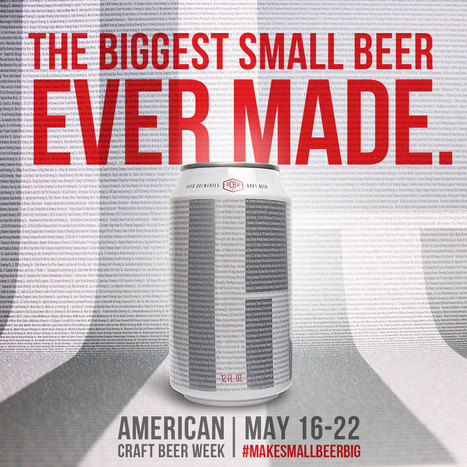
This week is American Craft Beer Week. To celebrate, craft brewers have teamed up to create a single beer, which is being made using the same recipe by more than 100 craft brewers—and in an act of even greater unity, features the names of 4,490 craft brewers from all 50 states on the can.
It's a cool idea, and an interesting design, though truth be told it doesn't exactly pop. Still, it's the thought (and the quality of the beer) that counts—and craft brewers are using this week to spread their message with a movement to #MakeSmallBeerBig....
|
|
Scooped by
Jeff Domansky
May 19, 2016 4:57 PM
|
Do you want to pay for a fresh box of golf balls or to get your nails done simply by doing what you are already doing all time time? Well, Pay Your Selfie has just what you need—an app that doles out cash for your moments of mobile narcissism.
The Chicago-based company has attracted 100,000 users since launching in September, accruing 500,000 photos from consumers, many of whom pose with brands. Here's why they selfie up with marketers: They get paid up to $1 when they upload a picture with a brand in it after Pay Your Selfie posts a request for such photos.
Unsponsored selfies—photos in which users do not snap pics with a specific product—pay just a few coins. At any rate, once their digital piggy bank (see below) gets to $20, the company will mail them a check for the amount or donate it, upon request, to their chosen charitable organization.
What's more, brands are forking over cash to Pay Your Selfie on a per-engagement basis, taking the data and utilizing the insights to inform future marketing efforts like creative for ads and packaging for products. The lion's share of the app's users are millennials, the all-important demographic marketers are trying to target....
New to SEO? Here’s all the tips you need to know to optimize your content before, after, and when you blog.
Via massimo facchinetti
|
|
Scooped by
Jeff Domansky
May 17, 2016 7:15 PM
|
Marketing audits are the dental checkups of the business world. Sure, you dread your regularly scheduled cleaning, but you know it’s good for you and your pearly whites. More importantly, it’s really the only thing standing between your dubious flossing regimen and a traumatizing root canal.
In similar vein, a marketing audit is designed to catch any major flaws in strategy, process and implementation before a costly mistake. If done right, they can save your company thousands of dollars, keep marketing aligned with revenue goals and serve as a safety net for preventing anything that could detrimental to the future of the company.
The best kind of audits usually begin at a holistic level, dive into deeper detail and end with a prioritized list of action steps. While not all marketing strategies are created equal, here are a few ways to go about auditing yours...
|
|
Scooped by
Jeff Domansky
May 17, 2016 5:21 PM
|
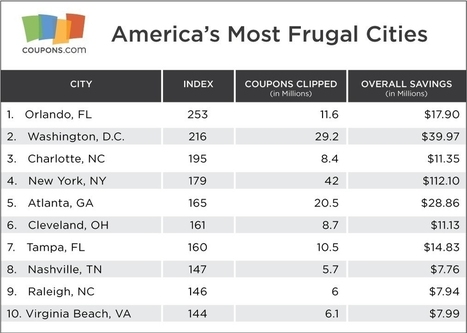
For the sixth year, Coupons.com, Quotient Technology Inc.'s (NYSE: QUOT) flagship savings destination, is releasing America's Most Frugal Cities list, showcasing cities with the most budget-conscious shoppers. According to the 2015 Coupons.com Savings Index[1], shoppers in 2015 clipped more than 1.6 billion digital coupons and saved more than $2.3 billion on consumer packaged goods, including grocery and household items.
This year, residents in Orlando are once again the savviest savers in the nation, reclaiming the title of Americas Most Frugal City from San Francisco, which took the lead in 2014 for the first time. Orlando won the 2013 honors and slipped to the third-ranked position in 2014. Rounding out the top 10 list, Washington, D.C., took the #2 spot for the second year in a row. Charlotte, N.C., moved up two spots to #3 and for the first time ever, New York City cracked the top 10 list as the #4 most frugal city in 2015. Atlanta (#5), Cleveland (#6), and Tampa, Fla. (#7), came in at a virtual tie, with Nashville, Tenn. (#8), narrowly beating Raleigh, N.C. (#9) and Virginia Beach, Va. (#10) to round out the top 10....
|
|
Scooped by
Jeff Domansky
May 17, 2016 5:13 PM
|
RetailMeNot, Inc., a leading digital savings destination connecting consumers with retailers, restaurants and brands, both online and in-store (www.retailmenot.com/corp), released a new study today, titled "The Evolution of Dining in the Digital Age," that explores digital savings and mobile habits among restaurant patrons, as well as general habits related to dining out and spending.
More than ever before, consumers are turning to their digital devices to help make dining out decisions easier, including searching for nearby locations and deals. In fact, nearly a third of consumers (32%) have used a deal that they found online or on their mobile device at a restaurant in the past three months. But that's not all they're using their smartphones for when dining; the survey breaks down when, where and how their mobile devices impact the dining journey....
|
|
Scooped by
Jeff Domansky
May 16, 2016 8:47 PM
|
France is one step closer to becoming the first country to set a curfew for email, after a bill banning companies with 50 or more employees from sending emails after work hours recently passed the French lower parliament.
The bill’s next destination is the French Senate, and if passed, it will be sent back to the National Assembly to become law. It would require businesses to define the work hours in which email can or cannot be sent, and is intended to reduce workplace stress.
Studies point to email as a major headache for consumers, with reports correlating checking email with negative health consequences....
|
|
Scooped by
Jeff Domansky
May 16, 2016 3:20 PM
|
...“Mainstream news organizations have endured a skeptical public for decades,” said Kjerstin Thorson, a professor at the Annenberg School for Communication and Journalism at the University of Southern California.
Now, she says, social media companies may face similar, and perhaps jarring, scrutiny.
Facebook declined to say how many people have editorial roles, as did Instagram, which Facebook owns. But several other companies provided some details about their operations that suggest the scope and variety of their editorial ambitions.
Snapchat said it has around 75 people who produce content, collecting and annotating videos and photos of live events and sometimes adding on-the-scene reporting themselves. Twitter employs just under a dozen people in the United States and around two dozen worldwide to collect and describe postings about notable topics.
Vine, the video service owned by Twitter, employs five to 10 people to highlight videos and producers that might have been overlooked by the audience, or that the company simply wants more people to see.
Vine employs five to 10 people to highlight videos on its site.
“Where curation picks up,” said Ankur Thakkar, the editorial lead of Vine, “is that you need human eyes and ears to pick up on a cultural trend that a machine might not see.”
In some cases, these teams coexist with media professionals working elsewhere on the platform. Peter Hamby, a former CNN political reporter, oversees a team of six journalists within Snapchat, while media companies — including CNN — produce content for the company’s Discover feature....
|






























McDonald's Global agency review and contract terms seem unfair and unreasonable.