 Your new post is loading...

|
Scooped by
Jeff Domansky
May 26, 2016 11:51 PM
|
Sick of your significant other skipping ahead and watching your favorite streaming shows without you? Lock them into a faithful TV-viewing relationship with a high-tech pair of series commitment rings, thanks to U.K. ice cream brand Cornetto.
The marketer, which tends to advertise around themes of teen love, created special rings that connect to streaming apps, and use near field communications to block access to TV shows you both watch unless your partner is nearby—thus putting an end to sneaking around with services like Netflix while feigning fidelity.
A two-minute video explains the concept, and illustrates the dangers of cheating—reaching its high point when one young woman pretends, in brilliantly unconvincing fashion, that she hasn't seen the episode she's watching with her boyfriend.
The idea of rings that forcibly prevent viewers from such dalliances is so silly and au courant that it almost doesn't matter that the details of its functionality aren't entirely ironed out....
|
|
Scooped by
Jeff Domansky
May 26, 2016 11:37 PM
|
Pure-play digital media companies ranked among the top 30 largest media suppliers in the world, but the list continues to be dominated by media companies that were founded on the basis of non-digital media. That’s the finding of an analysis released this morning by Publicis’ Zenith unit, ranking the volume of Madison Avenue’s biggest supply-chain players.
Google parent Alphabet continues to dominate the list at No. 1, but other than Facebook (No. 5) and China’s Baidu (No. 9) “traditional” media suppliers represent the rest of the top 10. The other pure-play digital suppliers -- Yahoo (No. 15) and Microsoft (No. 17) -- have not exactly been ascendant in recent years, although Google’s, Facebook’s and Baidu’s market power have been growing significantly as Madison Avenue reorganizes itself around the biggest-scale suppliers of digital media inventory.
To illustrate how much the media supply chain is becoming stratified -- and stratified among digital's Big 5 -- consider that the five pure-plays now represent about 19% of all global ad spending, but Google alone represents 12%, according to Zenith....
|
|
Scooped by
Jeff Domansky
May 26, 2016 10:43 AM
|
Mastercard has announced that it is powering the first commercial application of SoftBank’s humanoid robot Pepper, creating a service in Pizza Hut restaurants in Asia. The service will have Mastercard’s digital payment service MasterPass as the core and Pizza Hut, the first brand to come on board to test the service, aims to trial Pepper over the next few months with the goal for it to be live in-store in Asian restaurants by the end of 2016. Tobias Puehse, vice president, innovation management, digital payments and labs at MasterCard, said: “Consumers have come to expect personalized service, customized offers and simple and seamless processes both in-store and online. The app’s goal is to provide consumers with more memorable and personalized shopping experience beyond today’s self-serve machines and kiosks, by combining Pepper’s intelligence with a secure digital payment experience via MasterPass. ”Pepper will be programmed to launch on greeting, or when activated via a QR code or once the MasterPass has been activated within the app. Pepper will give personalised offers and suggestions, as well as helping with checking out and paying....
|
|
Scooped by
Jeff Domansky
May 25, 2016 9:30 PM
|
The number gets even more complicated if you consider that there are many offline marketing channels as well.
However, for most of us, the number of channels doesn’t matter.
What does matter is that there is a handful of core channels that are by far the most effective digital marketing channels.
That’s what this post is all about.
We’ll go over the six main digital marketing channels you should at least be familiar with. On top of that, I’m going to show you how to evaluate each channel to determine whether it’s worth your time....
|
|
Scooped by
Jeff Domansky
May 25, 2016 11:09 AM
|
Twitter will soon allow users to include more content in their tweets, even without increasing the platform’s 140-character limit. Specifically, Twitter announced four new features coming to the platform over the coming months, including two tweaks to the way a tweet’s character count is measured. First, @names will no longer count toward the 140-character limit, so users can add more words to their replies without removing usernames from a conversation.In addition, media attachments such as photos, GIFs, videos, polls and quote tweets will no longer count toward a tweet’s character limit. This feature was originally rumored by Bloomberg earlier this year. Next, Twitter will introduce the ability for users to retweet and quote tweet their own tweets. Finally, Twitter is removing the need for users to place periods before usernames when they want replies to be viewed by all of their followers. Instead, Twitter said, “New tweets that begin with a username will reach all of your followers … If you want a reply to be seen by all your followers, you will be able to retweet it to signal that you intend for it to be viewed more broadly.”...
|
|
Scooped by
Jeff Domansky
May 25, 2016 9:54 AM
|
Most people are not trained in how to deal with anger, frustration, disappointment, and a host of other emotions that happen as a result of client-agency interactions. When a client expresses his emotions due to a mistake from the agency or a miscommunication, people struggle with figuring out the right thing to say or the right way to handle the situation. So how do you calm the client's visible displeasure and salvage the trust that remains? How do you refocus their frustration and work together to find a solution to the current problem? The first step is getting the client to talk through the problem. Use these prompts to continue the conversation in a productive way:...
|
|
Scooped by
Jeff Domansky
May 25, 2016 3:07 AM
|
With the growing popularity of self-publishing, there is one recurring question I get from almost every aspiring author: “How much should I budget?” This is a really hard question to answer because the term “self-publishing” encompasses a wide range of very different possibilities. For example, let’s say you’ve written a first draft of your novel and just uploaded it to Amazon via Kindle Direct Publishing. Technically, you’re “self-publishing.” And your only monetary cost is the formatting to get the required .mobi file, which can be done for free via several online tools. Now, if you want to have a chance of selling that book, you need to replicate at least some of the steps of traditional publishing and ensure a certain level of quality and professionalism. This means having your book properly edited, typeset and proofread, and hiring a designer to create an eye-catching cover. Depending on your genre and your writing ability, these can cost more or less. It’s impossible to say, “Self-publishing your book with cost you $X.” However, it is possible to find average costs for the different steps that go into producing a book: editing, design and typesetting. And this is what the data and infographic below focus on....
|
|
Scooped by
Jeff Domansky
May 25, 2016 2:48 AM
|
When it was first created, Twitter was designed mostly for individuals. It was a place for people to share succinct versions of their thoughts and ideas with the world. As it grew in popularity, brands jumped on board and began using the platform to communicate with consumers. Over the past decade, it's become a go-to platform for engaging with fans and increasing brand exposure. Brands that tweet out quality content tend to see a lot of success on Twitter. But what exactly does quality brand content on Twitter look like? Below is a list of 10 brands -- even those in seemingly "boring" industries -- that are consistently tweeting out great content. (And to learn more about how to succeed on Twitter, download our introductory guide to Twitter for business.)....
|
|
Scooped by
Jeff Domansky
May 25, 2016 2:36 AM
|
An entrepreneur has a lot of responsibilities including marketing, managing teams and hiring employees. This can become stressful; with productivity, efficiency and the growth of the company suffering. But you can overcome these barriers by using some simple tools. These tools are helpful in making you a productive and efficient entrepreneur. If you want to stop wasting your valuable time, and instead focus on the important things in your business – these tools will help. So here are 7 tools every entrepreneur must use....
|
|
Scooped by
Jeff Domansky
May 24, 2016 11:30 AM
|
Surely you’ve heard of 3D printing, which is the printing of objects out of materials like plastic, concrete, and even steel. But did you know the technology has been around since the 1970s? Or perhaps even more surprising is the fact that soon we will be progressing to the next stage of this technology: 4D printing. It’s hard to believe the technology has been around that long, let alone that we’re naturally progressing to the next phase in its evolution, but it’s all true. So, what is 4D printing? And how is it different from 3D printing? We’ll break it down for you....
|
|
Scooped by
Jeff Domansky
May 24, 2016 10:37 AM
|
The sound of a word like "knife" or "truck" seems totally arbitrary—it’s just a random sound we’ve assigned to a thing, right? But for several decades, scientists have found good evidence that the sound of words have meaning in a very real way. Sound can convey subtle information about traits such as size, shape, smoothness, and also, according to a new study in Cognition, distance. This suggests that while the sound of company and product names—Lyft, Smuckers, Nike—may seem meaningless, it may actually quietly shape consumers' perceptions. This is what’s called "sound symbolism"—the theory that there’s an intrinsic meaning we unknowingly attach to certain speech sounds. Sound symbolism is probably best illustrated by a well-known study from 1929 by the renowned linguist and anthropologist Edward Sapir. In his experiment, Sapir had people assign two fake words—"mil" and "mal"—to either a larger or smaller table. And what he found was pretty astonishing: The majority of participants called the smaller table "mil" and the larger table "mal." Since Sapir made up the words "mil" and "mal," he concluded that people inferred word meaning from the sound. Over the decades, researchers have verified and added to what Sapir discovered in his study, that certain speech sounds have meaning, separate from the definition of a word itself. They’ve found links between word sounds and concepts for all sorts of characteristics, including size, shape, speed, weight, sharpness, and creaminess. "Sound symbolism says that people have this intuition, that there are right words for certain things," explains Sam Maglio, one of the authors of the new Cognition study and an assistant professor of marketing at the University of Toronto Scarborough....
|
|
Scooped by
Jeff Domansky
May 24, 2016 2:58 AM
|
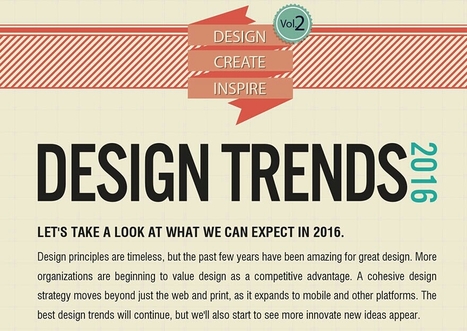
Except for those who are battling with a crappy connection, the internet moves really fast. Trends will always come and go, but they change at a particularly quick pace on the web. With evolving consumer demands, constant innovation, and the rapid exchange of ideas, the web never sleeps, never stops changing, never stops growing. And yet, despite the limitless possibilities and perpetual transformations, there are some trends in digital design that maintain great staying power. Certain elements of design are timeless and transcend all mediums, with the web being no exception. And one of the neat paradoxes where the internet meets design is that growing expertise and capabilities on the web need not call for greater intricacy or complexity in design. Often innovation is as simple as simplicity itself.In the vast, equalizing space that is the web, great design is accessible to all....
|
|
Scooped by
Jeff Domansky
May 24, 2016 2:01 AM
|
Towards the end of 2015, we revealed that we’d lost nearly half of our social referral traffic. And the discussion around this post made us realise that if we want to continue growing, we need to see change as a necessity. We need to continue to push ourselves and figure out how to keep reinventing ourselves to stay ahead of the curve. This new design is our latest experiment and in this post, I’m excited to go into detail about different sections of the new blog design and share some of the thinking behind our content strategy....
|
|
|
Scooped by
Jeff Domansky
May 26, 2016 11:43 PM
|
Brian Dean did a fabulous job when he created a post showcasing 200 Google ranking factors. The post went on to become very popular, generating thousands of new leads, from organic search, for Brian.
This article may not be as in-depth as Brian’s. Instead, I want to show you the 10 most important SEO tips that you need to know right now.
If you focus on these techniques alone, you’ll definitely drive more organic traffic to your blog and improve your search rankings, without risking a Google penalty.
|
|
Scooped by
Jeff Domansky
May 26, 2016 12:23 PM
|
You never get a second chance to make a first impression -- that’s why your homepage is undoubtedly one of the most important web pages on your website. For any given company, the homepage is its virtual front door. If a new visitor doesn't like what they see, their knee-jerk reaction is to hit the "back" button. That's right -- unfortunately, a lot of people still judge a book by its cover.What makes a website's homepage design brilliant instead of blah? Well, it takes more than looks alone -- it also has to work well. That's why the most brilliant homepages on this list don't just score high in beauty, but also in brains....
|
|
Scooped by
Jeff Domansky
May 26, 2016 10:21 AM
|
When I talked to Warren Buffett three years ago, he confided that he had a forbidden passion. "It's almost unnatural how much I love newspapers," he said. And he was acting on that love. Four years after saying that he wouldn't buy newspapers "at any price," the financial guru had started snapping them up. In his 2013 letter to shareholders, he and right-hand man Charlie Munger declared that they "believe that papers delivering comprehensive and reliable information to tightly bound communities and having a sensible Internet strategy will remain viable for a long time. " It was a powerful vote of confidence for a reeling industry totally disrupted by the digital revolution.Buffett admits an 'almost unnatural' newspaper love. So three years in, I wondered, how is Omaha's favorite Oracle feeling about those beleaguered ink-on-paper broadsheets and tabloids he adores? In a telephone interview Tuesday, Buffett sounded decidedly less bullish about their future. His ardor is undiminished, but he fears newspapers don't love him back. "We haven't cracked the code yet" as far as a viable business plan is concerned, he told me, speaking about his own holdings and the industry as a whole. "Circulation continues to decline at a significant pace, advertising at an even faster pace. The easy cutting has taken place. There's no indication that anyone besides the national papers has found a way."...
|
|
Scooped by
Jeff Domansky
May 25, 2016 9:23 PM
|
Craigslist is one of the ugliest websites on the Internet. The home page is an indistinct wall of links and text, the site is tough to navigate, the postings are cluttered, and the design has barely changed in the past 15 years. At a time when websites are competing to offer the best digital experiences, Craigslist is the pinnacle of user unfriendliness. And that's exactly what makes it brilliant, says Pascal Deville.
Deville is founder of Brutalist Websites, a site dedicated to the most frustrating design on the web. The site takes its name from the controversial architectural movement Brutalism. To some, Brutalist buildings are poetry in concrete; to others, they're chilly monoliths. Web design, Deville argues, has a similar dichotomy. Here's how he describes a Brutalist website:
In its ruggedness and lack of concern to look comfortable or easy, Brutalism can be seen as a reaction by a younger generation to the lightness, optimism, and frivolity of today's web design.
Appropriately, Deville's website has some of the hallmarks of the content it espouses—a rudimentary layout, one of the most basic typefaces (Courier), an infinite scroll, and no tabs or ways to sort the dozens of blog posts....
|
|
Scooped by
Jeff Domansky
May 25, 2016 11:02 AM
|
Google continues to emphasize mobile-first, which means that the look of the SERP is changing in ways that favor the mobile experience. Of course, paid ads need to adapt to the mobile-first world too, and today Google has announced some new and interesting changes to AdWords, rolling out over the next few months, that PPC marketers need to know about. Yesterday I flew out to the Google Performance Summit and got an exclusive first look at the newest ad formats and features coming to Google. Here’s everything you need to know moving forward about these big changes coming soon to AdWords....
|
|
Scooped by
Jeff Domansky
May 25, 2016 3:22 AM
|
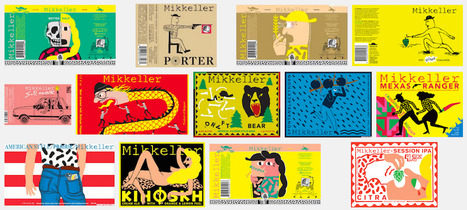
When the weather warms up, the arctic length of the supermarket beer aisle starts to beckon. And every year, when we venture over, we are amazed by the amount of design talent on display. Moreover, it is clear that the trends in beer label design are always changing. The growth of the craft beer (a.k.a. artisanal, a.k.a. micro-brewed, a.k.a. small batch, whatever) industry appears to be unstoppable. In fact, there are so many bottles to choose from now, almost all of them thoughtfully designed, that it has become rather difficult for any one to stand out. Is it still possible to do so on the basis of a particularly good beer label design alone? We think so.Here is our trend observation: the best examples of beer label design today do not take the middle road. They are either distinctly maximal (colorful, visually loud, eclectic and full of attitude) or minimal (confidently spare, geometric, typography-oriented, exuding elegance). Below we’ve rounded up our favorite recent examples of each type...
|
|
Scooped by
Jeff Domansky
May 25, 2016 2:56 AM
|
Do you want to give your content legs? Legs — so that your content can reach thousands of readers who perhaps don’t even know that your blog exists? Well, there’s a way to do it. It’s called content syndication. Content syndication is the process of republishing your content on third-party sites. I’ll admit: I borrowed the legs analogy from James Clear. James is a big fan of content syndication and he has had a lot of success with it....
|
|
Scooped by
Jeff Domansky
May 25, 2016 2:45 AM
|
Most people make a half-hearted effort at using Facebook Ads to grow their business. They use ONE crummy graphic, to build ONE ad and put it in front of ONE poorly designed audience. After three or four days of throwing money down the drain and not seeing results they quit and conclude “Facebook Ads don’t work!” They do. You are just placing all of your chips on one number!Here are the two things that you can do to vastly improve your success rate with Facebook Ads....
|
|
Scooped by
Jeff Domansky
May 25, 2016 2:28 AM
|
Pinterest is an emerging social media powerhouse that has not been included in most marketers’ and social media managers’ priority mediums compared to mainstays such as Facebook, Twitter, Google+, or Instagram. However, with its rapidly booming stats, that may soon change. In a recent report by PewResearch, 31% of adult internet users are now using Pinterest, compared to 28% in September 2014. Of this figure, 44% are women and 16% are men. Also, those younger than 50 are 37% more likely to use Pinterest compared to the 22% likelihood of those aged 50 and older. If that still does not convince social media managers and marketers of Pinterest’s rising status, perhaps this next set of data will. As it turns out, from having been on the #4 spot of most used social media platforms (trailing behind Facebook, Twitter, and Instagram) featured in PewResearch’s Demographics of Key Social Networking Platforms 2014 report, Pinterest has since then jumped to the #2 spot, right after the still un-dethroned top biller Facebook....
|
|
Scooped by
Jeff Domansky
May 24, 2016 11:18 AM
|
Selling through Amazon is extremely tempting for a simple, logical reason: you don’t have to pay for digital marketing to drive traffic to Amazon. The volume is bigger than any marketer can dream. Before Journelle, I worked at an Amazon subsidiary, Quidsi, and during my tenure, our core strategy pivoted from investing in its stand-alone sites like Diapers.com and Soap.com to rapidly scaling sales on Amazon’s Marketplace, exactly for this reason. Amazon Marketplace vendors simply need to offer the most competitive price on a product to win the coveted Amazon “Buy Box”. “Buy Box” winners take all of the sales volume without any marketing spend required, making up for margin loss and commission to Amazon. To scale on Amazon, Quidsi capitalized on selection breadth and uniqueness, and created effective and predictive pricing algorithms to beat their competitors. Overnight, day-to-day business became more like trading stocks than traditional online marketing. At the same time, there are downsides to relying too much on Amazon. First, there’s the risk of having too much of your revenue coming from a platform you don’t control. There’s also the risk that if you offer all your products on Amazon, you’ll cannibalize your own direct sales (and lose those higher margins). Finally, for high-end brands, Amazon’s site does not offer luxury customers a distinctive experience....
|
|
Scooped by
Jeff Domansky
May 24, 2016 3:09 AM
|
As you can see, Nielsen says that users read a maximum of 28% of the words during an average visit. When you apply this formula to your 1500-word post, the answer comes out as 420 words. If you’ve been spending hours whipping out longform content, know that your readers have been IGNORING most of it. But, there’s help: you can use findings of various web readability studies and other general web writing and styling practices to boost your post readership. Here are 12 of the most effective writing and formatting tactics, to give you a head start. ...
|
|
Scooped by
Jeff Domansky
May 24, 2016 2:38 AM
|
If you haven’t tried to optimize your writing habits, consider doing it now. It’s possible to double your productivity after some tweaks. Imagine being able to produce an article in half the time it currently takes you? Hopefully, by the end of this post, you’ll have picked up a few tips that you can apply right away to significantly decrease the amount of time you spend creating content. I’m going to share with you six tips, many of which are a bit unconventional but can work wonders....
|


















A little Friday fun.