Your new post is loading...

|
Scooped by
Jean-Michel Ané
December 8, 2021 5:40 PM
|
Plant and soil microbiomes consist of diverse communities of organisms from across kingdoms and can profoundly affect plant growth and health. Natural product-based intercellular signals govern important interactions between microbiome members that ultimately regulate their beneficial or harmful impacts on the plant. Exploiting these evolved signalling circuits to engineer microbiomes towards beneficial interactions with crops is an attractive goal. There are few reports thus far of engineering the intercellular signalling of microbiomes, but this article argues that it represents a tremendous opportunity for advancing the field of microbiome engineering. This could be achieved through the selection of synergistic consortia in combination with genetic engineering of signal pathways to realise an optimised microbiome.
|
|
Scooped by
Jean-Michel Ané
December 8, 2021 5:36 PM
|
Purpose
Studying the legume nodule microbiome is important for understanding the development and nutrition of the plants inhabited by the various microbes within and upon them. We analyzed the microbiomes of these underground organs from both an important crop plant (Medicago sativa) and a related legume (M. polymorpha) using metagenomic and culture-based techniques to identify the main cultivatable contributors to plant growth enhancement.
Methods
Using high-throughput sequencing, culturing, and in planta techniques, we identified and analyzed a broad population of the bacterial taxa within Medicago nodules and the surrounding soil.
Results
Fifty-one distinct bacterial strains were isolated and characterized from nodules of both Medicago species and their growth-promoting activities were studied. Sequencing of 16S rRNA gene amplicons showed that in addition to Ensifer, the dominant genus, a large number of Gram-positive bacteria belonging to the Firmicutes and Actinobacteria were also present. After performing ecological and plant growth-promoting trait analyses, selecting the most promising strains, and then performing in planta assays, we found that strains of Bacillus and Micromonospora among others could play important roles in supporting the growth, health, and productivity of the host plant.
Conclusion
To our knowledge, the comparison of the biodiversity of the microbiota of undomesticated vs. cultivated Medicago roots and nodules is novel and shows the range of potential Plant Growth-Promoting Bacteria that could be used for plants of agricultural interest. These and other nodule-isolated microbes could also serve as inoculants with rhizobia with the goal of replacing synthetic fertilizers and pesticides for sustainable agriculture.
|
|
Scooped by
Jean-Michel Ané
December 7, 2021 12:33 PM
|
Agricultural productivity relies on synthetic nitrogen fertilizers, yet half of that reactive nitrogen is lost to the environment. There is an urgent need for alternative nitrogen solutions to reduce the water pollution, ozone depletion, atmospheric particulate formation, and global greenhouse gas emissions associated with synthetic nitrogen fertilizer use. One such solution is biological nitrogen fixation (BNF), a component of the complex natural nitrogen cycle. BNF application to commercial agriculture is currently limited by fertilizer use and plant type. This paper describes the identification, development, and deployment of the first microbial product optimized using synthetic biology tools to enable BNF for corn (Zea mays) in fertilized fields, demonstrating the successful, safe commercialization of root-associated diazotrophs and realizing the potential of BNF to replace and reduce synthetic nitrogen fertilizer use in production agriculture. Derived from a wild nitrogen-fixing microbe isolated from agricultural soils, Klebsiella variicola 137-1036 (“Kv137-1036”) retains the capacity of the parent strain to colonize corn roots while increasing nitrogen fixation activity 122-fold in nitrogen-rich environments. This technical milestone was then commercialized in less than half of the time of a traditional biological product, with robust biosafety evaluations and product formulations contributing to consumer confidence and ease of use. Tested in multi-year, multi-site field trial experiments throughout the U.S. Corn Belt, fields grown with Kv137-1036 exhibited both higher yields (0.35 ± 0.092 t/ha ± SE or 5.2 ± 1.4 bushels/acre ± SE) and reduced within-field yield variance by 25% in 2018 and 8% in 2019 compared to fields fertilized with synthetic nitrogen fertilizers alone. These results demonstrate the capacity of a broad-acre BNF product to fix nitrogen for corn in field conditions with reliable agronomic benefits.
|
|
Scooped by
Jean-Michel Ané
December 4, 2021 12:57 PM
|
Legumes house nitrogen-fixing endosymbiotic rhizobia in specialized polyploid cells within root nodules, which undergo tightly regulated metabolic activity. By carrying out expression analysis of transcripts over time in Medicago truncatula nodules we found that the circadian clock enables coordinated control of metabolic and regulatory processes linked to nitrogen fixation. This involves the circadian clock-associated transcriptional factor LATE ELONGATED HYPOCOTYL (LHY), with lhy mutants being affected in nodulation. Rhythmic transcripts in root nodules include a subset of Nodule-specific Cysteine Rich peptides (NCRs) that have the LHY-bound conserved Evening Element in their promoters. Until now, studies have suggested that NCRs act to regulate bacteroid differentiation and keep the rhizobial population in check. However, these conclusions came from the study of a few members of this very large gene family that has complex diversified spatio-temporal expression. We suggest that rhythmic expression of NCRs may be important for temporal coordination of bacterial activity with the rhythms of the plant host, in order to ensure optimal symbiosis.
|
|
Scooped by
Jean-Michel Ané
December 4, 2021 12:51 PM
|
Light quality affects mutualisms between plant roots and arbuscular mycorrhizal fungi (AMF), which modify nutrient acquisition in plants. However, the mechanisms by which light systemically modulates root colonization by AMF and phosphate uptake in roots remain unclear.
We used a range of approaches, including grafting techniques, protein immunoblot analysis, electrophoretic mobility shift assay, chromatin immunoprecipitation, and dual-luciferase assays to unveil the molecular basis of light signal transmission from shoot to root that mediates arbuscule development and phosphate uptake in tomato.
The results show that shoot phytochrome B (phyB) triggers shoot-derived mobile ELONGATED HYPOCOTYL5 (HY5) protein accumulation in roots, and HY5 further positively regulates transcription of strigolactone (SL) synthetic genes, thus forming a shoot phyB-dependent systemic signaling pathway that regulates the synthesis and accumulation of SLs in roots. Further experiments with ccd7 mutants and supplementary red light confirm that SLs are indispensable in the red light-regulated mycorrhizal symbiosis in roots.
Our results reveal a phyB-HY5-SLs systemic signaling cascade that facilitates mycorrhizal symbiosis and phosphate utilization in plants. The findings provide new prospects on the potential application of AMF and light manipulation to effectively improve nutrient utilization and minimize the use of chemical fertilizers and associated pollution.
|
|
Scooped by
Jean-Michel Ané
December 2, 2021 4:23 PM
|
In nature, roots of healthy plants are colonized by multikingdom microbial communities that include bacteria, fungi, and oomycetes. A key question is how plants control the assembly of these diverse microbes in roots to maintain host–microbe homeostasis and health. Using microbiota reconstitution experiments with a set of immunocompromised Arabidopsis thaliana mutants and a multikingdom synthetic microbial community (SynCom) representative of the natural A. thaliana root microbiota, we observed that microbiota-mediated plant growth promotion was abolished in most of the tested immunocompromised mutants. Notably, more than 40% of between-genotype variation in these microbiota-induced growth differences was explained by fungal but not bacterial or oomycete load in roots. Extensive fungal overgrowth in roots and altered plant growth was evident at both vegetative and reproductive stages for a mutant impaired in the production of tryptophan-derived, specialized metabolites (cyp79b2/b3). Microbiota manipulation experiments with single- and multikingdom microbial SynComs further demonstrated that 1) the presence of fungi in the multikingdom SynCom was the direct cause of the dysbiotic phenotype in the cyp79b2/b3 mutant and 2) bacterial commensals and host tryptophan metabolism are both necessary to control fungal load, thereby promoting A. thaliana growth and survival. Our results indicate that protective activities of bacterial root commensals are as critical as the host tryptophan metabolic pathway in preventing fungal dysbiosis in the A. thaliana root endosphere.
|
|
Scooped by
Jean-Michel Ané
December 2, 2021 10:44 AM
|
Legumes house nitrogen-fixing endosymbiotic rhizobia in specialized polyploid cells within root nodules, which undergo tightly regulated metabolic activity. By carrying out expression analysis of transcripts over time in Medicago truncatula nodules we found that the circadian clock enables coordinated control of metabolic and regulatory processes linked to nitrogen fixation. This involves the circadian clock-associated transcriptional factor LATE ELONGATED HYPOCOTYL (LHY), with lhy mutants being affected in nodulation. Rhythmic transcripts in root nodules include a subset of Nodule-specific Cysteine Rich peptides (NCRs) that have the LHY-bound conserved Evening Element in their promoters. Until now, studies have suggested that NCRs act to regulate bacteroid differentiation and keep the rhizobial population in check. However, these conclusions came from the study of a few members of this very large gene family that has complex diversified spatio-temporal expression. We suggest that rhythmic expression of NCRs may be important for temporal coordination of bacterial activity with the rhythms of the plant host, in order to ensure optimal symbiosis.
|
|
Scooped by
Jean-Michel Ané
November 30, 2021 5:28 PM
|
Root exudates are important for shaping root-associated microbiomes. However, studies on a wider range of metabolites in exudates are required for a comprehensive understanding about their influence on microbial communities. We identified maize inbred lines that differ in exudate concentrations of DIMBOA and GABA using a semi-hydroponic system. These lines were grown in the field to determine the changes in microbial diversity and gene expression due to varying concentrations of DIMBOA and GABA in exudates using 16S rRNA amplicon sequencing and metatranscriptomics. Results showed individual and interaction effects of DIMBOA and GABA on the rhizosphere and root endosphere β-diversity, most strongly at the V10 growth stage. The main bacterial families affected by both compounds were Ktedonobacteraceae and Xanthomonadaceae. Higher concentrations of DIMBOA in exudates affected the rhizosphere metatranscriptome, enriching for KEGG pathways associated with plant disease. This study validated the use of natural variation within plant species as a powerful approach for understanding the role of root exudates on microbiome selection. We also showed that a semi-hydroponic system can be used to identify maize genotypes that differ in GABA and DIMBOA exudate concentrations under field conditions. The impact of GABA exudation on root-associated microbiomes was shown for the first time.
|
|
Scooped by
Jean-Michel Ané
November 30, 2021 5:23 PM
|
Burgeoning world population has pressurized the agricultural sector immensely. Fertilizer and pesticide usage injudiciously in conventional farming has adversely affected environment and human health. Globally coordinated sustainable agriculture is the way forward. Sustainable agriculture aims to maintain productivity, feed billions, and yet conserve the environment. Productivity devoid of environmental degradation, maintenance of agro-ecosystem health, and agro-biodiversity are essential for proper management of cultivated ecosystems. Soil dwelling microbial communities are key to resolving these concerns. A prominent rhizospheric microbial assemblage termed plant growth-promoting rhizobacteria contributes significantly to plant growth promotion and development. PGPR bioinoculants release and modify endogenic phytohormone levels, other biologically active molecules, solubilize or fix minerals facilitating nutrient uptake, helping crops overcome abiotic stresses. Further they control plant pathogenesis/disease by deploying antibiosis, rhizospheric competence, enzyme secretion, and induction of systemic resistance in host plants. Soil health and fertility are maintained owing to biofortification of nutrients. This translates to greater food security, social well-being, and human health. Bioinoculant viability and effectiveness are determined by the carrier material. Persistent research developing nontoxic, user-friendly bioformulations that can remain functionally viable during storage is pertinent to the continued large-scale application of PGPR. This chapter focuses upon the potential of four agriculturally important microbes—Azotobacter, Serratia, Bacillus, and Pseudomonas. Furthermore, the challenges to crop production by the usage of PGPR, problems in shelf life of bioformulations for commercial agriculture, and directions for future of PGPR research are highlighted.
|
|
Scooped by
Jean-Michel Ané
November 30, 2021 5:19 PM
|
The environmental and agricultural systems are prone to drastic effects due to water or drought stress, which is a major problem worldwide. It causes significant morphological, physiological, and molecular alteration of plant productivity. There are several studies demonstrated the Arbuscular mycorrhizal fungi symbiosis with plant root to helping the plant growth and create resistant capacity for drought stress. The AM fungi are most important and form symbiotic association with 80% of plants then it changes the plant morphological, physiological activity, increases the enzyme activity, and finally show controlled water stress. The present study was mainly conducted to investigate the development of drought resistance in maize plants by using AMF fungi (Glomus mosseae, Glomus intraradice). The effect of AMF on the seed germination of maize was studied at various levels of water stress. The soil moisture content was analysed before and after treatment. Additionally, the impact of water stress on variations soil fertility proteins was studied. The pot culture trials were conducted to assess the effects of AMF to improve plant growth against water deficit conditions. In this experiment, there are three levels of treatments carried out such as control, three nutrient solution treatments without AMF, and four AMF treatments with various water stress conditions under green-house conditions. Totally eight various treatments with triplicates were carried out. After 25 days of inoculation, the plant growth and other physiological parameters were measured and compared for all the treatments. After 75 days of treatment, better outcomes from AMF inoculation plants were observed when compared to other treatment plants. The superior result conformed by the increased level of protein, carbohydrate, phenol content, chlorophyll content, and increased glomalin secretions from AMF fungi inoculation plant root when compared with other treatment plants.
|
|
Scooped by
Jean-Michel Ané
November 30, 2021 5:12 PM
|
Ectomycorrhizal symbiosis is essential for the nutrition of most temperate forest trees and helps regulate the movement of carbon and nitrogen through forested ecosystems. The factors governing the exchange of plant carbon for fungal nitrogen, however, remain obscure.
Because competition and soil resources may influence ectomycorrhizal resource movement, we performed a ten month split-root microcosm study using Pinus muricata seedlings with Thelephora terrestris, Suillus pungens, or no ectomycorrhizal fungus, under two nitrogen levels in artificial soil. Fungi competed directly with roots, and indirectly with each other. We used stable isotope enrichment to track plant photosynthate and fungal nitrogen.
For Thelephora, plants received N commensurate with the C given to their fungal partners. Thelephora was a superior mutualist under high nitrogen. For Suillus, plant C and fungal N exchange were not coupled. However, in low nitrogen, plants preferentially allocated C to Suillus rather than Thelephora.
Our results suggest that ectomycorrhizal resource transfer depends on competitive and nutritional context. Plants can exchange C for fungal N, but coupling of these resources can depend on the fungal species and soil N. Understanding the diversity of fungal strategies, and how they change with environmental context, reveals mechanisms driving this important symbiosis.
|
|
Scooped by
Jean-Michel Ané
November 30, 2021 5:03 PM
|
|
|
Scooped by
Jean-Michel Ané
November 27, 2021 5:11 PM
|
Endosymbiotic association between hornworts and dinitrogen-fixing cyanobacteria form when the plant is limited for combined nitrogen (N). We generated RNA-Seq data to examine the temporal gene expression patterns during culture of N-starved Anthoceros punctatus in the absence and presence of the symbiotically competent cyanobacterium Nostoc punctiforme. Symbiotic nitrogenase activity commenced within 5 days of coculture reaching a maximal by 14 days. In symbiont-free gametophytes, chlorophyll content, chlorophyll fluorescence characteristics and transcription of genes encoding light harvesting and reaction center proteins, as well as the small subunit of ribulose-bisphosphate-carboxylase/oxygenase, were downregulated. The downregulation was complemented in a temporal pattern corresponding to the N. punctiforme provision of N2-derived ammonium. The impairment and complementation of photosynthesis was the most distinctive response of A. punctatus to N-starvation. Increases in transcription of ammonium and nitrate transporters and their N. punctiforme-dependent complementation was also observed. The temporal patterns of differential gene expression indicated N. punctiforme transmits signals to A. punctatus both prior to, and after its provision of fixed N. This is the only known temporal transcriptomic study during establishment of a symbiotic nitrogen-fixing association in this monophyletic evolutionary lineage of land plants.
|
|
|
Scooped by
Jean-Michel Ané
December 8, 2021 5:36 PM
|
Free-living nitrogen fixation (FNF) is a ubiquitous phenomenon that plays a modest role in the (N) economy of an ecosystem. However, sampling difficulties, methodological constraints and environmental controls have presented challenges for predicting the actual rate of FNF. Therefore, a deeper understanding of the accuracy to design models that consider dynamics, heterogeneity, influences, and other limitations is needed. This review presents an overview of the biology and diversity of microorganisms related to FNF as well as various ecological controls that influence these microorganisms. We also discussed contributions of FNF to the N input of various ecosystems. Overall, previous research has shown that considerable spatiotemporal variability exists in microbial types at both biome and microbiome scales, resulting in significant variation in FNF. Beyond this, rate of FNF is controlled by certain factors, such oxygen and metal ion availability, source of energy and soil nutrients, temperature, and pH. Empirical evidence increasingly indicates a significant contribution of FNF to N inputs in natural, agricultural, and aquatic ecosystems. It is inferred from this review that for the expanded exploitation of biological nitrogen fixation (BNF), we must pay additional attention to FNF because it occupies a central role within the process. Finally, we propose a framework for the quantification of FNF alongside a suite of recommendations that would deepen our understanding of FNF.
|
|
Scooped by
Jean-Michel Ané
December 7, 2021 12:35 PM
|
The interaction between legume plants and soil bacteria rhizobia results in the formation of new organs on the plant roots, symbiotic nodules, where rhizobia fix atmospheric nitrogen. Symbiotic nodules represent a perfect model to trace how the pre-existing regulatory pathways have been recruited and modified to control the development of evolutionary “new” organs. In particular, genes involved in the early stages of lateral root development have been co-opted to regulate nodule development. Other regulatory pathways, including the players of the KNOX-cytokinin module, the homologues of the miR172-AP2 module, and the players of the systemic response to nutrient availability, have also been recruited to a unique regulatory program effectively governing symbiotic nodule development. The role of the NIN transcription factor in the recruitment of such regulatory modules to nodulation is discussed in more details.
|
|
Scooped by
Jean-Michel Ané
December 4, 2021 12:58 PM
|
Food accounts for one of the most basic necessities in human society and the food industry relies solely on agriculture. Agriculture depends almost entirely on chemical fertilizers and pesticides for its sustenance and productivity. But with this chemical over abuse, came a fair share of hazardous effects ranging from environmental pollution, bioaccumulation, biomagnification, to deleterious effects on indigenous microorganisms etc. And therefore, it was the need of the hour to find alternate, eco-friendly approaches such as botanicals, microorganisms and the derived products of biologicals etc., that would improve plant growth and yield. Vesicular Arbuscular Mycorrhizae (VAM) is one such beneficial microorganism, which helps in enhancing the agricultural production by benefitting the plants in many ways. They help plant by enhancing the growth and yield, also many bio stimulants which indirectly helps by protecting the crop from invading pathogens. Therefore, it is crucial that we explore ways in which VAM might prove useful in meeting the global demand for quality food, one which will be safe for human consumption, without any pesticidal residues, and also reduces the pollution caused by chemicals. The present chapter, hence, summarizes some of the well documented roles of VAM in enhancing the quality and quantity of production of agricultural commodities.
|
|
Scooped by
Jean-Michel Ané
December 4, 2021 12:53 PM
|
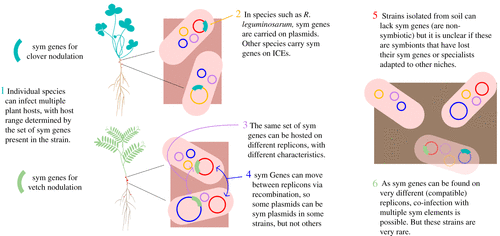
Rhizobia are one of the most important and best studied groups of bacterial symbionts. They are defined by their ability to establish nitrogen-fixing intracellular infections within plant hosts. One surprising feature of this symbiosis is that the bacterial genes required for this complex trait are not fixed within the chromosome, but are encoded on mobile genetic elements (MGEs), namely plasmids or integrative and conjugative elements. Evidence suggests that many of these elements are actively mobilizing within rhizobial populations, suggesting that regular symbiosis gene transfer is part of the ecology of rhizobial symbionts. At first glance, this is counterintuitive. The symbiosis trait is highly complex, multipartite and tightly coevolved with the legume hosts, while transfer of genes can be costly and disrupt coadaptation between the chromosome and the symbiosis genes. However, horizontal gene transfer is a process driven not only by the interests of the host bacterium, but also, and perhaps predominantly, by the interests of the MGEs that facilitate it. Thus understanding the role of horizontal gene transfer in the rhizobium–legume symbiosis requires a ‘mobile genetic element's-eye view' on the ecology and evolution of this important symbiosis.
|
|
Scooped by
Jean-Michel Ané
December 2, 2021 5:49 PM
|
Coordinated sharing of nutritional resources is a central feature of symbiotic interactions, and, despite the importance of this topic, many questions remain concerning the identification, activity, and regulation of transporter proteins involved. Recent progress in obtaining genome and transcriptome sequences for symbiotic organisms provides a wealth of information on plant, fungal, and bacterial transporters that can be applied to these questions. In this update we focus on legume-rhizobia and mycorrhizal symbioses and how transporters at the symbiotic interfaces can be regulated at the protein level. We point out areas where more research is needed and ways that an understanding of transporter mechanism and energetics can focus hypotheses. Protein phosphorylation is a predominant mechanism of posttranslational regulation of transporters in general and at the symbiotic interface specifically. Other mechanisms of transporter regulation, such as protein-protein interaction, including transporter multimerization, polar localization, and regulation by pH and membrane potential are also important at the symbiotic interface. Most of the transporters that function in the symbiotic interface are members of transporter families; we bring in relevant information on posttranslational regulation within transporter families to help generate hypotheses for transporter regulation at the symbiotic interface.
|
|
Scooped by
Jean-Michel Ané
December 2, 2021 4:16 PM
|
The low bioavailability of nutrients, especially nitrogen (N) and phosphorus (P), is one of the most limiting factors for crop production. In this study, under N- and P-free nutrient solution (-N-P), nodulating white lupin plants developed some nodules and analogous cluster root structures characterized by different morphological, physiological, and molecular responses than those observed upon single nutrient deficiency (strong acidification of external media, a better nutritional status than -N+P and +N-P plants). The multi-elemental analysis highlighted that the concentrations of nutrients in white lupin plants were mainly affected by P availability. Gene-expression analyses provided evidence of interconnections between N and P nutritional pathways that are active to promote N and P balance in plants. The root exudome was mainly characterized by N availability in nutrient solution, and, in particular, the absence of N and P in the nutrient solution triggered a high release of phenolic compounds, nucleosides monophosphate and saponines by roots. These morphological, physiological, and molecular responses result from a close interplay between N and P nutritional pathways. They contribute to the good development of nodulating white lupin plants when grown on N- and P-free media. This study provides evidence that limited N and P availability in the nutrient solution can promote white lupin-Bradyrhizobium symbiosis, which is favorable for the sustainability of legume production.
|
|
Scooped by
Jean-Michel Ané
November 30, 2021 5:32 PM
|
Here, we report an improved and complete genome sequence of Sinorhizobium (Ensifer) meliloti strain WSM1022, a microsymbiont of Medicago species, revealing its tripartite structure. This improved genome sequence was generated combining Illumina and Oxford nanopore sequencing technologies to better understand the symbiotic properties of the bacterium. The 6.75 Mb WSM1022 genome consists of three scaffolds, corresponding to a chromosome (3.70 Mb) and the pSymA (1.38 Mb) and pSymB (1.66 Mb) megaplasmids. The assembly has an average GC content of 62.2% and a mean coverage of 77X. Genome annotation of WSM1022 predicted 6058 protein coding sequences (CDSs), 202 pseudogenes, 9 rRNAs (3 each of 5S, 16S, and 23S), 55 tRNAs, and 4 ncRNAs. We compared the genome of WSM1022 to two other rhizobial strains, closely related Sinorhizobium (Ensifer) meliloti Sm1021 and Sinorhizobium (Ensifer) medicae WSM419. Both WSM1022 and WSM419 species are high-efficiency rhizobial strains when in symbiosis with Medicago truncatula, whereas Sm1021 is ineffective. Our findings report significant genomic differences across the three strains with some similarities between the meliloti strains and some others between the high efficiency strains WSM1022 and WSM419. The addition of this high-quality rhizobial genome sequence in conjunction with comparative analyses will help to unravel the features that make a rhizobial symbiont highly efficient for nitrogen fixation. View Full-Text
|
|
Scooped by
Jean-Michel Ané
November 30, 2021 5:24 PM
|
The root-associated microbiome (rhizobiome) plays a non-negligible role in determining plant health, stress tolerance, and nutrient use efficiency. However, it remains unclear to what extent the composition of the rhizobiome is governed by intraspecific variation in host plant genetics in the field and the degree to which host plant selection can reshape the composition of the rhizobiome. Here we quantify the rhizosphere microbial communities associated with a replicated diversity panel of 230 maize (Zea mays L.) genotypes grown in agronomically relevant conditions under high N (+N) and low N (-N) treatments. We show that the abundance of many root-associated microbes within a functional core microbial community of 150 abundant and consistently reproducible microbial groups is explainable by natural genetic variation in the host plant, with a greater proportion of microbial variance attributable to plant genetic variation in low N conditions. Population genetic approaches identify signatures of purifying selection in the maize genome associated with the abundance of several groups of microbes in the maize rhizobiome. Genome-wide association studies conducted using rhizobiome phenotypes identified n = 467 microbe-associated plant loci (MAPLs) in the maize genome linked to variation in the abundance of n = 115 microbial groups in the maize rhizosphere. In 62/115 cases, which is more than expected by chance, the abundance of these same microbial groups was correlated with variation in plant vigor indicators derived from high throughput phenotyping of the same field experiment. This study provides insights into harnessing the full potential of root-associated microbial symbionts in maize production.
|
|
Scooped by
Jean-Michel Ané
November 30, 2021 5:21 PM
|
Mycorrhizal fungi with different nutrient acquisition strategies influence the functional separation among plant species. This might drive resource competition dynamics that cumulatively impact tree species coexistence, but few manipulative experiments have directly tested this. Combining surveys and experiments in a modern coexistence theory framework, we tested how variation in mycorrhizal strategies and nutrient conditions affect competitive outcomes between co-occurring ectomycorrhizal (EM) and arbuscular mycorrhizal (AM) tree species. The dependency on EM symbioses increased with latitude and nitrogen (N) limitation, matching global trends. Host-specific soil microbiome conditioning and N fertilization combined to qualitatively affect coexistence outcomes. Lower N conditions favored EM over AM trees, but N fertilization reversed this outcome for southern species, consistent with regional-scale forest mycorrhizal transitions. As the magnitude and outcome of microbially-mediated competition depends on mycorrhizal differentiation and soil nutrient availability, this strongly supports the importance of mycorrhizal symbioses in driving large-scale biogeographic patterns of tree species.
|
|
Scooped by
Jean-Michel Ané
November 30, 2021 5:16 PM
|
The aerial parts of plants are host to taxonomically structured bacterial communities. Members of the core phyllosphere microbiota can protect Arabidopsis thaliana against foliar pathogens. However, whether plant protection is widespread and to what extent the modes of protection differ among phyllosphere microorganisms are not clear. Here, we present a systematic analysis of plant protection capabilities of the At-LSPHERE, which is a collection of >200 bacterial isolates from A. thaliana, against the bacterial pathogen Pseudomonas syringae pv. tomato DC3000. In total, 224 bacterial leaf isolates were individually assessed for plant protection in a gnotobiotic system. Protection against the pathogen varied, with ~10% of leaf microbiota strains providing full protection, ~10% showing intermediate levels of protection and the remaining ~80% not markedly reducing disease phenotypes upon infection. The most protective strains were distributed across different taxonomic groups. Synthetic community experiments revealed additive effects of strains but also that a single strain can confer full protection in a community context. We also identify different mechanisms that contribute to plant protection. Although pattern-triggered immunity coreceptor signalling is involved in protection by a subset of strains, other strains protected in the absence of functional plant immunity receptors BAK1 and BKK1. Using a comparative genomics approach combined with mutagenesis, we reveal that direct bacteria–pathogen interactions contribute to plant protection by Rhizobium Leaf202. This shows that a computational approach based on the data provided can be used to identify genes of the microbiota that are important for plant protection.
|
|
Scooped by
Jean-Michel Ané
November 30, 2021 5:05 PM
|
It is well known that AM symbiosis provides several ecosystem services leading to plant adaptation in different environmental conditions and positively affects physiological and production features. Although beneficial effects from grapevine and AM fungi interactions have been reported, the impact on growth-defence tradeoff features has still to be elucidated. In this study, the potential benefits of an inoculum formed by two AM fungal species, with or without a monosaccharide addition, were evaluated on young grapevine cuttings grafted onto 1103P and SO4 rootstocks. Inoculated and non-inoculated plants were maintained in potted vineyard substrate under greenhouse conditions for 3 months. Here, agronomic features were combined with biochemical and molecular techniques to assess the influence of the different treatments. Despite the opposite behaviour of the two selected rootstocks, in AM samples, the evaluation of gene expression, agronomic traits and metabolites production revealed an involvement of the whole root microbiome in the growth-defence tradeoff balancing. Noteworthy, we showed that rootstock genotypes and treatments shaped the root-associated microbes, stimulating plant growth and defence pathways. Progresses in this field would open new perspectives, enabling the application of AMF or their inducers to achieve a more sustainable agriculture also in light of the ongoing climate change.
|
|
Scooped by
Jean-Michel Ané
November 27, 2021 5:18 PM
|
Plants evolved in association with a diverse community of microorganisms. The effect of plant phylogeny and domestication on host–microbiome co-evolutionary dynamics are poorly understood.
Here we examined the effect of domestication and plant lineage on the composition of the endophytic microbiome of 11 Malus species, representing three major groups: domesticated apple (M. domestica), wild apple progenitors, and wild Malus species.
The endophytic community of M. domestica and its wild progenitors showed higher microbial diversity and abundance than wild Malus species. Heirloom and modern cultivars harbored a distinct community composition, though the difference was not significant. A community-wide Bayesian model revealed that the endophytic microbiome of domesticated apple is an admixture of its wild progenitors, with clear evidence for microbiome introgression, especially for the bacterial community. We observed a significant correlation between the evolutionary distance of Malus species and their microbiome.
This study supports co-evolution between Malus species and their microbiome during domestication. This finding has major implications for future breeding programs and our understanding of the evolution of plants and their microbiomes.
|