 Your new post is loading...

|
Scooped by
Jean-Michel Ané
January 11, 2022 2:07 PM
|
Very nice work from @CaroSchulte_, @VinoyOX, @antonis_papach, @PooleLabOxford and coll. Biological nitrogen fixation in rhizobium-legume symbioses is of major importance for sustainable agricultural practices. To establish a mutualistic relationship with their plant host, rhizobia transition from free-living bacteria in soil to growth down infection threads inside plant roots and finally differentiate into nitrogen-fixing bacteroids. We reconstructed a genome-scale metabolic model for Rhizobium leguminosarum and integrated the model with transcriptome, proteome, metabolome, and gene essentiality data to investigate nutrient uptake and metabolic fluxes characteristic of these different lifestyles. Synthesis of leucine, polyphosphate, and AICAR is predicted to be important in the rhizosphere, while myo-inositol catabolism is active in undifferentiated nodule bacteria in agreement with experimental evidence. The model indicates that bacteroids utilize xylose and glycolate in addition to dicarboxylates, which could explain previously described gene expression patterns. Histidine is predicted to be actively synthesized in bacteroids, consistent with transcriptome and proteome data for several rhizobial species. These results provide the basis for targeted experimental investigation of metabolic processes specific to the different stages of the rhizobium-legume symbioses.
|
|
Scooped by
Jean-Michel Ané
January 9, 2022 5:07 PM
|
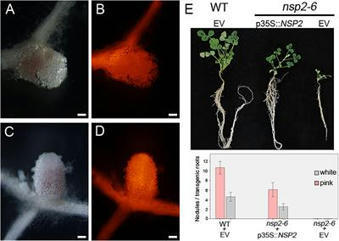
Legumes establish an endosymbiotic association with nitrogen-fixing soil bacteria. Following the mutual recognition of the symbiotic partner, the infection process is controlled by the induction of the signaling pathway and subsequent activation of symbiosis-related host genes. One of the protein complexes regulating nitrogen-fixing root nodule symbiosis is formed by GRAS domain regulatory proteins Nodulation Signaling Pathways 1 and 2 (NSP1 and NSP2) that control the expression of several early nodulation genes. Here, we report on a novel point mutant allele (nsp2-6) affecting the function of the NSP2 gene and compared the mutant with the formerly identified nsp2-3 mutant. Both mutants carry a single amino acid substitution in the VHIID motif of the NSP2 protein. We found that the two mutant alleles show dissimilar root hair response to bacterial infection. Although the nsp2-3 mutant developed aberrant infection threads, rhizobia were able to colonize nodule cells in this mutant. The encoded NSP2 proteins of the nsp2-3 and the novel nsp2 mutants interact with NSP1 diversely and, as a consequence, the activation of early nodulin genes and nodule organogenesis are arrested in the new nsp2 allele. The novel mutant with amino acid substitution D244H in NSP2 shows similar defects in symbiotic responses as a formerly identified nsp2-2 mutant carrying a deletion in the NSP2 gene. Additionally, we found that rhizobial strains induce delayed nodule formation on the roots of the ns2-3 weak allele. Our study highlights the importance of a conserved Asp residue in the VHIID motif of NSP2 that is required for the formation of a functional NSP1-NSP2 signaling module. Furthermore, our results imply the involvement of NSP2 during differentiation of symbiotic nodule cells.
|
|
Scooped by
Jean-Michel Ané
January 9, 2022 4:54 PM
|
Symbiotic nitrogen fixation entails successful interaction between legume hosts and rhizobia that occur in specialized organs called nodules. N2-fixing legumes have higher demand of phosphorus (P) than legumes grown on mineral N. Medicago truncatula is an important model plant for characterization of effects of P deficiency at the molecular level. Hence, a study was carried out to address the alteration in metabolite levels of M. truncatula grown aeroponically and subjected to four weeks of P stress. First, GC-MS based untargeted metabolomics employed initially revealed changes in metabolic profile of nodules with increased levels of amino acids and sugars and decline in amounts of organic acids. Subsequently, LC-MS/MS was used to quantify these compounds including phosphorylated metabolites in overall plant. Our results showed drastic reduction in levels of organic acids and phosphorylated compounds in -P leaves with moderate reduction in -P roots and nodules. Additionally, sugars and amino acids were elevated in the whole plant under P deprivation. These findings provide evidence that N2-fixation in M. truncatula is mediated through N feedback mechanism that in parallel is related to C and P metabolism.
|
|
Scooped by
Jean-Michel Ané
January 9, 2022 4:39 PM
|
Cadmium (Cd) is one of the most perilous soil contaminants, restricting growth and yielding potential of crop plants. Arbuscular mycorrhizal fungi (AMF) can impart Cd stress tolerance by establishing a mutualistic relationship with host plants. However, selection of the most competent AMF species is required in order to attain maximum benefits. Therefore, the current study was designed to assess the efficacy of four AMF species; Rhizoglomus intraradices (R. int), Claroideoglomus etunicatum (C. etu), Claroideoglomus claroideum (C. cla) and Funneliformis mosseae (F. mos) in imparting tolerance to pigeonpea [Cajanus cajan (L.) Millsp.] plants under Cd (0, 25, 50 mg/kg) stress. Cd accretion hampered growth, nutrients uptake, sugar-starch metabolism and productivity of stressed plants. Mycorrhizal supplementations enhanced growth and yield by reducing Cd uptake and improving carbohydrate synthesis of stressed plants with maximum gains provided by + R. int, closely followed by + F. mos and + C. etu, and least by + C. cla. This could be accredited to their differential colonization (MC) capability (R. int, F. mos, C. etu, and C. cla with 69.85, 60.92, 58.48 and 50.36% respectively, under Cd50). Higher efficacy of R. int could be linked to maximum glomalin production as well as soil microbial enzyme activities [phosphatases-acidic, alkaline (PHAs), invertase (INV), glucosidase (BGA), protease (PRO)] which, boosted the bioavailability of nutrients (N, P, C) to the stressed plants. Thus, our study suggested that pigeonpea plants were responsive to all the four AMF species, with host-R. int symbiosis exhibiting the strongest potential in alleviating Cd stress.
|
|
Scooped by
Jean-Michel Ané
January 1, 2022 12:22 PM
|
The IPD3/CYCLOPS transcription factor was shown to be involved in the regulation of nodule primordia development and subsequent stages of nodule differentiation. In contrast to early stages, the stages related to nodule differentiation remain less studied. Recently, we have shown that the accumulation of cytokinin at later stages may significantly impact nodule development. This conclusion was based on a comparative analysis of cytokinin localization between pea wild type and ipd3/cyclops mutants. However, the role of cytokinin at these later stages of nodulation is still far from understood. To determine a set of genes involved in the regulation of later stages of nodule development connected with infection progress, intracellular accommodation, as well as plant tissue and bacteroid differentiation, the RNA-seq analysis of pea mutant SGEFix--2 (sym33) nodules impaired in these processes compared to wild type SGE nodules was performed. To verify cytokinin’s influence on late nodule development stages, the comparative RNA-seq analysis of SGEFix--2 (sym33) mutant plants treated with cytokinin was also conducted. Findings suggest a significant role of cytokinin in the regulation of later stages of nodule development.
|
|
Scooped by
Jean-Michel Ané
December 28, 2021 6:40 PM
|
Beneficial rhizobacteria such as Arthrobacter agilis and Pseudomonas fluorescens produce N,N-dimethylhexadecylamine (DMHDA), a volatile organic compound that acts as a plant-microorganism signal, inducing bacterial motility and plant defense mechanisms. In the present study, Medicago truncatula seedlings were cultured in vitro and inoculated with the microbial fraction of soil with or without DMHDA, and DNA from Actinobacteria, Firmicutes, and α, β, and γ-proteobacteria were quantified using quantitative polymerase chain reaction to obtain a bacterial community profile of root and shoot endophytic compartments. In seedlings cultured without DMHDA, β-proteobacteria and α-proteobacteria were more abundant in root and shoot endophytic compartments, respectively. However, when seedlings were cultured with DMHDA, the proportion of Actinobacteria and Firmicutes increased in both compartments. These changes were dependent on the dose of DMHDA. We propose that DMHDA modulates the endophytic microbiome by inducing plant immune responses.
|
|
Scooped by
Jean-Michel Ané
December 28, 2021 6:27 PM
|
N-acyl homoserine lactones (AHLs) belong to the class of bacterial quorum sensing signal molecules involved in distance signal transduction between Gram-negative bacteria colonizers of the rhizosphere, as well as bacteria and plants. AHLs synchronize the activity of genes from individual cells, allowing the bacterial population to act as a multicellular organism, and establish a symbiotic or antagonistic relationship with the host plant. Although the effect of AHLs on plants has been studied for more than ten years, the mechanisms of plant perception of AHL-signals are not fully understood. The specificity of the reactions caused by AHL indicates the existence of appropriate mechanisms for their perception by plants. In the current review we summarize available data on the molecular mechanisms of AHL-signal perception in plants, its effect on plant growth, development, and stress resistance. We describe the latest research demonstrating direct (on plants) and indirect (on rhizosphere microflora) effects of AHLs, as well as the prospects of using these compounds in biotechnology to increase plant resistance to biotic and abiotic stresses.
|
|
Scooped by
Jean-Michel Ané
December 28, 2021 6:13 PM
|
Plant sugar transporters play an essential role in the organism’s productivity by carrying out carbohydrate transportation from source cells in the leaves to sink cells in the cortex. In addition, they aid in the regulation of a substantial part of the exchange of nutrients with microorganisms in the rhizosphere (bacteria and fungi), an ty essential to the formation of symbiotic relationships. This review pays special attention to carbohydrate nutrition during the development of arbuscular mycorrhiza (AM), a symbiosis of plants with fungi from the Glomeromycotina subdivision. This relationship results in the host plant receiving micronutrients from the mycosymbiont, mainly phosphorus, and the fungus receiving carbon assimilation products in return. While the efficient nutrient transport pathways in AM symbiosis are yet to be discovered, SWEET sugar transporters are one of the three key families of plant carbohydrate transporters. Specific AM symbiosis transporters can be identified among the SWEET proteins. The survey provides data on the study history, structure and localization, phylogeny and functions of the SWEET proteins. A high variability of both the SWEET proteins themselves and their functions is noted along with the fact that the same proteins may perform different functions in different plants. A special role is given to the SWEET transporters in AM development. SWEET transporters can also play a key role in abiotic stress tolerance, thus allowing plants to adapt to adverse environmental conditions. The development of knowledge about symbiotic systems will contribute to the creation of microbial preparations for use in agriculture in the Russian Federation.
|
|
Scooped by
Jean-Michel Ané
December 28, 2021 11:11 AM
|
Stability is a desirable property for agricultural microbiomes, but there is a poor understanding of the mechanisms that mediate microbial community stability. Recently, a representative bacterial synthetic community from maize roots has been proposed as a model system to study microbiome stability (Niu 2017, PNAS, 114:E2450). This SynCom assembles stably when all seven members are present, but community diversity collapses without the keystone E. cloacae strain. The aim of this study was to assess the role of metabolites for the stability of this SynCom, by defining the metabolic niches occupied by each strain, as well as their cross-feeding phenotypes and B-vitamin dependencies. We show that the individual member strains occupy complementary metabolic niches, measured by the depletion of distinct metabolites in exometabolomic experiments, as well as contrasting growth phenotypes on diverse carbon substrates. Minimal medium experiments show that the established seven-member community comprises a mixture of prototrophic and auxotrophic strains. Correspondingly, experimental cross-feeding phenotypes showed that spent media harvested from the prototrophic strains can sustain growth of two auxotrophs. We suggest that the metabolic mechanisms exhibited by this SynCom could serve as design principles to inform the rational assembly of stable plant-associated microbial communities.
|
|
Scooped by
Jean-Michel Ané
December 28, 2021 10:38 AM
|
Agricultural yields are often limited by nitrogen (N) availability, especially in countries of the developing world, whereas in industrialized nations the application of chemical N fertilizers has reached unsustainable levels that have resulted in severe environmental consequences. Finding alternatives to inorganic fertilizers is critical for sustainable and secure food production. Although gaseous nitrogen (N2) is abundant in the atmosphere, it cannot be assimilated by most living organisms. Only a selected group of microorganisms termed diazotrophs, have evolved the ability to reduce N2 to generate NH3 in a process known as biological nitrogen fixation (BNF) catalysed by nitrogenase, an oxygen-sensitive enzyme complex. This ability presents an opportunity to improve the nutrition of crop plants, through the introduction into cereal crops of either the N fixing bacteria or the nitrogenase enzyme responsible for N fixation. This review explores three potential approaches to obtain N-fixing cereals: (a) engineering the nitrogenase enzyme to function in plant cells; (b) engineering the legume symbiosis into cereals; and (c) engineering cereals with the capability to associate with N-fixing bacteria.
|
|
Scooped by
Jean-Michel Ané
December 28, 2021 10:28 AM
|
•Mulching under no-tillage increase soil organic carbon (SOC) and total nitrogen (N)
•No-tillage plus rotation improve symbiosis of arbuscular mycorrhizal fungi & maize
•Conventional tillage enhances stover decomposition but reduces SOC and N build-up
•Conservation agriculture influences maize yield positively via nitrogen uptake
|
|
Scooped by
Jean-Michel Ané
December 22, 2021 9:47 AM
|
Trees are able to colonize, establish and survive in a wide range of soils through associations with ectomycorrhizal (EcM) fungi. Proper functioning of EcM fungi implies the differentiation of structures within the fungal colony. A symbiotic structure is dedicated to nutrient exchange and the extramatricular mycelium explores soil for nutrients. Eventually, basidiocarps develop to assure last stages of sexual reproduction. The aim of this study is to understand how an EcM fungus uses its gene set to support functional differentiation and development of specialized morphological structures. We examined the transcriptomes of Laccaria bicolor under a series of experimental setups, including the growth with Populus tremula x alba at different developmental stages, basidiocarps and free-living mycelium, under various conditions of N, P and C supply. In particular, N supply induced global transcriptional changes, whereas responses to P supply seemed to be independent from it. Symbiosis development with poplar is characterized by transcriptional waves. Basidiocarp development shares transcriptional signatures with other basidiomycetes. Overlaps in transcriptional responses of L. bicolor hyphae to a host plant and N/C supply next to co-regulation of genes in basidiocarps and mature mycorrhiza were detected. Few genes are induced in a single condition only, but functional and morphological differentiation rather involves fine tuning of larger gene sets. Overall, this transcriptomic atlas builds a reference to study the function and stability of EcM symbiosis in distinct conditions using L. bicolor as a model and indicates both similarities and differences with other ectomycorrhizal fungi, allowing researchers to distinguish conserved processes such as basidiocarp development from nutrient homeostasis.
|
|
Scooped by
Jean-Michel Ané
December 19, 2021 10:16 PM
|
Beneficial root-associated rhizospheric microbes play a key role in maintaining host plant growth and can potentially allow drought-resilient crop production. The complex interaction of root-associated microbes mainly depends on soil type, plant genotype, and soil moisture. However, drought is the most devastating environmental stress that strongly reduces soil biota and can restrict plant growth and yield. In this review, we discussed our mechanistic understanding of drought and microbial response traits. Additionally, we highlighted the role of beneficial microbes and plant-derived metabolites in alleviating drought stress and improving crop growth. We proposed that future research might focus on evaluating the dynamics of root-beneficial microbes under field drought conditions. The integrative use of ecology, microbial, and molecular approaches may serve as a promising strategy to produce more drought-resilient and sustainable crops.
|
|
|
Scooped by
Jean-Michel Ané
January 10, 2022 6:09 PM
|
Small RNAs (sRNAs) are known to regulate pathogenic plant–microbe interactions. Emerging evidence from the study of these model systems suggests that microRNAs (miRNAs) can be translocated between microbes and plants to facilitate symbiosis. The roles of sRNAs in mutualistic mycorrhizal fungal interactions, however, are largely unknown. In this study, we characterized miRNAs encoded by the ectomycorrhizal fungus Pisolithus microcarpus and investigated their expression during mutualistic interaction with Eucalyptus grandis. Using sRNA sequencing data and in situ miRNA detection, a novel fungal miRNA, Pmic_miR-8, was found to be transported into E. grandis roots after interaction with P. microcarpus. Further characterization experiments demonstrate that inhibition of Pmic_miR-8 negatively impacts the maintenance of mycorrhizal roots in E. grandis, while supplementation of Pmic_miR-8 led to deeper integration of the fungus into plant tissues. Target prediction and experimental testing suggest that Pmic_miR-8 may target the host NB-ARC domain containing transcripts, suggesting a potential role for this miRNA in subverting host signaling to stabilize the symbiotic interaction. Altogether, we provide evidence of previously undescribed cross-kingdom sRNA transfer from ectomycorrhizal fungi to plant roots, shedding light onto the involvement of miRNAs during the developmental process of mutualistic symbioses.
|
|
Scooped by
Jean-Michel Ané
January 9, 2022 5:00 PM
|
Diazotrophic plant growth-promoting endophytic (DPGPEB) bacterium plays an important role in plant growth and development. However, the molecular mechanism of the interaction between DPGPEB and sugarcane is still less known. In this study, we used the RNA sequencing technology to compare the transcriptome of two sugarcane varieties GT11and B8 inoculated with Enterobacter roggenkampii ED5. The results showed that a total of 1905 differentially expressed genes (DEGs) were obtained in the ED5 inoculated plants as compared to the control for variety GT11, of which 812 were down-regulated and 1093 were up-regulated, respectively. Whereas, for variety B8, 6214 DEGs were detected in the ED5 inoculated plants as compared to the control, of which 1587 and 4627 of down-regulated and up-regulated, respectively. Gene Ontology (GO) and Kyoto Encyclopedia of Genes and Genomes (KEGG) analyses showed the DEGs were associated with starch and sucrose, nitrogen metabolism, biosynthesis of phenylpropanoid, phytohormone signal transduction, MAPK signaling pathway, secondary metabolic pathway, cell wall biogenesis, and photosynthesis. Additionally, the results of RNA-seq data were validated with qRT-PCR. In summary, these results provide valuable information about the transcriptomic changes of the two sugarcane varieties in response to E. roggenkampii ED5 for understanding the molecular mechanisms of sugarcane-bacteria interactions.
|
|
Scooped by
Jean-Michel Ané
January 9, 2022 4:42 PM
|
Enriched surface ozone (O3) can impose harmful effects on plants. Conversely, arbuscular mycorrhizal (AM) symbiosis can enhance plant tolerance to various environmental stresses and facilitate plant growth. The interaction of AM fungi and O3 on plant performance, however, seldom has been investigated. In this study, alfalfa (Medicago sativa L.) was used as a test plant to study the effects of O3 and AM symbiosis on plant physiology and growth under two O3 levels (ambient air and elevated O3 with 60 nmol·mol−1 O3 enrichment) and three AM inoculation treatments (inoculation with exogenous or indigenous AM fungi and non-inoculation control). The results showed that elevated O3 decreased plant net photosynthetic rate and biomass, and increased malondialdehyde concentration, while AM inoculation (with both exogenous and indigenous AM fungi) could promote plant nutrient acquisition and growth irrespective of O3 levels. The positive effects of AM symbiosis on plant nutrient acquisition and antioxidant enzyme (superoxide dismutase and peroxidase) activities were most likely offset by increased stomatal conductance and O3 intake. As a result, AM inoculation and O3 generally showed no significant interactions on plant performance: although elevated O3 did not diminish the beneficial effects of AM symbiosis on alfalfa plants, AM symbiosis also did not alleviate the harmful effects of O3 on plants.
|
|
Scooped by
Jean-Michel Ané
January 1, 2022 12:30 PM
|
Legumes, unlike most land plants, can form symbiotic root nodules with nitrogen-fixing bacteria to secure nitrogen for growth. The formation of nitrogen-fixing nodules on legume roots requires the coordination of rhizobial infection at the root epidermis with cell division in the cortex. The nodules house the nitrogen-fixing rhizobia in organelle-like structures known as symbiosomes, which enable nitrogen fixation and facilitate the exchange of metabolites between the host and symbionts. In addition to this beneficial interaction, legumes are continuously exposed to would-be pathogenic microbes; thus the ability to discriminate pathogens from symbionts is a major determinant of plant survival under natural conditions. Here, we summarize recent 0advances in the understanding of root nodule symbiosis signaling, transcriptional regulation, and regulation of plant immunity during legume-rhizobium symbiosis. In addition, we propose several important questions to be addressed and provide insights into the potential for engineering the capacity to fix nitrogen in legume and non-legume plants.
|
|
Scooped by
Jean-Michel Ané
December 28, 2021 6:41 PM
|
KARRIKIN INSENSITIVE2 (KAI2) is an α/β-hydrolase required for plant responses to karrikins, which are abiotic butenolides that can influence seed germination and seedling growth. Although represented by four angiosperm species, loss-of-function kai2 mutants are phenotypically inconsistent and incompletely characterised, resulting in uncertainties about the core functions of KAI2 in plant development. Here we characterised the developmental functions of KAI2 in the grass Brachypodium distachyon using molecular, physiological, and biochemical approaches. Bdkai2 mutants exhibit increased internode elongation and reduced leaf chlorophyll levels, but only a modest increase in water loss from detached leaves. Bdkai2 shows increased numbers of lateral roots and reduced root hair growth, and fails to support normal root colonisation by arbuscular-mycorrhizal (AM) fungi. The karrikins KAR1 and KAR2, and the strigolactone analogue rac-GR24, each elicit overlapping but distinct changes to the shoot transcriptome via BdKAI2. Finally, we show that BdKAI2 exhibits a clear ligand preference for desmethyl butenolides and weak responses to methyl-substituted strigolactone analogues such as GR24. Our findings suggest that KAI2 has multiple roles in shoot development, root system development, and transcriptional regulation in grasses. Although KAI2-dependent AM symbiosis is likely conserved within monocots, the magnitude of the effect of KAI2 on water relations may vary across angiosperms.
|
|
Scooped by
Jean-Michel Ané
December 28, 2021 6:32 PM
|
Mycorrhizal symbiosis influences the performance of plant individuals. However, its impact on plant communities is less well understood. We used a database of plant mycorrhizal traits and investigated how community mycorrhization - the prevalence of mycorrhizal symbiosis in plant communities - is related to plant community productivity and diversity.
Aims
We analyzed (1) how soil fertility affects community mycorrhization, (2) how plant productivity and diversity are related to community mycorrhization, and (3) whether community mycorrhization directly mediates the relationships between soil fertility and plant productivity and diversity.
Location
29 semi-natural grasslands in the South of Estonia, representing a steep productivity gradient (80 – 500 g/m2).
Methods
We estimated the proportion of plant biomass associated with mycorrhizal symbiosis (arbuscular mycorrhization index, AMI). The relationships between soil fertility (soil nitrogen (N), phosphorus (P) and potassium (K), accounting for soil moisture and pH), AMI, plant diversity and productivity were analyzed using model averaging and pairwise generalized linear models, and support for direct relationships was determined using path analysis.
Results
There was a positive linear relationship between soil nitrogen and AMI. In turn, plant biomass showed positive, and plant diversity negative linear relationships with AMI. Path analyses indicated that AMI mediates the relationship between soil nitrogen and plant diversity, but not the relationship between soil nitrogen and plant community productivity. Plant productivity and mycorrhization increased along the soil fertility gradient, but plant diversity decreased.
Conclusion
These results suggest that community mycorrhization, which is sensitive to soil fertility (N), can modulate community composition in temperate grasslands, probably by enhancing the most dominant plant species in the community.
|
|
Scooped by
Jean-Michel Ané
December 28, 2021 6:21 PM
|
Arbuscular mycorrhizal (AM) fungi form a mutual association with the majority of land plants, including most angiosperms of the dicotyledon and monocotyledon lineages. The symbiosis is based upon bidirectional nutrient exchange between the host and symbiont that occurs between inner cortical cells of the root and branched AM hyphae called arbuscules that develop within these cells. Lipid transport and its regulation during the symbiosis have been intensively investigated in dicotyledon plants, especially legumes. Here, we characterize OsRAM2 and OsRAM2L, homologs of M. truncatula RAM2, and found that plants defective in OsRAM2 were unable to be colonized by AM fungi and showed impaired colonization by Magnaporthe oryzae. The induction of OsRAM2 and OsRAM2L is dependent on OsRAM1 and the CSSP pathway genes CCaMK and CYCLOPS, while overexpression of OsRAM1 results in increased expression of OsRAM2 and OsRAM2L. Collectively, our data show that the function and regulation of OsRAM2 is conserved in monocot and dicot plants and reveals that, similar to mutualistic fungi, pathogenic fungi have recruited RAM2-mediated fatty acid biosynthesis to facilitate invasion.
|
|
Scooped by
Jean-Michel Ané
December 28, 2021 6:11 PM
|
The remarkable metabolic capacity of the soil-dwelling bacterium Sinorhizobium meliloti is encoded on its three circular replicons: the chromosome and two large megaplasmids, pSymA and pSymB. Despite making up 45% of the genome, the pSymA and pSymB megaplasmids can be cured from S. meliloti. This unique attribute provides an opportunity to study the essentiality of chromosomal genes in the presence or absence of nearly half the genome. By interrogating chromosomal genes via massively parallel transposon insertion sequencing (Tn-seq) in the presence and absence of pSymA and pSymB, we identified 307 genes as being essential for viability regardless of the genomic context and 104 genes as being essential specifically when the megaplasmids are absent. We also found that ten percent of genes encoded on the chromosome genetically interact with genes on pSymA and pSymB. In addition, Tn-seq data were utilized to significantly refine a metabolic model of S. meliloti, facilitating more accurate fitness predictions in user-defined nutrient and genetic contexts. Furthermore, the development of a library of barcoded transposon insertion (BarSeq) mutants has enabled us to identify genes that are essential for robust growth in hundreds of nutrient environments simultaneously. This will greatly assist efforts to assign more specific functions to the ~30% of S. meliloti genes that have remained uncharacterized over the years. S. meliloti has been studied for decades as a model organism for symbiotic communication. Its legume host, Medicago truncatula, provides fixed carbon for the bacteria in order to receive fixed nitrogen in return. The molecular dialogue between S. meliloti and M. truncatula, initiates and controls each stage of symbiotic development. When inside host cells, intracellular bacteria are subjected to an arsenal of plant-derived Nodule-specific Cysteine-Rich (NCR) peptides that induce significant morphological changes prior to nitrogen fixation. It was previously shown that a bacterial peptidase, HrrP, present in about 10% of S. meliloti isolates, could degrade host-derived peptides and give the bacterial symbionts greater fitness at the expense of the host. In a screen through peptidases conserved throughout the core S. meliloti genome, we identified one peptidase (sapA) that, when overexpressed, significantly modulates symbiotic outcome. In a manner similar to HrrP, SapA degrades NCR peptides in vitro. Additionally, expression of sapA seems to occur specifically inside the plant host providing compelling evidence that some rhizobial peptidases may have evolved away from housekeeping and toward symbiotic functions.
|
|
Scooped by
Jean-Michel Ané
December 28, 2021 11:03 AM
|
Although velvetleaf blueberry (Vaccinium myrtilloides) is usually associated with sandy (upland) areas of the North American boreal forest, lowland populations can be also found in bogs, suggesting possible adaptations to different site conditions. In this study, we examined the role of ericoid mycorrhizal (ERM) fungi in conferring drought resistance to the upland and lowland velvetleaf blueberry seedlings. The seedlings were inoculated with four ERM fungi (Pezicula ericae, Pezoloma ericae, Meliniomyces variabilis, and Oidiodendron maius) isolated from the roots of ericaceous plants and grown under controlled environmental conditions in sterilized soil. The inoculated and non-inoculated (inoculation control) plants were subsequently subjected to three cycles of drought stress by withdrawing watering. Lowland plants appeared to benefit relatively more from mycorrhizal colonization, compared with the upland plants, in terms of plant growth and drought survival. After three weeks of treatments, the dry weights of non-inoculated well-watered upland plants were higher compared to the non-inoculated lowland plants. However, these differences were offset by the inoculation of plants with ERM fungi, some of which also significantly improved drought resistance characteristics of the upland and lowland plants. There were no major differences in the effects of different ERM fungal species on drought responses of upland and lowland plants. Of the examined ericoid mycorrhizal fungi, inoculation with Pezicula ericae was the most effective in conferring drought resistance characteristics to both upland and lowland seedlings and helped maintain higher shoot water potentials, net photosynthetic, and transpiration rates in plants subjected to drought stress.
|
|
Scooped by
Jean-Michel Ané
December 28, 2021 10:32 AM
|
The genus Caulobacter encompasses several strains that can enhance the biomass of several plant species. However, for many plant-growth-promoting (PGP) Caulobacter strains, their genomic factors that facilitate positive interactions with their plant hosts remain unknown. Given that leveraging comparative genomics analyses can establish a framework to understand these plant–bacteria interactions, the genomes of three PGP Caulobacter strains that were isolated from distinct geographical locations and have been shown to associate with distinct plant species were compared. Using previously reported analyses to contextualize the genomic patterns among PGP Caulobacter strains, each of these PGP Caulobacter strains (CBR1, RHG1, and RHGG3) was observed harboring similar metabolic potentials and previously reported PGP genetic factors in their genomes. Together, these findings reinforce previous analyses that identify the cyo operon as a general PGP factor for Caulobacter strains while establishing a framework for further investigations that seek to uncover the mechanistic details that govern interactions between Caulobacter strains and diverse plant species.
|
|
Scooped by
Jean-Michel Ané
December 27, 2021 6:51 PM
|
Methylation of specific DNA sequences is ubiquitous in bacteria and has known roles in immunity and regulation of cellular processes, such as the cell cycle. Using single-molecule real-time sequencing, six genome-wide methylated motifs were identified across four Ensifer strains, five of which were strain-specific. Only the GANTC motif, recognized by the cell cycle-regulated CcrM methyltransferase, was methylated in all strains. In actively dividing cells, methylation of GANTC motifs increased progressively from the ori to ter regions in each replicon, in agreement with a cell cycle-dependent regulation of CcrM. In contrast, there was near full genome-wide GANTC methylation in the early stage of symbiotic differentiation. This was followed by a moderate decrease in the overall extent methylation and a progressive decrease in chromosomal GANTC methylation from the ori to ter regions in later stages of differentiation. We interpret these observations as evidence of dysregulated and constitutive CcrM activity during terminal differentiation, and we hypothesize that it is a driving factor for endoreduplication of terminally differentiated bacteroids.
|
|
Scooped by
Jean-Michel Ané
December 19, 2021 10:18 PM
|
Soil bacteria that form mutualisms with plants, such as rhizobia, affects susceptibility of plants to herbivores and pathogens. Soil rhizobia also promote nitrogen fixation, which mediates host nutrient levels and defenses. However, whether aboveground herbivores affect the function of soil rhizobia remains poorly understood. We assessed reciprocal interactions between Sitona lineatus, a chewing herbivore, and pea (Pisum sativum) plants grown with or without rhizobia (Rhizobium leguminosarum biovar viciae). We also examined the underlying plant-defense and nutritional mechanisms of these interactions. In our experiments, soil rhizobia influenced feeding and herbivory by chewing herbivores. Leaf defoliation by S. lineatus was lower on plants treated with rhizobia, but these insects had similar amino acid levels compared to those on un-inoculated plants. Plants grown with soil rhizobia had increased expression of gene transcripts associated with phytohormone-mediated defense, which may explain decreased susceptibility to S. lineatus. Rhizobia also induced expression of gene transcripts associated with physical and antioxidant-related defense pathways in P. sativum. Conversely, S. lineatus feeding reduced the number of root nodules and nodule biomass, suggesting a disruption of the symbiosis between plants and rhizobia. Our study shows that aboveground herbivores can engage in mutually antagonistic interactions with soil microbes mediated through a multitude of plant-mediated pathways.
|









Very nice work from @CaroSchulte_, @VinoyOX, @antonis_papach, @PooleLabOxford and coll.