Your new post is loading...

|
Scooped by
Jean-Michel Ané
March 31, 2022 5:43 PM
|
The establishment of the legume–rhizobia symbiosis, termed the root nodule symbiosis (RNS), requires elaborate interactions at the molecular level. The host plant-derived transcription factor NODULE INCEPTION (NIN) is known to be crucial for RNS, regulating associated processes such as alteration of root hair morphology, infection thread formation, and cell division during nodulation. This underlines the importance of the precise spatiotemporal regulation of NIN expression for the establishment of RNS; however, the detailed role of NIN promoter sequences in this process remains unclear. The daphne mutant, a nin mutant allele containing a chromosomal translocation approximately 4 kb upstream of the start codon, does not form nodules but does form infection threads, indicating that the region within 4 kb of the NIN start codon contributes to NIN expression during infection thread formation. CYCLOPS binds to a CYCLOPS response element (CYC-RE) in the NIN promoter, and cyclops mutants are defective in infection thread formation. Here, we performed complementation analysis in nin mutants using various truncated forms of the NIN promoter and found that the CYC-RE is important for infection thread formation. Additionally, the CYC-RE deletion mutant, generated through CRISPR/Cas9 technology, displayed a significant reduction in infection thread formation, indicating that the CYC-RE is important for the fine-tuning of NIN expression during this process. However, that infection thread formation is not completely abolished in the CYC-RE deletion mutant suggests that cis and trans factors other than CYCLOPS and the CYC-RE may cooperatively regulate NIN expression for the induction of infection thread formation.
|
|
Scooped by
Jean-Michel Ané
March 31, 2022 5:38 PM
|
IAA carboxyl methyltransferase 1 (IAMT1) converts auxin (IAA) into its methyl ester (MeIAA). IAMT1 is reportedly critical for shoot development of the nonsymbiotic plant Arabidopsis. On the other hand, the function of IAMT1 in roots is unknown. Here, we found that IAMT1 is duplicated in the legume lineage, which evolved root nodule symbiosis. In the model legume Lotus japonicus, one of two paralogs (named IAMT1a) was mainly expressed in root epidermis, but its function is required in the adjacent cell layer, root cortex, where it promotes nodule development. Application of MeIAA, but not IAA, significantly induced NIN, a master regulator of nodule development, without rhizobia. These findings illuminate our understanding of intertissue communication acquired during evolution of root nodule symbiosis.
|
|
Scooped by
Jean-Michel Ané
March 31, 2022 5:35 PM
|
Rhizobium leguminosarum has been widely used as a model to study nodule biochemistry, its genomic sequence has been published. We screened the Rhizobium leguminosarum bv. viciae 3841 genome sequence using a bioinformatics analysis for discovering potential small non-coding RNAs. One of these identified non-coding RNAs, cis-encoded antisense RLS1, was found to affect the symbiotic nodulation and nitrogen fixation. The mature form of RLS1 was 258 nt of non-coding RNA, its disruption mutant strain (△RLS1) caused that the nodulation stages were delayed dramatically and the total number of nodules decreased, leading to a 25% reduction in the total amount of nitrogen fixed in the symbiotic system of Rhizobium- Pisum sativum, compared with wild-type strain. RLS1 targets an ABC transporter mRNA, bind to Hfq in vitro, and to be stable in the absence of Hfq. Further analysis showed that Hfq is not required for interactions between RLS1 and its target mRNAs. △RLS1 strain exhibited that its production of extracellular polysaccharide (EPS) was over three times higher than in wild-type strain. The findings suggest that RLS1 might affect nodulation by participating in the regulatory network for EPS accurate secretion, playing a pivotal role in the infection process and in root nodule formation.
|
|
Scooped by
Jean-Michel Ané
March 31, 2022 5:27 PM
|
Florian Frugier completed his undergraduate studies at the University of Paris, France. In 1995, he started his Ph.D. in the Laboratory of the Prof. Adam Kondorosi at the Institute of Plant Sciences (ISV, ‘Institut des Sciences du Végétal’), Gif-sur-Yvette, working on symbiotic nodule organogenesis in legume plants, where he identified a new transcription factor that regulates nodule differentiation to form nitrogen-fixing organs (Frugier et al. 2000). From this work, two key observations emerged: (i) the developmental relationship of nodules with other organs, especially roots, and (ii) a role for plant hormones in the initiation of symbiotic nodules; as a postdoctoral fellow he pursued the latter line of research, working on Arabidopsis root development and auxin in Prof. Ben Scheres’ laboratory at Utrecht University (The Netherlands). In 2002, Florian was appointed a CNRS (Centre National de la Recherche) Researcher to investigate the role of hormones in nodule initiation in the laboratory of Dr. Martin Crespi (ISV, Gif-sur-Yvette). While there, he pioneered research on cytokinin signaling by establishing the role of the Cytokinin Response 1 (CRE1) receptor as a critical component of nodule organogenesis, besides negatively regulating root development (Gonzalez-Rizzo et al. 2006, Plet et al. 2011). He then studied how cytokinin signaling activates the nodule organogenesis program, either through downstream type B Response Regulator (RRB) transcription factors or through the regulation of polar auxin transport (Plet et al. 2011, Ariel et al. 2012). Concomitantly, he worked on root responses to abiotic stresses, particularly salt stress, and how they intersect with the induction of symbiotic nodule senescence (de Zélicourt et al. 2012). In 2010, Florian Frugier started his own independent team and went on to highlight the crosstalk during nodule initiation between cytokinins and gibberellins (Fonouni-Farde et al. 2016). During this time he also identified that cytokinins, in addition to being required for nodule organogenesis, also negatively regulate symbiotic rhizobia infections (Jardinaud et al. 2016) and identified a novel long distance (systemic) signaling pathway that promotes nodulation from shoots through the Compact Root architecture 2 (CRA2) receptor perceiving C-terminally Encoded signaling Peptides (CEP; Huault et al. 2014, Mohd-Radzman et al. 2016). In 2015, his research group moved to the Institute of Plant Sciences at the University of Paris-Saclay (IPS2). Currently, his lab focuses on the integration of local pathways that regulate nodulation in roots with positive and negative systemic pathways that control nodulation from shoots. Florian joined the PCP editorial team as a Handling Editor in 2020.
|
|
Scooped by
Jean-Michel Ané
March 17, 2022 10:57 AM
|
Soils with low pH and high aluminium (Al) contamination restrict common bean production, mainly due to adverse effects on rhizobia. We isolated a novel rhizobium strain, B3, from Kenyan soil which is more tolerant to Al stress than the widely used commercial strain CIAT899. B3 was resistant to 50 µM Al and recovered from 100 µM Al stress, while CIAT899 did not. Calcein labeling showed that less Al binds to the B3 membranes and less ATP and mScarlet-1 protein, a cytoplasmic marker, leaked out of B3 than CIAT899 cells in Al-containing media. Expression profiles showed that the primary targets of Al are genes involved in membrane biogenesis, metal ions binding and transport, carbohydrate, and amino acid metabolism and transport. The identified differentially expressed genes suggested that the intracellular γ-aminobutyric acid (GABA), glutathione (GSH), and amino acid levels, as well as the amount of the extracellular exopolysaccharide (EPS), might change during Al stress. Altered EPS levels could also influence biofilm formation. Therefore, these parameters were investigated in more detail. The GABA levels, extracellular EPS production, and biofilm formation increased, while GSH and amino acid level decreased. In conclusion, our comparative analysis identified genes that respond to Al stress in R. phaseoli. It appears that a large portion of the identified genes code for proteins stabilizing the plasma membrane. These genes might be helpful for future studies investigating the molecular basis of Al tolerance and the characterization of candidate rhizobial isolates that perform better in Al-contaminated soils than commercial strains.
|
|
Scooped by
Jean-Michel Ané
March 15, 2022 12:57 PM
|
Drought disrupts soil microbial activity and many biogeochemical processes. Although mycorrhizal fungi are known to impact plant functions and nutrient cycling during drought, their effects on drought-exposed soil microbial communities are not well resolved. We used H218O quantitative stable isotope probing (qSIP) to investigate microbial response to water limitation in the hyphospheres of two distinct mycorrhizal lineages (Rhizophagus irregularis and Serendipita bescii) grown with the bioenergy model grass Panicum hallii. In the absence of mycorrhizal inocula, water limitation resulted in significantly lower bacterial growth rates and lower diversity in the actively growing bacterial community. Water limitation also decoupled growth from CO2 efflux, resulting in a threefold lower growth efficiency. In contrast, both mycorrhizal lineages appeared to protect bacterial communities exposed to water limitation: bacterial growth rates, growth efficiency, and the diversity of the active bacterial community were similar in water-replete and water-limited soils inoculated with either fungus. Several of the bacterial taxa that responded positively to mycorrhizal inocula in water-limited soil belong to lineages that are considered drought-susceptible. Together, these results indicate that mycorrhizal-bacterial interactions can stabilize bacterial communities in water-limited environments. As drought frequency and severity increase, these synergistic relationships may support ecosystem resilience to moisture stress.
|
|
Scooped by
Jean-Michel Ané
March 15, 2022 12:47 PM
|
The rhizosphere and rhizoplane are nutrient-rich but selective environments for the root microbiome. Here, we deciphered a posttranscriptional network regulated by the homologous trans-small RNAs (sRNAs) AbcR1 and AbcR2, which rewire the metabolism of the nitrogen-fixing α-rhizobium Sinorhizobium meliloti during preinfection stages of symbiosis with its legume host alfalfa. The LysR-type regulator LsrB, which transduces the cell redox state, is indispensable for AbcR1 expression in actively dividing bacteria, whereas the stress-induced transcription of AbcR2 depends on the alternative σ factor RpoH1. MS2 affinity purification coupled with RNA sequencing unveiled exceptionally large and overlapping AbcR1/2 mRNA interactomes, jointly representing ⁓6% of the S. meliloti protein-coding genes. Most mRNAs encode transport/metabolic proteins whose translation is silenced by base pairing to two distinct anti-Shine Dalgarno motifs that function independently in both sRNAs. A metabolic model-aided analysis of the targetomes predicted changes in AbcR1/2 expression driven by shifts in carbon/nitrogen sources, which were confirmed experimentally. Low AbcR1/2 levels in some defined media anticipated overexpression growth phenotypes linked to the silencing of specific mRNAs. As a proof of principle, we confirmed AbcR1/2-mediated downregulation of the L-amino acid AapQ permease. AbcR1/2 interactomes are well represented in rhizosphere-related S. meliloti transcriptomic signatures. Remarkably, a lack of AbcR1 specifically compromised the ability of S. meliloti to colonize the root rhizoplane. The AbcR1 regulon likely ranks the utilization of available substrates to optimize metabolism, thus conferring on S. meliloti an advantage for efficient rhizosphere/rhizoplane colonization. AbcR1 regulation is predicted to be conserved in related α-rhizobia, which opens unprecedented possibilities for engineering highly competitive biofertilizers.
|
|
Scooped by
Jean-Michel Ané
March 15, 2022 12:37 PM
|
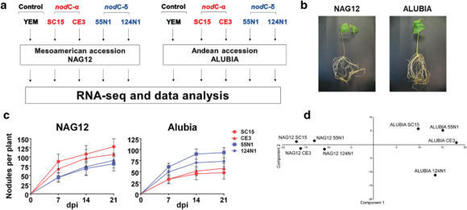
Legume plants establish a nitrogen-fixing symbiosis with soil bacteria known as rhizobia. Compatibility between legumes and rhizobia is determined at species-specific level, but variations in the outcome of the symbiotic process are also influenced by the capacity of the plant to discriminate and select specific strains that are better partners. We compared the transcriptional response of two genetically diverse accessions of Phaseolus vulgaris from Mesoamerica and South Andes to Rhizobium etli strains that exhibit variable degrees of symbiotic affinities. Our results indicate that the plant genotype is the major determinant of the transcriptional reprogramming occurring in roots at early stages of the symbiotic interaction. Differentially expressed genes (DEGs) regulated in the Mesoamerican and the Andean accessions in response to specific strains are different, but they belong to the same functional categories. The common and strain-specific transcriptional responses to rhizobia involve distinct transcription factors and cis-elements present in the promoters of DEGs in each accession, showing that diversification and domestication of common bean at different geographic regions influenced the evolution of symbiosis differently in each genetic pool. Quantitative PCR analysis validated our transcriptional datasets, which constitute a valuable source of coding and non-coding candidate genes to further unravel the molecular determinants governing the mechanisms by which plants select bacterial strains that produce a better symbiotic outcome.
|
|
Scooped by
Jean-Michel Ané
March 15, 2022 12:29 PM
|
Aims
Silicon (Si) uptake and accumulation improves plant resilience to environmental stresses, but most studies examining this functional role of Si have focussed on grasses (Poaceae) and neglected other important plant groups, such as legumes (Fabaceae). Legumes have evolved a symbiotic relationship with nitrogen-fixing bacteria (rhizobia) housed in root nodules. Our study determined the impacts of silicon (Si) supplementation on Medicago truncatula inoculated with Ensifer meliloti rhizobial strains that differed in their capacity for nitrogen fixation: Sm1021 (‘low-efficiency’) or Sm1022 (‘high-efficiency’).
Methods
We examined how Si and rhizobial efficacy influence nodule and plant functional traits, including their chemical aspects. These combinations were supplied with or without Si in a glasshouse experiment, where we quantified nodule flavonoids and foliar chemistry (free amino acids, soluble protein, elemental C, N and Si).
Results
Si supply increased nodule number per plant, specific nodule flavonoid concentrations, contents of foliar nitrogenous compounds and foliar C, but not foliar Si. We also demonstrated that rhizobial efficacy altered the magnitude of Si effects on certain traits. For example, Si significantly promoted concentrations of foliar N and soluble protein in the plants associated with the ‘low-efficiency’ strain only, and this was not the case with the ‘high-efficiency’ one.
Conclusions
Collectively, our study indicates that Si generates positive effects on M. truncatula, particularly when the association with rhizobia is relatively inefficient, and may play a more prominent role in rhizobial functionality than previously thought.
|
|
Scooped by
Jean-Michel Ané
March 15, 2022 12:27 PM
|
Arbuscular mycorrhizal (AM) fungi allocate mineral nutrients to their host plants, and the hosts supply carbohydrates and lipids to the fungal symbionts in return. The morphotypes of intraradical hyphae are primarily determined on the plant side into Arum- and Paris-type AMs. As an exception, Solanum lycopersicum (tomato) forms both types of AMs depending on the fungal species. Previously, we have shown the existence of diverse regulatory mechanisms in Arum- and Paris-type AM symbioses in response to gibberellin (GA) among different host species. However, due to the design of the study, it remained possible that the use of different plant species influenced the results. Here, we used tomato plants to compare the transcriptional responses during Arum- and Paris-type AM symbioses in a single plant species. The tomato plants inoculated with Rhizophagus irregularis or Gigaspora margarita exhibited Arum- and Paris-type AMs, respectively, and demonstrated similar colonization rates and shoot biomass. Comparative transcriptomics showed shared expression patterns of AM-related genes in tomato roots upon each fungal infection. On the contrary, the defense response and GA biosynthetic process was transcriptionally upregulated during Paris-type AM symbiosis. Thus, both shared and different transcriptional reprogramming function in establishing Arum- and Paris-type AM symbioses in tomato plants.
|
|
Scooped by
Jean-Michel Ané
March 13, 2022 6:28 PM
|
IAA carboxyl methyltransferase 1 (IAMT1) converts auxin (IAA) into its methyl ester (MeIAA). IAMT1 is reportedly critical for shoot development of the nonsymbiotic plant Arabidopsis. On the other hand, the function of IAMT1 in roots is unknown. Here, we found that IAMT1 is duplicated in the legume lineage, which evolved root nodule symbiosis. In the model legume Lotus japonicus, one of two paralogs (named IAMT1a) was mainly expressed in root epidermis, but its function is required in the adjacent cell layer, root cortex, where it promotes nodule development. Application of MeIAA, but not IAA, significantly induced NIN, a master regulator of nodule development, without rhizobia. These findings illuminate our understanding of intertissue communication acquired during evolution of root nodule symbiosis.
|
|
Scooped by
Jean-Michel Ané
March 13, 2022 6:18 PM
|
During the emergence of new host-microbe symbioses, multiple selective pressures –acting at the different steps of the microbial life cycle– will shape the phenotypic traits that jointly determine microbial fitness. However, the relative contribution of these different selective pressures on the adaptive trajectories of microbial symbionts are still poorly known. Here we characterized the dynamics of phenotypic adaptation and the underlying genetic bases during the experimental evolution of a plant pathogenic bacterium into a legume symbiont. We show that fast adaptation was supported by the sequential fixation of mutational cohorts within populations, and dominated by selection for host entry competitiveness over within-host proliferation. Computer simulations predict that this effect emerges from the presence of a strong selective bottleneck at host entry before bacterial multiplication. However, identifying and characterizing adaptive mutations revealed recurrent couplings between the two phenotypic traits, further increasing the efficiency of host-mediated selection of new symbionts.
|
|
Scooped by
Jean-Michel Ané
March 13, 2022 4:22 PM
|
Plant roots are colonized by microorganisms from the surrounding soil that belong to different kingdoms and form a multikingdom microbial community called the root microbiota. Despite their importance for plant growth, the relationship between soil management, the root microbiota, and plant performance remains unknown. Here, we characterize the maize root-associated bacterial, fungal, and oomycetal communities during the vegetative and reproductive growth stages of four maize inbred lines and the pht1;6 phosphate transporter mutant. These plants were grown in two long-term experimental fields under four contrasting soil managements, including phosphate-deficient and -sufficient conditions. We showed that the maize root-associated microbiota is influenced by soil management and changes during host growth stages. We identified stable bacterial and fungal root-associated taxa that persist throughout the host life cycle. These taxa were accompanied by dynamic members that covary with changes in root metabolites. We observed an inverse stable-to-dynamic ratio between root-associated bacterial and fungal communities. We also found a host footprint on the soil biota, characterized by a convergence between soil, rhizosphere, and root bacterial communities during reproductive maize growth. Our study reveals the spatiotemporal dynamics of the maize root-associated microbiota and suggests that the fungal assemblage is less responsive to changes in root metabolites than the bacterial community.
|
|
|
Scooped by
Jean-Michel Ané
March 31, 2022 5:43 PM
|
Early gene expression in arbuscular mycorrhiza (AM) and the nitrogen-fixing root nodule symbiosis (RNS) is governed by a shared regulatory complex. Yet many symbiosis-induced genes are specifically activated in only one of the two symbioses.
The Lotus japonicus T-DNA insertion line T90, carrying a promoterless uidA (GUS) gene in the promoter of Calcium Binding Protein1 (CBP1) is exceptional as it exhibits GUS activity in both root endosymbioses. To identify the responsible cis- and trans-acting factors, we subjected deletion/modification series of CBP1 promoter:reporter fusions to transactivation and spatio-temporal expression analysis and screened EMS-mutagenized T90 populations for aberrant GUS expression.
We identified one cis-regulatory element required for GUS expression in the epidermis and a second element, necessary and sufficient for transactivation by the Calcium and Calmodulin-dependent protein kinase (CCaMK) in combination with the transcription factor Cyclops and conferring gene expression during both AM and RNS. Lack of GUS expression in T90 white mutants could be traced to DNA hypermethylation detected in and around this element.
We concluded that the CCaMK/Cyclops complex can contribute to at least three distinct gene expression patterns on its direct target promoters NIN (RNS), RAM1 (AM), and CBP1 (AM and RNS), calling for yet-to-be identified specificity-conferring factors.
|
|
Scooped by
Jean-Michel Ané
March 31, 2022 5:37 PM
|
Soils worldwide have become increasingly degraded by human activities, especially in drylands. Land degradation negatively affects soil hydrological functioning and thereby the ecosystem services that soil provides. Soil microbes may play an important part in the restoration of degraded soils, positively influencing moisture content and other physical features of soil. Coban et al. reviewed recent work on soil hydraulic properties, potential groups of microorganisms for hydrological soil restoration based on their resilience in dry soils, and future strategies for long-term restoration of degraded lands.
|
|
Scooped by
Jean-Michel Ané
March 31, 2022 5:33 PM
|
Gluconacetobacter diazotrophicus is a nitrogen (N) fixing bacterium originally isolated from sugarcane in Brazil. Understanding the interactions between this bacterium and plants is important to exploit the nitrogen-fixing feature of G. diazotrophicus in different crops. Research was conducted to establish, monitor and optimize methods for introducing G. diazotrophicus into Brachypodium distachyon, a model for molecular research involving monocot plants. Colonization was studied in three plant growth media including liquid, semi-solid, and solid media. The effect of mineral nitrogen on colonization was also studied in each of these three media. The colonization of B. distachyon by G. diazotrophicus was analyzed by a histochemical β-glucuronidase (GUS) assay, PCR using G. diazotrophicus specific primers and bacterial re-isolation. Colonization was established in all tested plant growth conditions. The highest level of colonization was achieved in the liquid media without mineral nitrogen. Microscopic observations showed that G. diazotrophicus colonizes B. distachyon through the lateral root emergence sites, root hairs, and root tips. The colonization was found to be limited to root tissues and not found in other organs. These results indicate that B. distachyon roots are the primary organ of interaction and colonization by the bacterium. Plant fresh weight and lateral root numbers were significantly increased in inoculated plants indicating that G. diazotrophicus can stimulate growth of B. distachyon. This study indicates that B. distachyon is a useful model to study the mechanisms of G. diazotrophicus colonization and growth enhancement in monocot plants.
|
|
Scooped by
Jean-Michel Ané
March 17, 2022 1:29 PM
|
Legume roots interact with soil bacteria rhizobia to develop nodules, de novo symbiotic root organs that host these rhizobia and are mini factories of atmospheric nitrogen fixation. Nodulation is a sophisticated developmental process and is sensitive to several abiotic factors, salinity being one of them. While salinity influences both the free-living partners, symbiosis is more vulnerable than other aspects of plant and microbe physiology, and the symbiotic interaction is strongly impaired even under moderate salinity. In this review, we tease apart the various known components of rhizobium-legume symbiosis and how they interact with salt stress. We focus primarily on the initial stages of symbiosis, since we have a greater mechanistic understanding of the interaction at these stages.
|
|
Scooped by
Jean-Michel Ané
March 17, 2022 10:45 AM
|
Legumes are an integral part of a sustainable agroecosystem for their ability to form symbiosis with nitrogen-fixing rhizobia and deposit a significant amount of atmospheric nitrogen to agricultural land. In order to sustain and expand the contribution of legumes to agricultural production and ecosystem services, a leap forward advancement in legume genomics should be captured in all major legumes. One of the main advancements in understanding legume genomics has been the extensive investigation and utilization of model plants. Medicago truncatula was suggested and subsequently established as the model system for legumes and for understanding plant–microbe symbiotic associations. A wide array of genomics and bioinformatics tools were developed, and these tools provided an ample frame to understand different aspects of the Medicago genome and to delineate many veiled aspects of plant–microbe interactions. As part of an international consortium consisting of multiple universities and research institutes, the Medicago HapMap project was initiated, and over 300 genetically diverse inbred lines were re-sequenced, and genetic markers (single nucleotide polymorphisms (SNPs) and insertion/deletions (Indels)) have been publicly released. With the availability of high-density HapMap genetic markers, genome-wide association studies (GWAS) have been performed to explore the association between quantitative differences of a phenotype and genetic variation in a number of traits in M. truncatula. Here, we summarize the advances in the M. truncatula HapMap project as well as provide an up-to-date report of association studies in this model legume.
|
|
Scooped by
Jean-Michel Ané
March 15, 2022 12:54 PM
|
The traditional shallow tillage method reduces soil quality and affects the efficiency of agricultural production. Using conventional rotary tillage (12 cm) as the control, Yunyan 87 as the test variety, and paddy soil as the test site, we studied the effects of deep tillage (subsoiling 30 cm) on soil nutrients, arbuscular mycorrhizal fungi (AMF), and tobacco (Nicotiana tabacum L.) growth. The results showed that deep tillage increased the content of organic carbon, available phosphorus (AP), and available potassium (AK) in the 20–40 cm soil layer. The AMF community was also affected by deep tillage. Glomus, the dominant genus in both groups, increased significantly in soil after deep tillage. The AMF colonization rate was lower than that of conventional rotary tillage. Deep tillage was beneficial for tobacco growth in the middle and late stages. The root growth and nutrient content of the tobacco plants increased. Deep tillage significantly improved the output value of tobacco plants. Deep tillage is conducive to improving soil fertility, promoting the vigorous growth of roots, reducing the dependence of tobacco on AMF, and promoting the high quality and yield of tobacco in the drylands of Hunan.
|
|
Scooped by
Jean-Michel Ané
March 15, 2022 12:41 PM
|
Legumes are able to meet their nitrogen need by establishing nitrogen-fixing symbiosis with rhizobia. Nitrogen fixation is performed by rhizobia, which has been converted to bacteroids, in newly formed organs, the root nodules. In the model legume Medicago truncatula, nodule cells are invaded by rhizobia through transcellular tubular structures called infection threads (ITs) that are initiated at the root hairs. Here, we describe a novel M. truncatula early symbiotic mutant identified as ief (Infection-related Epidermal Factor) in which the formation of ITs is blocked in the root hair cells and only nodule primordia are formed. We show that the function of MtIEF is crucial for the bacterial infection in the root epidermis but not required for the nodule organogenesis. The IEF gene that appears to have been recruited for a symbiotic function after the duplication of a flower-specific gene, is activated by the ERN1-branch of the Nod Factor signal transduction pathway and independent of the NIN activity. The expression of MtIEF is induced transiently in the root epidermal cells by the rhizobium partner or Nod factors. Although its expression was not detectable at later stages of symbiosis, complementation experiments indicate that MtIEF is also required for the proper invasion of the nodule cells by rhizobia. The gene encodes an intracellular protein of unknown function possessing a coiled-coil motif and a plant-specific DUF761 domain. The IEF protein interacts with RPG, another symbiotic protein essential for normal IT development suggesting that combined action of these proteins plays a role in nodule infection.
|
|
Scooped by
Jean-Michel Ané
March 15, 2022 12:35 PM
|
Arbuscular mycorrhizal (AM) symbiosis is accompanied by alterations to root cell metabolism and physiology, and to the pathways of phosphate (Pi) entry into the root, which increase with Pi delivery to cortical cells via arbuscules. How AM symbiosis influences the Pi content and Pi response dynamics of cells in the root cortex and epidermis is unknown.
Using Fluorescence Resonance Energy Transfer (FRET)-based Pi biosensors, we mapped the relative cytosolic and plastidic Pi content of Brachypodium distachyon mycorrhizal root cells, analyzed responses to extracellular Pi and traced extraradical hyphae-mediated Pi transfer to colonized cells.
Colonized cortical cells had a higher cytosolic Pi content relative to non-colonized cortical and epidermal cells, while plastidic Pi content was highest in cells at the infection front. Pi application to the entire mycorrhizal root resulted in transient changes in cytosolic Pi that differed in direction and magnitude depending on cell type and arbuscule status; cells with mature arbuscules showed a substantial transient increase in cytosolic Pi while those with collapsed arbuscules showed a decrease. Directed Pi application to extraradical hyphae resulted in measurable changes in cytosolic Pi of colonized cells 18 h after application.
Our experiments reveal that cells within a mycorrhizal root vary in Pi content and Pi response dynamics.
|
|
Scooped by
Jean-Michel Ané
March 15, 2022 12:27 PM
|
Since nitrogenase is irreversibly inactivated within a few minutes after exposure to oxygen, current studies on the heterologous expression of nitrogenase are limited to anaerobic conditions. This study comprehensively identified genes showing oxygen-concentration-dependent expression only under nitrogen-fixing conditions in Azotobacter vinelandii, an aerobic diazotroph. Among the identified genes, nafU, with an unknown function, was greatly upregulated under aerobic nitrogen-fixing conditions. Through replacement and overexpressing experiments, we suggested that nafU is involved in the maintenance of nitrogenase activity under aerobic nitrogenase activity. Furthermore, heterologous expression of nafU in nitrogenase-producing Escherichia coli increased nitrogenase activity under aerobic conditions by 9.7 times. Further analysis of NafU protein strongly suggested its localization in the inner membrane and raised the possibility that this protein may lower the oxygen concentration inside the cells. These findings provide new insights into the mechanisms for maintaining stable nitrogenase activity under aerobic conditions in A. vinelandii and provide a platform to advance the use of nitrogenase under aerobic conditions.
|
|
Scooped by
Jean-Michel Ané
March 15, 2022 11:30 AM
|
Purpose
The effects of endophytic actinobacterial strains, Microbispora sp. CP56, Actinomadura sp. CP84B, Streptomyces spp. CP200B and CP21A, on the chickpea-Mesorhizobium symbiosis, were investigated in planta, with the aim of revealing the underlying mechanisms of action.
Methods
The actinobacterial endophytes were co-inoculated with Mesorhizobium ciceri onto chickpea seedlings to study the effect on plant growth parameters, nodulation development and grain yield. The role of actinobacterial exudates on rhizobial growth was investigated, as was the role of root exudates of actinobacteria-colonized plants on the expression of rhizobial nod factors and biofilm formation. Changes in expression of plant flavonoids and bacterial N-fixation genes resulting from actinobacterial co-inoculation were assessed using qPCR.
Results
Application of actinobacterial endophytes, together with M. ciceri, showed growth promotion of chickpea with an increase in root nodule number and weight. Enhanced nodulation was accompanied by increases in total plant nitrogen, larger total plant weight and a 2–3-fold increase in grain yield. Factors associated with this tripartite symbiosis are promotion of rhizobial growth, earlier nodule formation, increased secondary root formation, up-regulated expression of genes related to flavonoid synthesis and nif genes. In addition, exudates of chickpea roots colonised with actinobacteria increased nodulation-related biological processes - rhizobial chemotaxis, biofilm formation and nod gene expression.
Conclusion
These endophytic actinobacteria positively affect many aspects of the chickpea-Mesorhizobium symbiosis resulting in increases in grain yield. Similar improvements recorded in chickpea growing in potted field soils, shows the potential to enhance chickpea production in the field.
|
|
Scooped by
Jean-Michel Ané
March 13, 2022 6:21 PM
|
Nitrogen-fixing symbiosis is globally important in ecosystem functioning and agriculture, yet the evolutionary history of nodulation remains the focus of considerable debate. Recent evidence suggesting a single origin of nodulation followed by massive parallel evolutionary losses raises questions about why a few lineages in the N2-fixing clade retained nodulation and diversified as stable nodulators while most did not. Within legumes, nodulation is restricted to the two most diverse subfamilies, Papilionoideae and Caesalpinioideae, which show stable retention of nodulation across their core clades.
We characterize two nodule anatomy types across 128 species in 56 of the 150 genera of the legume subfamily Caesalpinioideae: 1) fixation thread nodules (FTs), where nitrogen-fixing bacteroids are retained within the apoplast in modified infection threads and 2) symbiosomes, where rhizobia are symplastically internalized in the host cell cytoplasm within membrane-bound symbiosomes.
Using a robust phylogenomic tree based on 997 genes from 146 caesalpinioid genera, we show that losses of nodulation are more prevalent in lineages with FTs.
We propose that evolution of the symbiosome allows for a more intimate and enduring symbiosis through greater compartmentalisation of their rhizobial microsymbionts, resulting in greater evolutionary stability of nodulation across this species-rich pantropical clade of legumes.
|
|
Scooped by
Jean-Michel Ané
March 13, 2022 5:59 PM
|
Both mutualism and polyploidy are thought to influence invasion success in plants but few studies have tested their joint effects. Mutualism can limit range expansion when plants cannot find a compatible partner in a novel habitat, or facilitate range expansion when mutualism increases a plant’s niche breadth. Polyploids are also expected to have greater niche breadth because of greater self-compatibility and phenotypic plasticity, increasing invasion success.
For 839 legume species, we compiled data from published sources to estimate ploidy, symbiotic status with rhizobia, specificity on rhizobia, and the number of introduced ranges.
We found that diploid species have had limited spread around the globe regardless of whether they are symbiotic or how many partners of rhizobia they can host. Polyploids, in contrast, have been successfully introduced to many new ranges, but interactions with rhizobia constrain their range expansion. In a hidden state model of trait evolution, we also found evidence of a high rate of re-diploidization in symbiotic legume lineages, suggesting that symbiosis and ploidy may interact at macroevolutionary scales.
Overall, our results suggest that symbiosis with rhizobia affects range expansion only in polyploid legumes.
|


 Scoop.it!