Your new post is loading...

|
Scooped by
Jean-Michel Ané
June 17, 2014 11:28 AM
|
A remarkable 180 million tons of nitrogen fertilizer is used every year in industrial farming [12], and it has played such an enabling role that fertilizer use is estimated to meet the nutritional needs of one-third of the human population [13]. However, the use of nitrogen fertilizers has serious disadvantages, including substantial cost and deleterious effects on the soil and surrounding environment, and neighboring waterways. Plants that could satisfy some or all of their own nitrogen requirement would transform agriculture by reducing or eliminating this enormous dependence on fertilizer. There are two conceivable ways in which a plant could be engineered to satisfy its own nitrogen requirement. The first takes advantage of the fact that some bacteria carry out their own version of the Haber-Bosch process—reducing atmospheric N2 into a more bioavailable form, NH3—using the enzyme nitrogenase [14]. This complex enzyme contains multiple metalloclusters and requires a large quantity of biochemical energy to transfer the electrons needed to activate the exceptionally stable N2 triple bond. By expressing nitrogenase, plants would be able to fix their own nitrogen. The primary advantage of this approach is that it is direct: nitrogen fixed by a plant could be used immediately to generate amino acid and nucleic acid monomers and transport them to neighboring cells. Although the process would incur a metabolic cost, it could be regulated by the endogenous level of nitrogen to maximize its efficiency. Immense technological challenges stand in the way of accomplishing this goal [15]. Eighteen gene products (in Klebsiella oxytoca) are necessary and sufficient for the production of nitrogenase and its complex iron-molybdenum cofactor. By an impressive feat of microbial engineering, the biosynthetic gene cluster for nitrogenase has been refactored—taken apart, re-coded, and put back together using known components—and shown to be active in its new host [16]. The successful transfer of other large gene clusters from one microbe to another, such as the one encoding the magnetosome, suggests that the process of functionalizing microbes is undergoing a dramatic improvement [17]. But new challenges must be overcome for the expression of similar elements in plants. First, all 18 components of the nitrogenase biosynthetic apparatus would need to be expressed simultaneously in plants and function in concert, a considerable barrier given that the largest number of genes expressed in an engineered plant to date is eight in the establishment of a photorespiratory bypass in Arabidopsis [18]. Second, since plants are eukaryotic and multicellular, where in the plant cell should the genes be expressed and in which cell types of the plant? This question is especially relevant for nitrogenase, which is poisoned by oxygen and must therefore be expressed under anaerobic conditions. Tools that enable organelle- and cell-type specific expression will be of great utility here and in other plant engineering efforts. The second way to reduce or eliminate the need for nitrogen fertilizer would be to engineer a rhizosphere symbiosis between a nitrogen-fixing microorganism and a plant host. Although this approach is less direct than expressing nitrogenase in plants, it has two primary advantages: (1) It uncouples the difficulties of utilizing nitrogenase (e.g., sequestering the enzyme in an anaerobic compartment) from the biology of the plant host, and outsources the demanding chemistry involved to a bacterial strain better suited to the task. (2) The well-studied symbioses between legumes and their nitrogen-fixing, root-nodulating bacterial symbionts prove that a bacterial mutualist can satisfy the nitrogen needs of a plant host [19]. Even though root-nodulating bacteria appear to be specific to legumes, the presence of nitrogen-fixing bacteria in the rhizosphere opens the possibility that symbioses of this sort are a much more widely distributed phenomenon [20]. If so, then the feasibility of making this mode of nitrogen exchange more efficient—rather than engineering it from scratch—would appear high. However, there remain two primary challenges in engineering a stable and practical rhizosphere symbiosis: enabling efficient nutrient exchange and maintaining specificity of the host-microbe pair. Both could take years to develop and are likely to require not just plant but also microbial metabolic engineering. In the meantime, advanced molecular breeding tools that enable access to natural variation in a plant's wild ancestors [21] are a promising alternative approach to increasing crop plant yields [22].
|
|
Scooped by
Jean-Michel Ané
June 17, 2014 11:20 AM
|
Saline soils are a major issue for agriculture because salt turns agronomically useful lands into unproductive areas. The United Nations Environment Program estimates that approximately 20 % of agricultural land and 50 % of cropland in the world is salt-stressed. Soil salinisation is reducing the area that can be used for agriculture by 1–2 % every year, hitting hardest in the arid and semi-arid regions. Salinity decreases the yield of many crops because salt inhibits plant photosynthesis, protein synthesis and lipid metabolism. Plant-growth-promoting rhizobacteria (PGPR), beneficial bacteria that live in the plant root zone named the rhizosphere, is one of the solutions to solve this issue. Indeed rhizobacteria counteract osmotic stress and help plant growth. This article reviews the benefits of plant-growth-promoting rhizobacteria for plants growing in saline soils. The major points are (1) plants treated with rhizobacteria have better root and shoot growth, nutrient uptake, hydration, chlorophyll content, and resistance to diseases; (2) stress tolerance can be explained by nutrient mobilisation and biocontrol of phytopathogens in the rhizosphere and by production of phytohormones and 1-aminocyclopropane-1-carboxylate deaminase; (3) rhizobacteria favour the circulation of plant nutrients in the rhizosphere; (4) rhizobacteria favour osmolyte accumulation in plants; (5) plants inoculated with rhizobacteria have higher K+ ion concentration and, in turn, a higher K+/Na+ ratio that favour salinity tolerance; and (6) rhizobacteria induce plant synthesis of antioxidative enzymes that degrade reactive oxygen species generated upon salt shock.
|
|
Scooped by
Jean-Michel Ané
June 17, 2014 11:15 AM
|
Arabica coffee is a major agricultural commodity worldwide, representing 60 % of the world’s coffee production. Arabica coffee is cultivated in more than 36 countries and is a key cash crop for many developing countries. Despite the coffee’s huge economic importance, there is very limited knowledge on the association of arbuscular mycorrhizal fungi with coffee roots. Therefore, we assessed the mycorrhizal diversity and community composition in Arabica coffee (Coffea arabicaL.), using 454 pyrosequencing, in its Ethiopian center of origin. We studied the five most common coffee management systems in Ethiopia. Using pyrosequencing, we retrieved 10,061 mycorrhizae sequences across 30 samples, generating 36 operational taxonomic units from the four mycorrhizae orders: Glomerales, Diversisporales, Archaeosporales, and Paraglomerales; and eight families. Our results show that mycorrhizal diversity strongly differed between natural forest coffee systems and the other management systems. Furthermore, 13 operational taxonomic units were uniquely found in natural forest coffee. Finally, the mycorrhizal community composition in shade coffee plantations was different from the community composition in the other managed systems and the natural forest coffee systems. This is the first in depth study of mycorrhizal communities in wild coffee in its Ethiopian region of origin. Furthermore, we show for the first time the major differences in mycorrhizal communities in coffee between natural coffee forest and more intensively managed coffee systems. We, therefore, provide evidence of the conservation value of natural coffee forest systems as they harbor a unique mycorrhizal diversity, with possible future applications in low input coffee agriculture.
|
|
Rescooped by
Jean-Michel Ané
from Plants and Microbes
June 16, 2014 10:44 PM
|
Plant roots are host to a multitude of filamentous microorganisms. Among these, arbuscular mycorrhizal fungi provide benefits to plants, while pathogens trigger diseases resulting in significant crop yield losses. It is therefore imperative to study processes which allow plants to discriminate detrimental and beneficial interactions in order to protect crops from diseases while retaining the ability for sustainable bio-fertilisation strategies. Accumulating evidence suggests that some symbiosis processes also affect plant–pathogen interactions. A large part of this overlap likely constitutes plant developmental processes. Moreover, microbes utilise effector proteins to interfere with plant development. Here we list relevant recent findings on how plant–microbe interactions intersect with plant development and highlight future research leads.
Via Kamoun Lab @ TSL
|
|
Scooped by
Jean-Michel Ané
June 16, 2014 12:41 PM
|
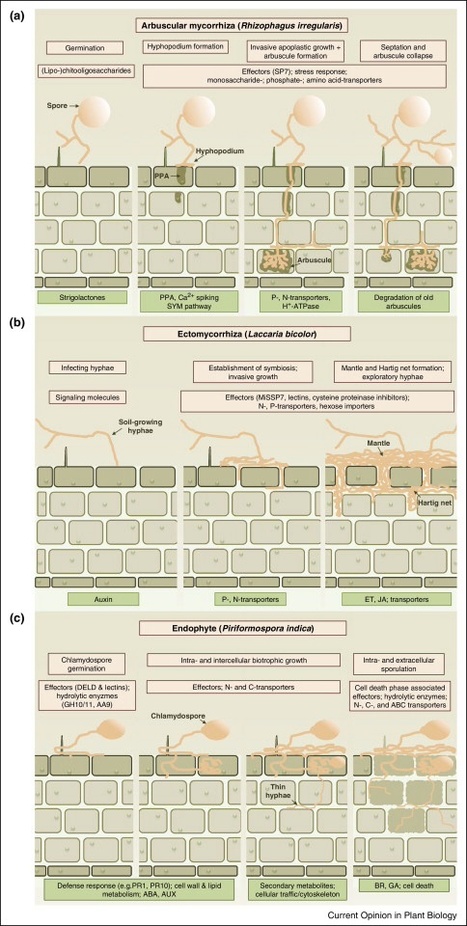
Highlights•Host-dependent root colonization strategies are a common feature in broad compatibility. •Gene family expansion and contraction correlate with fungal lifestyles/nutritional modes. •Fungal symbionts have few genes involved in toxin production and expanded signaling gene families. •Similar outputs of interactions in different root symbioses are examples of convergent evolution. Plants associate with a wide range of beneficial fungi in their roots which facilitate plant mineral nutrient uptake in exchange for carbohydrates and other organic metabolites. These associations play a key role in shaping terrestrial ecosystems and are widely believed to have promoted the evolution of land plants. To establish compatibility with their host, root-associated fungi have evolved diverse colonization strategies with distinct morphological, functional and genomic specializations as well as different degrees of interdependence. They include obligate biotrophic arbuscular mycorrhizal (AM), and facultative biotrophic ectomycorrhizal (ECM) interactions but are not restricted to these well-characterized symbioses. There is growing evidence that root endophytic associations, which due to their inconspicuous nature have been often overlooked, can be of mutualistic nature and represent important players in natural and managed environments. Recent research into the biology and genomics of root associations revealed fascinating insight into the phenotypic and trophic plasticity of these fungi and underlined genomic traits associated with biotrophy and saprotrophy. In this review we will consider the commonalities and differences of AM and ECM associations and contrast them with root endophytes.
|
|
Scooped by
Jean-Michel Ané
June 14, 2014 5:23 PM
|
We take a look at the top 5 myths surrounding Mycorrhizae for hydroponics, including why you should be using it and how to make it cheaper all round!
|
|
Scooped by
Jean-Michel Ané
June 14, 2014 5:20 PM
|
AM fungi are widespread and are found from arctic to tropics in most agricultural and natural ecosystems. They play an important role in plant growth, health and productivity. They increase seedling tolerance to drought, high temperatures, toxic heavy metals, high or low pH and even extreme soil acidity. The cultivation of medicinal and herbal plants has assumed greater importance in recent years due to their tremendous potential in modern and traditional medicine. They are also used as raw materials for pharmaceutical, cosmetic and fragrance industries. Indian system of medicine (ISM) uses 25,000 species belonging to more than 1000 genera. About 25% species are used by the industries. The Barak Valley is the southernmost part of the Assam and consists of three districts namely Cachar, Karimganj and Hailakandi. Different tribes staying here are directly using of medicinal plants for the treatments of different ailments. Comparatively very less attention has been given for the conservation of some of these rare and endangered medicinal plants which are extensively used by the tribes of Assam. So, AM fungi can play an effective role in the conservation of some valuable medicinal plants where Glomus sp. was found to be widely used for the increase yield of important medicinal plants. This review summarizes the data from recent studies to elucidate the potential use of AM fungi for promoting growth and disease resistance in medicinal plants found in southern part of Assam, which in turn provide a natural enhancer for the commercial production of traditional drugs from various important plants.
|
|
Scooped by
Jean-Michel Ané
June 14, 2014 5:15 PM
|
AbstractArbuscular mycorrhizal (AM) symbiosis that associates roots of most land plants with soil-borne fungi (Glomeromycota), is characterized by reciprocal nutritional benefits. Fungal colonization of plant roots induces massive changes in cortical cells where the fungus differentiates an arbuscule, which drives proliferation of the plasma membrane. Despite the recognized importance of membrane proteins in sustaining AM symbiosis, the root microsomal proteome elicited upon mycorrhiza still remains to be explored. In this study, we first examined the qualitative composition of the root membrane proteome of Medicago truncatula after microsome enrichment and subsequent in depth analysis by GeLC-MS/MS. The results obtained highlighted the identification of 1226 root membrane protein candidates whose cellular and functional classifications predispose plastids and protein synthesis as prevalent organelle and function, respectively. Changes at the protein abundance level between the membrane proteomes of mycorrhizal and nonmycorrhizal roots were further monitored by spectral counting, which retrieved a total of 96 proteins that displayed a differential accumulation upon AM symbiosis. Besides the canonical markers of the periarbuscular membrane, new candidates supporting the importance of membrane trafficking events during mycorrhiza establishment/functioning were identified, including flotillin-like proteins. The data have been deposited to the ProteomeXchange with identifier PXD000875. BIOLOGICAL SIGNIFICANCE: During arbuscular mycorrhizal symbiosis, one of the most widespread mutualistic associations in nature, the endomembrane system of plant roots is believed to undergo qualitative and quantitative changes in order to sustain both the accommodation process of the AM fungus within cortical cells and the exchange of nutrients between symbionts. Large-scale GeLC-MS/MS proteomic analysis of the membrane fractions from mycorrhizal and nonmycorrhizal roots of M. truncatula coupled to spectral counting retrieved around one hundred proteins that displayed changes in abundance upon mycorrhizal establishment. The symbiosis-related membrane proteins that were identified mostly function in signalling/membrane trafficking and nutrient uptake regulation. Besides extending the coverage of the root membrane proteome of M. truncatula, new candidates involved in the symbiotic program emerged from the current study, which pointed out a dynamic reorganisation of microsomal proteins during the accommodation of AM fungi within cortical cells.
|
|
Scooped by
Jean-Michel Ané
June 13, 2014 9:49 PM
|
Mycorrhizae and Biofungicide are bio-additives that are available premixed in different PRO-MIX® formulations such as PRO-MIX® BRK, BRK20, BX, HP, LP15, etc. The advantage of having these bio-additives premixed in the growing medium is the convenience of not having to add them at all during the crop cycle and they benefit the crop throughout the growing season – there is no need to reapply these biological organisms. Our biologically amended PRO-MIX® products are easy to use and most storage conditions are compatible with the biologicals. In this article, we will address questions that come up regarding the integrity of these organisms.
|
|
Scooped by
Jean-Michel Ané
June 12, 2014 5:22 PM
|
Within the framework of the JGI Mycorrhizal Genomics Initiative, we are sequencing a phylogenetically and ecologically diverse suite of mycorrhizal fungi (Basidiomycota and Ascomycota), which include the major clades of symbiotic species associating with trees and woody shrubs. Analyses of these genomes will provide insight into the diversity of mechanisms for the mycorrhizal symbiosis, including endo- and ectomycorrhiza. Pisolithus is actually a dominant fungus in ecological settings. In fact, P. tinctorius and P. microcarpusspecies are typically one of the most frequent fungi to colonize pines and eucalypts, respectively, in primary successional settings in their native habitat. They are currently used in the commercial forestry industry to inoculate conifer or eucalypt seedlings for lumber and landscape trees. Pisolithus is a versatile organism, and genomic data on this fungus will be useful to a variety of groups. Sequencing of these species will provide a more comprehensive understanding of the biological community of eucalypt and pine, two trees having their genome currently sequenced by the DOE JGI. Pisolithus is a distant relative to the other fungi slated for sequencing, and this property will yield important insights into evolution of ectomycorrhizal symbiosis, which is a foundation of terrestrial ecosystems. Laccaria bicolor belongs to the Agaricales. Like Rhizopogon andPaxillus, Pisolithus is a member of the Boletales, but it diverged about 130 mya from the other two genera and probably became mycorrhizal independently. It is known that mycorrhizal symbiosis has convergently evolved multiple times in the Basidiomycota. Having genomic information on related multiple lineages would enable us to understand the underlying evolutionary development of this process.
|
|
Scooped by
Jean-Michel Ané
June 12, 2014 12:32 PM
|
Bioprotective effects of mycorrhization with two different arbuscular mycorrhizal (AM) fungi,Funneliformis mosseae and Rhizophagus irregularis, against Aphanomyces euteiches, the causal agent of root rot in legumes, were studied in Medicago truncatula using phenotypic and molecular markers. Previous inoculation with an AM-fungus reduced disease symptoms as well as the amount of pathogen within roots, as determined by the levels of A. euteiches rRNA or transcripts of the genesterol C24 reductase. Inoculation with R. irregularis was as efficient as that with F. mosseae. To study whether jasmonates play a regulatory role in bioprotection of M. truncatula by the AM fungi, composite plants harboring transgenic roots were used to modulate the expression level of the gene encoding M. truncatula allene oxide cyclase 1, a key enzyme in jasmonic acid biosynthesis. Neither an increase nor a reduction in allene oxide cyclase levels resulted in altered bioprotection by the AM fungi against root infection by A. euteiches. These data suggest that jasmonates do not play a major role in the local bioprotective effect of AM fungi against the pathogen A. euteiches in M. truncatularoots.
|
|
Scooped by
Jean-Michel Ané
June 11, 2014 9:57 PM
|
The soybean cyst nematode (SCN; Heterodera glycines) is a major detriment to soybean production. The endophytic bacteriumSinorhizobium fredii strain Sneb183 is known to inhibit the activity of SCN. In the present study, soybean seedlings were inoculated with Sneb183, to study the penetration juveniles, and their development inside the roots. The number of cysts in the soybean roots was also examined. The induced systemic resistance in soybean was also examined through the split-root system. Our results revealed that the number of juveniles and cysts significantly decreased as a result of Sneb183 inoculation. Sneb183 also prolonged the developmental stage of SCN in the root to 30 days as compared to 27 days in the control. Furthermore, the number of nematodes in each stage was lower in the Sneb183 treated plants than control plants. We also used a split-root system to show that the S. fredii strain Sneb183 induced a systemic resistance to SCN infection in soybean. The repression rate of SCN penetration was 38.75%. Our study showed that Sneb183 can be an effective biocontrol agent for managing SCN infestation in soybean.
|
|
Scooped by
Jean-Michel Ané
June 11, 2014 9:50 PM
|
|
|
|
Scooped by
Jean-Michel Ané
June 17, 2014 11:25 AM
|
Many bacteria use quorum sensing (QS) to regulate phenotypes that ultimately benefit the bacterial population at high cell densities. These QS-dependent phenotypes are diverse and can have significant impacts on the bacterial host, including virulence factor production, motility, biofilm formation, bioluminescence, and root nodulation. As bacteria and their eukaryotic hosts have co-evolved over millions of years, it is not surprising that certain hosts appear to be able to sense QS signals, potentially allowing them to alter QS outcomes. Recent experiments have established that eukaryotes have marked responses to the N-acyl L-homoserine lactone (AHL) signals used by Gram-negative bacteria for QS, and the responses of plants to AHLs have received considerable scrutiny to date. However, the molecular mechanisms by which plants, and eukaryotes in general, sense bacterial AHLs remain unclear. Herein we report a systematic analysis of the responses of the model plants Arabidopsis thaliana and Medicago truncatula to a series of native AHLs and byproducts thereof. Our results establish that AHLs can significantly alter seedling growth in an acyl-chain length dependent manner. Based upon A. thaliana knockout studies and in vitro biochemical assays, we conclude that the observed growth effects are dependent upon AHL amidolysis by a plant-derived fatty acid amide hydrolase (FAAH) to yield L-homoserine. The accumulation of L-homoserine appears to encourage plant growth at low concentrations by stimulating transpiration, while higher concentrations inhibit growth by stimulating ethylene production. These results offer new insights into the mechanisms by which plant hosts can respond to QS signals and the potential role of QS in interkingdom associations.
|
|
Scooped by
Jean-Michel Ané
June 17, 2014 11:16 AM
|
Although the number of studies investigating mycorrhizal associations in orchids has increased in recent years, the fungal communities associating with orchids and how they differ between species and sites remain unclear. Recent research has indicated that individual orchid plants may associate with several fungi concurrently, implying that to study mycorrhizal associations in orchids the fungal community should be assessed, rather than the presence of individual dominant fungal species or strains. High-throughput sequencing methods, such as 454 pyrosequencing, are increasingly used as the primary tool for such analyses. However, many studies combine universal primers from previous phylogenetic or ecological studies to generate amplicons suitable for 454 pyrosequencing without first critically evaluating their performance, potentially resulting in biased fungal community descriptions. Here, following in silico primer analysis we evaluated the performance of different combinations of existing PCR primers to characterize orchid mycorrhizal communities using 454 pyrosequencing by analysis of both an artificially assembled community of mycorrhizal fungi isolated from diverse orchid species and root samples from three different orchid species (Anacamptis morio, Ophrys tenthredinifera and Serapias lingua). Our results indicate that primer pairs ITS3/ITS4OF and ITS86F/ITS4, targeting the internal transcribed spacer-2 (ITS-2) region, outperformed other tested primer pairs in terms of number of reads, number of operational taxonomic units recovered from the artificial community and number of different orchid mycorrhizal associating families detected in the orchid samples. Additionally, we show the complementary specificity of both primer pairs, making them highly suitable for tandem use when studying the diversity of orchid mycorrhizal communities.
Via Francis Martin
|
|
Scooped by
Jean-Michel Ané
June 16, 2014 10:43 PM
|
BackgroundLeguminous plants are able to form a root nodule symbiosis with nitrogen-fixing soil bacteria called rhizobia. This symbiotic association shows a high level of specificity. Beyond the specificity for the legume family, individual legume species/genotypes can only interact with certain restricted group of bacterial species or strains. Specificity in this system is regulated by complex signal exchange between the two symbiotic partners and thus multiple genetic mechanisms could be involved in the recognition process. Knowledge of the molecular mechanisms controlling symbiotic specificity could enable genetic improvement of legume nitrogen fixation, and may also reveal the possible mechanisms that restrict root nodule symbiosis in non-legumes. ResultsWe screened a core collection of Medicago truncatula genotypes with several strains of Sinorhizobium meliloti and identified a naturally occurring dominant gene that restricts nodulation by S. meliloti Rm41. We named this gene as Mt-NS1 (for M. truncatula nodulation specificity 1). We have mapped the Mt-NS1 locus within a small genomic region on M. truncatula chromosome 8. The data reported here will facilitate positional cloning of the Mt-NS1 gene. ConclusionsEvolution of symbiosis specificity involves both rhizobial and host genes. From the bacterial side, specificity determinants include Nod factors, surface polysaccharides, and secreted proteins. However, we know relatively less from the host side. We recently demonstrated that a component of this specificity in soybeans is defined by plant NBS-LRR resistance (R) genes that recognize effector proteins delivered by the type III secretion system (T3SS) of the rhizobial symbionts. However, the lack of a T3SS in many sequenced S. meliloti strains raises the question of how the specificity is regulated in the Medicago-Sinorhizobium system beyond Nod-factor perception. Thus, cloning and characterization of Mt-NS1 will add a new dimension to our knowledge about the genetic control of nodulation specificity in the legume-rhizobial symbiosis.
|
|
Scooped by
Jean-Michel Ané
June 14, 2014 5:26 PM
|
Aiming to unravel their potential involvement in the regulation of the nitrogen (N) metabolism in Methanosarcina mazei strain Gö1, we characterized five genes differentially transcribed in response to changing N-availabilities and encoding putative transcriptional regulators. Studying the respective mutant strains under N-depletion revealed a growth delay for M. mazei MM0444::pac and MM1708::pac, and strongly reduced diazotrophic growth for MM0872::pac, whereas the absence of MM2441 or MM2525 did not affect growth behaviour. Transcriptome analyses further demonstrated that exclusively MM1708 – encoding a CxxCG zinc finger protein - plays a regulatory role in N metabolism, most likely by specifically enhancing transcription of the N2 fixation (nif)-operon under N-limitation. In agreement a palindromic binding motif was predicted in silico in the nifH-promoter region, 9 nucleotides (nt) up-stream of the BRE-box and confirmed to bind purified MBP-MM1708 by electro-mobility shift assays. Since MM1708 itself is under the control of the global nitrogen repressor NrpR, this adds a secondary level to the transcriptional regulation of the nif-genes, and is most likely crucial for maximal nif-induction under N-limitation. This is in accordance with the finding that protein expression of NifH is highly reduced in the absence of MM1708 under N-limitation. Based on our findings we hypothesize that in M. mazei N-fixation is controlled by a hierarchical network of two transcriptional regulators, the global nitrogen repressor NrpR and the newly identified activator NrpA (MM1708), thereby providing a tight control of N2-fixation.
|
|
Scooped by
Jean-Michel Ané
June 14, 2014 5:21 PM
|
ROP-type GTPases of plants function as molecular switches within elementary signal transduction pathways such as the regulation of ROS synthesis via activation of NADPH oxidases (RBOH-respiratory burst oxidase homologue in plants). Previously, we reported that silencing of the Medicago truncatula GTPase MtROP9 led to reduced ROS production and suppressed induction of ROS-related enzymes in transgenic roots (MtROP9i) infected with pathogenic (Aphanomyces euteiches) and symbiotic microorganisms (Glomus intraradices, Sinorhizobium meliloti). While fungal infections were enhanced, S. meliloti infection was drastically impaired. In this study, we investigate the temporal proteome response of M. truncatula MtROP9i transgenic roots during the same microbial interactions under conditions of deprived potential to synthesize ROS. In comparison with control roots (Mtvector), we present a comprehensive proteomic analysis using sensitive MS protein identification. For four early infection time-points (1, 3, 5, 24 hpi), 733 spots were found to be different in abundance: 213 spots comprising 984 proteins (607 unique) were identified after S. meliloti infection, 230 spots comprising 796 proteins (580 unique) after G. intraradices infection, and 290 spots comprising 1240 proteins (828 unique) after A. euteiches infection. Data evaluation by GelMap in combination with a heatmap tool allowed recognition of key proteome changes during microbial interactions under conditions of hampered ROS synthesis. Overall, the number of induced proteins in MtROP9i was low as compared with controls, indicating a dual function of ROS in defense signaling as well as alternative response patterns activated during microbial infection. Qualitative analysis of induced proteins showed that enzymes linked to ROS production and scavenging were highly induced in control roots, while in MtROP9i the majority of proteins were involved in alternative defense pathways such as cell wall and protein degradation.
|
|
Rescooped by
Jean-Michel Ané
from Plant microbe interactions
June 14, 2014 5:18 PM
|
During endosymbiotic interactions between legume plants and nitrogen-fixing rhizobia, successful root infection by bacteria and nodule organogenesis requires the perception and transduction of bacterial lipo-chitooligosaccharidic signal called Nod Factor (NF). NF perception in legume roots leads to the activation of an early signaling pathway and of a set of symbiotic genes which is controlled by specific early transcription factors (TFs) including CYCLOPS/IPD3, NSP1, NSP2, ERN1 and NIN. In this study, we bring strong evidence that the Medicago truncatula CCAAT box-binding NF-YA1 TF, previously associated with later stages of rhizobial infection and nodule meristem formation is, together with its closest homolog NF-YA2, also an essential positive regulator of the NF signaling pathway. Here show that NF-YA1 and NF-YA2 are both expressed in epidermal cells responding to NFs and their knock-down by reverse genetic approaches severely affects the NF-induced expression of symbiotic genes and rhizobial infection. Further overexpression, transactivation and ChIP-PCR approaches indicate that NF-YA1 and NF-YA2 function, at least in part, via the direct activation of ERN1. We thus propose a model in which NF-YA1 and NF-YA2 appear as early symbiotic regulators acting downstream of DMI3 and NIN and possibly within the same regulatory complexes as NSP1/2 to directly activate the expression of ERN1.
Via Olivier ANDRE
|
|
Scooped by
Jean-Michel Ané
June 14, 2014 5:12 PM
|
To feed a planet of 9 billion, scientists are breeding mycorrhizal fungi that promise to boost crop yields by unlocking more nutrients in the soil.
|
|
Scooped by
Jean-Michel Ané
June 13, 2014 9:47 PM
|
Transposable elements (TEs) are ubiquitous inhabitants of eukaryotic genomes and their proliferation and dispersal shape genome architectures and diversity. Nevertheless, TE dynamics are often explored for one species at a time, and are rarely considered in ecological contexts. Recent work with plant pathogens suggests a link between symbiosis and TE abundance. The genomes of pathogenic fungi appear to house an increased abundance of TEs, and TEs are frequently associated with the genes involved in symbiosis. To investigate if this pattern is general, and relevant to mutualistic plant-fungal symbioses, we sequenced the genomes of related asymbiotic (AS) and ectomycorrhizal (ECM) Amanitafungi. Using methods developed to interrogate both assembled and unassembled sequence, we characterized and quantified TEs across three AS and three ECM species, including the AS outgroup Volvariella volvacea. The ECM genomes are characterized by abundant numbers of TEs, an especially prominent feature of unassembled sequencing libraries. Increased TE activity in ECM species is also supported by phylogenetic analysis of the three most abundant TE superfamilies; phylogenies revealed many radiations within contemporary ECM species. However, the AS species Amanita thiersii also houses extensive amplifications of elements, highlighting the influence of additional evolutionary parameters on TE abundance. Our analyses provide further evidence for a link between symbiotic associations among plants and fungi, and increased TE activity, while highlighting the importance individual species' natural histories may have in shaping genome architecture.
|
|
Scooped by
Jean-Michel Ané
June 12, 2014 2:39 PM
|
Breakthroughs in science are usually the result of labour over a lifetime or longer. Most crop research is devoted to incremental improvements, but some are devoted to transformative change. One such search is for a way to allow cereals to fix nitrogen as pulse crops do. Such a breakthrough would free producers, particularly poor farmers in the developing world, from the crushing expense of commercial fertilizers.
The Gates Foundation funds research on nitrogen fixation. As Western Producer reporter Robert Arnason found in this second part of a special report on crop research, the foundation’s support gives security for scientists who pursue a goal that will likely take decades to achieve.
Nitrogen (N) transfer among plants has been found where at least one plant can fix N2. In nutrient-poor soils, where plants with contrasting nutrient-acquisition strategies (without N2 fixation) co-occur, it is unclear if N transfer exists and what promotes it. A novel multi-species microcosm pot experiment was conducted to quantify N transfer between arbuscular mycorrhizal (AM), ectomycorrhizal (EM), dual AM/EM, and non-mycorrhizal cluster-rooted plants in nutrient-poor soils with mycorrhizal mesh barriers. We foliar-fed plants with a K15NO3 solution to quantify one-way N transfer from ‘donor’ to ‘receiver’ plants. We also quantified mycorrhizal colonization and root intermingling. Transfer of N between plants with contrasting nutrient-acquisition strategies occurred at both low and high soil nutrient levels with or without root intermingling. The magnitude of N transfer was relatively high (representing 4% of donor plant N) given the lack of N2 fixation. Receiver plants forming ectomycorrhizas or cluster roots were more enriched compared with AM-only plants. We demonstrate N transfer between plants of contrasting nutrient-acquisition strategies, and a preferential enrichment of cluster-rooted and EM plants compared with AM plants. Nutrient exchanges among plants are potentially important in promoting plant coexistence in nutrient-poor soils.
Via Francis Martin
|
|
Scooped by
Jean-Michel Ané
June 11, 2014 9:55 PM
|
An investigation into nitrogen transfers between plants has found that different species can share nutrients through fungal interactions.
|