


The soybean endosymbiont Bradyrhizobium japonicum is able to scavenge the greenhouse gas N2O through the N2O reductase (Nos). In previous research, N2O emission from soybean rhizosphere was mitigated by B. japonicum Nos++ strains (mutants with increased Nos activity). Here we report the mechanism underlying the Nos++ phenotype. Comparative analysis of Nos++ mutant genomes showed that mutation of bll4572 resulted in Nos++ phenotype. bll4572 encodes NasS, the nitrate (NO3−)-sensor of the two-component NasST regulatory system. Transcriptional analyses of nosZ (encoding Nos) and other genes from the denitrification process in nasS and nasSTmutants showed that, in the absence of NO3−, nasS mutation induces nosZ and nap (periplasmic nitrate reductase) via nasT. NO3−addition dissociated the NasS-NasT complex in vitro, suggesting the release of the activator NasT. Disruption of nasT led to a marked decrease in nosZ and nap transcription in cells incubated in the presence of NO3−. Thus, although NasST is known to regulate the NO3−-mediated response of NO3− assimilation genes in bacteria, our results show that NasST regulates the NO3−-mediated response of nosZand napE genes, from the dissimilatory denitrification pathway, in B. japonicum.

Plant-Microbe Symbiosis
524.4K views |
+59 today
Beneficial associations between plants and microbes
Curated by
Jean-Michel Ané
 Your new post is loading...
 Scoop.it! 
The native legume Adesmia bicolor shows nitrogen fixation efficiency via symbiosis with soil rhizobia. The infection mechanism by means of which rhizobia infect their roots has not been fully elucidated to date. Therefore, the purpose of the present study was to identify the infection mechanism in Adesmia bicolor roots. To this end, inoculated roots were processed following conventional methods as part of our root anatomy study, and the shape and distribution of root nodules were analyzed as well. Neither root hairs nor infection threads were observed in the root system, whereas infection sites—later forming nodules—were observed in the longitudinal sections. Nodules were found to form between the main root and the lateral roots. It can be concluded that inAdesmia bicolor, a bacterial crack entry infection mechanism prevails and that such mechanism could be an adaptive strategy of this species which is typical of arid environments. 
Scoop.it!

Structural variation, including variation in gene copy number and presence or absence of genes, is a widespread and important source of genomic variation. We used whole-genome DNA sequences from 48 strains of Sinorhizobium (recently renamed Ensifer), including 20 strains ofSinorhizobium meliloti and 12 strains of S. medicae that were the focus of the analyses, to study the fitness effects of new structural variants created by duplication and horizontal gene transfer. We find that derived duplicated and horizontally transferred (HT) genes segregate at lower frequency than synonymous and nonsynonymous nucleotide variants in S. meliloti and S. medicae. Furthermore, the relative frequencies of different types of variants are more similar in S. medicae than in S. meliloti, the species with the larger effective population size. These results are consistent with the hypothesis that most duplications and HT genes have deleterious effects. Diversity of duplications, as measured by segregating duplicated genes per gene, is greater than nucleotide diversity, consistent with a high rate of duplication. Our results suggest that the vast majority of structural variants found among closely related bacterial strains are short-lived and unlikely to be involved in species-wide adaptation.
Epstein B, Sadowsky MJ, Tiffin P (2014). Genome Biol Evol. 2014 May 6;6(5):1199-209.
Via IvanOresnik
Scoop.it!
Background Arbuscular mycorrhizal fungi (AMF) form mutualistic symbioses with c. two-thirds of all land plants. Traditionally, it was thought that they played no role in nitrogen (N) acquisition for their host, despite early evidence to the contrary. More recently, this perception has changed radically, with the demonstration that AMF can acquire N from both inorganic and organic N sources and transfer some of this N to their host plant. Scope This review discusses the current evidence for AMF N uptake, transport and plant transfer under different experimental conditions and highlights key questions that remain to be resolved. The relevance of this AMF N acquisition pathway is discussed both in relation to host plant and fungal N nutrition. The importance of interactions with the soil community and subsequent implications for soil N cycling are also highlighted. Conclusions Reported AMF contribution to plant N varies widely, but the reasons for this variability are unclear. In low N systems even small amounts of ‘extra’ N may confer the plant with a competitive advantage, but it is also likely that competition for N between symbionts occurs. To advance this area, a more mechanistic approach is required that treats the fungus as a Darwinian organism rather than a mere extension of the plant. Application of genomics and metabolomics technologies to this topic should enable resolution of some of the key questions outlined in this review.
Jean-Michel Ané's insight:
Another great review for today
Scoop.it!

Biological nitrogen fixation (BNF) in woody plants is often investigated using foliar measurements of δ15N and is of particular interest in ecosystems experiencing increases in BNF due to woody plant encroachment. We sampled δ15N along the entire N uptake pathway including soil solution, xylem sap and foliage to (1) test assumptions inherent to the use of foliar δ15N as a proxy for BNF; (2) determine whether seasonal divergences occur between δ15Nxylem sap and δ15Nsoil inorganic N that could be used to infer variation in BNF; and (3) assess patterns of δ15N with tree age as indicators of shifting BNF or N cycling. Measurements of woody N-fixingProsopis glandulosa and paired reference non-fixing Zanthoxylum fagara at three seasonal time points showed that δ15Nsoil inorganicN varied temporally and spatially between species. Fractionation between xylem and foliar δ15N was consistently opposite in direction between species and varied on average by 2.4‰. Accounting for these sources of variation caused percent nitrogen derived from fixation values for Prosopis to vary by up to ∼70%. Soil–xylem δ15N separation varied temporally and increased with Prosopis age, suggesting seasonal variation in N cycling and BNF and potential long-term increases in BNF not apparent through foliar sampling alone.
Jean-Michel Ané's insight:
No wonder why we get so much variation when we make these d15N measurements...
Scoop.it!
Medicago root waving - the entire time period is 16 days, one frame per hour
Scoop.it!
I The Medicago truncatula 2HA seed line is highly embryogenic while the parental line Jemalong rarely produces embryos. The 2HA line was developed from one of the rare Jemalong regenerates and this method for obtaining a highly regenerable genotype in M. truncatula is readily reproducible suggesting an epigenetic mechanism. Microarray transcriptomic analysis showed down regulation of an ETHYLENE INSENSITIVE 3-like gene in 2HA callus which provided an approach to investigating epigenetic regulation of genes related to ethylene signalling and the 2HA phenotype. Ethylene is involved in many developmental processes including somatic embryogenesis (SE) and is associated with stress responses.
Jean-Michel Ané's insight:
Is there any evidence that Jemalong 2HA is derived from Jemalong A17? I thought that they were 2 independent single-seed descent lines derived from the highly heterogenous Jemalong cultivar.
Scoop.it!
The soybean endosymbiont Bradyrhizobium japonicum is able to scavenge the greenhouse gas N2O through the N2O reductase (Nos). In previous research, N2O emission from soybean rhizosphere was mitigated by B. japonicum Nos++ strains (mutants with increased Nos activity). Here we report the mechanism underlying the Nos++ phenotype. Comparative analysis of Nos++ mutant genomes showed that mutation of bll4572 resulted in Nos++ phenotype. bll4572 encodes NasS, the nitrate (NO3−)-sensor of the two-component NasST regulatory system. Transcriptional analyses of nosZ (encoding Nos) and other genes from the denitrification process in nasS and nasSTmutants showed that, in the absence of NO3−, nasS mutation induces nosZ and nap (periplasmic nitrate reductase) via nasT. NO3−addition dissociated the NasS-NasT complex in vitro, suggesting the release of the activator NasT. Disruption of nasT led to a marked decrease in nosZ and nap transcription in cells incubated in the presence of NO3−. Thus, although NasST is known to regulate the NO3−-mediated response of NO3− assimilation genes in bacteria, our results show that NasST regulates the NO3−-mediated response of nosZand napE genes, from the dissimilatory denitrification pathway, in B. japonicum.
Scoop.it!
Nitrogenase, which catalyzes the ATP-dependent reduction of dinitrogen (N2) to ammonia (NH3), accounts for roughly half of the bioavailable nitrogen supporting extant life. The fundamental requirement for fixed forms of nitrogen for life on Earth, both at present and in the past, has led to broad and significant interest in the origin and evolution of this fundamental biological process. One key question is whether the limited availability of fixed nitrogen was a factor in life’s origin or whether there were ample sources of fixed nitrogen produced by abiotic processes or delivered through the weathering of bolide impact materials to support this early life. If the latter, the key questions become what were the characteristics of the environment that precipitated the evolution of this oxygen sensitive process, when did this occur, and how was its subsequent evolutionary history impacted by the advent of oxygenic photosynthesis and the rise of oxygen in the Earth’s biosphere. Since the availability of fixed sources of nitrogen capable of supporting early life is difficult to glean from the geologic record, there are limited means to get direct insights into these questions. Indirect insights, however, can be gained by deep phylogenetic studies of nitrogenase structural gene products and additional gene products involved in the biosynthesis of the complex metal-containing prosthetic groups associated with this enzyme complex. Insights gained from such studies, as reviewed herein, challenge traditional models for the evolution of biological nitrogen fixation and provide the basis for the development of new conceptual models that explain the stepwise evolution of this highly complex and life sustaining process.
Jean-Michel Ané's insight:
Very interesting review from John Peters
Scoop.it!
Jean-Michel Ané's insight:
Great work!
Scoop.it!
The EcfG-type sigma factor RpoE2 is the regulator of the general stress response in Sinorhizobium meliloti. RpoE2 activity is negatively regulated by two NepR-type anti-sigma factors (RsiA1/A2), themselves under control of two anti-anti-sigma factors (RsiB1/B2) belonging to the PhyR family of response regulators. The current model of RpoE2 activation suggests that in response to stress, RsiB1/B2 are activated by phosphorylation of an aspartate residue in their receiver domain. Once activated, RsiB1/B2 become able to interact with the anti-sigma factors and thus release RpoE2, which can then associate with the RNA polymerase to transcribe its target genes. The purpose of this work was to identify and characterize proteins involved in controlling the phosphorylation status of RsiB1/B2. Using in vivo approaches, we show that the putative histine kinase encoded by the rsiC gene (SMc01507), located downstream from rpoE2, is able to both positively and negatively regulate the general stress response. In addition, our data suggest that the negative action of RsiC results from inhibition of RsiB1/B2 phosphorylation. From these observations, we propose that RsiC is a bifunctional histidine kinase/phosphatase responsible for RsiB1/B2 phosphorylation or dephosphorylation in the presence or absence of stress, respectively. Two proteins were previously proposed to control PhyR phosphorylation in Caulobacter crescentus and Sphingomonas sp. FR1. However, these proteins contain a Pfam:HisKA_2 domain of dimerization and histidine phosphotransfer, whereas S. meliloti RsiC harbors a Pfam:HWE_HK domain instead. This is therefore the first report of a HWE_HK-containing protein controlling the general stress response in α-Proteobacteria. Sauviac L, Bruand C. (2014). J Bacteriol. May 2. [Epub ahead of print] Via IvanOresnik
Scoop.it!
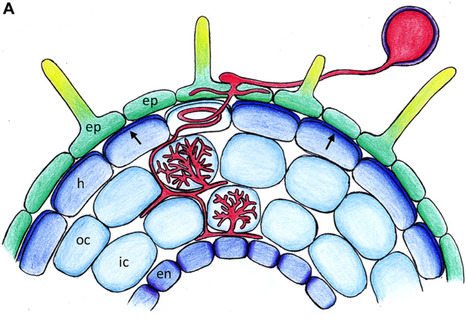
Plants engage in mutualistic interactions with microbes that improve their mineral nutrient supply. The most wide-spread symbiotic association is arbuscular mycorrhiza (AM), in which fungi of the order Glomeromycota invade roots and colonize the cellular lumen of cortical cells. The establishment of this interaction requires a dedicated molecular-genetic program and a cellular machinery of the plant host. This program is partially shared with the root nodule symbiosis (RNS), which involves prokaryotic partners collectively referred to as rhizobia. Both, AM and RNS are endosymbioses that involve intracellular accommodation of the microbial partner in the cells of the plant host. Since plant cells are surrounded by sturdy cell walls, root penetration and cell invasion requires mechanisms to overcome this barrier while maintaining the cytoplasm of the two partners separate during development of the symbiotic association. Here, we discuss the diverse functions of the cell wall compartment in establishment and functioning of plant symbioses with the emphasis on AM and RNS, and we describe the stages of the AM association between the model organisms Petunia hybrida and Rhizophagus irregularis. Via Francis Martin
Scoop.it!

ROP-type GTPases of plants function as molecular switches within elementary signal transduction pathways such as the regulation of ROS synthesis via activation of NADPH oxidases (RBOH-respiratory burst oxidase homologue in plants).
|
Scoop.it!

Drought negatively impacts symbiotic nitrogen fixation (SNF) in chickpea (Cicer arietinum L.), thereby limiting yield potential. Understanding how drought affects chickpea nodulation will enable the development of strategies to biotechnologically engineer chickpea varieties with enhanced SNF under drought conditions. By analyzing carbon and nitrogen metabolism, we studied the mechanisms of physiological adjustment of nitrogen fixation in chickpea plants nodulated with Mesorhizobium ciceri during both drought stress and subsequent recovery. The nitrogenase activity, levels of several key carbon (in nodules) and nitrogen (in both nodules and leaves) metabolites and antioxidant compounds, as well as the activity of related nodule enzymes were examined in M. ciceri-inoculated chickpea plants under early drought stress and subsequent recovery. Results indicated that drought reduced nitrogenase activity and this was associated with reduced expression of the nifK gene. Furthermore, drought stress promoted an accumulation of amino acids, mainly asparagine in nodules (but not in leaves), and caused a cell redox imbalance in nodules. An accumulation of organic acids, especially malate, in nodules, which coincided with the decline of nodulated root respiration, was also observed under drought stress. Taken together, our findings indicate that reduced nitrogenase activity occurring at early stages of the drought stress involves, at least, inhibition of respiration, nitrogen accumulation, and an imbalance in cell redox status in nodules. The results of this study demonstrate the potential that genetic engineering-based improvement of SNF efficiency could be applied to reduce the impact of drought on the productivity of chickpea and perhaps other legume crops.
Scoop.it!

Scientific Exchange for Marchantia polymorpha, maintained by Jim Haseloff at the University of Cambridge. The liverworts are among the most primitive plant forms, and provide new opportunities for studies of plant biology. Their small size, rapid growth, simple genetic architectures and easy transformability make them promising new models systems for developmental and synthetic biology. This site provides a forum for scientific exchange about the liverwort species Marchantia polymorpha, with resources for use by scientists, students and naturalists.
Jean-Michel Ané's insight:
Guess why I am interested in Marchantia :-)
Scoop.it!

To evaluate the dose-response effects of endogenous indole-3-acetic acid (IAA) on Medicago plant growth and dry weight production, we increased the synthesis of IAA in both free-living and symbiosis-stage rhizobial bacteroids duringRhizobium-legume symbiosis. For this purpose, site-directed mutagenesis was applied to modify an 85-bp promoter sequence, driving the expression of iaaMand tms2 genes for IAA biosynthesis. A positive correlation was found between the higher expression of IAA biosynthetic genes in free-living bacteria and the increased production of IAA under both free-living and symbiotic conditions. Plants nodulated by RD65 and RD66 strains, synthetizing the highest IAA concentration, showed a significant (up to 73%) increase in the shoot fresh weight and upregulation of nitrogenase gene, nifH, compared to plants nodulated by the wild-type strain. When these plants were analyzed by confocal microscopy, using an anti-IAA antibody, the strongest signal was observed in bacteroids ofMedicago sativa RD66 (Ms-RD66) plants, even when they were located in the senescent nodule zone. We show here a simple system to modulate endogenous IAA biosynthesis in bacteria nodulating legumes suitable to investigate which is the maximum level of IAA biosynthesis, resulting in the maximal increase of plant growth.
Scoop.it!

Conventional wisdom considers the mycorrhizal symbiosis as mutualistic because both the mycorrhizal fungus and the mycorrhizal plant potentially benefit from the exchange of nutrients and carbon (C). Cases in which mycorrhizal plants are smaller than nonmycorrhizal plants have been reported (Klironomos, 2003). While these cases are often considered exceptions, they raise an important question of partner control. How do plant and fungal partners ensure that they are getting a ‘fair-deal’ for the resources they are trading, and avoid being cheated (Ghoul et al., 2014)? Does engaging in a mutualistic partnership translate into consistent and measurable benefits? Recently, Näsholm et al. (2013) explicitly addressed the question of whether ectomycorrhizal fungi alleviate or aggravate nitrogen (N) limitation of conifers in boreal forests. They concluded that, in these systems, ectomycorrhizal fungi immobilize large quantities of N and thus drive N limitation for host plants. In this issue of New Phytologist, Franklin et al. (pp. 657–666) expand upon that hypothesis. In their paper they provide a model that predicts that trees associating with ectomycorrhizal fungi show reduced performance. The work explores the idea of how trees can become ‘trapped’ by these dynamics, unable to eliminate their mycorrhizal fungal partners under conditions where a nonmycorrhizal habit would be more beneficial, even if this appears to be ‘maladaptive’.
Jean-Michel Ané's insight:
Great commentary!
Scoop.it!

Not Pacman - a bursting spore of the arbuscular mycorrhiza fungus Rhizophagus irregularis - releasing oil droplets. Picture: Ruth Le Fevre (Photo: Not Pacman - a bursting spore of the arbuscular mycorrhiza fungus Rhizophagus irregularis -...
Jean-Michel Ané's insight:
Cute!
Scoop.it!

Nitrogen is undisputedly, one of the most important macronutrients for plant growth, and a process invented by Haber-Bosh (Image 1) made it possible to produce nitrogen out of “thin air” and bag it to be applied in farm fields. Manufacturing fertilizer via Haber-Bosch requires vast amounts of energy (up to 3,600 psi of pressure and up to 1,022 ̊F). This is required to sever the nitrogen triple bond and combine it with hydrogen to form ammonia.
Scoop.it!
Scoop.it!

Jean-Michel Ané's insight:
Amen... Watch the entire video here:
Scoop.it!
Key Points
Jean-Michel Ané's insight:
Good job!
Scoop.it!
The responses of two pea genotypes to treatment with Rhizobium Nod factors were analysed in a pot experiment with a completely randomised design. The first-order factor was pea cultivar: Milwa and Klif, and the second-order factor was seed soaking: control (distilled water), solution-containing Nod factors (LCOs) at a concentration of 10-12M·dm-3 water. Pea plants were harvested at the flowering (BBCH 60) and at fully ripe stage (BBCH 90). In both pea cultivars, the application of Rhizobium Nod factors improved plant growth and yield. Nod factors (LCOs) accelerated seed germination and contributed to significant differences in seedling emergence patterns between days 7 and 11 after seed sowing. Nod factor treatment increased the number and weight of root nodules, thus stimulating the growth of vegetative and reproductive organs in pea plants. Nod factors had the greatest influence on the dry matter yield of peas at the fruit development stage, which is marked by intensive plant growth. The increase in seed yield observed after the application of Rhizobium LCOs resulted from a higher number of pods and seeds per plant and improved grain plumpness. It was found that the number of root nodules was highly correlated with seed yield. Several differences in the responses of the analysed genotypes to Nod treatment were observed, most significant being a higher number of root nodules and improved yield of peas cv. Klif.
Scoop.it!

Jean-Michel Ané's insight:
Very nice review
Scoop.it!

BackgroundLeguminous plants are able to form a root nodule symbiosis with nitrogen-fixing soil bacteria called rhizobia. This symbiotic association shows a high level of specificity.
|




