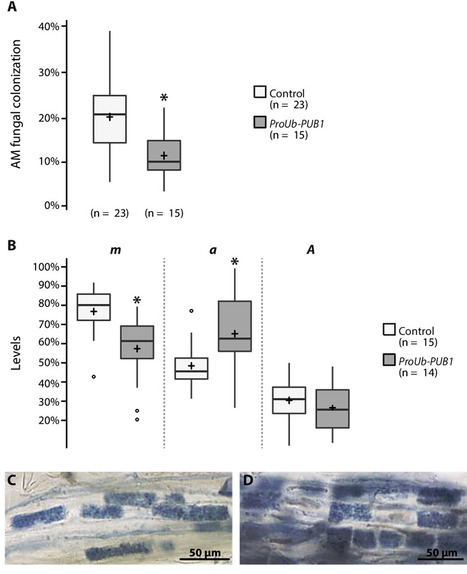
PUB1, an E3 ubiquitin ligase, which interacts with and is phosphorylated by the LYK3 symbiotic receptor kinase, negatively regulates rhizobial infection and nodulation during the nitrogen-fixing root nodule symbiosis in Medicago truncatula. In this study, we show that PUB1 also interacts with and is phosphorylated by DMI2, the key symbiotic receptor kinase of the common symbiosis signaling pathway, required for both the rhizobial and the arbuscular mycorrhizal (AM) endosymbioses. We also show here that PUB1 expression is activated during successive stages of root colonization by Rhizophagus irregularis which is compatible with its interaction with DMI2. Through characterization of a mutant, pub1-1, affected in the E3 ubiquitin ligase activity of PUB1 we have shown that the ubiquitination activity of PUB1 is required to negatively modulate successive stages of infection and development of rhizobial and AM symbioses. In conclusion, PUB1 represents a novel common component of symbiotic signaling integrating both signal perception, through interaction with and phosphorylation by two key symbiotic receptor kinases, and downstream signaling, via its ubiquitination activity, to fine tune both rhizobial and AM root endosymbioses
The study of plant-microbe associations by new techniques has significantly improved our understanding of the structure and specificity of the plant microbiome. Yet, microbiome function and the importance of the plant’s microbiome in the context of human and plant health are largely unexplored. Comparable ...
Karrikins and strigolactones are two classes of butenolide molecules that have diverse effects on plant growth. Karrikins are found in smoke and strigolactones are plant hormones, yet both molecules are likely recognized through highly similar signaling mechanisms. Here we review the most recent discoveries of karrikin and strigolactone perception and signal transduction. Two paralogous α/β hydrolases, KAI2 and D14, are respectively karrikin and strigolactone receptors. D14 acts with an F-box protein, MAX2, to target SMXL/D53 family proteins for proteasomal degradation, and genetic data suggest that KAI2 acts similarly. There are striking parallels in the signaling mechanisms of karrikins, strigolactones, and other plant hormones, including auxins, jasmonates, and gibberellins. Recent investigations of host perception in parasitic plants have demonstrated that strigolactone recognition can evolve following gene duplication of KAI2.
There is an urgent need to create new solutions for sustainable agricultural practices that circumvent the heavy use of fertilizers and pesticides and increase the resilience of agricultural systems to environmental change. Beneficial microbial symbionts of plants are expected to play an important role in integrated pest management schemes over the coming decades. Epichloë endophytes, symbiotic fungi of many grass species, can protect plants against several stressors, and could therefore help to increase the productivity of forage grasses and the hardiness of turf grasses while reducing the use of synthetic pesticides. Indeed, Epichloë endophytes have successfully been developed and commercialized for agricultural use in the USA, Australia and New Zealand. Many of the host grass species originate from Europe, which is a biodiversity hotspot for both grasses and endophytes. However, intentional use of endophyte-enhanced grasses in Europe is virtually non-existent. We suggest that the diversity of European Epichloë endophytes and their host grasses should be exploited for the development of sustainable agricultural, horticultural and landscaping practices, and potentially for bioremediation and bioenergy purposes, and for environmental improvement.
Transgenic cotton GK 12 expressing insecticidal Cry1Ab/1Ac gene can effectively control the lepidopteran pests in agriculture, however it may have unintended side-effects on soil fungal communities. Therefore, the fungal community size and structure in rhizosphere soil of Bt and non-Bt cottons were analyzed by real-time polymerase chain reaction (qPCR) and denaturing gradient gel electrophoresis (DGGE) at growth stages and three annual replications in an intensive conventional cultivation system. The Cry1Ab/1Ac protein was undetectable or occasionally detectable at a low level (<0.1 ng/g soil) at seedling and senescence, and that the concentration of Cry1Ab/Ac protein in soil extracts did not increase over time or repeated cultivations. No significant differences in fungal population size and structure in rhizosphere soil were found between Bt-cotton GK 12 and its near-isogenic comparator at all growth stages, but they were different between Bt-cotton GK 12 and conventional cotton DP 5415 at some growth stages. The fungal population size and structure was significantly influenced by variation in years and plant growth stages. Sequencing results from DGGE bands showed that the dominant fungi were not different between Bt-cotton GK 12 and its near-isogenic comparator. Thus, the data of this study do not indicate any significant effect of Bt-cotton GK 12 on the fungal community size and structure in rhizosphere soil during these three continuous years.
To investigate the effect of arbuscular mycorrhizal fungi (AMF) inoculation and short-term cold exposer on Elymus nutans Griseb, 45 day old seedlings of two cultivars, Zhengdao (ZD) and Kangma (KM), were subjected to a 5 day cold treatment after inoculated with Glomus mosseae. The effects of AMF on the physiology of the two cultivars were determined, and we were especially interested in oxidative indexes under cold stress. Accumulation of reactive oxygen species (ROS), including superoxide and hydrogen peroxide, was very high in cold-stressed plants and caused lipid peroxidation in membranes, which measured as relative electrolyte leakage (REL), malondialdehyde (MDA) content. Less oxidative damage was detected in AMF colonized plants, which was associated with higher activities of superoxide dismutase (SOD), catalase (CAT), ascorbate peroxidase (APX) and glutathione reductase (GR). Mycorrhizal inoculum application promoted plant growth and enhanced the level of chlorophyll and antioxidant compounds such as glutathione and soluble sugars. We also measured the extent of mycorrhizal colonization. These protective mechanisms were found to be more efficient in temperature-tolerant KM than temperature-sensitive ZD. Overall, we suggest that AMF inoculation can improve plant resistance to cold stress in E. nuatans seedlings by directly scavenging ROS and by modulating redox balance and other defense mechanisms.
Understanding how mutualisms evolve in response to a changing environment will be critical for predicting the long-term impacts of global changes, such as increased N (nitrogen) deposition. Bacterial mutualists in particular might evolve quickly, thanks to short generation times and the potential for independent evolution of plasmids through recombination and/or HGT (horizontal gene transfer). In a previous work using the legume/rhizobia mutualism, we demonstrated that long-term nitrogen fertilization caused the evolution of less-mutualistic rhizobia. Here, we use our 63 previously isolated rhizobium strains in comparative phylogenetic and quantitative genetic analyses to determine the degree to which variation in partner quality is attributable to phylogenetic relationships among strains versus recent genetic changes in response to N fertilization. We find evidence of distinct evolutionary relationships between chromosomal and pSym genes, and broad similarity between pSym genes. We also find that nifD has a unique evolutionary history that explains much of the variation in partner quality, and suggest MoFe subunit interaction sites in the evolution of less-mutualistic rhizobia. These results provide insight into the mechanisms behind the evolutionary response of rhizobia to long-term N fertilization, and we discuss the implications of our results for the evolution of the mutualism.
From the deepest sea vents to the mountains with the highest elevation, symbionts allow their hosts to exploit new environments [1]. These partnerships between different species are remarkable not only in their ubiquity, but also in how partners evolve mechanisms to maximize their benefits in varying contexts [2]. Now a new study by Lowe et al. [3] in this issue of Current Biology adds to this marvel by demonstrating the precision by which hosts can gain benefits from symbionts across a gradient of environments — supporting them when needed and starving them when they are not.
Lowe et al. focus on the symbiosis between the protist host Paramecium bursaria and the algal symbiont Chlorella sp. ( Figure 1A), which engage in a facultative photo-symbiosis found in shallow freshwater habitats [3]. In this partnership, endosymbionts provide hosts with maltose and oxygen derived from photosynthesis, and hosts provide endosymbionts with nitrogen compounds. Although identifying the products of symbiotic exchange has become easier with emerging techniques [4], quantifying the actual costs and benefits of symbiotic trade remains difficult. Lowe et al. are able to do this because the fitness of the two partners can be studied both engaged in symbiosis, or not.
Bacteria capable of nodulating Acacia tortilis and A. gummifera could be recovered from sand dunes collected in the Moroccan Merzouga desert. The trapping approach enabled the recovery of 17 desert rhizobia that all clustered within the Ensifer (Sinorhizobium) genus. Four isolates of the dominant genotype comprising 15 strains as well as 2 divergent strains were further characterized by MLSA. Phylogenetic analyzes indicated that the dominant genetic type was belonging to a new and yet undefined species within the Ensifer genus. Interestingly, housekeeping gene phylogenies showed that this possibly new species is also present in another desert but in India. Phylogenetic analyses of nifH and nodC sequences showed high sequence conservation among the Moroccan strains belonging to the dominant genotype but high divergence with sequences from Indian isolates suggesting acquisition of symbiotic genes through Horizontal Gene Transfer. These desert rhizobia were capable of growing in media containing high salt concentrations, under high pH and most of the strains showed growth at 45 °C. Only recovered from desert type of Biome, yet, this new taxon appears particularly adapted to such harsh environment.
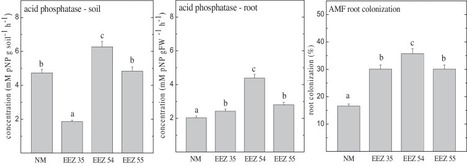
The mycorrhizal fungi community is a significant soil rhizosphere component that benefits plant nutrition and improve plant tolerance to abiotic stresses. The present research compared the influence of three mycorrhizal strains over pot marigold (Calendula officinalis L.) development and their contribution to promoting the valuable secondary metabolites accumulation in the condition of heavy metal (Cd and Pb) pollution. Two Claroideoglomus claroideum isolates (from industrially and naturally enriched metal-contaminated sites) and Funneliformis mosseae (derived from a soil with a high concentration of various metals) were studied. The mycorrhizal status and acid phosphatase activity were best exposed in the roots associated with C. claroideum (from native metalliferous sites) and corresponded with the highest total phenols and flavonoids concentrations. Neither Pb nor Cd was detected in the marigold flowers (Calendula flos drug) following targeted mycorrhizal treatment. The higher Cd and Pb levels in non-mycorrhizal plants lead to the lowest flower weight, but in the aerial plant parts, we found a slight distinction. The tested strains stimulated the accumulation of important secondary metabolites (total phenols, flavonoids, carotenoids) in pot marigold flowers and, therefore, enhanced the antioxidant capacity. The carotenoid profile of mycorrhizal plants performed notable differences between the primarily defined constituents (lutein, lycopene, β-carotene). The highest β-carotene values (respectively vitamin A) and lycopene were found in pot marigold—F. mosseae association. The findings are essential to obtain the optimum benefits of mycorrhizal association in unfavorable conditions concerning pot marigold bioactive compounds synthesis.
Phosphorus is one of the most important macronutrients required for plant growth. Plants have evolved many strategies for inorganic phosphorus (Pi) acquisition, including the symbiotic pathways, involving the formation of mycorrhiza. With regard to arbuscular mycorrhiza (AM), high Pi availability has long been known to negatively affect this association, although the underlying mechanism is unknown. In the present study, the interactive role played by ethylene and Pi in AM regulation was investigated in the tomato-Rhizophagus irregularis symbiosis. AM fungal colonization was analysed in epi, rin and NRO ethylene-responsive mutants under different Pi availability conditions, with a focus on the late stages of the interaction. Although Pi inhibited mycorrhizal parameters in the ethylene-insensitive rin mutant and wild-type cultivars, it did not alter the mycorrhization of the epi tomato mutant, which exhibits a constitutive ethylene-induced response. As with the colonization parameters, root ethylene content and the expression of AM-related and ethylene receptor 6 genes were inhibited by Pi in wild-type cultivars and rin mutants, but were unaffected or slightly activated in epi plants. The application of ethephon offsets the negative impact on the mycorrhizal development caused by the application of Pi. This compensation effect is dose dependent and was ineffective in the NRO mutant, which is more insensitive to the action of ethylene. Our results provide evidence that ethylene signalling negatively affects the suppressive effect of Pi on AM formation and suggests an overlap between this suppressive effect and the regulatory mechanism of Pi-starvation response pathway in plants mediated by ethylene.
By exploring symbiosis between plants and fungi, microbiologist Rusty Rodriguez has made surprising discoveries about the adaptive benefits of unique cohabit...
An environmentally improved synthesis of the N-differentiated chitotetrasaccharide CO-IV-(NH2), a key intermediate for the preparation of lipochitooligosaccharides and the TMG-chitotriomycin, is reported based on a chromatography-free ionic-liquid tagging approach. The method involves the glycosylation of ionic-liquid-tagged acceptors with thioglucosamine donors leading to the stereoselective formation of β-(14)-linked glucosamine-containing oligomers.
Plant rhizo- and phyllospheres are exposed to a plethora of nitrogen-fixing bacteria, providing opportunities for the establishment of symbiotic associations. Nitrogen-fixing endosymbioses are most profitable and have evolved more than ten times in the angiosperms. This suggests that the evolutionary trajectory towards endosymbiosis is not complex. Here, we argue that microbe-induced cell divisions are a prerequisite for the entrance of diazotrophic prokaryotes into living plant cells. For rhizobia and Frankia bacteria, this is achieved by adapting the readout of the common symbiosis signalling pathway, such that cell divisions are induced. The common symbiosis signalling pathway is conserved in the plant kingdom and is required to establish an endosymbiosis with mycorrhizal fungi. We also discuss the adaptations that may have occurred that allowed nitrogen-fixing root nodule endosymbiosis.
Advances over the past years have provided a range of genomic and chemical tools applicable to research in host-symbiont interactions. This course will introduce and critically address these tools with the primary objective of providing PhD students with extensive knowledge of the applicability of tools to their own work. The course mainly addresses PhD students early in their PhD and who work with interactions between hosts and symbionts at the molecular level.
A field experiment was conducted during 2010-2011 and 2011-2012 to investigate the effect of recommended 100% nitrogen, phosphorus and potassium (NPK) to super-optimal doses (200% NPK) of mineral fertilizers on root growth pattern, microbial biomass and counts, organic carbon and mineral nitrogen at various phenological stages of wheat growth. Super-optimal level of fertilizers (200% NPK) increased the root length density by 71.8% as compared to recommended dose of fertilizers in the surface layer (0-15 cm). There was positive effect of fertilizer addition on soil ammonium-N and nitrate-N contents. Excessive mineral fertilizer did not affect the soil organic carbon (SOC), but SOC was found to be higher at anthesis stage (16.67% and 12.32% higher over maturity and Crown Root Initiation (CRI) stage, respectively). Microbial biomass carbon (MBC) was found to be higher (252.06 µg g-1 dry soil) at anthesis stage of wheat growth, which declined to 213.28 µg g-1 dry soil at maturity. Super-optimal application of fertilizers led to significant increase in microbial biomass nitrogen (MBN) at anthesis (+17.7%) and maturity stage (+15.55%) over the 100% recommended dose of fertilizer. Data on microbial count (bacteria, fungi and actinomycetes) revealed a significant decrease in treatments receiving 175% NPK (-64.90% for bacteria, -38.78% for fungi and -16.41% for actinomycetes) as compared to 100% NPK.
Many plant species adapted to P-impoverished soils, including jarrah (Eucalyptus marginata), develop toxicity symptoms when exposed to high doses of phosphate (Pi) and its analogs such as phosphite (Phi) and arsenate (AsV). The present study was undertaken to investigate the effects of fungal symbionts Scutellospora calospora, Scleroderma sp., and Austroboletus occidentalis on the response of jarrah to highly toxic pulses (1.5 mmol kg−1 soil) of Pi, Phi, and AsV. S. calospora formed an arbuscular mycorrhizal (AM) symbiosis while both Scleroderma sp. and A. occidentalis established a non-colonizing symbiosis with jarrah plants. All these interactions significantly improved jarrah growth and Pi uptake under P-limiting conditions. The AM fungal colonization naturally declines in AM-eucalypt symbioses after 2–3 months; however, in the present study, the high Pi pulse inhibited the decline of AM fungal colonization in jarrah. Four weeks after exposure to the Pi pulse, plants inoculated with S. calospora had significantly lower toxicity symptoms compared to non-mycorrhizal (NM) plants, and all fungal treatments induced tolerance against Phi toxicity in jarrah. However, no tolerance was observed for AsV-treated plants even though all inoculated plants had significantly lower shoot As concentrations than the NM plants. The transcript profile of five jarrah high-affinity phosphate transporter (PHT1 family) genes in roots was not altered in response to any of the fungal species tested. Interestingly, plants exposed to high Pi supplies for 1 day did not have reduced transcript levels for any of the five PHT1 genes in roots, and transcript abundance of four PHT1 genes actually increased. It is therefore suggested that jarrah, and perhaps other P-sensitive perennial species, respond positively to Pi available in the soil solution through increasing rather than decreasing the expression of selected PHT1 genes. Furthermore, Scleroderma sp. can be considered as a fungus with dual functional capacity capable of forming both ectomycorrhizal and non-colonizing associations, where both pathways are always accompanied by evident growth and nutritional benefits.
In order to determine if intensive agricultural land use and/or edaphic characteristics modify the community of the arbuscular mycorrhizal fungi (AMF) indigenous of soils from the Argentinean Pampa; mycorrhizal colonization, sporulation, glomalin (GRSP) and genetic diversity were assessed. Soils were collected from seven localities from Buenos Aires Province (Argentina) under contrasting land use intensity (at each site both pristine and agricultural soils). The capacity for root colonization, sporulation and glomalin content of trap plants and growth substrate were considered as measure of AMF activity. Analysis of diversity was conducted using PCR-single strand conformation polymorphism (SSCP). Profiles were generated by using primers to amplify the 28S rDNA of AMF from rDNA extracted directly from the substrate of trap plant or AMF spore. Five bands of the SSCP gel were sequenced and showed similarity with the genus Glomus. Analysis of colonization and GRSP content, were not clearly related to the land use intensity but sporulation capacity was, in general, lower in agricultural soils than in pristine ones. Soil phosphorus, ferrum and zinc contents, were negatively related to the root colonization and sporulation capacities. High genetic diversity was found both from soil and spore samples. Although similar diversity was found under agricultural and pristine soils, in most sites SSCP-diversity was separately clustered by land use. Still remains clarify if soil characteristics, resulting from agricultural management; exert selection pressure on the AMF and whether they could be vectors of interest to select potential plant growth promoting microorganisms.
Mutualisms are cooperative interactions between members of different species, often involving the trade of resources. Here, we suggest that otherwise-cooperative mutualists might be able to gain a benefit from actively restricting their partners’ ability to obtain resources directly, hampering the ability of the restricted partner to survive and/or reproduce without the help of the restricting mutualist. We show that (i) restriction can be favoured when it makes the resources of the restricting individual more valuable to their partner, and thus allows them to receive more favourable terms of trade; (ii) restriction maintains cooperation in conditions where cooperative behaviour would otherwise collapse; and (iii) restriction can lead to either an increase or decrease in a restricted individual’s fitness. We discuss the applicability of this scenario to mutualisms such as those between plants and mycorrhizal fungi. These results identify a novel conflict in mutualisms as well as several public goods dilemmas, but also demonstrate how conflict can help maintain cooperation.
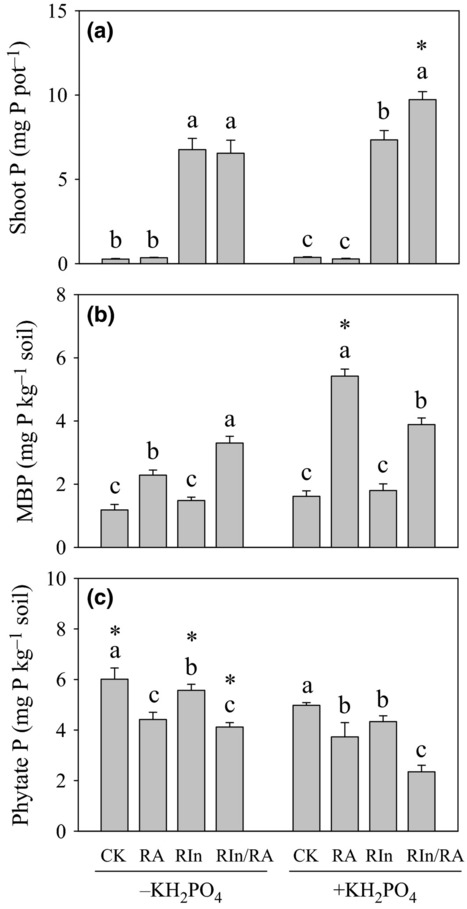
Arbuscular mycorrhizal fungi (AMF) transfer plant photosynthate underground which can stimulate soil microbial growth. In this study, we examined whether there was a potential link between carbon (C) release from an AMF and phosphorus (P) availability via a phosphate-solubilizing bacterium (PSB). We investigated the outcome of the interaction between the AMF and the PSB by conducting a microcosm and two Petri plate experiments. An in vitro culture experiment was also conducted to determine the direct impact of AMF hyphal exudates on growth of the PSB. The AMF released substantial C to the environment, triggering PSB growth and activity. In return, the PSB enhanced mineralization of organic P, increasing P availability for the AMF. When soil available P was low, the PSB competed with the AMF for P, and its activity was not stimulated by the fungus. When additional P was added to increase soil available P, the PSB enhanced AMF hyphal growth, and PSB activity was also stimulated by the fungus. Our results suggest that an AMF and a free-living PSB interacted to the benefit of each other by providing the C or P that the other microorganism required, but these interactions depended upon background P availability.
The intensive application of chemical fertilizers to meet the growing demand of food for burgeoning population has led to an unprecedented perturbation of the soil environment. Environment degradation has had serious impacts on the nutrient use efficiency by the soil crop plants owing to irrational use of chemical fertilizers, thus warranting prioritization of the beneficial soil microorganisms for improving the soil health. Rhizosphere supports huge diversity of microbial community including beneficial plant growth promoting rhizobacteria (PGPR) as primary determinants of plant health and soil fertility. PGPR colonize roots of dicots and monocots and improve plant growth either by assisting nutrient acquisition (N, P, and essential nutrients) or modulating root system architecture by releasing phytohormones (direct effect) or reducing detrimental effects of various biotic and abiotic stress (indirect effect). The abilities of PGPR are of immense importance in sustainable agriculture in terms of improving crop production and soil health, therefore declining the negative effect of inorganic fertilizers on the environment. This chapter is an effort to illuminate the prevailing scenario on underlying mechanisms of nutrient management by PGPR. It is vital that soil microbiologists and agronomists pay due attention to strategies for nutrient management for enhancing crop production in a sustainable manner.
Background Establishment and maintenance of mutualistic plant–microbial interactions in the rhizosphere and within plant roots involve several root cell types. The processes of host–microbe recognition and infection require complex signal exchange and activation of downstream responses. These molecular events coordinate host responses across root cell layers during microbe invasion, ultimately triggering changes of root cell fates. The progression of legume root interactions with rhizobial bacteria has been addressed in numerous studies. However, tools to globally resolve the succession of molecular events in the host root at the cell type level have been lacking. To this end, we aimed to identify promoters exhibiting cell type enriched expression in roots of the model legume Lotus japonicus, as no comprehensive set of such promoters usable in legume roots is available to date.
Results Here, we use promoter:GUS fusions to characterize promoters stemming from Arabidopsis, tomato (Lycopersicon esculentum) or L. japonicus with respect to their expression in major cell types of the L. japonicus root differentiation zone, which shows molecular and morphological responses to symbiotic bacteria and fungi. Out of 24 tested promoters, 11 showed cell type enriched activity in L. japonicus roots. Covered cell types or cell type combinations are epidermis (1), epidermis and cortex (2), cortex (1), endodermis and pericycle (2), pericycle and phloem (4), or xylem (1). Activity of these promoters in the respective cell types was stable during early stages of infection of transgenic roots with the rhizobial symbiont of L. japonicus, Mesorhizobium loti. For a subset of five promoters, expression stability was further demonstrated in whole plant transgenics as well as in active nodules.
Conclusions 11 promoters from Arabidopsis (10) or tomato (1) with enriched activity in major L. japonicus root and nodule cell types have been identified. Root expression patterns are independent of infection with rhizobial bacteria, providing a stable read-out in the root section responsive to symbiotic bacteria. Promoters are available as cloning vectors. We expect these tools to help provide a new dimension to our understanding of signaling circuits and transcript dynamics in symbiotic interactions of legumes with microbial symbionts.
Coniferous forest nitrogen (N) budgets indicate unknown sources of N. A consistent association between limber pine (Pinus flexilis) and potential N2-fixing acetic acid bacteria (AAB) indicates that native foliar endophytes may supply subalpine forests with N. To assess whether the P. flexilis–AAB association is consistent across years, we re-sampled P. flexilis twigs at Niwot Ridge, CO and characterized needle endophyte communities via 16S rRNA Illumina sequencing. To investigate whether endophytes have access to foliar N2, we incubated twigs with 13N2-enriched air and imaged radioisotope distribution in needles, the first experiment of its kind using 13N. We used the acetylene reduction assay to test for nitrogenase activity within P. flexilis twigs four times from June to September. We found evidence for N2 fixation in P. flexilis foliage. N2 diffused readily into needles and nitrogenase activity was positive across sampling dates. We estimate that this association could provide 6.8–13.6 μg N m−2 d−1 to P. flexilis stands. AAB dominated the P. flexilis needle endophyte community. We propose that foliar endophytes represent a low-cost, evolutionarily stable N2-fixing strategy for long-lived conifers. This novel source of biological N2 fixation has fundamental implications for understanding forest N budgets.
Arbuscular mycorrhizal fungi (AMF) protect host plants against diverse biotic and abiotic stresses, and promote biodegradation of various contaminants. In this study effect of Glomus mosseae/Medicago sativa mycorrhiza on atrazine degradation was investigated. It was observed that the atrazine degradation rates with any addition level in mycorrhizal treatments were all significantly higher than those in non- mycorrhizal treatments. When atrazine was applied at 20 mg kg−1, the removal efficiency was up to 74.65%. Therefore, G. mosseae can be considered as ideal inhabitants of technical installations to facilitate phytoremediation. Furthermore, a total of 10.4 Gb was used for de novo transcriptome assembly, resulting in a comprehensive data set for the identification of genes corresponding to atrazine stress in the AM association. After comparative analysis with edgeR, a total of 2,060 differential expressed genes were identified, including 570 up-regulated genes and 1490 down-regulated genes. After excluding ‘function unknown’ and ‘general function predictions only’ genes, 172 up-regulated genes were obtained. The differentially expressed genes in AM association with and without atrazine stress were associated with molecular processes/other proteins, zinc finger protein, intracellular/extracellular enzymes, structural proteins, anti-stress/anti-disease protein, electron transport-related protein, and plant growth associated protein. Our results not only prove AMF has important ecological significance on atrazine degradation but also provide evidence for the molecular mechanisms of atrazine degradation by AMF.
To get content containing either thought or leadership enter:
To get content containing both thought and leadership enter:
To get content containing the expression thought leadership enter:
You can enter several keywords and you can refine them whenever you want. Our suggestion engine uses more signals but entering a few keywords here will rapidly give you great content to curate.


 Your new post is loading...













Great paper.