


Boreal trees rely on their ectomycorrhizal fungal symbionts to acquire growth-limiting nutrients, such as nitrogen (N), which mainly occurs as proteins complexed in soil organic matter (SOM). The mechanisms for liberating this N are unclear as ectomycorrhizal fungi have lost many genes encoding lignocellulose-degrading enzymes present in their saprotrophic ancestors. We hypothesized that hydroxyl radicals (˙OH), produced by the ectomycorrhizal fungus Paxillus involutus during growth on SOM, are involved in liberating organic N. Paxillus involutus was grown for 7 d on N-containing or N-free substrates that represent major organic compounds of SOM. ˙OH production, ammonium assimilation, and proteolytic activity were measured daily. ˙OH production was strongly induced when P. involutus switched from ammonium to protein as the main N source. Extracellular proteolytic activity was initiated shortly after the oxidation. Oxidized protein substrates induced higher proteolytic activity than unmodified proteins. Dynamic modeling predicted that ˙OH production occurs in a burst, regulated mainly by ammonium and ferric iron concentrations. We propose that the production of ˙OH and extracellular proteolytic enzymes are regulated by similar nutritional signals. Oxidation works in concert with proteolysis, improving N liberation from proteins in SOM. Organic N mining by ectomycorrhizal fungi has, until now, only been attributed to proteolysis.

Plant-Microbe Symbiosis
524.7K views |
+11 today
Beneficial associations between plants and microbes
Curated by
Jean-Michel Ané
 Your new post is loading...
 Scoop.it! The recent technological advancements in arbuscular mycorrhizal (AM)–plant symbiosis have helped improve the potential applications of mycorrhizal biotechnology in agriculture, horticulture, landscaping, phytoremediation, and other areas of plant market. The most common conventional methods used for large-scale production of AM fungi include cultivation in pots with sterilized soil, aeroponics, hydroponics, or greenhouse-based in vivo methods. However, these techniques suffer from severe problems of cross-contamination in the inoculum production; therefore, production of high-quality inoculum remains a major challenge. The most advanced method is transformed root organ culture (ROC) to produce AM propagules without adulterated microbial contaminants under strictly controlled sterilized conditions after pure AM fungi are inoculated into the transformed root organ. The scientific breakthroughs and advancements in the field of mycorrhizal research during past two-to-three decades have resulted in new technological developments with different types of products and diverse modes of their applications. For example, mycorrhizal formulations are available in the market for seed coating, liquid applications, or biostimulants. An established symbiosis in the plant roots confirms the adaptation even under unsuitable soil or unfavorable climatic conditions. These advantages have led to an increasing demand for mycorrhiza products in the last few years. There is a growing interest among the enterprises in the developed as well as developing world for the production of mycorrhizae-based inoculum given the fact presented by the emerging market trends in developing economies. However, even today it is not possible to trace out the absolute origin of the fungal species/strain used in commercial inoculum. Despite the regulatory challenges imposed by the regulatory bodies to maintain the highest quality standards, a significant number of commercialized products may still be found in the market which claims for extensive and effective mycorrhizal colonization even though they lack the necessary potential for this. This review provides an updated overview of the recent developments in the technology adoption and commercial production of mycorrhizae-based quality inoculum. 
Scoop.it!
While arbuscular mycorrhizal (AM) fungi may have a prominent role in trophic ecology, mycorrhizal improvement or reduction on herbivore growth and survival may also be dependent on herbivore’s stage of development. Solanum lycopersicon (tomato) was grown on sterile background soil treated with either mycorrhizal inoculant (AM+) or non-mycorrhizal control (AM−). Mycorrhizal treatments included four single species of AM-fungi (Entrophospora infrequens, Funneliformis mosseae, Claroideoglomus claroideum, and Racocetra fulgida) and a mixture of all four species (fungal community). To determine if mycorrhizal treatment indirectly alters the ability of beetle larvae (Leptinotarsa decemlineata) to access plant resources, plant damage and trichome density were quantified as plants were infested with a single neonate (early-stage) for 96 hours (h). In a second experiment, beetle growth rate was assessed as plants were infested with a single third-instar (late-stage). After 72 h of late-stage beetle infestation, beetle mass was measured. It was found that early-stage beetles inflicted more damage on AM+ tomatoes. Interestingly, this corresponds with fewer trichomes on AM+ tomatoes, as well as higher early-stage beetle survivorship. Specifically, AM taxon, C. claroideum increases herbivory and thereby reduces beetle mortality. Among late-stage beetles, C. claroideum does not improve beetle growth nor rate of survival. This suggests that AM taxa that are beneficial to early-stage beetles may not necessarily provide an advantage to late-stage beetles. Taken together, these findings highlight potential dependencies of AM-fungal effects on herbivory and herbivore life history, including growth and life-stage specific survival.
Scoop.it!
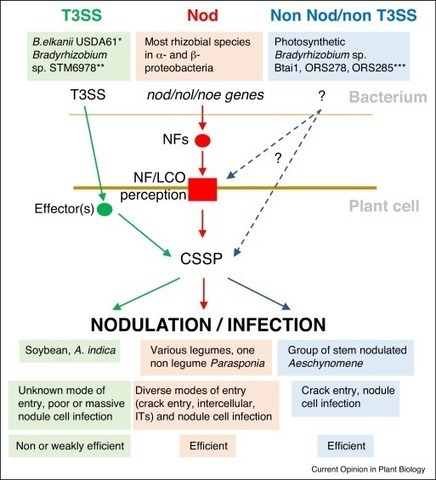
By evolving the dual capacity of intracellular survival and symbiotic nitrogen fixation in legumes, rhizobia have achieved an ecological and evolutionary success that has reshaped our biosphere. Despite complex challenges, including a dual lifestyle of intracellular infection separated by a free-living phase in soil, rhizobial symbiosis has spread horizontally to hundreds of bacterial species and geographically throughout the globe. This symbiosis has also persisted and been reshaped through millions of years of history. Here, we summarize recent advances in our understanding of the molecular mechanisms, ecological settings, and evolutionary pathways that are collectively responsible for this symbiotic success story. We offer predictions of how this symbiosis can evolve under new influences and for the benefit of a burgeoning human population.
Scoop.it!

The arbuscular mycorrhizal (AM) symbiosis is key to plant nutrition, and hence is potentially key in sustainable agriculture. Fertilization and other agricultural practices reduce soil AM fungi and root colonization. Such conditions might promote the evolution of low mycorrhizal responsive crops. Therefore, we ask if and how evolution under domestication has altered AM symbioses of crops.
Scoop.it!

This year marks the 100th anniversary of the first in a series of papers on the biota of a 407-million-year-old hot spring system that opened a window onto early life on land (1). The site near the village of Rhynie in Aberdeenshire, Scotland, is exceptional because fossilization occurred in microcrystalline silica (chert), preserving organisms to the cellular level and shedding light on community structure and interactions among the plants, arthropods, fungi, algae, and cyanobacteria. Recent research on these remarkable fossils and advances in understanding plant developmental genetics are beginning to reveal how major changes in life cycle had an early influence on the direction of plant evolution. Via Loïc Lepiniec
Scoop.it!
Micro-organisms, or ‘microbes’, have formed intimate associations with plants throughout the length of their evolutionary history. In extant plant systems microbes still remain an integral part of the ecological landscape impacting plant health, productivity, and long-term fitness. Therefore, to properly understand the genetic wiring of plants, we must first determine what perception systems plants have evolved to parse beneficial from commensal from pathogenic microbes. In this review, we consider some of the most recent advances in how plants respond at the molecular level to different microbial lifestyles. Further, we cover some of the means by which microbes are able to manipulate plant signaling pathways through altered destructiveness and nutrient sinks as well as the use of effector proteins and miRNA's. We conclude by highlighting some of the major questions still to be answered in the field of plant-microbe research and suggest some of key areas that most need further research investment. The results of these proposed studies will have impacts in a wide range of plant research disciplines and will, ultimately, translate into stronger agronomic crops and forestry stock whose immune perception and response system is bred to foster beneficial microbial symbioses while repudiating pathogenic symbioses.
Scoop.it!

Plants intimately associate with diverse bacteria. Plant-associated bacteria have ostensibly evolved genes that enable them to adapt to plant environments. However, the identities of such genes are mostly unknown, and their functions are poorly characterized. We sequenced 484 genomes of bacterial isolates from roots of Brassicaceae, poplar, and maize. We then compared 3,837 bacterial genomes to identify thousands of plant-associated gene clusters. Genomes of plant-associated bacteria encode more carbohydrate metabolism functions and fewer mobile elements than related non-plant-associated genomes do. We experimentally validated candidates from two sets of plant-associated genes: one involved in plant colonization, and the other serving in microbe–microbe competition between plant-associated bacteria. We also identified 64 plant-associated protein domains that potentially mimic plant domains; some are shared with plant-associated fungi and oomycetes. This work expands the genome-based understanding of plant–microbe interactions and provides potential leads for efficient and sustainable agriculture through microbiome engineering.
Via Francis Martin
Scoop.it!
Biofertilizers are a large part of the global agricultural economy.
Jean-Michel Ané's insight:
Very good to read...
Scoop.it!

Mycorrhizal scientists from 53 countries gathered in the city of Prague from 30 July until 4 August 2017 for the 9th International Conference on Mycorrhiza (ICOM9). They came to discuss an ancient symbiosis based on the exchange of resources between plant and fungal partners, with many impacts on plant health (van der Heijden et al., 2015). Much like this mutualistic interaction, delegates from disparate disciplines united with a strong focus on integration and sharing of resources for mutual benefit. By exchanging knowledge among researchers from the fields of molecular biology, physiology and ecology, the participants of ICOM9 made a leap forward in our understanding of symbiotic structure and function at multiple scales (Fig. 1).

Bob Reeves's curator insight,
December 14, 2017 2:49 PM
Would have loved to have been a fly on the wall at this conference. So may great insights become possible when the various science disciplines mingle and share their findings. Symbiosis?
Scoop.it!

Plant cell surface receptor-like kinases (RLKs) mediate the signals from microbe-associated molecular patterns (MAMPs) that induce immune responses. Lipopolysaccharide (LPS), the major constituent of the outer membrane of gram-negative bacteria, is a common MAMP perceived by animals and plants; however, the plant receptors/co-receptors are unknown except for LORE, a bulb-type lectin S-domain RLK (B-lectin SD1-RLK) in Arabidopsis. OsCERK1 is a multifunctional RLK in rice that contains lysin motifs (LysMs) and is essential for the perception of chitin, a fungal MAMP, and peptidoglycan, a bacterial MAMP. Here, we analyzed the relevance of OsCERK1 to LPS perception in rice.
Jean-Michel Ané's insight:
Unexpected... for me at least...
Scoop.it!

Medicago truncatula was chosen by the legume community, along with Lotus japonicus, as a model plant to study legume biology. Since then, numerous resources and tools have been developed for M. truncatula. These include, for example, its genome sequence, core ecotype collections, transformation/regeneration methods, extensive mutant collections, and a gene expression atlas. This review aims to describe the different genetic and genomic tools and resources currently available for M. truncatula. We also describe how these resources were generated and provide all the information necessary to access these resources and use them from a practical point of view. © 2017 by John Wiley & Sons, Inc.
Scoop.it!
Nitrogenase and Hydrogenase of the Actinobacteria Frankia: From Gene Expression to Proteins Function
Frankia R43 is a filamentous actinobacteria, known for its ability to fix atmospheric nitrogen and to concomitantly produce hydrogen. Not much is understood about the variations in nitrogen fixation and hydrogen production among Frankia strains at the molecular level. Thus, studies providing direct comparisons between less known and well-annotated Frankia strains, may provide further information on the specific functions of the nitrogenase and hydrogenase(s). We compared candidate gene expression, protein sequence similarities and physiological activities of the well-annotated clade I Frankia casuarinae strain CcI3 and the recently sequenced lineage III Frankia strain R43. Our candidate genes, members of the nif gene cluster, involved in dinitrogen fixation, and genes encoding uptake hydrogenase (Hup) subunits, with an importance for energetic efficiency, were examined under varying oxygen and nitrogen conditions. Relative expression of almost all genes tested was higher in CcI3 than in R43, except nifK, following different but distinct expression patterns among all conditions. Candidate genes expression in CcI3 seemed more sensitive to oxygen than in R43, and the oxygen status seemed to influence gene expression much more than the nitrogen status per se.
|
Scoop.it!

Forest declines have been reported with increasing regularity during the last decade and are expected to increase due to the ongoing environmental changes. During adverse environmental conditions, plant symbioses with mycorrhizas can help to reduce plant stress. Mycorrhizas are symbiotic associations between fungi and roots of living plants. Plants offer carbohydrates to the fungus and the fungus improves the acquisition of nutrients and water to the plant. Specifically, arbuscular mycorrhizal (AM) fungi are the most abundant mycorrhizas. In South Africa, there are increasing reports describing the decline of native Euphorbia ingens trees. This study analysed the presence and abundance of AM fungal colonisation in the roots of E. ingens trees, and the number of AM fungal spores in the surrounding soil, with the aim to improve the understanding of the rapid decline of these trees. AM fungal colonisation and spores in relation to the soil properties were also analysed. Soil and root samples were collected from different rates of declining E. ingens trees at three sites in South Africa. AM fungal colonisation of the roots was assessed and fungal spores in the surrounding soil were enumerated. Soil phosphorus, mineral nitrogen and pH were analysed from the soil samples. The results showed that AM fungi are associated with E. ingens trees. AM abundance was influenced by site specific properties and not by E. ingens health. Moreover, the level of soil NO3− and soil texture significantly influenced AM colonisation in roots and the number of spores enumerated. These preliminary findings provide background information for further research into the large-scale decline of E. ingens populations in South Africa.
Scoop.it!

It has long been postulated that symbiotic fungi facilitated plant migrations onto land through enhancing the scavenging of mineral nutrients and exchanging these for photosynthetically fixed organic carbon. Today, land plant–fungal symbioses are both widespread and diverse. Recent discoveries show that a variety of potential fungal associates were likely available to the earliest land plants, and that these early partnerships were probably affected by changing atmospheric CO2 concentrations. Here, we evaluate current hypotheses and knowledge gaps regarding early plant–fungal partnerships in the context of newly discovered fungal mutualists of early and more recently evolved land plants and the rapidly changing views on the roles of plant–fungal symbioses in the evolution and ecology of the terrestrial biosphere.
Jean-Michel Ané's insight:
Fantastic review!
Scoop.it!
Ubiquitination is mediated by an enzymatic cascade that results in the modification of substrate proteins, redefining their fate. This post-translational modification is involved in most cellular processes, yet its analysis faces manifold obstacles due to its complex and ubiquitous nature. Reconstitution of the ubiquitination cascade in bacterial systems circumvents several of these problems and was shown to faithfully recapitulate the process.
Scoop.it!

Plant cell infection is tightly controlled by cell surface receptor-like kinases (RLKs) Alike other RLKs the Medicago truncatula entry receptor LYK3 laterally segregates into membrane nanodomains in a stimulus-dependent manner. Although nanodomain localization arises as a generic feature of plant membrane proteins, molecular mechanisms underlying such dynamic transitions and their functional relevance remained poorly understood. Here, we demonstrate that actin and the flotillin protein FLOT4 form the primary and indispensable core of a specific nanodomain. Infection-dependent induction of the remorin protein and secondary molecular scaffold SYMREM1 results in subsequent recruitment of ligand-activated LYK3 and its stabilization within these membrane subcompartments. Reciprocally, the majority of this LYK3 receptor pool is destabilized at the plasma membrane and undergoes rapid endocytosis in symrem1 mutants upon rhizobial inoculation resulting in premature abortion of host cell infections. These data reveal that receptor recruitment into nanodomains is indispensable for their function during host cell infection. 2 Via Yogesh Gupta
Scoop.it!

Heterothallic strains of the Closterium peracerosum-strigosum-littorale (C. psl.) complex have two sexes, mating-type plus (mt+) and mating-type minus (mt−). Conjugation between these two sexes is regulated by two sex pheromones, protoplast-release-inducing protein (PR-IP) and PR-IP Inducer, which are produced by mt+ and mt− cells, respectively. PR-IP mediates the release of protoplasts from mt− cells during mating. In this study, we examined the mechanism of action of CpRLP1 (receptor-like protein 1), which was previously identified in a cDNA microarray analysis as one of the PR-IP-inducible genes. Using CRISPR/Cas9 technology, we generated CpRLP1 knockout mutants in mt− cells of the C. psl. complex. When the knockout mt− cells were mixed with wild-type mt+ cells, conjugation was severely reduced. Many cells released protoplasts without pairing, suggesting a loss of synchronization between the two mating partners. Furthermore, the knockout mutants were hypersensitive to PR-IP. We conclude that CpRLP1 is a negative regulator of PR-IP that regulates the timing of protoplast release in conjugating C. psl. cells. As the first report of successful gene knockout in the class Charophyceae, this study provides a basis for research aimed at understanding the ancestral roles of genes that are indispensable for the development of land plants.
Scoop.it!

Fossil evidence from the Rhynie chert indicates that early land plants, which evolved in a high-CO2 atmosphere during the Palaeozoic Era, hosted diverse fungal symbionts. It is hypothesized that the rise of early non-vascular land plants, and the later evolution of roots and vasculature, drove the long-term shift towards a high-oxygen, low CO2 climate that eventually permitted the evolution of mammals and, ultimately, humans. However, very little is known about the productivity of the early terrestrial biosphere, which depended on the acquisition of the limiting nutrient phosphorus via fungal symbiosis. Recent laboratory experiments have shown that plant–fungal symbiotic function is specific to fungal identity, with carbon-for-phosphorus exchange being either enhanced or suppressed under superambient CO2. By incorporating these experimental findings into a biogeochemical model, we show that the differences in these symbiotic nutrient acquisition strategies could greatly alter the plant-driven changes to climate, allowing drawdown of CO2 to glacial levels, and altering the nature of the rise of oxygen. We conclude that an accurate depiction of plant–fungal symbiotic systems, informed by high-CO2 experiments, is key to resolving the question of how the first terrestrial ecosystems altered our planet. Via Francis Martin
Bob Reeves's curator insight,
December 21, 2017 8:20 AM
The 'carbon-for-phosphorus' exchange between plants and mycorrhizae can accelerate the Drawdown of atmospheric CO2; sequestering carbon in soils. A timely win-win. It worked in the Carboniferous Era - it can work again. And, we restore soils to a highly productive, sustainable state - and reduce our consumption of a diminishing mineral resource (rock phosphate). Bonus!
Scoop.it!

Studies of the human microbiome frequently omit characterization of fungal communities (the mycobiome), which limits our ability to investigate how fungal communities influence human health. The internal transcribed spacer 1 (ITS1) region of the eukaryotic ribosomal cluster has features allowing for wide taxonomic coverage and has been recognized as a suitable barcode region for species-level identification of fungal organisms. We developed custom ITS1 primer sets using iterative alignment refinement. Primer performance was evaluated using in silico testing and experimental testing of fungal cultures and human samples. Using an expanded novel reference database, SIS (18S-ITS1-5.8S), the newly designed primers showed an average in silico taxonomic coverage of 79.9% ± 7.1% compared to a coverage of 44.6% ± 13.2% using previously published primers ( P = 0.05). The newly described primer sets recovered an average of 21,830 ± 225 fungal reads from fungal isolate culture samples, whereas the previously published primers had an average of 3,305 ± 1,621 reads ( P = 0.03). Of note was an increase in the taxonomic coverage of the Candida genus, which went from a mean coverage of 59.5% ± 13% to 100.0% ± 0.0% ( P = 0.0015) comparing the previously described primers to the new primers, respectively. The newly developed ITS1 primer sets significantly improve general taxonomic coverage of fungal communities infecting humans and increased read depth by an order of magnitude over the best-performing published primer set tested. The overall best-performing primer pair in terms of taxonomic coverage and read recovery, ITS1-30F/ITS1-217R, will aid in advancing research in the area of the human mycobiome. Via Steve Marek
Scoop.it!
In order to improve the use of commercial inoculants, 12 arbuscular mycorrhizal fungi (AMF) inoculants were evaluated in a two-step experiment under greenhouse conditions using maize. First, commercial mycorrhizal inoculants were propagated in a trap pot culture experiment under sterilized sand to evaluate their potential for maize (Zea may L.) root colonization as compared with an indigenous soil inoculum and to survey the AMF species present in the products. Three inoculants significantly increased root colonization levels compared with a soil inoculum. Instead of 12 declared AMF species, 13 fungal strains were extracted from the pot culture survey, including five undeclared species, while four declared species did not produce spores. In a second experiment, commercial products were inoculated into soil to assess their impact on maize growth and yield. Six weeks after planting, seven inoculants increased root colonization levels compared with control soil, while only three inoculants increased slightly the shoot biomass of maize plants. These experiments highlight the need to pre-evaluate commercial mycorrhizal inoculants on a selected crop and regional soil before launching large-scale field use.
Jean-Michel Ané's insight:
On the same theme...
Scoop.it!
The draft genome of the moss model, Physcomitrella patens, comprised approximately 2,000 unordered scaffolds. In order to enable analyses of genome structure and evolution we generated a chromosome-scale genome assembly using genetic linkage as well as (end) sequencing of long DNA fragments. We find that 57% of the genome comprises transposable elements (TEs), some of which may be actively transposing during the life cycle. Unlike in flowering plant genomes, gene- and TE-rich regions show an overall even distribution along the chromosomes. However, the chromosomes are mono-centric with peaks of a class of Copia elements potentially coinciding with centromeres. Gene body methylation is evident in 5.7% of the protein-coding genes, typically coinciding with low GC and low expression. Some giant virus insertions are transcriptionally active and might protect gametes from viral infection via siRNA mediated silencing. Structure-based detection methods show that the genome evolved via two rounds of whole genome duplications (WGDs), apparently common in mosses but not in liverworts and hornworts. Several hundred genes are present in colinear regions conserved since the last common ancestor of plants. These syntenic regions are enriched for functions related to plant-specific cell growth and tissue organization. The P. patens genome lacks the TE-rich pericentromeric and gene-rich distal regions typical for most flowering plant genomes. More non-seed plant genomes are needed to unravel how plant genomes evolve, and to understand whether the P. patens genome structure is typical for mosses or bryophytes.
Scoop.it!

As decomposers, fungi are key players in recycling plant material in global carbon cycles. We hypothesized that genomes of early diverging fungi may have inherited pectinases from an ancestral species that had been able to extract nutrients from pectin-containing land plants and their algal allies (Streptophytes). We aimed to infer, based on pectinase gene expansions and on the organismal phylogeny, the geological timing of the plant–fungus association. We analyzed 40 fungal genomes, three of which, including Gonapodya prolifera , were sequenced for this study. In the organismal phylogeny from 136 housekeeping loci, Rozella diverged first from all other fungi. Gonapodya prolifera was included among the flagellated, predominantly aquatic fungal species in Chytridiomycota. Sister to Chytridiomycota were the predominantly terrestrial fungi including zygomycota I and zygomycota II, along with the ascomycetes and basidiomycetes that comprise Dikarya. The Gonapodya genome has 27 genes representing five of the seven classes of pectin-specific enzymes known from fungi. Most of these share a common ancestry with pectinases from Dikarya. Indicating functional and sequence similarity, Gonapodya , like many Dikarya, can use pectin as a carbon source for growth in pure culture. Shared pectinases of Dikarya and Gonapodya provide evidence that even ancient aquatic fungi had adapted to extract nutrients from the plants in the green lineage. This implies that 750 million years, the estimated maximum age of origin of the pectin-containing streptophytes represents a maximum age for the divergence of Chytridiomycota from the lineage including Dikarya.
Jean-Michel Ané's insight:
Wow... awesome!
Scoop.it!

This book addresses basic and applied aspects of two nexus points of microorganisms in agro-ecosystems, namely their functional role as bio-fertilizers and bio-pesticides. Readers will find detailed
Scoop.it!

Mutualistic interactions, where two interacting species have a net beneficial effect on each other's fitness, play a crucial role in the survival and evolution of many species. Despite substantial empirical and theoretical work in past decades, the impact of these interactions on natural selection is not fully understood. In addition, mutualisms between microorganisms have been largely ignored, even though they are ecologically important and can be used as tools to bridge the gap between theory and empirical work. Here, I describe two problems with our current understanding of natural selection in mutualism and highlight the properties of microbial mutualisms that could help solve them. One problem is that bias and methodological problems have limited our understanding of the variety of mechanisms by which species may adapt to mutualism. Another problem is that it is rare for experiments testing coevolution in mutualism to address whether each species has adapted to evolutionary changes in its partner. These problems can be addressed with genome resequencing and time-shift experiments, techniques that are easier to perform in microorganisms. In addition, microbial mutualisms may inspire novel insights and hypotheses about natural selection in mutualism.
|





