Your new post is loading...

|
Scooped by
Jean-Michel Ané
November 1, 2019 5:21 PM
|
Aims
We evaluated the effect of Azospirillum brasilense strain HM053 inoculation on maize seeds, a spontaneous mutant that excrete ammonium and fix nitrogen constitutively.
Methods
Maize was grown with different nitrogen (urea) concentration and inoculated with A. brasilense Ab-V5 (Brazilian commercial strain) or HM053 strain in four field experiments, in three regions of Parana State, Southern Brazil. We evaluated yield components, nutrient content on leaves and grains and productivity during the crop cycle.
Results
Inoculation with A. brasilense strain Ab-V5 and HM053 associated with base fertilization (30 kg ha−1 N) improved crop yield in all trials. Ab-V5 increased production between 2.2 to 10.4%, or 178.0 to 759.9 kg ha−1, respectively. HM053, by itself, increased production between 4.7 to 29%, or 460.5 to 1769.3 kg ha−1, respectively.
Conclusion
The new strain HM053 showed to be a great biofertilizer for maize seeds and a new alternative for a more sustainable agriculture.
|
|
Scooped by
Jean-Michel Ané
November 1, 2019 5:16 PM
|
To investigate the responses of alfalfa root-/ soil-associated arbuscular mycorrhizal (AM) fungal communities to phosphorus (P) addition, we examined the intraradical and extraradical mycorrhizal communities in an alfalfa (Medicago sativa) field being fertilized with four levels of P for 9 years. We found that AM fungal colonization declined significantly at the highest P level and was negatively related to soil available phosphorus, suggesting a decreased reliance on AM fungi at this high P level. A total of 22 operational taxonomic units (OTUs) from three families were detected in roots and 25 in soil. Both AM fungal OTU richness and diversity in soil were higher than that in roots. The AM fungal diversity in roots declined significantly when P was the highest. The indicator species in roots increased in relative abundance in the P1 treatment (75 kg P2O5 ha−1 a−1). Although P addition had no significant effect on OTU richness or AM fungal community composition in soil, we found that pH and soil organic matter structured roots and soil mycorrhizal communities, respectively. In conclusion, P addition affected root and soil AM fungal communities differently. Further research is needed to determine how individual AM fungal species may respond to P fertilization, and how this may impact plant productivity.
|
|
Scooped by
Jean-Michel Ané
November 1, 2019 5:14 PM
|
Understanding the factors and mechanisms driving the structure of ecological networks is a challenge for community ecologists. Notably, it remains unclear whether observed interaction patterns between two trophic groups are a result of (a) preferential partner selection between groups, or (b) species interactions within groups.
We conducted an experiment in order to disentangle these two drivers, using the plant–mycorrhizal symbiosis as a model system. We followed mycorrhizal colonization of plant roots growing either with or without neighbours. This allowed us to assess the relative importance of interaction within trophic groups (here, plant‐to‐plant interactions) on ecological network assembly.
Results showed that plants were not equally affected by the presence of neighbours and that network nestedness was higher when plants grew without neighbours. We also found a poor correlation between the centrality (i.e., standardized number of interactions) of plant species grown in communities and those grown without neighbours, while the reverse was true for mycorrhizal fungi. This suggests that the optimum level of specificity or generalism in mycorrhizal selection is not a fixed plant trait, but a plastic, context‐dependent one.
Synthesis. Our results show that ecological networks are not only shaped by preferential partner selection, but also by interactions within a given trophic group. This finding should be considered in future modelling exercises on ecological network dynamics. Moreover, our nestedness results suggest that in the presence of multiple host plants, mycorrhizal fungi display preferences for specific interactions, suggesting that local plant diversity may shape mycorrhizal fungal community structure.
|
|
Scooped by
Jean-Michel Ané
November 1, 2019 2:19 PM
|
Beneficial microbes have a positive impact on the productivity and fitness of the host plant. A better understanding of the biological impacts and underlying mechanisms by which the host derives these benefits will help to address concerns around global food production and security. The recent development of omics‐based technologies has broadened our understanding of the molecular aspects of beneficial plant–microbe symbiosis. Specifically, proteomics has led to the identification and characterization of several novel symbiosis‐specific and symbiosis‐related proteins and post‐translational modifications that play a critical role in mediating symbiotic plant–microbe interactions and have helped assess the underlying molecular aspects of the symbiotic relationship. Integration of proteomic data with other “omics” data can provide valuable information to assess hypotheses regarding the underlying mechanism of symbiosis and help define the factors affecting the outcome of symbiosis. Herein, an update is provided on the current and potential applications of symbiosis‐based “omic” approaches to dissect different aspects of symbiotic plant interactions. The application of proteomics, metaproteomics, and secretomics as enabling approaches for the functional analysis of plant‐associated microbial communities is also discussed.
|
|
Scooped by
Jean-Michel Ané
November 1, 2019 2:10 PM
|
Mycorrhizal fungi are critical members of the plant microbiome, forming a symbiosis with the roots of most plants on Earth. Most plant species partner with either arbuscular or ectomycorrhizal fungi, and these symbioses are thought to represent plant adaptations to fast and slow soil nutrient cycling rates. This generates a second hypothesis, that arbuscular and ectomycorrhizal plant species traits complement and reinforce these fungal strategies, resulting in nutrient acquisitive vs. conservative plant trait profiles. Here we analyzed 17,764 species level trait observations from 2,940 woody plant species to show that mycorrhizal plants differ systematically in nitrogen and phosphorus economic traits. Differences were clearest in temperate latitudes, where ectomycorrhizal plant species are more nitrogen use- and phosphorus use-conservative than arbuscular mycorrhizal species. This difference is reflected in both aboveground and belowground plant traits and is robust to controlling for evolutionary history, nitrogen fixation ability, deciduousness, latitude, and species climate niche. Furthermore, mycorrhizal effects are large and frequently similar to or greater in magnitude than the influence of plant nitrogen fixation ability or deciduous vs. evergreen leaf habit. Ectomycorrhizal plants are also more nitrogen conservative than arbuscular plants in boreal and tropical ecosystems, although differences in phosphorus use are less apparent outside temperate latitudes. Our findings bolster current theories of ecosystems rooted in mycorrhizal ecology and support the hypothesis that plant mycorrhizal association is linked to the evolution of plant nutrient economic strategies.
|
|
Scooped by
Jean-Michel Ané
October 31, 2019 3:03 PM
|
Aims
Characterization of barley-tissue–colonization efficiency (Hordeum vulgare L.) by Paraburkholderia tropica MTo-293 after seed inoculation was studied in two plant-growth systems: (1) in flasks with semisolid agar-containing sterile medium, as a suitable environment to study plant-bacteria interaction and also optimize molecular-biology techniques, and (2) in a pot-substrate system as an approach to understand their potential behavior as bioinput.
Methods
Culture-dependent techniques were implemented to quantify surface and endophytic bacterial populations in plant tissues. Culture-independent techniques were employed to detect and localize the inoculated bacteria in tissue samples along with evaluating the biofilm-forming capability by epifluorescent, confocal-laser-scanning, and scanning-electron microscopy. Plant-growth parameters were measured to evaluate the effects of the inoculated bacteria on the development of the barley plants.
Results
Paraburkholderia tropica grew as a biofilm on both abiotic and biotic surfaces and efficiently colonized barley roots and stems in plants grown in flasks in presence of other microorganisms. The bacteria was localized on root surfaces, hairs, and central-cylinder areas. Paraburkholderia tropica also colonized the roots and stems in plants grown in the pot-substrate system. Although no endophytic root colonization occurred, the presence of the inoculated bacteria improved the aerial weight. A nested PCR detected P. tropica in the tissue samples.
Conclusions
Paraburkholderia tropica MTo-293 was characterized as an efficient biofilm-forming and barley-tissue–colonizing bacterium despite the presence of other microorganisms, but root endophytic colonization resulted dependent on the plant-growth system. Molecular-biology techniques were optimized, and also, its presence was correlated with plant-growth–promoting activity.
|
|
Scooped by
Jean-Michel Ané
October 31, 2019 2:52 PM
|
In Rhizobium-legume symbiosis, the nodule is the most frequently studied compartment, where the endophytic/symbiotic microbiota demands critical investigation for development of specific inocula. We identified the bacterial diversity within root nodules of mung bean from different growing areas of Pakistan using Illumina sequencing of 16S rRNA gene. We observed specific OTUs related to specific site where Bradyrhizobium was found to be the dominant genus comprising of 82-94% of total rhizobia in nodules with very minor fraction of sequences from other rhizobia at three sites. In contrast, Ensifer (Sinorhizobium) was single dominant genus comprising 99.9% of total rhizobial sequences at site four. Among non-rhizobial sequences, the genus Acinetobacter was abundant (7-18% of total sequences), particularly in Bradyrhizobium-dominated nodule samples. Rhizobia and non-rhizobial PGPR isolated from nodule samples include Ensifer, Bradyrhizobium, Acinetobacter, Microbacterium and Pseudomonas strains. Co-inoculation of multi-trait PGPR Acinetobacter sp. VrB1 with either of the two rhizobia in field exhibited more positive effect on nodulation and plant growth than single-strain inoculation which favors the use of Acinetobacter as an essential component for development of mung bean inoculum. Furthermore, site-specific dominance of rhizobia and non-rhizobia revealed in this study may contribute towards decision making for development and application of specific inocula in different habitats.
|
|
Scooped by
Jean-Michel Ané
October 31, 2019 2:16 PM
|
Abiotic changes due to anthropogenic activities affect selection regimes for organisms. How trees and their mycorrhizal symbionts adapt to altered environments in heterogeneous landscapes is of great interest. With a global distribution and multiple adaptive phenotypes available, Suillus luteus is an excellent ectomycorrhizal model to study evolutionary dynamics of local adaptation. We assessed pathways of homeostasis and detoxification in S. luteus isolates, displaying contrasting Zn tolerance phenotypes to identify mechanisms underlying adaptive Zn tolerance. Using 30 randomly selected isolates sampled at metal contaminated and control sites, we documented Zn tolerance phenotypes, assessed the link with identified candidate genes and explored its genetic basis via targeted amplicon sequencing and qPCR. Zn tolerance phenotypes covering a continuum from Zn sensitive to hypertolerant were identified and inversely correlate with cellular Zn accumulation. Gene expression of SlZnT2, encoding a putative Zn transporter explains 72% of the observed phenotypic variation. SlZnT2 copy number varies among isolates and different promotor genotypes were identified. Rapid adaptation in this species is supported by the cumulative effect of gene copy number variation and differences in cis-regulation and might be triggered by environmental stress rather than being the result of standing variation.
|
|
Scooped by
Jean-Michel Ané
October 30, 2019 7:29 PM
|
Transformed root cultures (TRC) are used to mass produce arbuscular mycorrhizal (AM) fungal propagules in vitro. These propagules are then used in research, agriculture, and ecological restoration. There are many examples from other microbial systems that long-term in vitro propagation leads to domesticated strains that differ genetically and functionally. Here, we discuss potential consequences of in TRC propagation on AM fungal traits, and how this may affect their functionality. We examine weather domestication of AM fungi has already happened and finally, we explore whether it is possible to overcome TRC-induced domestication.
|
|
Scooped by
Jean-Michel Ané
October 30, 2019 7:13 PM
|
Serendipita indica is a root-colonizing basidiomycete that has received considerable attention in recent decades on account of its wide host range and the diverse benefits it imparts to host plants, including banana (Musa spp.). Banana is globally threatened by the fungal pathogen Fusarium oxysporum f. sp. cubense (Foc). In this study, to examine whether S. indica can improve the Foc resistance of banana, S. indica colonized (S+) and non-colonized (CK) ‘Tianbaojiao’ banana plants were inoculated with Foc tropical race 4 (TR4). Chlorophyll fluorescence parameters in leaves and antioxidant enzyme activities in roots of S+, CK, FocTR4-inoculated S+ plants (SF), and FocTR4-inoculated CK plants (F+) were determined and symptom appearance in corms of SF and F+ plants was observed. An analysis of antagonistic activity between S. indica and FocTR4 was performed and results showed that no significant differences in chlorophyll fluorescence parameters were displayed between CK and S+. No significant differences in Y(II) (effective quantum yield of photochemical energy in PSII) and Y(NPQ) (quantum yield of regulated energy dissipation in PSII) were exhibited among the four groups. However, the Fv/fm (ratio of variable to maximal fluorescence) values were significantly decreased (p < 0.01) in F+ and SF, and the Fv/fm value of SF was significantly improved than that of F+ (p < 0.05). The Y(NO) (quantum yield of non-regulated energy dissipation in PSII) was remarkable improved (p < 0.01) in F+ but not in SF. Although infection symptoms in SF were significantly alleviated compared with those of F+, no obvious antagonistic effect was observed between S. indica and FocTR4, indicating that the enhancement of FocTR4 resistance in banana was not directly induced by S. indica. Colonization by S. indica increased superoxide dismutase (SOD), peroxidase (POD), catalase (CAT) and ascorbate peroxidase (APX) activities in S+. After FocTR4 inoculation, SOD activity was significantly compromised in F+ but not in SF; POD activity was drastically increased in both F+ and SF, and that in SF was significantly higher than in F+; CAT activity was significantly improved in S+, but no obvious change was observed in F+ and SF when compared with CK. Moreover, APX and glutathione reductase (GR) activities were enhanced dramatically in SF but not in F+ compared with CK. Results obtained in this study indicated that the beneficial effect of S. indica colonization on FocTR4 resistance of banana might be achieved, at least partly, through regulation of antioxidant enzyme activities.
|
|
Scooped by
Jean-Michel Ané
October 30, 2019 7:12 PM
|
Abstract: Arbuscular mycorrhizal fungi (AMF) have been used to promote numerous benefits to plants. In this study, we evaluated the symbiosis between AMF species (Rhizophagus clarus, Claroideoglomus etunicatum) and Piper nigrum L. ‘Bragantina’. Volatile compounds, lipoxygenase (LOX) and phenylalanine ammonia-lyase (PAL) activities, and total phenolic content were monitored from 1 to 60 days post-inoculation (dpi). Hyphae, arbuscles, and vesicles were observed during the root colonization. In the leaves, AMF induced an increase of sesquiterpene hydrocarbons (54.0%–79.0%) and a decrease of oxygenated sesquiterpenes (41.3%–14.5%) at 7 dpi and 60 dpi (41.8%–21.5%), respectively. Cubenol, the main volatile compound of leaves, showed a significant decrease at 7 dpi (21.5%–0.28%) and 45 dpi (20.4%–18.42%). β-caryophyllene, the major volatile compound of the roots, displayed a significant reduction at 45 dpi (30.0%–20.0%). LOX increased in the roots at 21, 30, and 60 dpi. PAL was higher in leaves during all periods, except at 60 dpi, and increased at 21 and 45 dpi in the roots. The total phenolic content showed a significant increase only in the roots at 30 dpi. The results suggested that AMF provided changes in the secondary metabolism of P. nigrum, inducing its resistance.
|
|
Scooped by
Jean-Michel Ané
October 29, 2019 1:07 PM
|
Root nodulation results from a symbiotic relationship between a plant host and rhizobium bacteria. Synchronized gene expression patterns over the course of rhizobial infection result in activation of pathways that are unique but overlapping with the highly conserved pathways that enable mycorrhizal symbiosis. We performed RNA sequencing of 30 Medicago truncatula root maturation zone samples at five distinct time points. These samples included plants inoculated with Sinorhizobium medicae and control plants that did not receive any rhizobium. Following gene expression quantification, we identified 1,758 differentially expressed genes at various time points. We constructed a gene co-expression network (GCN) from the same data and identified Link Community Modules (LCMs) that were comprised entirely of differentially expressed genes at specific time points post inoculation. One LCM included genes that were up-regulated at 24 hours following inoculation, suggesting an activation of allergen family genes and carbohydrate-binding gene products in response to rhizobium. We also identified two LCMs that were comprised entirely of genes that were down regulated at 24 and 48 hours post-inoculation. The identity of the genes in these modules suggest that down-regulating specific genes at 24 hours may result in decreased jasmonic acid production with an increase in cytokinin production. At 48 hours, coordinated down-regulation of a specific set of genes involved in lipid biosynthesis may play a role in nodulation. We show that GCN-LCM analysis is an effective method to preliminarily identify polygenic candidate biomarkers of root nodulation and develop hypotheses for future discovery.
|
|
Scooped by
Jean-Michel Ané
October 27, 2019 12:56 PM
|
Arbuscular mycorrhizal fungi (AMF) are important symbionts of plants. Recently, studies of the AMF Rhizophagus irregularis recorded within-isolate genetic variation that does not completely match the proposed homokaryon or heterokaryon state (where heterokaryons comprise a population of two distinct nucleus genotypes). We re-analysed published data showing that bi-allelic sites (and their frequencies), detected in proposed homo- and heterokaryote R. irregularis isolates, were similar across independent studies using different techniques. This indicated that observed within-fungus genetic variation was not an artefact of sequencing and that such within-fungus genetic variation possibly exists. We looked to see if bi-allelic transcripts from three R. irregularis isolates matched those observed in the genome as this would give a strong indication of whether bi-allelic sites recorded in the genome were reliable variants. In putative homokaryon isolates, very few bi-allelic transcripts matched those in the genome. In a putative heterokaryon, a large number of bi-allelic transcripts matched those in the genome. Bi-allelic transcripts also occurred in the same frequency in the putative heterokaryon as predicted from allele frequency in the genome. Our results indicate that while within-fungus genome variation in putative homokaryon and heterokaryon AMF was highly similar in 2 independent studies, there was little support that this variation is transcribed in homokaryons. In contrast, within-fungus variation thought to be segregated among two nucleus genotypes in a heterokaryon isolate was indeed transcribed in a way that is proportional to that seen in the genome.
|
|
|
Scooped by
Jean-Michel Ané
November 1, 2019 5:18 PM
|
Root endophytic nitrogen-fixing bacteria (reNFB) have been proposed as important contributors to the invasiveness of exotic legumes; however, the reNFB of invasive nonlegumes has received less attention. In particular, the growth-promoting effect of reNFB on invasive plants remains unknown. In this study, 131 strains of potential nitrogen-fixing bacteria were isolated and purified from the roots of the invasive plant, Ageratina adenophora, in Southwest China. Phylogenetically, these reNFB were categorized into three phyla at 97% sequence identity that included Proteobacteria (92.4%), Actinobacteria (4.6%), and Firmicutes (3.1%). The dominant isolates ranked by number were Pseudomonas (80 isolates, 61.1%), Rhizobium (12 isolates, 9.2%), and Duganella (11 isolates, 8.4%). The community composition and diversity of A. adenophora reNFB were markedly different across study regions. The capacity of these reNFB to accumulate indolyl-3-acetic acid (IAA), solubilize phosphate, and produce siderophores was determined. All 131 isolates of reNFB accumulated IAA, 67 isolates solubilized phosphate, and 108 isolates produced siderophores. Among the three dominant genera of reNFB, Pseudomonas had the highest phosphorus solubilization and siderophore production, while the accumulation of IAA in the genus Duganella was the lowest. Interestingly, the calculated reNFB Shannon diversity index of each A. adenophora individual was negatively correlated with the capacity of reNFB to produce growth-promoting products. Six randomly selected isolates from three dominant genera were further used to conduct inoculation experiments, and all isolates showed significant positive growth-promoting effects on A. adenophora seedlings. The contribution of reNFB to the root biomass was higher than that to the shoot biomass. Our results suggest that reNFB, similar to soil or nodular nitrogen-fixing bacteria, can potentially promote plant growth and may play an important role in the invasion of nonleguminous plants. More detailed studies on the correlation between reNFB and invasive plants are necessary.
|
|
Scooped by
Jean-Michel Ané
November 1, 2019 5:14 PM
|
Microbiomes play critical roles in ecosystems and human health, yet in most cases scientists lack standardized and reproducible model microbial communities. The development of fabricated microbial ecosystems, which we term EcoFABs, will provide such model systems for microbiome studies.
|
|
Scooped by
Jean-Michel Ané
November 1, 2019 3:37 PM
|
Aims
Plant species with thin roots and high root-growth rate are thought to have greater root foraging precision than species with thick roots and low root-growth rate. However, whether root morphological traits (such as root diameter) are correlated with foraging precision of roots and mycorrhizal fungi in heterogeneous nutrient environments across tree species remains unclear.
Methods
We examined 13 coexisting arbuscular mycorrhizal subtropical tree species, measured functional traits of roots, leaves and mycorrhizal fungi and assessed foraging precision of roots and mycorrhizal fungi in response to different nutrient patches using an in situ root-bag approach.
Results
Thin-root species had greater specific root length and root growth rate than thick-root species, but they showed similar root and mycorrhizal hyphae foraging precisions. As root diameter increased, root foraging precision exhibited the U-shape patterns in the nitrogen and phosphorus patches, but hyphal foraging precision showed a slightly increasing trend only in the nitrogen patch. Foraging precisions of roots and hyphae were independent, and were not influenced by plant traits across species.
Conclusions
Our findings challenge the notion that thin-root species with high root growth rate have greater foraging precision, suggesting that root morphological traits may not be correlated with the variation in foraging strategies of roots and mycorrhizal hyphae.
|
|
Scooped by
Jean-Michel Ané
November 1, 2019 2:16 PM
|
Polyploidy (i.e., the possession of more than two complete sets of chromosomes) is a major driver of ecological and evolutionary processes in plants. Previous work has illuminated how polyploidy affects genotypes, phenotypes, and abiotic interactions, yet little is known about how it alters plant-biotic interactions. The legume-rhizobia symbiosis is a model interaction between plants and mutualistic microbes, in which rhizobia bacteria fix nitrogen in exchange for carbon provided by plant hosts. This mutualism regulates global nutrient cycles and plays a prominent role in the distribution and diversification of legume taxa. Despite the widespread importance of this mutualism, it remains unclear how polyploidy affects mutualism traits and host benefits from it. To address this fundamental gap in knowledge, I developed a framework of mechanistic hypotheses for how plant polyploidy might directly enhance the quantity and quality of rhizobial symbionts hosted, subsequently improving plant growth benefits. I tested mechanisms within this framework using stabilized polyploids of Medicago sativa by asking whether polyploids exhibited greater niche breadth, increased host benefits, and reduced fitness plasticity across a broad range of Sinorhizobium symbionts relative to diploids. Finally, to isolate the direct effects of plant polyploidy on the legume-rhizobia mutualism, I created synthetic neotetraploid M. sativa plants and compared them to their diploid progenitors. Using confocal microscopy, I quantified the direct effects of plant polyploidy on the internal structure of mature root nodules. These studies reveal that polyploid plants obtain greater benefits from rhizobial symbionts and maintain them across a broad range of rhizobial symbionts relative to diploid plants, which may be due to direct changes in internal nodule structure. Overall, this dissertation uncovers novel patterns and underlying mechanisms for how plant polyploidy alters a model species interaction, and in doing so, contributes to ecological and evolutionary theories concerning the widespread success of polyploid plants.
|
|
Scooped by
Jean-Michel Ané
October 31, 2019 3:04 PM
|
Piriformospora indica, an endophytic fungus of Sebacinales, has a wide host range and promotes the performance of mono- and eudicot plants. Here, we compare the interaction of P. indica with the roots of seven host plants (Anthurium andraeanum, Arabidopsis thaliana, Brassica campestris, Lycopersicon esculentum, Oncidium orchid, Oryza sativa, and Zea mays). Microscopical analyses showed that the colonization time and the mode of hyphal invasion into the roots differ in the symbiotic interactions. Substantial differences between the species were also observed for the levels and accumulation of jasmonate (JA) and gibberellin (GA) and the transcript levels for genes involved in their syntheses. No obvious correlation could be detected between the endogenous JA and/or GA levels and the time point of root colonization in a given plant species. Our results suggest that root colonization strategies and changes in the two phytohormone levels are highly host-specific.
|
|
Scooped by
Jean-Michel Ané
October 31, 2019 3:03 PM
|
The establishment of nitrogen-fixing root nodules in legume–rhizobia symbiosis requires an intricate communication between the host plant and its symbiont. We are, however, limited in our understanding of the symbiosis signaling process. In particular, how membrane-localized receptors of legumes activate signal transduction following perception of rhizobial signaling molecules has mostly remained elusive. To address this, we performed a coimmunoprecipitation-based proteomics screen to identify proteins associated with Nod factor receptor 5 (NFR5) in Lotus japonicus. Out of 51 NFR5-associated proteins, we focused on a receptor-like cytoplasmic kinase (RLCK), which we named NFR5-interacting cytoplasmic kinase 4 (NiCK4). NiCK4 associates with heterologously expressed NFR5 in Nicotiana benthamiana, and directly binds and phosphorylates the cytoplasmic domains of NFR5 and NFR1 in vitro. At the cellular level, Nick4 is coexpressed with Nfr5 in root hairs and nodule cells, and the NiCK4 protein relocates to the nucleus in an NFR5/NFR1-dependent manner upon Nod factor treatment. Phenotyping of retrotransposon insertion mutants revealed that NiCK4 promotes nodule organogenesis. Together, these results suggest that the identified RLCK, NiCK4, acts as a component of the Nod factor signaling pathway downstream of NFR5.
|
|
Scooped by
Jean-Michel Ané
October 31, 2019 2:51 PM
|
The root microbiome consists of commensal, pathogenic, and plant-beneficial microbes [1]. Most members of the root microbiome possess microbe-associated molecular patterns (MAMPs) similar to those of plant pathogens [2]. Their recognition can lead to the activation of host immunity and suppression of plant growth due to growth-defense tradeoffs [3, 4]. We found that 42% of the tested root microbiota, including the plant growth-promoting rhizobacteria Pseudomonas capeferrum WCS358 [5, 6] and Pseudomonas simiae WCS417 [6, 7], are able to quench local Arabidopsis thaliana root immune responses that are triggered by flg22 [8], an immunogenic epitope of the MAMP flagellin [9], suggesting that this is an important function of the root microbiome. In a screen for WCS358 mutants that lost their capacity to suppress flg22-induced CYP71A12pro:GUS MAMP-reporter gene expression, we identified the bacterial genes pqqF and cyoB in WCS358, which are required for the production of gluconic acid and its derivative 2-keto gluconic acid. Both WCS358 mutants are impaired in the production of these organic acids and consequently lowered their extracellular pH to a lesser extent than wild-type WCS358. Acidification of the plant growth medium similarly suppressed flg22-induced CYP71A12pro:GUS and MYB51pro:GUS expression, and the flg22-mediated oxidative burst, suggesting a role for rhizobacterial gluconic acid-mediated modulation of the extracellular pH in the suppression of root immunity. Rhizosphere population densities of the mutants were significantly reduced compared to wild-type. Collectively, these findings show that suppression of immune responses is an important function of the root microbiome, as it facilitates colonization by beneficial root microbiota.
|
|
Scooped by
Jean-Michel Ané
October 31, 2019 10:56 AM
|
Root nodulation results from a symbiotic relationship between a plant host and Rhizobium bacteria. Synchronized gene expression patterns over the course of rhizobial infection result in activation of pathways that are unique but overlapping with the highly conserved pathways that enable mycorrhizal symbiosis. We performed RNA sequencing of 30 Medicago truncatula root maturation zone samples at five distinct time points. These samples included plants inoculated with Sinorhizobium medicae and control plants that did not receive any Rhizobium. Following gene expression quantification, we identified 1,758 differentially expressed genes at various time points. We constructed a gene co-expression network (GCN) from the same data and identified link community modules (LCMs) that were comprised entirely of differentially expressed genes at specific time points post-inoculation. One LCM included genes that were up-regulated at 24 h following inoculation, suggesting an activation of allergen family genes and carbohydrate-binding gene products in response to Rhizobium. We also identified two LCMs that were comprised entirely of genes that were down regulated at 24 and 48 h post-inoculation. The identity of the genes in these modules suggest that down-regulating specific genes at 24 h may result in decreased jasmonic acid production with an increase in cytokinin production. At 48 h, coordinated down-regulation of a specific set of genes involved in lipid biosynthesis may play a role in nodulation. We show that GCN-LCM analysis is an effective method to preliminarily identify polygenic candidate biomarkers of root nodulation and develop hypotheses for future discovery.
|
|
Scooped by
Jean-Michel Ané
October 30, 2019 7:22 PM
|
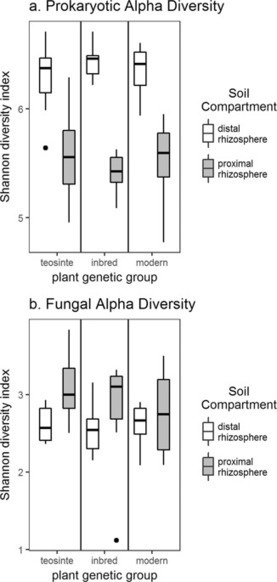
Maize domestication and breeding have resulted in drastic and well documented changes in aboveground traits, but belowground effects on root system functioning and rhizosphere microbial communities remain poorly understood, despite their critical importance for nutrient and water acquisition. We investigated the rhizosphere microbial community composition and structure of ten Zea mays accessions along an evolutionary transect (two teosinte, three inbred maize lines, and five modern maize hybrids) grown in nutrient depleted soil from a low input agricultural system. Microbial community analysis revealed significant differences in community composition between soil compartments (proximal vs. distal rhizosphere) and between plant genetic groups (teosinte, inbred, and modern hybrid). Only a small portion of the microbial community was differentially selected across plant genetic groups: 3.7% of prokaryotic community members and 4.9% of fungal community members were significantly associated with a specific plant genetic group. Indicator species analysis showed the greatest differentiation between modern hybrids and the other two plant genetic groups. Co-occurrence network analysis revealed that microbial co-occurrence patterns of the inbred maize lines’ rhizosphere were significantly more similar to those of the teosintes than to the modern hybrids. Our results suggest that advances in hybrid development significantly impacted rhizosphere microbial communities and network assembly.
|
|
Scooped by
Jean-Michel Ané
October 30, 2019 7:12 PM
|
In sustainable agriculture, integrated plant nutrition management along with a biological agent is an imperative module as a cost-effective and eco-friendly approach against drastic plant hackers (phytopathogens). Bacillus subtilis is one of the most potential biological control agents, because of the broad-spectrum activity of their antibiotics. The current study was carried out to explore in vivo biocontrol efficacy of Bacillus subtilis alone and in combination with plant nutrients [NPK, Zn (1X & 2X), Mg and B] against early blight disease of tomato caused by the necrotrophic fungus Alternaria solani. Results revealed that foliar application of B. subtilis alone and in combination with the plant nutrients managed EB disease significantly by 67-83%, while improved plant growth attributes by 20-77%. B. subtilis and plant nutrients helped the tomato plant to fight off the plant hacker by up-regulating the production of total phenolic contents and defensive enzymes (phenylalanine ammonia-lyase, superoxide dismutase, catalase, peroxidase, and polyphenol oxidase). In the current investigation, the light was shed on the interactive effect of microbial agent and positive consequences on plant mineral uptake. It was concluded that integrative use of NPK and Zn (2X) along with B. subtilis have a synergistic impact to manage the disease, improve plant growth, and optimistically enhance physiological and biochemical attributes to contest EB stress in tomato plants.
|
|
Scooped by
Jean-Michel Ané
October 30, 2019 1:14 PM
|
Rhizobia are α- and β-proteobacteria that form a symbiotic partnership with legumes, fixing atmospheric dinitrogen to ammonia and providing it to the plant. Oxygen regulation is key in this symbiosis. Fixation is performed by an oxygen-intolerant nitrogenase enzyme but requires respiration to meet its high energy demands. To satisfy these opposing constraints the symbiotic partners cooperate intimately, employing a variety of mechanisms to regulate and respond to oxygen concentration. During symbiosis rhizobia undergo significant changes in gene expression to differentiate into nitrogen-fixing bacteroids. Legumes host these bacteroids in specialized root organs called nodules. These generate a near-anoxic environment using an oxygen diffusion barrier, oxygen-binding leghemoglobin and control of mitochondria localization. Rhizobia sense oxygen using multiple interconnected systems which enable a finely-tuned response to the wide range of oxygen concentrations they experience when transitioning from soil to nodules. The oxygen-sensing FixL-FixJ and hybrid FixL-FxkR two-component systems activate at relatively high oxygen concentration and regulate fixK transcription. FixK activates the fixNOQP and fixGHIS operons producing a high-affinity terminal oxidase required for bacterial respiration in the microaerobic nodule. Additionally or alternatively, some rhizobia regulate expression of these operons by FnrN, an FNR-like oxygen-sensing protein. The final stage of symbiotic establishment is activated by the NifA protein, regulated by oxygen at both the transcriptional and protein level. A cross-species comparison of these systems highlights differences in their roles and interconnections but reveals common regulatory patterns and themes. Future work is needed to establish the complete regulon of these systems and identify other regulatory signals.
|
|
Scooped by
Jean-Michel Ané
October 27, 2019 11:29 PM
|
There’s no better way to eat a fresh tomato than by adding a little salt. But when growing these sumptuous fruits (or vegetables, depending on your perspective), salt in the soil or salty irrigation water has been a big no-no. Until now.
Plant scientists in the Middle East have discovered that adding a desert root fungus, Piriformospora indica—first isolated in India—to the soil protects the tomato from salt’s damaging effects. They planted tomatoes in a greenhouse similar to how a commercial grower might, half in soil with fungi in it. For 4 months, they watered about half the tomatoes with and without fungus in the soil with water about one-third as salty as seawater. The tomato’s leaves from infected plants made more of an enzyme that removes harmful sodium from cells. What’s more, the plant was better able to maintain proper levels of potassium, which is necessary for growth, the team reports this month in Scientia Horticulturae.
In plants irrigated with salty water, fungal infection of the roots boosted the yield of tomatoes 65% compared with uninfected plants. Even infected tomatoes irrigated with nonsalty water did better, with a 22% increase in yield. Others had shown this fungus improved the growth of barley and rice grown in salty conditions. And another fungus had proved beneficial in low salt conditions.
|