Your new post is loading...

|
Scooped by
Jean-Michel Ané
April 27, 2021 10:12 PM
|
Purpose
Plants growing in the soils of karst forests associate with arbuscular mycorrhizae (AM) or ectomycorrhizae (ECM) to acquire nutrients. We researched how these different mycorrhizal associations affect rhizosphere soil nutrient economy in these calcareous soils.
Methods
Bulk and rhizosphere soils were sampled beneath 25 AM and 9 ECM plants growing in primary forests at the Puding Karst Critical Zone Observatory. Nutrient contents and potential enzyme activities were analyzed to test the effect of different types of mycorrhizal association on rhizosphere soil nitrogen (N) and phosphorus (P) economies.
Results
The contents of nitrate-N and available-P were markedly lower in the rhizospheres of ECM plants compared to AM plants. Ectomycorrhizal plants promoted relatively greater investment in N-acquisition enzymes, in contrast, AM plants caused relatively greater investment in P-acquisition enzymes. The decreased pH in the rhizospheres of AM plants likely promoted the greater P availability.
Conclusion
Our results revealed how plants that form contrasting mycorrhizal associations have fundamentally different effects on rhizospheric nutrient economies in the low fertility karst soils of southwest China. Differentiation in N- and P-acquisition capacity of these plants have implications for species coexistence and the high levels of plant biodiversity observed in these forests.
|
|
Scooped by
Jean-Michel Ané
April 27, 2021 10:10 PM
|
Mycorrhizas are known to have a positive impact on plant growth and ability to resist major biotic and abiotic stresses. However, the metabolic alterations underlying mycorrhizal symbiosis are still understudied. By using metabolomics and transcriptomics approaches, cork oak roots colonized by the ectomycorrhizal fungus Pisolithus tinctorius were compared with non-colonized roots. Results show that compounds putatively corresponding to carbohydrates, organic acids, tannins, long-chain fatty acids and monoacylglycerols, were depleted in ectomycorrhizal cork oak colonized roots. Conversely, non-proteogenic amino acids, such as gamma-aminobutyric acid (GABA), and several putative defense-related compounds, including oxylipin-family compounds, terpenoids and B6 vitamers were induced in mycorrhizal roots. Transcriptomic analysis suggests the involvement of GABA in ectomycorrhizal symbiosis through increased synthesis and inhibition of degradation in mycorrhizal roots. Results from this global metabolomics analysis suggest decreases in root metabolites which are common components of exudates, and in compounds related to root external protective layers which could facilitate plant-fungal contact and enhance symbiosis. Root metabolic pathways involved in defense against stress were induced in ectomycorrhizal roots that could be involved in a plant mechanism to avoid uncontrolled growth of the fungal symbiont in the root apoplast. Several of the identified symbiosis-specific metabolites, such as GABA, may help to understand how ectomycorrhizal fungi such as P. tinctorius benefit their host plants.
|
|
Scooped by
Jean-Michel Ané
April 27, 2021 10:08 PM
|
Background
The present study aims to study the effects of biofertilizers potential of Arbuscular Mycorrhizal Fungi (AMF) and Bradyrhizobium japonicum (B. japonicum) strains on yield and growth of drought stressed soybean (Giza 111) plants at early pod stage (50 days from sowing, R3) and seed development stage (90 days from sowing, R5).
Results
Highest plant biomass, leaf chlorophyll content, nodulation, and grain yield were observed in the unstressed plants as compared with water stressed-plants at R3 and R5 stages. At soil rhizosphere level, AMF and B. japonicum treatments improved bacterial counts and the activities of the enzymes (dehydrogenase and phosphatase) under well-watered and drought stress conditions. Irrespective of the drought effects, AMF and B. japonicum treatments improved the growth and yield of soybean under both drought (restrained irrigation) and adequately-watered conditions as compared with untreated plants. The current study revealed that AMF and B. japonicum improved catalase (CAT) and peroxidase (POD) in the seeds, and a reverse trend was observed in case of malonaldehyde (MDA) and proline under drought stress. The relative expression of the CAT and POD genes was up-regulated by the application of biofertilizers treatments under drought stress condition. Interestingly a reverse trend was observed in the case of the relative expression of the genes involved in the proline metabolism such as P5CS, P5CR, PDH, and P5CDH under the same conditions. The present study suggests that biofertilizers diminished the inhibitory effect of drought stress on cell development and resulted in a shorter time for DNA accumulation and the cycle of cell division. There were notable changes in the activities of enzymes involved in the secondary metabolism and expression levels of GmSPS1, GmSuSy, and GmC-INV in the plants treated with biofertilizers and exposed to the drought stress at both R3 and R5 stages. These changes in the activities of secondary metabolism and their transcriptional levels caused by biofertilizers may contribute to increasing soybean tolerance to drought stress.
Conclusions
The results of this study suggest that application of biofertilizers to soybean plants is a promising approach to alleviate drought stress effects on growth performance of soybean plants. The integrated application of biofertilizers may help to obtain improved resilience of the agro ecosystems to adverse impacts of climate change and help to improve soil fertility and plant growth under drought stress.
|
|
Scooped by
Jean-Michel Ané
April 27, 2021 10:05 PM
|
Homocitrate is an essential component of the iron-molybdenum cofactor of nitrogenase, the bacterial enzyme that catalyzes the reduction of dinitrogen (N2) to ammonia. In nitrogen-fixing and nodulating alpha-rhizobia, homocitrate is usually provided to bacteroids in root nodules by their plant host. In contrast, non-nodulating free-living diazotrophs encode the homocitrate synthase (NifV) and reduce N2 in nitrogen-limiting free-living conditions. Paraburkholderia phymatum STM815 is a beta-rhizobial strain, which can enter symbiosis with a broad range of legumes, including papilionoids and mimosoids. In contrast to most alpha-rhizobia, which lack nifV, P. phymatum harbors a copy of nifV on its symbiotic plasmid. We show here that P. phymatum nifV is essential for nitrogenase activity both in root nodules of papilionoid plants and in free-living growth conditions. Notably, nifV was dispensable in nodules of Mimosa pudica despite the fact that the gene was highly expressed during symbiosis with all tested papilionoid and mimosoid plants. A metabolome analysis of papilionoid and mimosoid root nodules infected with the P. phymatum wild-type strain revealed that among the approximately 400 measured metabolites, homocitrate and other metabolites involved in lysine biosynthesis and degradation have accumulated in all plant nodules compared to uninfected roots, suggesting an important role of these metabolites during symbiosis.
|
|
Scooped by
Jean-Michel Ané
April 27, 2021 11:56 AM
|
The profound negative effect of inorganic chemical fertilizer application on rhizobacterial diversity has been well documented using 16S rRNA gene amplicon sequencing and predictive metagenomics. We aimed to measure the function and relative abundance of readily culturable putative plant growth-promoting rhizobacterial (PGPR) isolates from wheat root soil samples under contrasting inorganic fertilization regimes. We hypothesized that putative PGPR abundance will be reduced in fertilized relative to unfertilized samples. Triticum aestivum cv. Cadenza seeds were sown in a nutrient depleted agricultural soil in pots treated with and without Osmocote® fertilizer containing nitrogen-phosphorous-potassium (NPK). Rhizosphere and rhizoplane samples were collected at flowering stage (10 weeks) and analyzed by culture-independent (CI) amplicon sequence variant (ASV) analysis of rhizobacterial DNA as well as culture-dependent (CD) techniques. Rhizosphere and rhizoplane derived microbiota culture collections were tested for plant growth-promoting traits using functional bioassays. In general, fertilizer addition decreased the proportion of nutrient-solubilizing bacteria (nitrate, phosphate, potassium, iron, and zinc) isolated from rhizocompartments in wheat whereas salt tolerant bacteria were not affected. A “PGPR” database was created from isolate 16S rRNA gene sequences against which total amplified 16S rRNA soil DNA was searched, identifying 1.52% of total community ASVs as culturable PGPR isolates. Bioassays identified a higher proportion of PGPR in non-fertilized samples [rhizosphere (49%) and rhizoplane (91%)] compared to fertilized samples [rhizosphere (21%) and rhizoplane (19%)] which constituted approximately 1.95 and 1.25% in non-fertilized and fertilized total community DNA, respectively. The analyses of 16S rRNA genes and deduced functional profiles provide an in-depth understanding of the responses of bacterial communities to fertilizer; our study suggests that rhizobacteria that potentially benefit plants by mobilizing insoluble nutrients in soil are reduced by chemical fertilizer addition. This knowledge will benefit the development of more targeted biofertilization strategies.
|
|
Scooped by
Jean-Michel Ané
April 27, 2021 10:00 AM
|
Cowpea (Vigna unguiculata (L.) Walp) is an important multipurpose legume crop grown in arid and semi-arid areas of sub-Saharan Africa. The crop associates with a wide diversity of high ecological value rhizobia bacteria, improving biological soil fertility and crop production. Here, we evaluated the symbiotic efficiency (SE) and genetic diversity of native rhizobia isolated from root nodules of cowpea genotypes cultivated in semi-arid areas of lower Eastern Kenya. Rhizobia trapping and SE experiments were done in the greenhouse while genetic diversity was evaluated based on 16S rRNA gene sequencing. Twenty morphologically distinct isolates representing a total of 94 isolates were used for genetic analysis. After 16S rRNA gene sequencing, the isolates closely resembled bacteria belonging to the genus Rhizobium, Paraburkholderia and non-rhizobial endophytes (Enterobacter, Strenotrophomonas and Pseudomonas). This study also reports for the first time the presence of an efficient native cowpea nodulating Beta-Rhizobia (Paraburkholderia phenoliruptrix BR3459a) in Africa. Symbiotic efficiency of the native rhizobia isolates varied (p < 0.0001) significantly. Remarkably, two isolates, M2 and M3 recorded higher SE of 82.49 % and 72.76 % respectively compared to the commercial strain Bradyrhizobium sp. USDA 3456 (67.68 %). Our results form an important step in the development of efficient microbial inoculum and sustainable food production.
|
|
Scooped by
Jean-Michel Ané
April 27, 2021 9:59 AM
|
Plant‐associated microbes play essential roles in nutrient uptake and plant productivity, but their role in driving plant germination, a critical stage in the plant life cycle, is still poorly understood.
We used data from a large‐scale, field‐based soil seed bank study to examine the relationship among plants germinating from the seed bank and soil microbial community composition. We combined this with an experiment using 34 laboratory‐based microcosms whereby sterile soil was inoculated with microbes from different field sites to examine how microbes affect the germination of nine plant species.
The community composition of plants in the soil seed bank was highly and significantly associated with bacterial and fungal community composition, with stronger correlations for soil beneath plant canopies. Microbes predicted a unique portion of the variation in the community composition of germinants after accounting for differences in environmental variables. The strongest correlations among microbes and plant functional traits included those related to perenniality, growth form, plant size, root type and seed shape. Our microcosm study showed that different plant species had their own associated germination microbiome, and most plant–microbe interactions were positive during germination.
Synthesis. Our study provides evidence for intimate relationships between plant and soil biodiversity during germination. Our work fills an important knowledge gap for plant–microbe interactions and reveals valuable insights into the shared natural history of plants and microbes in terrestrial ecosystems.
|
|
Scooped by
Jean-Michel Ané
April 24, 2021 5:48 PM
|
Most legumes can establish a symbiotic association with soil rhizobia that triggers the development of root nodules. These nodules host the rhizobia and allow them to fix nitrogen efficiently. The perception of bacterial lipo-chitooligosaccharide (LCO) signal in the epidermis initiates a signaling cascade that allows rhizobial intracellular infection in the root and de-differentiation and activation of cell division that gives rise to the nodule. Nodule organogenesis and rhizobial infection need to be coupled in space and time for successful nodulation. The plant hormone cytokinin (CK) acts as an essential positive regulator of nodule organogenesis, and specific CK receptors are required for nodule formation. Temporal regulation of tissue-specific CK signaling and biosynthesis in response to LCOs or Sinorhizobium meliloti inoculation in Medicago truncatula remains poorly understood. In the present study, using a fluorescence-based CK sensor (TCSn::nls:tGFP), we performed a high-resolution tissue-specific temporal characterization of the CK response's sequential activation during root infection and nodule development in M. truncatula after inoculation with S. meliloti. Loss-of-function mutants of the CK-biosynthetic gene ISOPENTENYL TRANSFERASE 3 (IPT3) showed impairment of nodulation, suggesting that IPT3 is required for nodule development in M. truncatula. Simultaneous live imaging of pIPT3::tdTOMATO and the CK sensor showed that IPT3 induction in the root stele at the base of nodule primordium contributes to CK biosynthesis, which in turn promotes expression of positive regulators of nodule organogenesis in M. truncatula.
|
|
Scooped by
Jean-Michel Ané
April 24, 2021 5:06 PM
|
DNA methylation has recently emerged as a powerful regulatory mechanism controlling the expression of key regulators of various developmental processes, including nodulation. However, the functional role of DNA methylation in regulating the expression of microRNA (miRNA) genes during the formation and development of nitrogen-fixing nodules remains largely unknown. In this study, we profiled DNA methylation patterns of miRNA genes during nodule formation, development, and early senescence stages in soybean (Glycine max) through the analysis of methylC—seq data. Absolute DNA methylation levels in the CG, CHH, and CHH sequence contexts over the promoter and primary transcript regions of miRNA genes were significantly higher in the nodules compared with the corresponding root tissues at these three distinct nodule developmental stages. We identified a total of 82 differentially methylated miRNAs in the nodules compared with roots. Differential DNA methylation of these 82 miRNAs was detected only in the promoter (69), primary transcript region (3), and both in the promoter and primary transcript regions (10). The large majority of these differentially methylated miRNAs were hypermethylated in nodules compared with the corresponding root tissues and were found mainly in the CHH context and showed stage-specific methylation patterns. Differentially methylated regions in the promoters of 25 miRNAs overlapped with transposable elements, a finding that may explain the vulnerability of miRNAs to DNA methylation changes during nodule development. Gene expression analysis of a set of promoter-differentially methylated miRNAs pointed to a negative association between DNA methylation and miRNA expression. Gene Ontology and pathways analyses indicate that changes in DNA methylation of miRNA genes are reprogrammed and contribute to nodule development through indirect regulation of genes involved in cellular processes and pathways with well-established roles in nodulation.
|
|
Scooped by
Jean-Michel Ané
April 23, 2021 6:35 PM
|
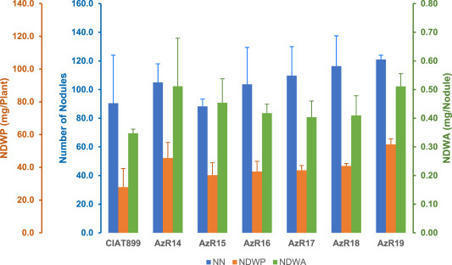
Inoculation with Rhizobium tropici and Rhizobium freirei can partially meet the nitrogen demand required for normal development and high productivity of common bean (Phaseolus vulgaris L.). Here, a simple and low-cost approach was used to select R. tropici sodium azide-resistant mutants with improved efficiency as microsymbiont of common bean. We mutagenized R. tropici CIAT889 by treatment with methyl methanesulfonate (MMS) and selected azide-resistant mutants. Six mutants (AzR14, AzR15, AzR16, AzR17, AzR18, and AzR19) with varying levels of resistance were obtained and characterized for symbiotic traits and performance upon inoculation of common bean. Mutants grew and produced exopolysaccharides similar to the CIAT899 wildtype; however, swarming motility, biofilm, and auxin production were altered. About nodulation, shoot biomass, and nitrogen content, the performance of mutant strains was improved or similar to that of CIAT899. All mutants enhanced nodulation of common bean; furthermore, AzR14, AzR18, and AzR19 increased nodule biomass by 25%–36%. AzR18 and AzR19 increased shoot biomass by up to 13% compared to CIAT899, whereas AzR14, AzR15, AzR16, and AzR17 reduced biomass accumulation by 9%–19%. In addition, AzR18 and AzR19 showed higher motility or biofilm production than the other mutant strains, suggesting that these traits are involved in bacterial symbiotic effectiveness. Shoot N content do not differ between plants inoculated with the CIAT899 or mutant strains, although plants inoculated with AzR18, AzR19 and CIAT899 had increased the shoot N as compared to uninoculated plants grown at N-limiting conditions. Our results demonstrated the possibility to improve the performance of the R. tropici microsymbiont through induced mutagenesis followed by the selection of azide resistant mutants. This approach allowed to identify the AzR18 and AzR19 strains, which showed superior nodulation and symbiotic effectiveness than CIAT899 while providing equivalent amounts of N to the inoculated plants. We propose the AzR18 and AzR19 as promising candidates for developing new and more efficient inoculants for common bean, nevertheless further trials under field conditions are required to confirm their superior performance to the wild strain.
|
|
Scooped by
Jean-Michel Ané
April 23, 2021 6:33 PM
|
Maize plays a vital role in Benin's agricultural production systems. However, at the producer-level, yields are still low, although the production of this cereal is necessary for food security. The aims of this study were to assess the efficacy of solid biostimulants formulated from the rhizobacteria Pseudomonas putida and different binders on maize cultivation in the farming environment in three (03) study areas in South Benin. For this purpose, three (03) biostimulants were formulated based on Pseudomonas putida and the clay, peat and clay-peat combinations binders. The experimental design was a randomized block of four (04) treatments with 11 replicates per study area. Each replicate represented one producer. The trials were set up at 33 producers in the study areas of Adakplamè, Hayakpa and Zouzouvou in Southern Benin. The results obtained show that the best height, stem diameter, leaf area as obtained by applying biostimulants based on P. putida and half dose of NPK and Urea with respective increases of 15.75, 15.93, and 15.57% as compared to the full dose of NPK and Urea. Regarding maize yield, there was no significant difference between treatments and the different study areas. Taken together, the different biostimulants formulations were observed to be better than the farmers' practice in all the zones and for all the parameters evaluated, with the formulation involving Pseudomonas putida on the clay binder, and the half-dose of NPK and Urea showing the best result. The biostimulant formulated based on clay + Pseudomonas putida could be used in agriculture for a more sustainable and environmentally friendly maize production in Benin.
|
|
Scooped by
Jean-Michel Ané
April 23, 2021 6:22 PM
|
REVERSE genetic approach was used to isolate and characterize Medicago truncatula containing “knockout” mutations in gene involved in nodulation process and in many other physiological processes. More than 60 Tnt1-Flanking sequence tags (FSTs) ranging from ~70bp to ~600bp were isolated, sequenced and submitted to Genebank referring for akt1 mutant characterization. The proper Tnt1-insertion was mapped in chromosome number 8 of Medicago truncatula genome. It was precisely identified upstream the base number 141 and downstream of the ATG start codon of Medicago truncatula potassium channel AKT1 gene (MtAKT1). MtAKT1 gene encodes inwardly rectifying potassium channel was isolated, sequenced, and submitted to Genebank with accession number MN649185.1 .M. truncatula akt1 mutant is achieving higher number of deformed root nodules and shorter root length compared to wild type. akt1 nodules exhibited reduced size occupied with un-differentiated cells and abnormalities in symbiotic nodule zones. Non-functional nitrogen fixation zone and compacted infection zone were observed as well. AKT1 null mutant exhibits attenuation in its ability to maintain the proper K+ and Na+ ions content in akt1 seedlings which is 2-3 fold less than wild type seedlings,. In contrast, akt1 seedlings showed three-fold increase in Ca++ ion concentration compared to wild type.
In conclusion Medicago truncatula mutant, akt1 is Tnt1-retrotransposon mutant impaired in inwardly rectifying potassium channel AKT1. As the first reported AKT1 null mutant was isolated from legume plants, this mutant is displaying abnormalities in nitrogen fixation organ and affecting ions uptake.
|
|
Scooped by
Jean-Michel Ané
April 23, 2021 6:20 PM
|
Antimicrobial peptides (AMPs) represent an ancient mechanism for antagonizing microbial opponents, being generated by eukaryotes, eubacteria, and archaea alike [1,2]. Given the dearth in new antibiotics, there has been increasing interest in AMPs. As our understanding has grown, a tantalizing possibility has taken shape: Might these agents of competition be at the heart of the cooperative success story that gave rise to mitochondria and chloroplasts? Striking similarities suggest that the system of protein import into these endosymbiotic organelles may derive from an interplay of AMP attack and defense [3].
|
|
|
Scooped by
Jean-Michel Ané
April 27, 2021 10:11 PM
|
Phaseolus vulgaris (L.), commonly known as bean or common bean, is considered a promiscuous legume host since it forms nodules with diverse rhizobial species and symbiovars. Most of the common bean nodulating rhizobia are mainly affiliated to the genus Rhizobium, though strains belonging to Ensifer, Pararhizobium, Mesorhizobium, Bradyrhizobium, and Burkholderia have also been reported. This is the first report on the characterization of bean-nodulating rhizobia at the species and symbiovar level in Greece. The goals of this research were to isolate and characterize rhizobia nodulating local common bean genotypes grown in five different edaphoclimatic regions of Greece with no rhizobial inoculation history. The genetic diversity of the rhizobial isolates was assessed by BOX-PCR and the phylogenetic affiliation was assessed by multilocus sequence analysis (MLSA) of housekeeping and symbiosis-related genes. A total of fifty fast-growing rhizobial strains were isolated and representative isolates with distinct BOX-PCR fingerpriniting patterns were subjected to phylogenetic analysis. The strains were closely related to R. anhuiense, R. azibense, R. hidalgonense, R. sophoriradicis, and to a putative new genospecies which is provisionally named as Rhizobium sp. I. Most strains belonged to symbiovar phaseoli carrying the α-, γ-a and γ-b alleles of nodC gene, while some of them belonged to symbiovar gallicum. To the best of our knowledge, it is the first time that strains assigned to R. sophoriradicis and harbored the γ-b allele were found in European soils. All strains were able to re-nodulate their original host, indicating that they are true microsymbionts of common bean.
|
|
Scooped by
Jean-Michel Ané
April 27, 2021 10:09 PM
|
Plant hybridization is common and important in ecological and economic contexts, however little is known about the impact of plant hybridization on ectomycorrhizal fungal (EMF) communities in natural habitats. We used a Populus hybrid system (P. angustifolia x P. fremontii) in a heterogeneous riparian landscape to address the hypothesis that EMF communities differ among hybrids and their parental species (cross types). Several key results emerged. (1) Cross type influenced EMF composition, with communities on hybrids being distinct from their parents. (2) Cross type influenced the composition of hyphal exploration types important for soil resource foraging, although contact and short distance exploration types were dominant on all cross types. (3) Cross type had a marginal influence on EMF colonization, with P. angustifolia highest and P. fremontii lowest. These results highlight the potential for tree hybridization to structure belowground communities in heterogeneous natural ecosystems.
|
|
Scooped by
Jean-Michel Ané
April 27, 2021 10:06 PM
|
Purpose
Struvite is a wastewater-derived P mineral that offers a means to redirect wastestream P flows to agroecosystems. The low water solubility of struvite (< 3%) has been reported to limit early-season crop P uptake. Arbuscular mycorrhizae (AM) could enhance dissolution of struvite and thereby increase crop utilization of struvite-P. We tested the hypothesis that AM would increase struvite dissolution and thereby enhance plant P uptake and biomass in a P-deficient soil.
Methods
We employed a tomato (Solanum lycopersicum L.) genotype model with a wild-type mycorrhizal tomato (MYC) and a reduced mycorrhizal mutant (rmc). Monoammonium phosphate (MAP) was used as a highly water soluble P fertilizer for comparison with struvite.
Results
Struvite granules underwent 4-fold less dissolution (% mass remaining) than MAP granules, and apparent struvite dissolution was similar under MYC and rmc. However, scanning electron microscopy revealed qualitative differences in surface morphology of residual struvite between MYC and rmc. Under struvite fertilization, biomass of MYC was 22% greater than rmc, and P and N shoot uptake (mg plant−1) were 32% and 34% greater than rmc. Shoot biomass was 24% greater for MYC fertilized with struvite than with MAP, and shoot P and N uptake were 26% and 34% greater, respectively.
Conclusion
Increased N and P uptake by AM-associated tomato plants fertilized with struvite suggests AM as a strategy to surmount solubility constraints to the use of struvite as a fertilizer.
|
|
Scooped by
Jean-Michel Ané
April 27, 2021 11:56 AM
|
Interactions between plants and each neighbouring microbial species are fundamental building blocks that collectively determine the structure and function of the plant microbiota, but the molecular basis of such interactions is poorly characterized. Here, we monocolonized Arabidopsis leaves with nine plant-associated bacteria from all major phyla of the plant microbiota and profiled co-transcriptomes of plants and bacteria. These strains elicited quantitatively different plant transcriptional responses including typical pattern-triggered immunity responses. Genes of non-pathogenic bacteria involved in general metabolism and energy production were commonly suppressed in planta in contrast to a virulent pathogen. Various nutrient acquisition pathways that are frequently encoded in the genomes of plant-associated bacteria were induced in planta in a strain-specific manner, shedding light on bacterial adaptation to the plant environment and identifying a potential driving force of niche separation. Integrative analyses of plant and bacterial transcriptomes suggested that the transcriptional reprogramming of plants is largely uncoupled from that of bacteria at an early stage of interactions. This study provides insights into how plants discriminate among bacterial strains and sets the foundation for in-depth mechanistic dissection of plant-microbiota interactions.
|
|
Scooped by
Jean-Michel Ané
April 27, 2021 11:56 AM
|
Chemical fertilisers reduce the number of nutrient solubilising bacteria associated with the roots of wheat, according to new research.
The Rothamsted led team found the addition of fertiliser decreased the proportion of bacteria that help make nutrients such as nitrogen, potassium, phosphorous, iron, and zinc more readily available from soil.
The results point to the idea that the addition of fertiliser means that plants no longer need to interact with these beneficial bacteria to access the nutrients required to grow.
The authors say this knowledge will benefit the development of more targeted biofertilization strategies.
Lead author Tessa Reid said: “Current high-yielding dwarf crop varieties rely on unsustainable levels of inorganic chemical fertilizers. Understanding the effect of fertilization regime on growth promoting bacteria is essential to optimize microbiome function in the sustainable intensification of agriculture.”
|
|
Scooped by
Jean-Michel Ané
April 27, 2021 9:59 AM
|
A clover booklet ‘Management and Establishment of Grass-White Clover Swards’ for 2021 is being launched by Teagasc today.
And because the agri-sector is coming under increasing pressure to reduce nitrogen fertiliser use, reduce greenhouse gas emissions and increase nitrogen use efficiency, the role of white clover in sustainable Irish pasture-based milk and meat production systems has never been more important.
The high quality forage and the nitrogen fixation benefits of grass-white clover pastures have led to a resurgence of interest in its use as a means of reducing the economic and environmental costs in pasture-based milk and meat production systems.
|
|
Scooped by
Jean-Michel Ané
April 27, 2021 9:54 AM
|
Abstract: The root system of a plant performs vital functions including resource uptake when nutrient availability in soil is non-homogenous; while also providing a surface for interactions with beneficial microbes. Legume roots tolerate deficiency of the macronutrient Nitrogen by not only enhancing its direct uptake but also by establishing a unique symbiotic relationship with soil bacteria called rhizobia. Here I present findings that put genome-encoded small secreted peptides or ‘peptide hormones’ at the center-stage of N-acquisition in legumes. Our findings suggest that peptides likely provide a cheap, environmentally-friendly, non-GMO route to address current challenges of plant growth in nutrient-deprived soils.
|
|
Scooped by
Jean-Michel Ané
April 24, 2021 5:32 PM
|
•NGS detected 120 OTUs in total, 7 genera and 25 virtual species, and Glomus was the most predominant genus in samples.
•N fertilization adversely affected the Shannon index and had a stronger influence than the cropping pattern on AMF community.
•The pH, nitrate N, and available P mainly drove the AMF community structure.
|
|
Scooped by
Jean-Michel Ané
April 24, 2021 5:03 PM
|
Salinity is a major abiotic stress threatening crop production. Root-derived bacteria (RDB) are hypothesized to play a role in enhancing plant adaptability to various stresses. However, it is still unclear whether and how plants build up specific RDB when challenged by salinity. In this study, we measured the composition and variation in the rhizosphere and endophyte bacteria of salt-sensitive (SSs) and salt-resistant (SRs) plants under soil conditions with/without salinity. The salt-induced RDB (both rhizobiomes and endophytes) were isolated to examine their effects on the physiological responses of SSs and SRs to salinity challenge. Moreover, we examined whether functional redundancy exists among salt-induced RDB in enhancing plant adaptability to salt stress. We observed that although SSs and SRs recruited distinct RDB and relevant functions when challenged by salinity, salt-induced recruitment of specific RDB led to a consistent growth promotion in plants regardless of their salinity tolerance capacities. Plants employed a species-specific strategy to recruit beneficial soil bacteria in the rhizosphere rather than in the endosphere. Furthermore, we demonstrated that the consortium, but not individual members of the salt-induced RDB, provided enduring resistance against salt stress. This study confirms the critical role of salt-induced RDB in enhancing plant adaptability to salt stress.
|
|
Scooped by
Jean-Michel Ané
April 23, 2021 6:33 PM
|
Farming of barley and chickpea is nitrogen (N) fertilizer dependent. Using strategies that increase the nitrogen use efficiency (NUE) and its components, nitrogen uptake efficiency (NUpE) and nitrogen utilization efficiency (NUtE) would reduce the N fertilizer application in the soil and its adverse environmental effects. We evaluated the effects of three different strains of diazotroph Klebsiella (K.p. SSN1, K.q. SGM81, and K.o. M5a1) to understand the role of biological nitrogen fixation (BNF) and bacterial indole-3-acetic acid (IAA) on NUE of the plants. A field study revealed that K.p. SSN1 results in profound increment of root surface area by eightfold and threefold compared to uninoculated (control) in barley and chickpea, respectively. We measured significant increase in the plant tissue nitrogen, chlorophyll content, protein content, nitrate reductase activity, and nitrate concentration in the inoculated plants (p ≤ 0.05). Treated barley and chickpea exhibited higher NUE and the components compared to the control plants (K.p. SSN1 ≥ K.q. SGM81> K.o. M5a1). Specifically, K.q. SGM81 treatment in barley increased NUpE by 72%, while in chickpea, K.p. SSN1 increased it by 187%. The substantial improvement in the NUpE and NUE by the auxin producers K.p. SSN1 and K.q. SGM81 compared with non-auxin producer K.o. M5a1 was accompanied by an augmented root architecture suggesting larger contribution of IAA over marginal contribution of BNF in nitrogen acquisition from the soil. View Full-Text
|
|
Scooped by
Jean-Michel Ané
April 23, 2021 6:25 PM
|
Plant endosymbiosis relies on the development of specialized membranes that encapsulate the endosymbiont and facilitate nutrient exchange. However, the identity and function of lipids within these membrane interfaces is largely unknown. Here, we identify GLUCOSAMINE INOSITOL PHOSPHORYLCERAMIDE TRANSFERASE1 (GINT1) as a sphingolipid glycosyltransferase highly expressed in Medicago truncatula root nodules and roots colonized by arbuscular mycorrhizal (AM) fungi and further demonstrate that this enzyme functions in the synthesis of N-acetyl-glucosamine-decorated glycosyl inositol phosphoryl ceramides (GIPCs) in planta. MtGINT1 expression was developmentally regulated in symbiotic tissues associated with the development of symbiosome and periarbuscular membranes. RNAi silencing of MtGINT1 did not affect overall root growth but strongly impaired nodulation and AM symbiosis, resulting in the senescence of symbiosomes and arbuscules. Our results indicate that, although M. truncatula root sphingolipidome predominantly consists of hexose-decorated GIPCs, local reprogramming of GIPC glycosylation by MtGINT1 is required for the persistence of endosymbionts within the plant cell.
|
|
Scooped by
Jean-Michel Ané
April 23, 2021 6:22 PM
|
Given the current trends in climate change, extreme weather events are expected to increase in strength and frequency. Such events can impact species survival and species interactions. One of the most ubiquitous symbioses on earth is the nutrient exchange partnership between arbuscular mycorrhizal fungi and their host plants. While past work has shown that mycorrhizal fungi can help alleviate stress, it is unknown how phosphorus uptake by plants to fungi is affected by extreme weather events, such as flooding and heat waves. To test this response, we grew Medicago truncatula host plants with or without mycorrhizal fungi and then exposed them to extreme weather treatments: increasing soil temperature by 12°C, or by flooding the plant roots for 7 days. We measured plant and fungal performance, and quantified phosphorus (P) uptake before and after extreme weather treatments using a technique in which we tagged apatite, a form of rock phosphorus, with fluorescing quantum-dots (QDs) nanoparticles. We then measured fluorescence in root and shoot tissue at harvest. We found that plants and arbuscular mycorrhizal fungi were affected by soil flooding, with plant survival, fungal colonization and QD-apatite uptake decreasing under flooded conditions. We did not see these negative effects in the heat treatment. While the presence of arbuscular mycorrhizal fungi affected plant biomass allocation, leading to an increase in shoot biomass, the symbiosis did not increase plant survival, total biomass or QD uptake in either treatment. More generally, we found host tissue contained roughly 80% more QD-apatite from the pre-treatment compared to the post-treatment nutrient injection. Future studies should focus on various plant-fungal combinations to create databases on which predictive models to extreme weather events can be constructed.
|