Your new post is loading...

|
Scooped by
Jean-Michel Ané
May 9, 2021 4:10 PM
|
The most comprehensive study of the family tree for legumes, the plant family that includes beans, soybeans, peanuts, and many other economically important crop plants, reveals a history of whole-genome duplications. The study also helps to uncover the evolution of genes involved in nitrogen fixation–a key trait likely important in the evolutionary spread and diversification of legumes and vital for their use as “green manure” in agriculture. To reconstruct the family tree, researchers compared the DNA sequence of more than 1500 genes from 463 different legume species, including 391 newly sequenced species, that span the diversity of this large plant family.
|
|
Scooped by
Jean-Michel Ané
May 9, 2021 3:59 PM
|
Bradyrhizobium spp. are well known to mediate biological nitrogen fixation (BNF) as microsymbionts inhabiting nodules on leguminous plants. However, they may also contribute to plant growth via free‐living N2 fixation (FLNF) in association with non‐legumes. Notably, several Bradyrhizobium strains from sugarcane roots display FLNF activity. Among them, B. sacchari is a legume symbiotic species, whereas strains AG48 and M12 are non‐symbiotic. In the present study, a phylogenomic approach was applied to study peculiarities of these and other Bradyrhizobium strains with respect to N fixation (nif) gene content in order to reveal genetic features that enable FNLF in Bradyrhizobium spp. All FLNF strains carry an ancestral ‘non‐symbiotic’ nif‐gene cluster (NSC). B. sacchari also contains a second ‘symbiotic’ nif‐gene cluster (SC), a characteristic observed in only three of 156 evaluated genomes. B. sacchari stood out and presented a high level of sequence divergence between individual nif‐gene homologues and we discuss scenarios for the evolutionary origin of these clusters. The transcript level of NSC nifH gene increased during FLNF, when compared to symbiotic conditions. The data suggest that sugarcane roots harbor diverse Bradyrhizobium spp. that are genetically adapted to a dynamic environment where leguminous and non‐leguminous host plants are alternately available.
|
|
Scooped by
Jean-Michel Ané
May 9, 2021 3:55 PM
|
The role that common mycorrhizal networks (CMNs) play in plant‐to‐plant transfer of zinc (Zn) has not yet been investigated, despite the proved functions of arbuscular mycorrhizal fungi (AMF) in crop Zn acquisition. Here, two autotrophic Medicago truncatula plants were linked by a CMN formed by Rhizophagus irregularis. Plants were grown in vitro in physically separated compartments (Donor‐C and Receiver‐C) and their connection ensured only by CMN. A symbiosis‐defective mutant of M. truncatula was used as control in Receiver‐C. Plants in both compartments were grown on Zn‐free medium, and only the leaves of the donor plants were Zn fertilized. A direct transfer of Zn was demonstrated from donor leaves to receiver shoots mediated by CMN. Direct transfer of Zn was supported by changes in the expression of fungal genes, RiZRT1 and RiZnT1, and plant gene MtZIP2 in roots and MtNAS1 in roots and shoots of the receiver plants. Moreover, Zn transfer was supported by the change in expression of MtZIP14 gene in AM fungal colonized roots. This work is the first evidence of a direct Zn transfer from a donor to a receiver plant via CMN, and of a triggering of transcriptional regulation of fungal‐plant genes involved in Zn transport‐related processes.
|
|
Scooped by
Jean-Michel Ané
May 7, 2021 10:39 PM
|
The lncRNA ENOD40 is required for cortical cell division during root nodule symbiosis (RNS) of legumes, though it is not essential for actinorhizal RNS. Our objective was to understand whether ENOD40 was required for aeschynomenoid nodule formation in Arachis hypogaea. AhENOD40 express from chr5 (AhENOD40-1) and chr15 (AhENOD40-2) during symbiosis, and RNA interference of these transcripts drastically affected nodulation indicating the importance of ENOD40 in A.hypogaea. Furthermore, we demonstrated several distinct characteristics of ENOD40: (i) Natural antisense transcript of ENOD40 was detected from the AhENOD40-1 locus (designated as NAT-AhDONE40). (ii) Both AhENOD40-1 and AhENOD40-2 had two exons, whereas NAT-AhDONE40 was monoexonic. RT-qPCR analysis indicated both sense and antisense transcripts to be present in both cytoplasm and nucleus, and their expression increased with the progress of symbiosis. (iii) RNA Pulldown from whole cell extracts of infected roots at 4DPI indicated NAT-AhDONE40 to interact with the SET (Su(var)3-9, Enhancer-of-zeste and Trithorax) domain containing Ash (Absent Small homeotic disc) family protein AhASHR3 and this interaction was further validated using RNA immunoprecipitation and EMSA. (iv) ChIP assays indicate deposition of ASHR3 specific histone marks H3K36me3 and H3K4me3 in both the ENOD40 loci during the progress of symbiosis. ASHR3 is known for its role in optimizing cell proliferation and reprogramming. Since both ASHR3 and ENOD40 from legumes cluster away from those in actinorhizal plants and other nonlegumes in phylogenetic distance trees, we hypothesize that the interaction of DONE40 with ASHR3 could have evolved for adapting the nodule organogenesis program for legumes.
|
|
Scooped by
Jean-Michel Ané
May 2, 2021 10:26 PM
|
We investigated how plant inoculation with two diazotrophic bacteria would influence the modulation of root architecture and parameters associated with N uptake rate under high and low NO3− availability. The treatments were arranged in a 2 × 3 factorial design, the first factor being N dose (0.3 and 3.0 mM, or low and high N, respectively) and the second being inoculation with Herbaspirillum seropedicae strain ZAE94 (Hs-ZAE94), Azospirillum brasilense strain Sp245 (Ab-Sp245) and an uninoculated control. The parameters evaluated were: root architecture, mineral N in the growth solution, soluble metabolites, and activities of two N enzymes, dry mass, N accumulation, and the ratio of plant dry mass to N accumulation (NUE). Plant parameters improved with higher N availability. Only under high N, the inoculation with Ab-Sp245 brought about a change in root architecture with an improvement in root surface area, which was in agreement with an increased plant dry matter, N accumulation, and NUE, which was not always observed on either sampling date, 24 and 32 days after transfer to the hydroponic system. The shift in root architecture and the maintenance of N uptake per unit of root area by inoculation with Ab-Sp245 was likely the main effect.
|
|
Scooped by
Jean-Michel Ané
May 2, 2021 10:23 PM
|
Plant roots are composed of many differentiated tissue types, with each tissue exhibiting differential quantitative and qualitative accumulation of metabolites. The large-scale nontargeted metabolite profiles of these differentiated tissues are complex, which complicates the interpretation and development of hypotheses relative to the biological roles of differentially localized metabolites. Thus, we created a data visualization tool to aid in the visualization and understanding of differential metabolite accumulations in Medicago truncatula roots. This was achieved through the development of the Medicago truncatula Metabolite Atlas based upon an adaptation of the Arabidopsis Electronic Fluorescent Pictograph (eFP) Browser. Medicago truncatula roots were dissected into border cells, root cap, elongation zone, mature root, and root secretions. Each tissue was then analyzed by UHPLC-QTOF-MS and GC-Q-MS. Data were uploaded into a MySQL database and displayed in the Medicago truncatula Metabolite Atlas. The data revealed unique differential spatial localization of many metabolites, some of which are discussed here. Ultimately, the Medicago truncatula Metabolite Atlas compiles metabolite data into a singular, useful, and publicly available web-based tool that enables the visualization and understanding of differential metabolite accumulation and spatial localization.
|
|
Scooped by
Jean-Michel Ané
May 2, 2021 10:15 PM
|
Background
Arbuscular mycorrhizal (AM) fungi associate with most plants and can increase nutrient uptake. As a result, commercial inoculants called “biofertilizers” containing AM fungi have been developed and marketed to increase plant performance. However, successful establishment of these inoculants remains a challenge, and may be negatively impacted by competition with fungi already present (priority effects). Perennial agriculture may be more amenable if inoculants can be successfully established on crops prior to field planting.
Methods
Here, we inoculate grapevine (Vitis vinifera) with a commercial inoculant in three treatments designed to manipulate the strength and direction of priority effects and quantified the abundance of the fungal strain before and after introduction using droplet digital PCR (ddPCR).
Results
We found that the introduced strain did not establish in any treatment, even with priority advantage, and inoculated vines did not differ in performance from non-inoculated vines. Fungal abundance was not greater than in pre-inoculation soil samples during any of the five years sampled and may have been impaired by high available phosphorus levels in the soil. This study highlights the need to understand and evaluate how the management of the agricultural system will affect establishment before introduction of “biofertilizers”, which is often unpredictable.
|
|
Scooped by
Jean-Michel Ané
May 2, 2021 10:06 PM
|
Cowpea (Vigna unguiculata (L.) Walp) is an important multipurpose legume crop grown in arid and semi-arid areas of sub-Saharan Africa. The crop associates with a wide diversity of high ecological value rhizobia bacteria, improving biological soil fertility and crop production. Here, we evaluated the symbiotic efficiency (SE) and genetic diversity of native rhizobia isolated from root nodules of cowpea genotypes cultivated in semi-arid areas of lower Eastern Kenya. Rhizobia trapping and SE experiments were done in the greenhouse while genetic diversity was evaluated based on 16S rRNA gene sequencing. Twenty morphologically distinct isolates representing a total of 94 isolates were used for genetic analysis. After 16S rRNA gene sequencing, the isolates closely resembled bacteria belonging to the genus Rhizobium, Paraburkholderia and non-rhizobial endophytes (Enterobacter, Strenotrophomonas and Pseudomonas). This study also reports for the first time the presence of an efficient native cowpea nodulating Beta-Rhizobia (Paraburkholderia phenoliruptrix BR3459a) in Africa. Symbiotic efficiency of the native rhizobia isolates varied (p < 0.0001) significantly. Remarkably, two isolates, M2 and M3 recorded higher SE of 82.49 % and 72.76 % respectively compared to the commercial strain Bradyrhizobium sp. USDA 3456 (67.68 %). Our results form an important step in the development of efficient microbial inoculum and sustainable food production.
|
|
Scooped by
Jean-Michel Ané
May 2, 2021 10:01 PM
|
Aims
Arbuscular mycorrhizal fungi (AMF) could influence plant abilities of total nitrogen (N) acquisition. Global changes have been influencing availabilities of different N forms and water resources in soil. However, it is uncertain whether and how AMF colonization affects plant uptake and preference of different N forms and how are they affected by soil water conditions.
Methods
We conducted a pot experiment with Funneliformis mosseae (a common arbuscular mycorrhizal fungal species) colonized and non-colonized maize (Zea mays L.) growing at low and high water conditions, the growth medium contained much more nitrate (NO3−) than ammonium (NH4+).
Results
F. mosseae colonization and high water availability increased maize biomass and total N uptake. Enhanced water supply increased proportional contributions of NH4+ to colonized and non-colonized maize because high water conditions may increase NH4+ accessibility to maize. F. mosseae colonization weakened proportional contributions and preference of NH4+ in maize, indicating that AMF enable plants to prefer using the more abundant N form and develop more beneficial N uptake strategies considering that NO3− was more dominant than NH4+ in growth medium. Furthermore, maize NH4+ preference was decreased by F. mosseae colonization more under high than low water conditions. This demonstrated greater effects of AMF on regulating plant N uptake strategies in soils with greater water availability.
Conclusions
This work revealed the regulation of AMF colonization on plant N uptake strategies under different soil water conditions. The findings enriched our knowledge of plant N use in the context of global changes.
|
|
Scooped by
Jean-Michel Ané
April 28, 2021 4:58 PM
|
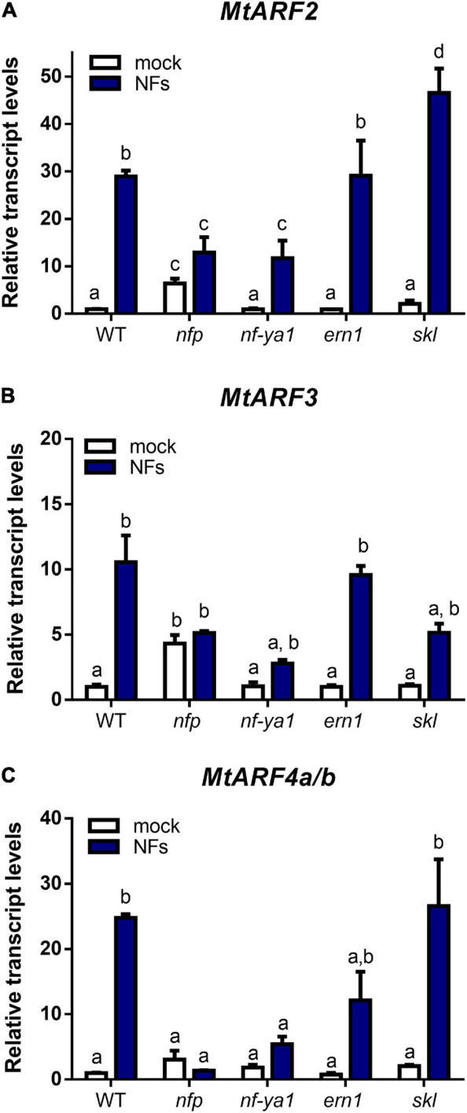
Auxin Response Factors (ARFs) constitute a large family of transcription factors that mediate auxin-regulated developmental programs in plants. ARF2, ARF3, and ARF4 are post-transcriptionally regulated by the microRNA390 (miR390)/trans-acting small interference RNA 3 (TAS3) module through the action of TAS3-derived trans-acting small interfering RNAs (ta-siRNA). We have previously reported that constitutive activation of the miR390/TAS3 pathway promotes elongation of lateral roots but impairs nodule organogenesis and infection by rhizobia during the nitrogen-fixing symbiosis established between Medicago truncatula and its partner Sinorhizobium meliloti. However, the involvement of the targets of the miR390/TAS3 pathway, i.e., MtARF2, MtARF3, MtARF4a, and MtARF4b, in root development and establishment of the nitrogen-fixing symbiosis remained unexplored. Here, promoter:reporter fusions showed that expression of both MtARF3 and MtARF4a was associated with lateral root development; however, only the MtARF4a promoter was active in developing nodules. In addition, up-regulation of MtARF2, MtARF3, and MtARF4a/b in response to rhizobia depends on Nod Factor perception. We provide evidence that simultaneous knockdown of MtARF2, MtARF3, MtARF4a, and MtARF4b or mutation in MtARF4a impaired nodule formation, and reduced initiation and progression of infection events. Silencing of MtARF2, MtARF3, MtARF4a, and MtARF4b altered mRNA levels of the early nodulation gene nodulation signaling pathway 2 (MtNSP2). In addition, roots with reduced levels of MtARF2, MtARF3, MtARF4a, and MtARF4b, as well as arf4a mutant plants exhibited altered root architecture, causing a reduction in primary and lateral root length, but increasing lateral root density. Taken together, our results suggest that these ARF members are common key players of the morphogenetic programs that control root development and the formation of nitrogen-fixing nodules.
|
|
Scooped by
Jean-Michel Ané
April 27, 2021 10:18 PM
|
Aims
It is well established that mycorrhizal symbiosis can affect plant-plant interactions. On the other hand, how intraspecific plant interactions influence communities of arbuscular mycorrhizal fungi (AMF) is still very poorly understood.
Methods
We applied 454 pyrosequencing to determine the responses of AMF communities to intraspecific shoot and root interactions using Medicago sativa L. as host plant.
Results
We found that intraspecific plant interaction caused significant variation in the structure of the AMF community assessed from roots but not from soil. Intraspecific root system interaction resulted in significantly elevated AMF species richness, greater total mycorrhizal and arbuscular colonization, and a larger root:shoot ratio compared to plants experiencing intraspecific shoot interaction or no interaction. Intraspecific shoot interaction resulted in significantly depressed AMF species richness.
Conclusions
Our results support two hypotheses. The first is that increased AMF species richness in plants experiencing intraspecific root interaction originates from competitive release provided by high root density. The second is that shoot interaction leads to reduced allocation to root systems, increasing the stringency with which host plants selectively reward the most cooperative fungi. Because intraspecific interactions among host plants can influence the structure of their AMF community, interactions among species in complex plant communities may influence AMF community structure in addition to a plant diversity effect.
|
|
Scooped by
Jean-Michel Ané
April 27, 2021 10:16 PM
|
•AMF communities differed between fertilization regimes and soildepths.
•AMF communities correlated with available phosphorus in topsoil and nitrogen in subsoil.
•Soil organic carbon and rainfall correlated with AMF community Chao1 index and diversity.
•Fertilization, but not AMF Chao1 index, determined plant biomass and grain yield.
•AMF communities in subsoil were influenced by N fertilization.
|
|
Scooped by
Jean-Michel Ané
April 27, 2021 10:12 PM
|
Rhizobacteria in the genus Pseudomonas can enhance plant resistance to a range of pathogens and herbivores. However, resistance to these different classes of plant antagonists is mediated by different molecular mechanisms, and the extent to which induced systemic resistance by Pseudomonas can simultaneously protect plants against both pathogens and herbivores remains unclear. We screened 12 root-colonizing Pseudomonas strains to assess their ability to induce resistance in Arabidopsis thaliana against a foliar pathogen (Pseudomonas syringae DC3000) and a chewing herbivore (Spodoptera littoralis). None of our 12 strains increased plant resistance against herbivory; however, four strains enhanced pathogen resistance, and one of these (Pseudomonas strain P97-38) also made plants more susceptible to herbivory. Phytohormone analyses revealed stronger SA induction in plants colonized by P97-38 (vs controls) following subsequent pathogen infection but weaker induction of JA-mediated defenses following herbivory. We found no effects of P97-38 inoculation on herbivore-relevant nutrients such as sugars and protein, suggesting that the observed enhancement of susceptibility to S. littoralis is due to effects on plant defense chemistry rather than nutrition. These findings suggest that Pseudomonas strains that enhance plant resistance to pathogens may have neutral or negative effects on resistance to herbivores and provide insight into potential mechanisms associated with effects on different classes of plant antagonists. Improved understanding of these effects has potentially important implications for the use of rhizobacteria inoculation in agriculture.
|
|
|
Scooped by
Jean-Michel Ané
May 9, 2021 4:03 PM
|
•SL production is promoted by the AM fungus at the early stages of the interaction.
•AM symbiosis alters apocarotenoid fluxes along the plant–fungus interaction.
•Strigolactone and C13/C14 derivatives production is spatially and temporally regulated.
•This regulation occurs at the transcriptional level by changes in the CCD genes.
•CCD7 is a key enzyme acting as a hub in the regulation of the AM symbiosis.
|
|
Scooped by
Jean-Michel Ané
May 9, 2021 3:56 PM
|
There is increasing interest in understanding how the microbial communities on roots can be manipulated to improve plant productivity. Root systems are not homogeneous organs but are comprised of different root types of various ages and anatomies that perform different functions. Relatively little is known about how this variation influences the distribution and abundance of microorganisms on roots and in the rhizosphere. Such information is important for understanding how root–microbe interactions might affect root function and prevent diseases. This study tested specific hypotheses related to the spatial variation of bacterial and fungal communities on wheat (Triticum aestivum L.) and rice (Oryza sativa L.) roots grown in contrasting soils. We demonstrate that microbial communities differed significantly between soil type, between host species, between root types, and with position along the root axes. The magnitude of variation between different root types and along individual roots was comparable with the variation detected between different plant species. We discuss the general patterns that emerged in this variation and identify bacterial and fungal taxa that were consistently more abundant on specific regions of the root system. We argue that these patterns should be measured more routinely so that localised root–microbe interactions can be better linked with root system design, plant health and performance.
|
|
Scooped by
Jean-Michel Ané
May 9, 2021 3:52 PM
|
• Mycorrhizal fungi are central to the biology of land plants. However, to what extent mycorrhizal shifts – broad evolutionary transitions in root‐associated fungal symbionts – are related to changes in plant trophic modes remains poorly understood.
• We built a comprehensive DNA dataset of Orchidaceae fungal symbionts and a dated plant molecular phylogeny to test the hypothesis that shifts in orchid trophic modes follow a stepwise pattern, from autotrophy over partial mycoheterotrophy (mixotrophy) to full mycoheterotrophy, and that these shifts are accompanied by switches in fungal symbionts.
• We estimate that at least 17 independent shifts from autotrophy towards full mycoheterotrophy occurred in orchids, mostly through an intermediate state of partial mycoheterotrophy. A wide range of fungal partners was inferred to occur in the roots of the common ancestor of this family, including ‘rhizoctonias’, ectomycorrhizal, and wood‐ or litter‐decaying saprotrophic fungi. Phylogenetic hypothesis tests further show that associations with ectomycorrhizal or saprotrophic fungi were most likely a prerequisite for evolutionary shifts towards full mycoheterotrophy.
• We show that shifts in trophic mode often coincided with switches in fungal symbionts, suggesting that the loss of photosynthesis selects for different fungal communities in orchids. We conclude that changes in symbiotic associations and ecophysiological traits are tightly correlated throughout the diversification of orchids.
|
|
Scooped by
Jean-Michel Ané
May 4, 2021 9:35 PM
|
Legumes are high in protein and form a valuable part of human diets due to their interaction with symbiotic nitrogen-fixing bacteria known as rhizobia. Plants house rhizobia in specialized root nodules and provide the rhizobia with carbon in return for nitrogen. However, plants usually house multiple rhizobial strains that vary in their fixation ability, so the plant faces an investment dilemma. Plants are known to sanction strains that do not fix nitrogen, but nonfixers are rare in field settings, while intermediate fixers are common. Here, we modeled how plants should respond to an intermediate fixer that was otherwise isogenic and tested model predictions using pea plants. Intermediate fixers were only tolerated when a better strain was not available. In agreement with model predictions, nodules containing the intermediate-fixing strain were large and healthy when the only alternative was a nonfixer, but nodules of the intermediate-fixing strain were small and white when the plant was coinoculated with a more effective strain. The reduction in nodule size was preceded by a lower carbon supply to the nodule even before differences in nodule size could be observed. Sanctioned nodules had reduced rates of nitrogen fixation, and in later developmental stages, sanctioned nodules contained fewer viable bacteria than nonsanctioned nodules. This indicates that legumes can make conditional decisions, most likely by comparing a local nodule-dependent cue of nitrogen output with a global cue, giving them remarkable control over their symbiotic partners.
|
|
Scooped by
Jean-Michel Ané
May 2, 2021 10:26 PM
|
Plants associating with mutualistic ectomycorrhizal (ECM) fungi may directly obtain nitrogen (N) bound in soil organic matter (N-SOM). However, the contribution of N-SOM to plant growth under field conditions remains poorly constrained. We tested the hypothesis that turnover in ECM communities along soil inorganic N gradients mediates a functional transition from plant reliance on N-SOM in low inorganic N soils, to primarily inorganic N uptake in inorganic N-rich condition soils. We quantified the δ 15 N of Q. rubra foliage and roots, organic and inorganic soil N pools, and used molecular sequencing to characterize ECM communities, morpho-traits associated with N-foraging, and a community aggregated sporocarp δ 15 N. In support of our hypothesis, we document the progressive enrichment of root and foliar δ 15 N with increasing soil inorganic N supply; green leaves ranged from − 5.95 to 0.16‰ as the supply of inorganic N increased. ECM communities inhabiting low inorganic N soils were dominated by the genus Cortinarius, and other fungi forming hyphal morphologies putatively involved in N-SOM acquisition; sporocarp estimates from these communities were enriched (+ 4‰), further supporting fungal N-SOM acquisition. In contrast, trees occurring in high inorganic N soils hosted distinct communities with morpho-traits associated with inorganic N acquisition and depleted sporocarps (+ 0.5‰). Together, our results are consistent with apparent tradeoffs in the foraging cost and contribution of N-SOM to plant growth and demonstrate linkages between ECM community composition, fungal N-foraging potential and foliar δ 15 N. The functional characteristics of ECM communities represent a mechanistic basis for flexibility in plant nutrient foraging strategies. We conclude that the contribution of N-SOM to plant growth is likely contingent on ECM community composition and local soil nutrient availability.
|
|
Scooped by
Jean-Michel Ané
May 2, 2021 10:16 PM
|
•Single AMF species enhance plant growth ~20% better than mixed AMF species.
•Competition between AMF species have adverse effect on plant growth.
•Funneliformis caledonium is the most resistant to phenol and PAHs.
•Moderate phenol/PAH contamination stimulates mycorrhizal colonization of roots.
•Arbuscular mycorrhiza might regulate antioxidative defense in plants.
|
|
Scooped by
Jean-Michel Ané
May 2, 2021 10:08 PM
|
The tubulin cytoskeleton plays an important role in establishing legume–rhizobial symbiosis at all stages of its development. Previously, tubulin cytoskeleton organization was studied in detail in the indeterminate nodules of two legume species, Pisum sativum and Medicago truncatula. General as well as species-specific patterns were revealed. To further the understanding of the formation of general and species-specific microtubule patterns in indeterminate nodules, the tubulin cytoskeleton organization was studied in three legume species (Vicia sativa, Galega orientalis, and Cicer arietinum). It is shown that these species differ in the shape and size of rhizobial cells (bacteroids). Immunolocalization of microtubules revealed the universality of cortical and endoplasmic microtubule organization in the meristematic cells, infected cells of the infection zone, and uninfected cells in nodules of the three species. However, there are differences in the endoplasmic microtubule organization in nitrogen-fixing cells among the species, as confirmed by quantitative analysis. It appears that the differences are linked to bacteroid morphology (both shape and size).
|
|
Scooped by
Jean-Michel Ané
May 2, 2021 10:04 PM
|
•Fertilisation combined with AMF affected the composition and quality of tomato fruits.
•AMF increased nitrogen, manganese, and hydrophilic phenol content in tomato fruits.
•Interaction between fertilisation and AMF application modified tomato fruit volatiles.
•The effect of AMF inoculation might depend on native AMF and environmental conditions.
|
|
Scooped by
Jean-Michel Ané
April 28, 2021 5:04 PM
|
Plants and microbes form beneficial associations. It is expected that understanding these interactions will allow for microbiome management to enhance crop productivity and resilience to stress. Here, we apply a genome-centric approach to identify key leaf microbiome members and quantify their activities on field-grown switchgrass and miscanthus. We integrate metagenome and metatranscriptome sequencing from 237 leaf samples collected over key time points in crop phenology. We curate metagenome-assembled-genomes (MAGs), and conservatively focus analysis on the highest quality MAGs that were <15.5% contaminated, >70% complete, and detected in a minimum of 10% of samples for each crop. Populations represented by these MAGs were actively transcribing genes, and exhibited seasonal dynamics in key functions, including pyruvate metabolism, threonine, homoserine and serine biosynthesis, and stress response. Notably, we detected enrichment in transcripts annotated to nonmavalonate isoprene biosynthesis in the late season, prior to and during host senescence, concurrent with when plants are expected to decrease their isoprene biosynthesis. We also detected groups of MAGs that had coherent transcript dynamics in thioredoxin reductase, which suggests a response to reactive oxygen species, potentially released by plant hosts experiencing abiotic stress. Overall, this study overcame laboratory and bioinformatic challenges associated with field-based leaf metatranscriptomes analysis to direct to some of the key activities of phyllosphere bacteria. These activities collectively support that leaf-associated bacterial populations can be seasonally dynamic, responsive to host cues, and, likely, interactively engage in feedbacks with the plant.
|
|
Scooped by
Jean-Michel Ané
April 28, 2021 1:58 PM
|
Anthropogenic activity has clearly altered the N cycle contributing (among other factors) to climate change. This book aims to provide new biotechnological approach representing innovative strategies to solve specific problems related to the imbalance originating in the N cycle. Aspects such as new conceptions in agriculture, wastewater treatment, and greenhouse gas emissions are discussed in this book with a multidisciplinary vision. A team of international authors with wide experience have contributed up-to-date reviews, highlighting scientific principles and their environmental importance and integrating different biotechnological processes in environmental technology.
|
|
Scooped by
Jean-Michel Ané
April 27, 2021 10:16 PM
|
Aims
The aim of the study was to explore whether the encroachment of an East-African savannah ecosystem by the invasive shrub Dichrostachys cinerea L. Wight & Arn has resulted in changes in the Arbuscular Mycorrhizal Fungus (AMF) communities which are associated with roots of the extant herbaceous plant communities. We hypothesized that this could happen either through introducing new AMF taxa, or through inducing changes in the savannah soil environment or plant community composition.
Methods
We selected five blocks in the savannah plains of the Nech Sar National Park, southern Ethiopia, and in each block, we established nine vegetation plots along a gradient of D. cinerea encroachment. We sampled roots from the encroaching shrub D. cinerea and from three dominant graminoids (Brachiaria deflexa, Chrysopogon plumulosus, Lintonia nutans) and two forbs (Commelina forskaolii, Ruellia prostrata), and used a metagenomics approach to identify the AMF taxa associated with their roots.
Results
D. cinerea exhibited higher AMF richness and diversity, and a significantly different AMF community composition, compared with the sampled herbaceous plants in the unencroached plots. Herbaceous plants in sparsely encroached plots harbored a higher AMF diversity as compared to the control plots, while those in densely encroached plots exhibited an intermediate AMF diversity. D. cinerea encroachment, host plant lifeform, soil characteristics and extant herbaceous plant species diversity all affected AMF community composition associated with the herbaceous plant roots.
Conclusions
Woody encroachment might have affected AMF communities of the extant herbaceous vegetation in savannah ecosystems both directly, through introducing novel AMF taxa associated with the encroaching shrub species, and indirectly, through encroachment effects on the environment. Restoration of encroached savannahs should therefore take into account the legacy effects of the invader on the microbial communities.
|
|
Scooped by
Jean-Michel Ané
April 27, 2021 10:15 PM
|
The intimate interactions of indigenous crops with their associated microbiomes during long-term co-evolution strengthen the capacity and flexibility of crops to cope with biotic and abiotic stresses. This represents a promising untapped field for searching novel tools to sustainably increase crop productivity. However, the current capability of harnessing the power of indigenous crop microbiomes for sustainable crop production is limited due to low efficiency of separating the targeted functional microbes. Here, we highlight the potential benefits and existing challenges of utilizing indigenous crop microbiomes to reduce agrochemical inputs and increase crop resistance to biotic and abiotic stresses. We propose a framework using Raman-spectroscopy-based single-cell-sorting technology combined with a synthetic community approach to design and optimize a functionally reliable ‘beneficial biome’ under controlled conditions. This framework will offer opportunities for sustainable agriculture and provide a new direction for future studies.
|