 Your new post is loading...

|
Rescooped by
Gilbert C FAURE
from Nik Peachey
August 3, 2020 7:48 AM
|
Good teaching is good teaching, whether it is done face-to-face or online. As a teacher, you will already have many skills and strategies that you can bring to teaching online, whatever digital tools you choose (or are asked) to use. And as a language teacher, you already know how to engage and motivate your students. You also know that you need to give your students opportunities to listen to and practise English. In this paper, we look at tools, techniques, and activities that will enable you to use these essential skills in your online teaching.
Via Nik Peachey
|
|
Scooped by
Gilbert C FAURE
August 3, 2020 4:01 AM
|
Depuis des années, institutions et scientifiques ont lancé de grandes manœuvres pour passer à l'open access. Si la science ouverte progresse, on reste loin des objectifs et les budgets consacrés aux publications scientifiques explosent.
|
|
Scooped by
Gilbert C FAURE
August 1, 2020 9:00 AM
|
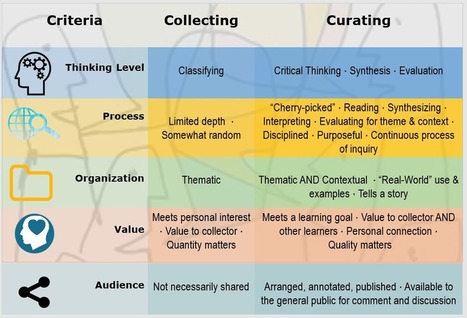
In the summer of 2012, I began an exploration of the concept of Content Curation, and what this meant for teachers and students. Little did I know at the time that my journey would involve curating…about curating. Given the task of providing professional development for teachers to curate resources for backwards-designed units, I started researching…
|
|
Scooped by
Gilbert C FAURE
August 1, 2020 5:11 AM
|
You’ll stay relevant and be happier.
|
|
Scooped by
Gilbert C FAURE
August 1, 2020 1:40 AM
|
I admire the evolving technology of Google Custom Search Engines (CSEs). By guessing some clever terms and operator combinations, over time, we have been able to un-dig (for example) loads of conta…
|
|
Scooped by
Gilbert C FAURE
July 31, 2020 12:34 PM
|
When people talk about “continuous learning” or “lifelong learning” they often mean by that term “continuous education” or “continuous training”, i.e. regularly attending courses or programmes, but in this article I want to show how continuous learning is, in fact, a process of incremental learning, i.e constantly adding to one’s knowledge and expertise over time. …
|
|
Scooped by
Gilbert C FAURE
July 29, 2020 3:55 AM
|
Emergent taxonomy [Wed 29 Jul 2020] I sometimes use emergent taxonomy. We usually develop taxonomies to help us organise, label and 'tag' content items to make them more naturally findable for users of content.
|
|
Scooped by
Gilbert C FAURE
July 29, 2020 3:35 AM
|
Fluently est un outil actuellement disponible en version bêta, permettant d'écrire un texte dans sa langue maternelle et le traduire !
As we look forward to the fall in which many schools will continue in a distance learning model to begin the year, we know that the Herculean effort that has been referred to as emergency remote le…
Via Dr. Tom D'Amico (@TDOttawa)
|
|
Scooped by
Gilbert C FAURE
July 29, 2020 2:27 AM
|
Ikigai is the Japanese art of living. I am a fan of Japanese way of thinking whether it is related to how they led the quality movement or how they exercise their craftsman spirit in day to da
|
|
Scooped by
Gilbert C FAURE
July 28, 2020 3:23 AM
|
With classes online, “active learning” is more important than ever.
|
|
Scooped by
Gilbert C FAURE
July 27, 2020 3:04 AM
|
Provides recommendations on how to get the most out of ResearchGate
"Dear Bonni, I have heard you recommend that we think more about being content curators, instead of creators. I am excited about the possibilities. Do you have a recommendation for how much should be curated in online classes vs. how much should be original and created by the instructor? In other words, is there such a thing as too much curation of existing content?"
Via EDTECH@UTRGV
|
|
|
Scooped by
Gilbert C FAURE
August 3, 2020 4:54 AM
|
|
|
Scooped by
Gilbert C FAURE
August 1, 2020 9:02 AM
|
A couple years ago I shared my original " Hipster Google " post, where I listed a collection of lesser known Google tools . The idea wa
Via Dr. Tom D'Amico (@TDOttawa)
|
|
Scooped by
Gilbert C FAURE
August 1, 2020 4:16 AM
|
Welcome! This presentation offers an overview of the National Teaching Repository, the rationale, aim and purpose. It tells you who we are, our institutional organisations and affiliations, what we are doing and why we are doing it. It outlines the role of the curator and the critical friend and signposts further information and guidance should you require it. It contains information for authors about how to share your practice and how you can get more involved should you wish to do so. We hope you will join us!Kindest regardsEveryone working to establish The National Teaching Repository
I’m fascinated by hyperdocs so I created this notebook template with tabs as a simple packaging for them. As usual, if you want to use it for something else, you can edit the titles of the tabs by clicking on Edit > Find and Replace. Colors are editable within the master, go to Slide > Edit Master and change the theme colors.Do not delete or add slides, duplicate the existing ones so you don’t have to add the links again.
Via Dr. Tom D'Amico (@TDOttawa)

|
Suggested by
Société Francaise d'Immunologie
July 31, 2020 11:24 AM
|
Science communication is part of the research process. Elodie Chabrol explains why.
|
|
Scooped by
Gilbert C FAURE
July 29, 2020 3:46 AM
|
Find out your best friends on Twitter
|
|
Scooped by
Gilbert C FAURE
July 29, 2020 3:32 AM
|
There is a widespread notion that educational systems should empower learners with skills and competences to cope with a constantly changing landscape. Reference is often made to skills such as critical thinking, problem solving, collaborative skills, innovation, digital literacy, and adaptability. What is negotiable is how best to achieve the development of those skills, in particular which teaching and learning approaches are suitable for facilitating or enabling complex skills development. In this paper, we build on our previous work of exploring new forms of pedagogy for an interactive world, as documented in our Innovating Pedagogy report series. We present a set of innovative pedagogical approaches that have the potential to guide teaching and transform learning. An integrated framework has been developed to select pedagogies for inclusion in this paper, consisting of the following five dimensions: (a) relevance to effective educational theories, (b) research evidence about the effectiveness of the proposed pedagogies, (c) relation to the development of twenty-first century skills, (d) innovative aspects of pedagogy, and (e) level of adoption in educational practice. The selected pedagogies, namely formative analytics, teachback, place-based learning, learning with drones, learning with robots, and citizen inquiry are either attached to specific technological developments, or they have emerged due to an advanced understanding of the science of learning. Each one i
Via NextLearning, Dennis Swender, juandoming
|
|
Scooped by
Gilbert C FAURE
July 28, 2020 9:49 AM
|
|
|
Scooped by
Gilbert C FAURE
July 27, 2020 11:09 AM
|
With information on COVID-19 evolving daily, the public is confronted with a mix of partial information, conflicting information and sometimes outright misinformation. Who should they turn to for the truth? In the context of acute uncertainty, I discuss what scientists can do to help mitigate the misinformation about what we do know and give some context to help decision-making in the unfolding story of COVID-19. In this Comment, Heidi Larson discusses the COVID-19 ‘infodemic’ and suggests the ways in which scientists can help to mitigate the spread of misinformation.
|
|
Scooped by
Gilbert C FAURE
July 25, 2020 6:41 AM
|
|









My article for OUP
My article for OUP