Your new post is loading...

|
Scooped by
Gilbert C FAURE
October 13, 2013 8:40 AM
|
is a personal Notebook Thanks John Dudley for the following tweet "If you like interesting snippets on all sorts of subjects relevant to academia, information, the world, highly recommended is @grip54 's collection:" La curation de contenus, la mémoire partagée d'une veille scientifique et sociétale
|
|
Scooped by
Gilbert C FAURE
Today, 11:48 AM
|
The recent Nature article raises important questions for academic medicine and healthcare institutions. Are traditional universities failing the future of academic medicine? The Nature commentary highlights the alarming decline in physician-scientists. But is the real problem a talent shortage or the academic systems we have created? Universities increasingly celebrate Q1 publications, research grants, citations and global rankings. However, are we rewarding research that actually transforms clinical practice, improves patient outcomes and strengthens healthcare systems? Do most academic institutions value application and impact as much as research publications & grants? Is it time to rethink academic medicine?
Perhaps we need to move beyond traditional university structures and seamlessly integrate Academic Health Systems with Health Professional Schools to create strong Health & Medical Universities. Academic Institutions where education, research, clinical practice and innovation are united by one mission: improving health! Where academic excellence is measured not only by what we publish, but by what changes because of our research & clinical innovation and application. The question for university and healthcare leaders is simple: Are we building universities that climb global rankings or institutions that genuinely improve peoples lives?
https://lnkd.in/g7KCAus5
#AcademicMedicine #AcademicHealthSystems #MedicalEducation #UniversityLeadership #HealthcareInnovation
|
|
Scooped by
Gilbert C FAURE
Today, 10:56 AM
|
Face au déploiement massif des intelligences artificielles génératives, la fin des outils de veille traditionnels semblait programmée. À quoi bon s'encombrer de plateformes spécialisées quand un algorithme délivre une réponse instantanée à la moindre requête ?
🛑 Ce postulat se révèle pourtant trompeur. Il confond la simple génération de contenu avec la véritable ingénierie de l'intelligence économique.
🟢 La veille stratégique ne se résume pas à l'obtention d'une donnée ponctuelle. Il s'agit d'un processus rigoureux qui exige de capter, filtrer, contextualiser et diffuser l'information pour la transformer en véritable levier décisionnel. Loin d'être condamnées, les cellules de veille et leurs plateformes dédiées conservent un rôle central. Leur développement passe désormais par une mue incontournable : absorber la puissance de l'IA pour enrichir une expertise analytique qui dépasse très largement le cadre du simple chatbot.
🤖 Sindup accompagne ce virage à travers de nouvelles fonctionnalités, de nouveaux outils et des formations adaptées.
👉 Lire l'article complet sur Archimag : https://lnkd.in/eBHTTCFA
gf2i - Groupement français de l'industrie de l'information EBD - Les formations de l'information IAE de Poitiers AEGE - Le réseau d'experts en intelligence économique EEIE - École Européenne d'Intelligence Économique Philippe HUGO Christophe Deschamps Réseau de compétences documentaires FLA Consultants Christian Marcon Fabrice Bellingard Pierre-Yves Platini mind Media Frédéric Guérineau Gaël Mallet Mickael Clement Jean Karinthi Christian BRUÈRE Corentin Thomas Constance Nebbula NATHALIE BOURGEOIS-FELICH
Régis Barondeau Terry ZIMMER Benoît Maille Olivier Hamant Olivier Hamant François LEMPEREUR Thibault Renard Jeanne Bretécher Myriam Moriquand Emmanuelle Roux
Evelyne SECHE-MAILLET Xavier Cazard Henri Stiller Jean-Pierre Sabio Pauline PANCHOT Denis Pansu ✍️ Christophe Faurie Ludovic Huth
|
|
Scooped by
Gilbert C FAURE
October 14, 6:56 AM
|
|
|
Scooped by
Gilbert C FAURE
October 12, 9:03 AM
|
#PISA2025 : la pédagogie, art ou science ?
Le déclin des résultats français tient aussi à une immaturité du débat public sur ce que signifie aujourd'hui enseigner. Une question que l’arrivée de l’IA dans le quotidien des élèves rend d'ailleurs d’autant plus difficile.
🏥 Le parallèle avec la médecine est de plus en plus fait : en quelques décennies, soigner est devenu moins un art qu'un savoir-faire evidence-based, guidé par les données actualisées de la science. Qu'en est-il de la pédagogie ?
🏫 Dans cette analyse pour Evidences, Mélanie Heard montre que PISA documente avec précision les faiblesses, mais aussi les qualités des élèves français : des qualités qu'une pédagogie evidence-based, mieux explicitée et plus standardisée permettrait d'épanouir.
En s'appuyant sur le plan d'action que le Conseil d'analyse économique (CAE) vient de proposer pour l'école, elle plaide pour que la recherche et l'évaluation guident davantage nos politiques éducatives, du pilotage national jusqu'au quotidien de la classe.
🔭 À l'heure où chacun redoute que la science ne devienne, comme aux États-Unis, le terrain d'une guerre culturelle, la campagne #2027 devrait être l'occasion de clarifier sa valeur pour guider notre école.
Analyse à lire ici : https://lnkd.in/esgbQDHK
Mélanie HeardMélanie Heard Agnès BuzynAgnès Buzyn Xavier Jaravel Clio DintilhacClio Dintilhac Jerry SheehanJerry Sheehan Éric Charbonnier La Grande Conversation Conseil scientifique de l'éducation nationale [CSEN]
|
|
Scooped by
Gilbert C FAURE
October 12, 8:44 AM
|
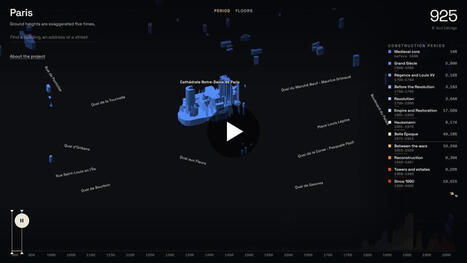
I made a map of Paris where each of its 122,435 buildings appears in the year it was built.
The surprise for me: only one building in fifteen dates from the Haussmann period, 1851 to 1870. Six times as many went up in the Belle Époque that followed, 1871 to 1914.
Two things I haven't seen in similar maps. You can pick any street and see every building on it side by side. And you can drop into a street-level panorama and walk around.
Link in first comment 👇
|
|
Scooped by
Gilbert C FAURE
October 12, 4:42 AM
|
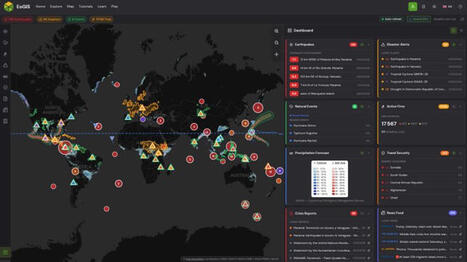
🤓 EoGIS.com et EoGIS.fr : toujours plus d’utilisateurs, toujours gratuit.
Depuis le lancement, la fréquentation ne cesse de progresser, et je tiens à remercier toutes celles et ceux qui utilisent EoGIS au quotidien.
Le principe reste le même :
✅ Gratuit
✅ Sans compte, sans inscription
✅ Accès libre, directement dans le navigateur
Vous ouvrez la page, vous travaillez sur la carte. C’est tout.
👉 www.eogis.com (Un WebSIG disponible dans le monde entier)
👉 www.eogis.fr (OpenData sur les communes françaises)
Vos retours sont précieux : n’hésitez pas à partager l’outil autour de vous et à me dire ce qui vous serait utile.
#SIG #GIS #Cartographie #Géomatique #OpenAccess #WebMapping
|
|
Scooped by
Gilbert C FAURE
October 11, 12:43 PM
|
📚 𝗟𝗜𝗥𝗘 𝟱𝟬 𝗔𝗥𝗧𝗜𝗖𝗟𝗘𝗦 𝗡𝗘 𝗦𝗜𝗚𝗡𝗜𝗙𝗜𝗘 𝗣𝗔𝗦 𝗙𝗔𝗜𝗥𝗘 𝗨𝗡𝗘 𝗕𝗢𝗡𝗡𝗘 𝗥𝗘𝗩𝗨𝗘 𝗗𝗘 𝗟𝗜𝗧𝗧É𝗥𝗔𝗧𝗨𝗥𝗘.
Vous pouvez lire 50, 100 ou même 200 articles…
et pourtant avoir une revue de littérature faible.
Pourquoi ?
Parce qu’une revue de littérature n’est pas une succession de résumés.
❌ Résumé des articles ≠ synthèse critique
🔹 𝟭. 𝗡𝗘 𝗩𝗢𝗨𝗦 𝗖𝗢𝗡𝗧𝗘𝗡𝗧𝗘𝗭 𝗣𝗔𝗦 𝗗𝗘 𝗥É𝗦𝗨𝗠𝗘𝗥
❌ « Dupont (2022) montre que… »
❌ « Martin (2023) constate que… »
❌ « Smith (2024) conclut que… »
Article après article, vous pouvez avoir beaucoup de références…
mais peu d’analyse.
👉 Le lecteur doit comprendre ce que les études disent collectivement, pas seulement ce que chaque auteur a écrit.
🔹 𝟮. 𝗖𝗢𝗠𝗣𝗔𝗥𝗘𝗭 𝗟𝗘𝗦 𝗥𝗘𝗖𝗛𝗘𝗥𝗖𝗛𝗘𝗦
Demandez-vous :
👉 Quels résultats sont similaires ?
👉 Quels facteurs reviennent régulièrement ?
👉 Quelles méthodes sont les plus utilisées ?
👉 Quelles populations ou contextes sont étudiés ?
L’objectif est de faire apparaître des tendances.
🔹 𝟯. 𝗖𝗢𝗡𝗧𝗥𝗔𝗦𝗧𝗘𝗭 𝗟𝗘𝗦 𝗥É𝗦𝗨𝗟𝗧𝗔𝗧𝗦
C’est souvent ici que commence la véritable analyse critique.
❓ Pourquoi certaines études obtiennent-elles des résultats différents ?
Peut-être à cause :
• du contexte
• de l’échantillon
• de la méthodologie
• des variables étudiées
• de la période d’étude
👉 Les contradictions peuvent devenir particulièrement intéressantes pour votre recherche.
🔹 𝟰. 𝗜𝗗𝗘𝗡𝗧𝗜𝗙𝗜𝗘𝗭 𝗟𝗘𝗦 𝗟𝗜𝗠𝗜𝗧𝗘𝗦
Une bonne revue ne montre pas uniquement ce que l’on sait.
Elle montre aussi :
❓ Ce qui reste incertain
❓ Ce qui a été peu étudié
❓ Ce qui n’a été étudié que dans certains contextes
❓ Quelles limites méthodologiques persistent
Et c’est ici que vous commencez à vous rapprocher du Research Gap.
🔹 𝟱. 𝗖𝗢𝗡𝗦𝗧𝗥𝗨𝗜𝗦𝗘𝗭 𝗟𝗘 𝗥𝗘𝗦𝗘𝗔𝗥𝗖𝗛 𝗚𝗔𝗣
La logique peut être résumée ainsi :
📚 Littérature
↓
🔎 Comparer
↓
⚡ Contraster
↓
❓ Identifier les limites et les zones peu explorées
↓
🎯 Construire le Research Gap
📌 𝗨𝗡 𝗕𝗢𝗡 𝗥É𝗙𝗟𝗘𝗫𝗘 𝗣𝗢𝗨𝗥 𝗩𝗢𝗧𝗥𝗘 𝗥𝗘𝗩𝗨𝗘
Au lieu de demander uniquement :
« Qu’est-ce que dit cet article ? »
demandez-vous :
« Qu’est-ce que l’ensemble de ces travaux nous permet de comprendre ? »
C’est cette question qui transforme une liste de références en synthèse scientifique.
📥 Enregistrez ce post pour votre prochaine revue de littérature.
💬 Et vous, quelle est votre plus grande difficulté : trouver les articles, les organiser ou construire la synthèse critique ?
𝗣𝗿𝗼𝗿é𝗱𝗮𝗰𝘁𝗶𝗼𝗻 accompagne les étudiants, doctorants et chercheurs dans la structuration et la rédaction de leurs travaux académiques.
📲 WhatsApp : +33 6 63 42 22 87
📧 info@proredaction.com
#RevueDeLittérature #ResearchGap #MéthodologieDeRecherche #RechercheScientifique #Doctorat #Thèse #Mémoire #AcademicWriting #PublicationScientifique
|
|
Scooped by
Gilbert C FAURE
October 10, 5:33 AM
|
Check out the schedule for OEGlobal 2026
|
|
Scooped by
Gilbert C FAURE
October 10, 2:48 AM
|
AI made researchers three times more productive. It also made them read each other less.
Researchers ran a classifier across 41.3 million papers in the natural sciences to find the ones where AI did part of the work.
For the individual it reads like a case for adoption:
"Scientists who engage in AI-augmented research publish 3.02 times more papers, receive 4.84 times more citations, and become research project leaders 1.37 years earlier than those who do not."
Then the same authors measured the field:
"AI adoption shrinks the collective volume of scientific topics studied by 4.63% and decreases scientists' engagement with one another by 22%."
That second number is researchers citing, building on, and arguing with each other's work. Down by a fifth, among the group publishing three times as much.
My suspicion is that these tools pull you towards the medium. Ask a model for the literature and it returns what is most cited, most repeated in its training data, and most centrally placed. You never learn what did not come back.
Effort used to decide whether something needed to exist. Somewhere around the third paragraph of something pointless you would run out of things to say and stop. AI removes that moment. It will finish any document you begin, at a standard most people will accept. Unnecessary work no longer dies of its own accord.
So before you make the next thing, ask one question.
Who asked for this?
Name a person, a real one. The sector will not do. Stakeholders will not do. Leadership will not do.
I have written up the whole argument, including the paper of mine I spent ten years calling pointless and was wrong about. Read it here on Slow AI on Substack:
https://lnkd.in/eD7V9x8N
What is the last thing you read that you would never have found through a search box?
#AILiteracy #Research #HigherEducation #AcademicPublishing #ResearchMethods #CriticalThinking #ScholarlyCommunication #OpenScience #AIinEducation #SlowAI | 38 comments on LinkedIn
|
|
Scooped by
Gilbert C FAURE
October 8, 8:49 AM
|
London School of Economics researchers say Gen Alpha will talk, not type at work—they predict that voice notes will make keyboard practically obsolete by 2030.
|
|
Scooped by
Gilbert C FAURE
October 8, 8:35 AM
|
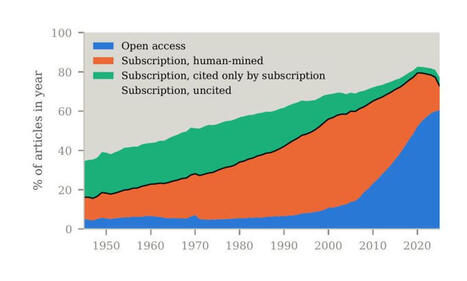
Is up to 80% of the content of the research literature already available in an LLM?
In 1950 Norbert Wiener worried less about machines doing the work of people than about people becoming components in processes they had neither designed nor could control. My new paper, The machine use of human beings, turns his title round to ask how AI systems come to know research that sits behind a paywall.
A machine that may lawfully read only open-access papers still learns a good deal about subscription work, because the researchers who read it go on to cite and restate it in open articles. We call this human mining. Across 124 million articles in Dimensions and Unpaywall (https://unpaywall.org/), three quarters of the subscription articles that have ever been cited have been cited from the open literature. The median wait for that first open citation has fallen from thirteen years for work published in 1990 to one year for work from 2020. That change comes from the growth of open publishing, not from any change in how we cite.
What crosses over is selective, though. It carries single results rather than the method, the caveat or the approach that failed. It favours the recent and the much-cited, it can pick up errors along the way, and the researchers acting as the machines' sensors get no credit for it.
The chart splits each year's output into open, subscription-but-cited-openly, cited only behind the paywall, and uncited. The black line is roughly the most an open-only machine reader can see.
https://lnkd.in/eBpC595H
|
|
Scooped by
Gilbert C FAURE
October 8, 8:23 AM
|
L'intégrité de la recherche est fondamentale pour la confiance dans la production scientifique, mais les systèmes qui la protègent sont soumis à une pression croissante. Des défis de longue date, tels que la fraude, la manipulation et les pratiques de recherche problématiques, se conjuguent désormais avec l'augmentation du volume des soumissions, l'évolution des incitations et les progrès rapides de l'intelligence artificielle. Ces pressions affectent différemment les différents maillons de l'écosystème de la communication scientifique, soulevant des questions importantes quant à l'origine des risques, à l'efficacité de leur détection et à la capacité des politiques, pratiques et ressources actuelles à suivre le rythme.
L'intéressant sondage #PulseCheck de la Society for Scholarly Publishing examine comment les organisations de l’écosystème de l’édition scientifique réagissent aux défis actuels en matière d’intégrité de la recherche. Les résultats offrent un aperçu opportun des priorités actuelles, de la confiance de la communauté et des causes sous-jacentes.
👉 https://lnkd.in/eexVmJ6g
Quelques points saillants :
🎯 les manuscrits générés ou manipulés par l’IA constituent le principal défi, et les inquiétudes l’emportent sur la confiance dans la détection ;
🎯 bien que 94 % des organisations aient mis en place au moins une mesure d’intégrité, 63 % d’entre elles ont peu confiance dans la capacité de l’écosystème à protéger efficacement le patrimoine scientifique ;
🎯 l’IA est à la fois un défi et un outil. Plus de la moitié ont recours à un filtrage assisté par l’IA, mais la communauté reste divisée quant à savoir si l’IA améliore la détection et la prévention des atteintes à l’intégrité ;
🎯 la place qu’occupent les organisations au sein de l’écosystème détermine leur perception. Les éditeurs mettent l’accent sur les menaces pesant sur le processus de publication, tandis que les bailleurs de fonds, les institutions et les bibliothèques accordent une importance relativement plus grande aux pratiques de recherche et aux défis systémiques.
🎯 La pression liée au « publish or perish » est considérée comme la principale cause profonde, les personnes interrogées soulignant comment cette pression, l’IA, le volume des soumissions, la fraude et les contraintes de ressources se renforcent mutuellement.
|
|
|
Scooped by
Gilbert C FAURE
Today, 11:51 AM
|
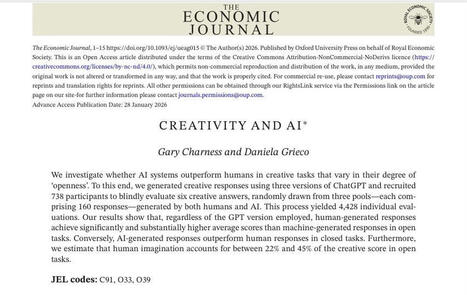
Humans are more creative than LLMs on open tasks requiring imagination.
A new fascinating paper compares humans with three LLMs on two creative tasks.
The closed task: write a story incorporating ten specified words, such as “house”, “cow” and “planet”.
The open task: imagine you could invent anything simply by thinking about it. What would you create, and why?
Creativity was rated from 1 to 10 by human evaluators who did not know whether responses came from humans or AI.
The results are super interesting:
In the closed task, LLMs outperform humans on average.
By contrast, in the open task, humans outperform all three LLMs.
Why?
To provide a first potential answer, the authors model imagination as the human capacity to generate ideas beyond what instructions prescribe. Then they estimate its contribution from differences between human and AI scores.
Their model attributes between 22% and 45% of humans’ creativity scores in the open task to imagination.
Humans may be more creative than LLMs thanks to their capacity to jump beyond what is prescribed.
*
Paper in the first comment. | 15 comments on LinkedIn
|
|
Scooped by
Gilbert C FAURE
Today, 11:34 AM
|
Et si, pour vérifier une information, le premier réflexe des adolescents était de... demander à une intelligence artificielle ?
L’IA conversationnelle s’installe progressivement dans les pratiques informationnelles des jeunes. Mais quelle place occupe-t-elle dans leur manière de s’informer, et surtout, quelle confiance lui accordent-ils ?
📊 Notre étude « Les adolescents face à l’information », réalisée avec l’institut Toluna Harris Interactive, auprès des 11-18 ans, révèle que :
• Plus d’1 adolescent sur 4 utilise une IA, comme ChatGPT, pour vérifier une information.
• 38 % des 16-18 ans utilisent l’IA pour chercher à comprendre un sujet.
• Plus d’1 adolescent sur 2 déclare faire confiance aux informations fournies par les IA conversationnelles.
• 4 adolescents sur 10 remettent rarement, voire jamais, en question les réponses de ces outils.
🔎 Pourtant, les réflexes d'esprit critique existent : 6 adolescents sur 10 déclarent vérifier les informations auxquelles ils sont exposés.
👉 L’enjeu n’est donc pas tant d’apprendre aux jeunes à vérifier l’information que de les accompagner dans l’évolution de leurs pratiques, à l’heure où un même outil peut servir à la fois à chercher une réponse et à en vérifier la fiabilité.
Car une réponse immédiate, même formulée avec assurance, n’est pas nécessairement une réponse fiable.
💡 Face à ces nouveaux usages, l’éducation aux médias et à l’information joue un rôle essentiel : apprendre à identifier les sources, croiser les informations, distinguer les faits des opinions et conserver un regard critique sur les réponses générées par l’IA.
L’objectif n’est pas de faire de chaque adolescent un expert du "fact-checking", mais de lui donner les clés pour s’informer sans déléguer son jugement à une intelligence artificielle.
💡 À l’heure où accéder à une réponse n’a jamais été aussi simple, savoir d’où vient l’information et comment en évaluer la fiabilité devient une compétence indispensable.
Justine ATLAN | Samuel Comblez | Véronique BECHU | Inès Legendre | Edouard GEFFRAY | Sarah El Haïry | Anne Le Hénanff | Stephanie RIST | Virginie Sassoon | Serge Barbet | CLEMI | François Saltiel | Thomas Huchon | Gregoire Borst | Vincent Couronne
#ÉducationAuxMédias #EspritCritique #EMI
|
|
Scooped by
Gilbert C FAURE
October 14, 7:33 AM
|
One of my favourite journal articles of all time, Fifty shades of open by Jeffrey Pomerantz and Robin Peek, was published a decade ago: Open source. Open access…
|
|
Scooped by
Gilbert C FAURE
October 14, 3:47 AM
|
Si même le Kansas vacille…...
|
|
Scooped by
Gilbert C FAURE
October 12, 9:02 AM
|
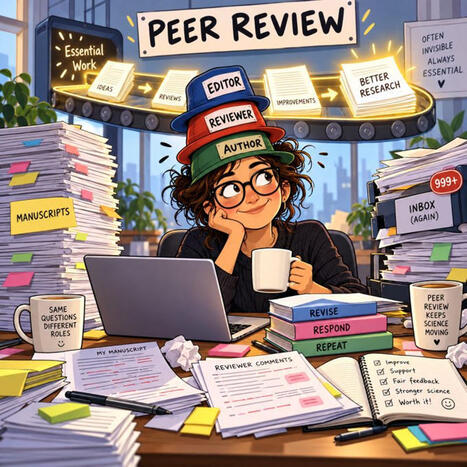
This commentary by Emma Tillman on peer review raises some really important points.
As someone who sits on all sides of the process—as a reviewer, editor, AND author—I can attest that the challenges are real.
Peer review is essential to the scholarly enterprise, yet the work is largely invisible: rarely measured, rarely rewarded, and often piled onto the same relatively small group of people who are already juggling research, teaching, clinical care, and administrative responsibilities.
If we want a sustainable peer-review system, we probably need to start treating reviewing as the scholarly work that it is.
Worth a read: https://lnkd.in/ep4rnswC
BTW, we (the editors of Journal of Graduate Medical Education) wrote about some of the benefits of peer-review—and how we can value it as legitimate #scholarship—here: https://lnkd.in/ePmyVf-4
#AcademicMedicine #PeerReview #MedEd #Scholarship Deb Simpson Gail Sullivan Lainie Yarris
|
|
Scooped by
Gilbert C FAURE
October 12, 4:44 AM
|
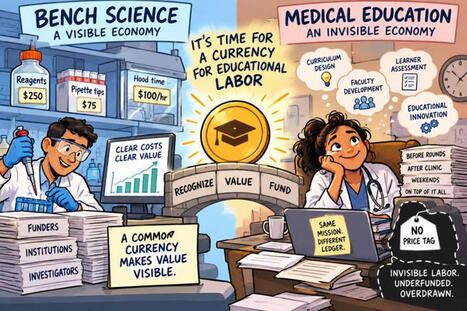
It's not just the small-grant economy that's problematic for clinician-educators and others in #MedEd...
In this excellent Academic Medicine Journal letter to the editor, Michael Soh et al. build on one of our previously published papers about the small-grant economy in medical education. In particular, the authors discuss another, potentially larger problem: the extent to which educational labor remains largely invisible within the economic structures of academic medicine.
Their argument is simple but important: if educational work has no recognized “currency,” it becomes easy to undervalue, underfund, and absorb into the margins of faculty members’ professional lives. The authors ultimately call for better ways to recognize, value, and account for educational work within our institutions.
Boy oh boy, does this argument strike close to home...
Our original paper: https://lnkd.in/efG6ueNV
Soh et al.'s letter: https://lnkd.in/eHVm_yfn | 14 comments on LinkedIn
|
|
Scooped by
Gilbert C FAURE
October 11, 12:52 PM
|
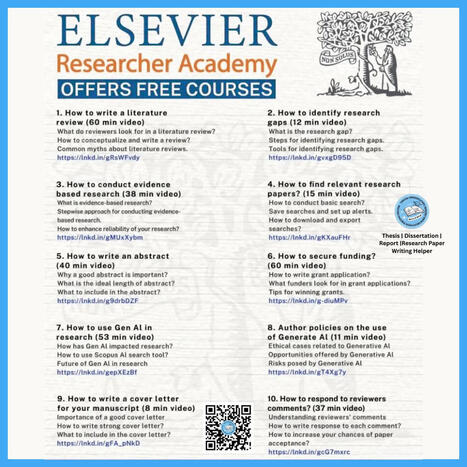
10 Free Research Courses Every Researcher Should Know
Looking to strengthen your research and academic writing skills without spending money?
Elsevier Researcher Academy offers free courses to help researchers improve their knowledge and publishing skills.
1. How to Write a Literature Review
2. How to Identify Research Gaps
3. How to Conduct Evidence-Based Research
4. How to Find Relevant Research Papers
5. How to Write an Abstract
6. How to Secure Research Funding
7. How to Use Generative AI in Research
8. Understanding AI Ethics and Policies
9. How to Write a Manuscript Cover Letter
10. How to Respond to Reviewers' Comments
These courses are useful for university students, PhD scholars, early-career researchers and academic writers who want to improve their research skills and publish with confidence.
Connect on all platforms : https://lnkd.in/gF-bQFND
Follow me SARMIN AKTER for more
Comment "RESEARCH" to get the links to these free courses. | 99 comments on LinkedIn
|
|
Scooped by
Gilbert C FAURE
October 11, 4:55 AM
|
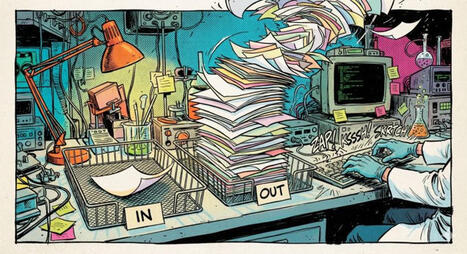
Last year, ICLR received 19,000 submissions. This year, based on abstract registrations, it looks like 60,000.
You don't get a 3x increase in academic output in a single year because researchers suddenly started working harder. You get it because the cost of production dropped.
AI is now generating a massive portion of these papers.
I’m actually not pessimistic about this. Better tools mean more ideas get explored, which is generally a good thing. But the second-order effects are strange, and they are quietly breaking our definition of truth.
Look at the new lifecycle of a research paper:
1. 𝗖𝗿𝗲𝗮𝘁𝗶𝗼𝗻: The researcher uses an LLM to brainstorm, write the code, run the experiment, and draft the text.
2. 𝗥𝗲𝘃𝗶𝗲𝘄: It’s not just human reviewers secretly using LLMs to survive a 60,000-submission avalanche. It is becoming systemic. We already see unofficial LLM-generated reviews sitting alongside human ones on open review portals. Conferences like AISTATS have even officially introduced LLM reviews for "factual checking", carefully noting that the AI doesn't determine the final decision, even if it clearly informs it. But fast-forward a little bit, and it is only a matter of time before the AI's critique dictates the verdict.
3. 𝗖𝗼𝗻𝘀𝘂𝗺𝗽𝘁𝗶𝗼𝗻: When the paper is published, the audience uses LLMs to summarize what it says.
𝗔𝗜 𝗯𝗿𝗮𝗶𝗻𝘀𝘁𝗼𝗿𝗺𝘀 𝗶𝘁. 𝗔𝗜 𝗿𝗲𝘃𝗶𝗲𝘄𝘀 𝗶𝘁. 𝗔𝗜 𝗿𝗲𝗮𝗱𝘀 𝗶𝘁.
For centuries, our most practical signal of credibility in science has been peer review. We trusted the journal because we trusted the human consensus behind it.
But what happens to the 𝘀𝗼𝘂𝗿𝗰𝗲 𝗼𝗳 𝘁𝗿𝘂𝘁𝗵 when the peers are mostly language models talking to each other?
We aren't just automating research. We are automating the 𝘃𝗲𝗿𝗶𝗳𝗶𝗰𝗮𝘁𝗶𝗼𝗻 𝗼𝗳 𝗸𝗻𝗼𝘄𝗹𝗲𝗱𝗴𝗲. We are moving toward a world where the system is essentially a machine grading its own homework, and we don't yet know what that means for truth.
| 20 commentaires sur LinkedIn
|
|
Scooped by
Gilbert C FAURE
October 10, 4:37 AM
|
Le monde de l’édition scientifique est aujourd’hui confronté à une multiplication de pratiques frauduleuses de plus en plus sophistiquées, dont l’objectif est principalement de percevoir de l’argent (au travers de frais de publication, de la vente de « services »…). Quelles sont les principales méthodes de prédation à connaître ?
#revuepredatrice
https://lnkd.in/egvfXvGg
|
|
Scooped by
Gilbert C FAURE
October 10, 2:44 AM
|
Ordre des traits des caractères chinois
Cet outil va vous aider à écrire correctement les caractères chinois grâce à une animation trait par trait. En effet, l’ordre et la direction de chaqu
|
|
Scooped by
Gilbert C FAURE
October 8, 8:47 AM
|
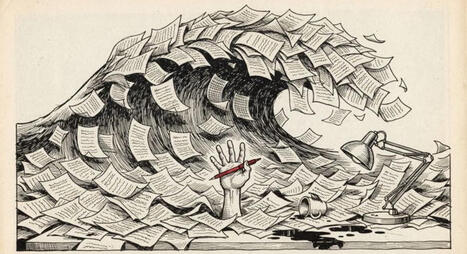
A journal that received 160 submissions in 2022 expects more than 1,000 this year. Its own editors say they will soon lack the resources to keep up. AI is to blame.
This comes from an editorial published on 25 September in the journal Accountability in Research.
The numbers around it are arguably even worse than the surge itself. A study of 7.3 million journal articles found that sentences showing GenAI influence rose from 12% in 2023 to 57% in 2025. One estimate puts 140,000 hallucinated citations in articles on preprint servers and scholarly indexes in 2025 alone. It is also likely that more than half of scientists now use GenAI to write peer review reports, despite most journals prohibiting this.
The editors are blunt about enforcement. They state that AI detection tools remain unreliable, and that even the watermarking Anthropic introduced earlier this year cannot always label AI-generated or AI-assisted text.
So, the editors changed the system.
They have capped each author at four submissions a year to make the journal a harder target for paper mills, made ORCID numbers a requirement for all authors, demanded underlying data for empirical papers, and banned AI in commentaries and letters to the editor.
Have they gone far enough?
Read the editorial in full here: https://lnkd.in/eU5GsVnv
#ResearchIntegrity #ScholarlyPublishing #PeerReview #AcademicPublishing #AIinResearch #CriticalAILiteracy #HigherEducation #OpenScience #AIEthics #Academia | 25 comments on LinkedIn
|
|
Scooped by
Gilbert C FAURE
October 8, 8:25 AM
|
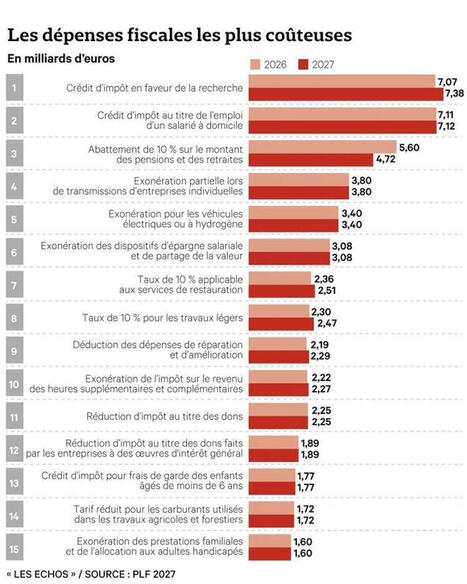
Le Crédit d'Impot Recherche est dépourvu de ciblage et de stratégie et a un effet de levier négatif sur l'investissement en R & D en France, quand la Belgique a un système d'aides focalisées, avec un effet de levier x4. Quatre euros privés investis pour un euro d argent public.
Cette niche fiscale désastreuse est l'un des plus gros facteurs de déclin économique et technologique. Les hauts fonctionnaires de Bercy, analphabètes scientifiquement, en font à nouveau la plus grosse niche fiscale du Projet de Loi de Finances.
Il est temps de réorienter le dispositif pour répondre aux besoins de la société, par une politique pensée, ciblée et évaluée.
https://lnkd.in/eg849fPx | 19 comments on LinkedIn
|
|
Scooped by
Gilbert C FAURE
October 8, 8:12 AM
|
https://lnkd.in/eg9Ztbgd
La publication scientifique en masse : un problème qui s'est installé progressivement.
H-index, g-index, i10, autant d'indices "d'excellences" dont la côte est importante pour la poursuite de la carrière. Cet aspect, mais pas que, conduit à cette course à la publication effrénée et, pas forcémen
|