Give each tool a clear job before your team adds more tabs. Use this five-part stack as a starting point to test. The roles overlap. No tool owns a whole category.
1 → ChatGPT for quick ideas Draft email rewrites, explore angles and get coding help. Ask for three options with one clear difference each. Pick a direction, then check the details before use.
2 → Claude for deep work Bring a complex document, report or deck outline. State the decision and the audience before asking for a draft. Ask it to flag gaps and separate facts from assumptions. Keep a human owner for the final recommendation.
3 → Perplexity for current research Start with a question that needs recent sources. Ask for dates, evidence and links you can open. Check whether each citation supports the actual claim. A cited answer still needs a source check.
4 → Gemini + Nano Banana for visuals and Google work Use Gemini for document work and Workspace context. Nano Banana is image generation within Gemini. Give it the subject, layout and words a visual must contain. Check image text and file limits before relying on output. Access and integrations depend on your plan and setup.
5 → Copilot for Microsoft work Try it where the task already lives: Excel, Word or PowerPoint. Use Outlook help for a draft tied to the thread. Check formulas against known values and read before sending. Confirm your Microsoft 365 plan supports the feature.
Use five minutes as a switching cue, not a proven cutoff. If the answer keeps failing, first check the brief. Missing context will follow you into the next tool. Then try another tool on the same task and compare results.
Make every brief include goal + audience + format. For example: turn these notes into a CEO update. Use six short points and flag missing decisions. Define a useful result before you judge the draft.
For repeat work, save context in a project or agent. Start with meeting notes, replies or a weekly report. Keep one good example and a short review checklist. Test on real work before giving an agent broader actions.
Track time spent checking and fixing the output. Keep the tools that reduce that total for your team. More subscriptions alone will not improve the workflow. Choose one recurring task to test this week.
Which job are you still forcing your default AI tool to do? | 29 comments on LinkedIn
"If you like interesting snippets on all sorts of subjects relevant to academia, information, the world, highly recommended is @grip54 's collection:"
La curation de contenus, la mémoire partagée d'une veille scientifique et sociétale
Gilbert C FAURE's insight:
... designed to collect posts and informations I found and want to keep available but not relevant to the other topics I am curating on Scoop.it (on behalf of ASSIM):
because we have a long standing collaboration through a french speaking medical training program between Faculté de Médecine de Nancy and WuDA, Wuhan university medical school and Zhongnan Hospital
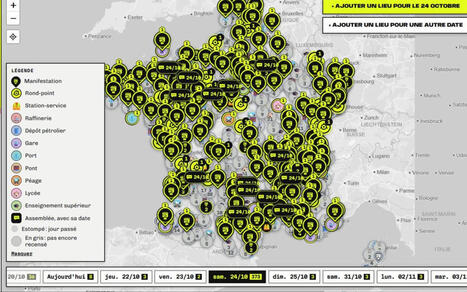
Après la mobilisation du 17 octobre, les Gilets jaunes appellent à un nouvel acte contre la vie chère ce samedi 24 octobre. Rassemblements sur les ronds-points, manifestations et actions locales : découvrez la carte des mobilisations annoncées partout en France, alors que lycéens et étudiants sont également appelés à poursuivre la contestation.
🤖 IA en santé : quand les patients arrivent en consultation avec leur diagnostic...et leur ordonnance !
Le Dr Google a-t-il définitivement laissé sa place au Dr ChatGPT ?
L’intelligence artificielle générative s’invite dans la relation médecin-patient et bouleverse progressivement les habitudes de consultation. Diagnostic présumé, examens souhaités, traitements envisagés : les patients sont de plus en plus nombreux à interroger l’IA avant de consulter, voire parfois à la place d’un médecin.
En avant-première de la deuxième édition du Baromètre Data & IA en santé, qui sera dévoilée dans son intégralité le 5 novembre prochain, l'Acsel - L'association de l'économie numérique et Toluna révèlent des chiffres particulièrement éclairants sur ces nouveaux usages.
📊 Des chiffres particulièrement révélateurs :
🔹 90 % des professionnels de santé interrogés dont les patients utilisent l'IA ont déjà reçu un patient arrivant avec une idée précise de sa pathologie après avoir consulté une IA générative. Côté patients utilisateurs d'IA en santé, 46 % déclarent lavoir fait.
🔹 82 % des professionnels ont déjà été confrontés à un patient ayant une idée précise des examens complémentaires qu'il souhaitait réaliser grâce à l'IA (46 % côté patients).
🔹 79 % des professionnels ont également vu des patients arriver avec une idée précise du traitement souhaité (43 % côté patients).
⚠️ Plus préoccupant : 53 % des professionnels ont été confrontés à des patients ayant utilisé l'IA à la place dune consultation médicale, estimant quelle pouvait les aider autant qu'un médecin. Une situation reconnue par 43 % des patients utilisateurs d'IA en santé.
Le patient ne vient plus seulement consulter. Il vient aussi confronter les réponses de l'IA à l'expertise médicale.
Un grand merci à toutes celles et ceux qui suivent Sindup ici, interagissent avec nos contenus et partagent leur intérêt pour la veille stratégique et l’innovation.
Nous partageons aussi de plus en plus de contenus vidéo sur YouTube ! Abonnez-vous à notre chaîne pour ne rien manquer de nos prochaines publications 👉 https://lnkd.in/eCqcgEtr
Join us this November as the Active Learning Network (ALN) celebrates its milestone 10-year anniversary with the global ALNiversary Showcase! Whether you are a higher education leader or manager, academic, educational developer, learning technologist, or educator in any role from across the globe, this month-long celebration is for you. Sign up Event Schedule When: Every Tuesday throughout November Sessions: Two…
Je vous partage un texte lu sur Facebook et qui m'a intéressée. Pour le reste, faites vos propres recherches..
Pour la première fois depuis plus d’un siècle, une rupture historique se dessine, avec une génération entière qui affiche des performances cognitives inférieures à celles qui l’ont précédée.
La Génération Z devient officiellement la première génération moderne à régresser sur le plan intellectuel par rapport aux Millennials.
Ce constat a été formulé sous serment par le neuroscientifique Jared Cooney Horvath lors de son audition devant le Sénat américain en janvier 2026.
Les faits sont clairs :
1. Un recul mesuré, mondial, documenté QI moyen, mémoire de travail, compréhension écrite, raisonnement mathématique, résolution de problèmes, avec tous les indicateurs cognitifs fondamentaux qui sont en baisse, dans plus de 80 pays. Il ne s’agit pas d’un phénomène culturel local, mais d’une tendance globale.
2. Le problème n’est pas l’éducation, mais sa numérisation. Contrairement au discours dominant, ce déclin n’est pas lié à un manque d’accès au savoir. Il est corrélé à l’intégration massive des écrans à l’école, avec les tablettes, les ordinateurs, les contenus interactifs. Selon Horvath, ces outils ont freiné, et parfois altéré, le développement cérébral.
3. Le cerveau humain n’est pas conçu pour le “format court”. Notre biologie repose sur l’effort cognitif, l’attention soutenue, l’échange humain. La consommation permanente de contenus courts, de vidéos rapides, de résumés visuels, des listes à puces …, empêche la consolidation des connexions neuronales profondes. On stimule, mais on n’imprime plus.
4. Le paradoxe le plus inquiétant, est l’illusion de compétence. Plus l’accès à l’information est immédiat, plus le sentiment de maîtrise augmente …, alors que la compréhension réelle diminue. La Gen Z confond savoir et disponibilité de la donnée, lecture et survol, intelligence et rapidité.
La formule de Horvath est brutale, mais précise : « Nous ne progressons pas. Nous capitulons ».
Face à ce qu’il qualifie d’urgence sociétale, il recommande une rupture claire avec le modèle actuel, et s’inspire des pays scandinaves, limitant drastiquement les écrans à l’école, reviennent aux manuels, à la lecture longue, et à l’interaction humaine directe.
Thierry Perruchot L'Être dans sa Globalité Spirituel | 13 comments on LinkedIn
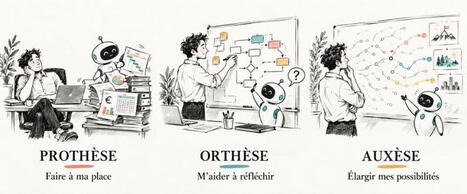
Vous servez-vous de l'IA comme d'une prothèse, d'une orthèse ou d'une auxèse ? 3 chercheurs -Olivier Las Vergnas -Antoine Rio-Jouet -Christophe Jeunesse nous proposent cette analogie éclairante (cf. en commentaire le lien vers leur article)
- La prothèse : je demande à l'lA de produire à ma place Vous risquez à terme de perdre en compétence et de maîtrise des sujets Par exemple : un planning bien présenté ne signifie pas que je sais expliquer ses dépendances, défendre ses estimations ou les adapter à un changement.
- L’orthèse : je me sers de l'IA pour challenger mon travail, me questionner et progresser Elle vous permet de garder la maîtrise du sujet et votre regard critique. Par exemple : « Voici mon analyse des risques. Quelles hypothèses sont fragiles ? Quels risques ai-je pu oublier ? Pose-moi des questions ?
- L’auxèse : à partir de ce que j’ai produit à partir de mes hypothèses et contraintes, comment pourrais-je changer de perspective pour explorer d’autres possibilités ? Un usage qui permet de développer vos compétences et votre capacité de réflexion et éclairer vos décisions.
La promesse de l'intelligence artificielle est séduisante : faire à votre place et vous permettre d’aller plus vite. Derrière cette facilité apparente d’usage de l’IA pour produire mes livrables, trois questions se posent : - Est-ce que je continue à acquérir des compétences ? - Est-ce que j'apporte de la valeur dans mon travail ? - Est-ce que je développe mon sens critique pour résoudre des problèmes et prendre des décisions ? | 31 comments on LinkedIn
We need more meta-analyses of research on #science #communication. This is what Mike S. Schäfer, Elisa Tedaldi, and I argue in a new commentary, published in Public Understanding of Science Journal: https://lnkd.in/eJY35ujM #OpenAccess
Our main points: 🔎 Research on science communication has grown and diversified substantially, but we have few consolidated answers to key questions, such as: Does #hate speech against scholars affect public perceptions of them? Does political advocacy affect scientists' #trustworthiness? How are #socialmedia use and science #literacy related to each other? We do have several studies on these questions, but they are fragmented across different contexts, conceptual approaches, study designs, and construct operationalizations.
⚙️ Meta-analyses can provide answers to some of these questions – yet they are rare in #scicomm research, unlike in political, #health, and #environmental communication. They provide statistically robust estimates of effect sizes across many studies, including the conditions under which effects vary – so they are a powerful tool to synthesize the large portion of #survey-based and #experimental research in our field.
🧭 We propose a meta-analytical research #agenda: Use moderator analyses to account for cultural and topical differences, include multilingual and grey literature to counter the Western skew of the literature, weight evidence by its quality, handle the many operationalizations of concepts like #trust in science, and improve #OpenScience standards for reporting effect sizes and sharing data.
💢 Following this agenda can enable us to provide robust, cumulative evidence on overarching themes of science communication research. This, in turn, both benefits the progress within our field and increases its #impact beyond it.
Many thanks to my co-authors Mike S. Schäfer and Elisa Tedaldi! A shout-out also to Aart van Stekelenburg, Gabi Schaap, Harm Veling, Jonathan Van 't Riet', and Moniek Buijzen, as well as Zhuo Guo and colleagues whose meta-analyses on consensus and uncertainty communication show what's possible in our field 🙏
#scicomm #wetkomm #metaanalysis NeFCA Division Science Communication | Strategic Communication Chair Group | UZH Department of Communication and Media Research (IKMZ) | DGPuK-Fachgruppe Wissenschaftskommunikation | Metascience 2027 | Center for Reproducible Science and Research Synthesis UZH
Amnis is voice dictation for Mac. Speak naturally, and clean, finished text lands in the app you already have open. The ums drop out, your corrections are applied, and the formatting follows.
In this video: 0:00 Just speak: your email writes itself 0:11 Change your mind mid-sentence 0:22 Names it remembers, and other languages 0:34 Select an email and say the reply
In 1979, Archie Cochrane called for critical summaries of all relevant trials, updated periodically. Fifty years later, we have the summaries. We rarely have the updates.
The obstacle was never intellectual, it was arithmetic: reviews take years, while thousands of papers appear every day.
That gap is closing.
🔎 otto-SR reproduced and updated 12 Cochrane reviews in two days, roughly 12 work-years, with higher screening sensitivity than dual human review. Updating shifted 3 conclusions: keeping pace with evidence changes what we believe.
🔎 Elicit searches 138 million papers, ties every claim to its source sentence, and matched human accuracy in data extraction in a randomized study, faster and cheaper.
These tools are only a first step. Research on AI-assisted evidence synthesis is moving fast, and the methods, benchmarks and standards are still being built.
The reviewer moves from reader to auditor. Machines provide exhaustiveness; humans retain judgment.
Cochranes promise was never a problem of method, but of capacity. We may finally have it.
👉 If evidence synthesis became continuous, how would we write guidelines?
The recent Nature article raises important questions for academic medicine and healthcare institutions. Are traditional universities failing the future of academic medicine? The Nature commentary highlights the alarming decline in physician-scientists. But is the real problem a talent shortage or the academic systems we have created? Universities increasingly celebrate Q1 publications, research grants, citations and global rankings. However, are we rewarding research that actually transforms clinical practice, improves patient outcomes and strengthens healthcare systems? Do most academic institutions value application and impact as much as research publications & grants? Is it time to rethink academic medicine?
Perhaps we need to move beyond traditional university structures and seamlessly integrate Academic Health Systems with Health Professional Schools to create strong Health & Medical Universities. Academic Institutions where education, research, clinical practice and innovation are united by one mission: improving health! Where academic excellence is measured not only by what we publish, but by what changes because of our research & clinical innovation and application. The question for university and healthcare leaders is simple: Are we building universities that climb global rankings or institutions that genuinely improve peoples lives?
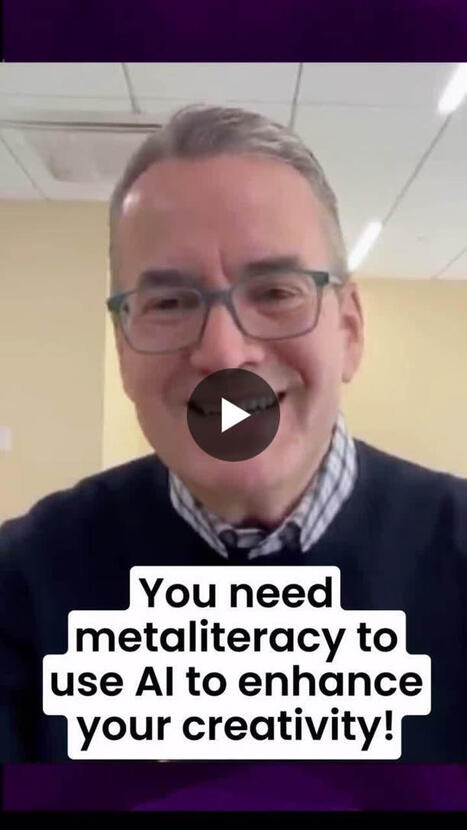
💥Did you know that AI used appropriately can enhance who you are, your originality, and your creativity? That’s where metaliteracy comes to help you in this process!
💥Please listen to Dr. Thomas P. Mackey, Ph.D. ’s explanation of metaliteracy and tune to the whole episode for amazing ideas on how to incorporate AI to enrich your own thinking!
💥 Dr. Mackey is Professor in the Department of Arts and Media, College of Arts and Sciences of Empire State University. He also serves as Program Coordinator for the BA and BS in Digital Media Arts. His work focuses on metaliteracy as a framework for learning and digital environment, with a growing emphasis on ethical and creative engagement with AI.
In twenty years, European streets will be darker than they are tonight.
And nobody will be complaining.
Here is what I think will have happened, and none of it needs technology we do not already have. Light will have become conditional. Streets at full output only when someone is actually there, not because sensors are a gadget but because continuously illuminating empty space will look like exactly what it is: waste, in a system where every watt has a name.
Levels will be lower and people will see better.
Two decades of serious glare control and better spectrum will have taught the public what every lighting designer already knows, which is that adaptation matters more than quantity. The sky will be part of the brief. Not a compliance box at the end of the report. A design objective, in the same way daylight became one. And the biggest change will not be technical at all.
Darkness will have stopped meaning danger, neglect or poverty. It will mean that somebody made a decision.
The part I am least sure about is who drives this. Regulation is slow. Manufacturers sell products, and less light is a difficult product to sell.
Cities move when there is a budget argument, and there is a very good one, but nobody has made it well yet.
My guess is that it starts somewhere small. Someone removes half the lighting in a public space, measures what happens, and can prove that nothing bad did. The rest is imitation.
I would rather design that city than the one we are lighting tonight. | 58 comments on LinkedIn
Vous aussi, vous préféreriez lire plutôt que de scroller sur votre téléphone pendant des heures ? Pierre-Alexis Geoffroy, psychiatre et invité d'Ali Rebeihi dans “Grand bien vous fasse !”, a peut-être des solutions pour vous...
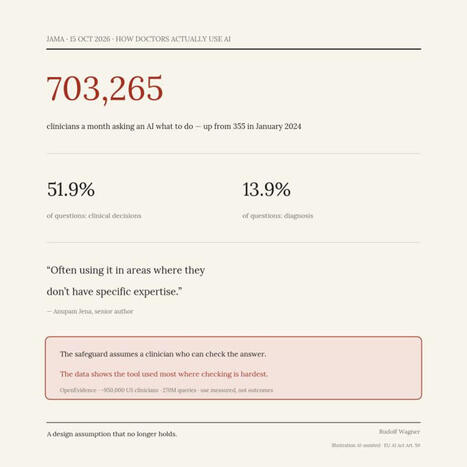
703,265 clinicians a month now ask an AI what to do with their patients. Not for admin. Not for emails. More than half of the questions are about clinical decisions.
That's the first large-scale study of how doctors actually use AI, published in JAMA on 15 October by researchers at Harvard Medical School and Brigham and Women's.
The numbers, from one platform — OpenEvidence — across roughly 950,000 US physicians, PAs and nurse practitioners:
→ Monthly active users: 355 in January 2024. 703,265 in June 2026. → 270 million queries in total. → 51.9% about clinical decision-making, mostly treatment and management. 13.9% about diagnosis. → Early-career physicians and internal medicine ask disproportionately often.
And then the sentence that matters most, from senior author Anupam Jena: clinicians are "often using it in areas where they don't have specific expertise."
Sit with that, because it collides with how these tools are regulated.
In the US, whether clinical decision support software is a medical device turns largely on one condition: the clinician must be able to independently review the basis of the recommendation, so they don't rely primarily on it. The whole safeguard assumes a professional who can check the answer.
The usage data shows the opposite pattern. The tool is used most where the user is least able to check it.
One more detail. When the FDA updated its clinical decision support guidance in January 2026, it removed the discussion of automation bias that the 2022 version contained. The risk didn't go away. The paragraph did.
Precision, because it matters: I am not saying this tool is unsafe, and I'm not making a claim about its regulatory status. The study measured use, not outcomes, and the authors say outcomes are next. Three of the co-authors work for OpenEvidence, which supplied the de-identified data; the study was NIH-funded.
But last week I wrote that a doctor's signature has quietly become the approval for AI output. This is the data behind that sentence. The signature is supposed to come from someone who knows the field. Increasingly, it comes from someone asking the machine precisely because they don't.
That isn't a scandal. It's a design assumption that no longer holds — and regulation built on it needs a new one.
— 🤖 AI-assisted (Claude). Editorial responsibility mine. Labeled per EU AI Act Art. 50. | 20 comments on LinkedIn
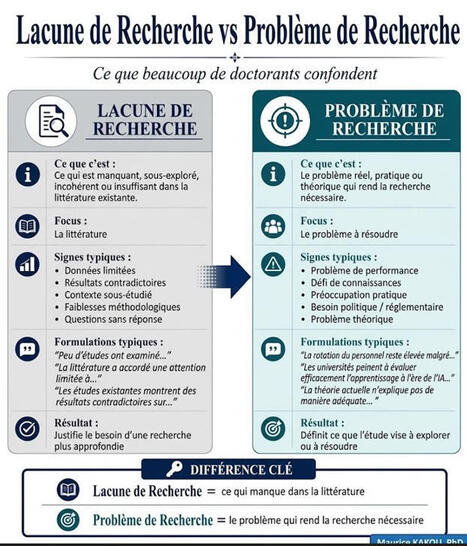
Lacune de recherche (Research Gap) vs. Problème de recherche (Research Problem) — comprenez bien la différence. 🎓📚 Une lacune de recherche décrit ce qui est manquant, limité, contradictoire ou sous-exploré dans la littérature existante. Un problème de recherche décrit l’enjeu réel, théorique ou pratique qui rend votre étude indispensable. En termes simples : — Lacune de recherche = Qu'est-ce qui manque dans les connaissances actuelles ? — Problème de recherche = Quel problème concret ou théorique doit être résolu ? Un projet de thèse (ou protocole de recherche) rigoureux doit impérativement articuler et rendre limpide le lien direct entre les deux. Si vous parvenez à formuler clairement le problème, à identifier précisément la lacune et à démontrer la pertinence de votre apport, vous disposez d'ores et déjà d'un socle scientifique solide pour votre recherche.
I came across this npj Digital Medicine study on AI-assisted healthcare evidence search, and I think it will be interesting for anyone following the field of AI in evidence synthesis.
The study tested popular AI search tools, including Consensus, ChatGPT, Gemini, and Claude, and found that a single query often misses a significant share of relevant studies. Results were also inconsistent: the same question returned very different sets of studies on different occasions, and gaps varied by publication year, venue type, and topic.
Why this matters to me: as AI search becomes a common first step for clinicians, researchers, and HTA teams, a fast answer is not the same as a complete one. Systematic, transparent, and reproducible searching remains essential, and it is a useful conversation to have with our customers when they ask whether AI search can replace structured evidence identification.
Where have you seen AI search tools fall short in your own evidence work?
Thank you Alexander Bedenkov for sharing this article.
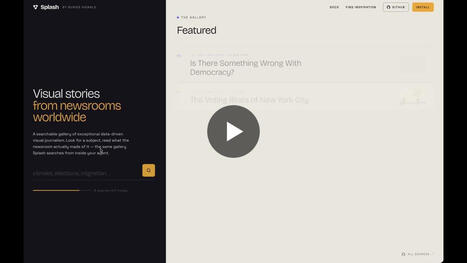
Splash can now semantically search through over 4,500 published visual stories: maps, interactives, 3D, audio and documentary pieces. They span 15 years and come from hundreds of newsrooms, studios and designers. New visuals are added to the catalogue every week.
The search is baked into the graphics selection process, so you can ask your agent to find inspiration for your next story. Splash can then continue into graphics production based on your preferences!
Each piece carries around ten tags for its form, place and topic, and the full text of almost every page is indexed. So a word or two about your subject is enough: - heatwave matches 46 pieces - floods, 466 - election results, 403 - glaciers, 87
I use it before I pick a chart type or a map, to see how other newsrooms showed the same kind of comparison.
(2/12) La revue de littérature : 5 erreurs qui peuvent la fragiliser… et comment les éviter 👇 1️⃣ Commencer à lire sans fil conducteur Partezz d’un phénomène à expliquer dans un contexte précis. Par exemple : « Pourquoi certains consommateurs achètent-ils les produits recommandés par des influenceurs sur Instagram ? » Demandez-vous ensuite : comment les chercheurs expliquent-ils ce phénomène ? Quelles théories mobilisent-ils ? Qu’est-ce qui reste mal compris ? Votre question de départ s’affinera au fil des lectures.
2️⃣ Se limiter à une seule source documentaire Croisez des sources complémentaires : Scopus, Web of Science, Google Scholar, mais aussi Cairn pour les travaux francophones, selon votre sujet. Variez les mots-clés et leurs synonymes, puis explorez les références des articles pertinents.
3️⃣ Enchaîner les résumés « article par article » Je propose souvent une matrice de lecture sous Excel pour décortiquer chaque article : question de recherche, théorie, concepts, méthode, résultats et limites (un fichier excel que je donne souvent en image (mettez les en colonne et l'analyse des articles ligne par ligne). Ce travail prépare la synthèse : organisez ensuite votre revue autour des thèmes, des concepts et des débats. Faites dialoguer les travaux en montrant leurs convergences, leurs contradictions et leurs différences d’explication.
4️⃣ Citer sans avoir lu Remontez à la source et vérifiez ce que les auteurs ont réellement étudié, démontré… et nuancé. Une citation reprise sans vérification peut déformer un résultat ou lui donner une portée qu’il n’a jamais eue.
5️⃣ Confondre rareté des études et lacune théorique « Peu de recherches ont étudié ce sujet » ne suffit pas à justifier une contribution. Votre revue doit faire apparaître un problème précis dans les connaissances existantes : des résultats contradictoires, un mécanisme mal expliqué, ou une théorie dont les limites apparaissent dans certaines conditions. La question essentielle : qu’allons-nous mieux comprendre grâce à votre recherche ? 📌 Pour démarrer : une question directrice, une matrice de lecture et Zotero dès les premières lectures.
Pour aller plus loin, je recommande le cadre d’analyse TCCM : → T — Théories mobilisées. → C — Contextes étudiés. → C — Caractéristiques : variables et relations examinées. → M — Méthodologies employées. Croiser ces dimensions aide à comprendre pourquoi les résultats convergent ou divergent, et à préciser ce qui mérite d’être approfondi.
Connaissez-vous ce cadre ? Quel conseil auriez-vous aimé recevoir au début de votre recherche ? 💬 #Recherche #RevueDeLittérature #Doctorat #Méthodologie #TCCM
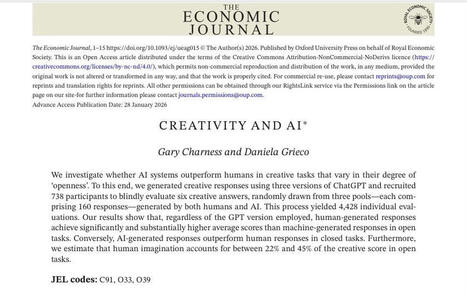
Humans are more creative than LLMs on open tasks requiring imagination.
A new fascinating paper compares humans with three LLMs on two creative tasks.
The closed task: write a story incorporating ten specified words, such as “house”, “cow” and “planet”.
The open task: imagine you could invent anything simply by thinking about it. What would you create, and why?
Creativity was rated from 1 to 10 by human evaluators who did not know whether responses came from humans or AI.
The results are super interesting:
In the closed task, LLMs outperform humans on average.
By contrast, in the open task, humans outperform all three LLMs.
Why?
To provide a first potential answer, the authors model imagination as the human capacity to generate ideas beyond what instructions prescribe. Then they estimate its contribution from differences between human and AI scores.
Their model attributes between 22% and 45% of humans’ creativity scores in the open task to imagination.
Humans may be more creative than LLMs thanks to their capacity to jump beyond what is prescribed.
*
Paper in the first comment. | 15 comments on LinkedIn
Et si, pour vérifier une information, le premier réflexe des adolescents était de... demander à une intelligence artificielle ?
L’IA conversationnelle s’installe progressivement dans les pratiques informationnelles des jeunes. Mais quelle place occupe-t-elle dans leur manière de s’informer, et surtout, quelle confiance lui accordent-ils ?
📊 Notre étude « Les adolescents face à l’information », réalisée avec l’institut Toluna Harris Interactive, auprès des 11-18 ans, révèle que : • Plus d’1 adolescent sur 4 utilise une IA, comme ChatGPT, pour vérifier une information. • 38 % des 16-18 ans utilisent l’IA pour chercher à comprendre un sujet. • Plus d’1 adolescent sur 2 déclare faire confiance aux informations fournies par les IA conversationnelles. • 4 adolescents sur 10 remettent rarement, voire jamais, en question les réponses de ces outils.
🔎 Pourtant, les réflexes d'esprit critique existent : 6 adolescents sur 10 déclarent vérifier les informations auxquelles ils sont exposés.
👉 L’enjeu n’est donc pas tant d’apprendre aux jeunes à vérifier l’information que de les accompagner dans l’évolution de leurs pratiques, à l’heure où un même outil peut servir à la fois à chercher une réponse et à en vérifier la fiabilité. Car une réponse immédiate, même formulée avec assurance, n’est pas nécessairement une réponse fiable.
💡 Face à ces nouveaux usages, l’éducation aux médias et à l’information joue un rôle essentiel : apprendre à identifier les sources, croiser les informations, distinguer les faits des opinions et conserver un regard critique sur les réponses générées par l’IA.
L’objectif n’est pas de faire de chaque adolescent un expert du "fact-checking", mais de lui donner les clés pour s’informer sans déléguer son jugement à une intelligence artificielle.
💡 À l’heure où accéder à une réponse n’a jamais été aussi simple, savoir d’où vient l’information et comment en évaluer la fiabilité devient une compétence indispensable.
Justine ATLAN | Samuel Comblez | Véronique BECHU | Inès Legendre | Edouard GEFFRAY | Sarah El Haïry | Anne Le Hénanff | Stephanie RIST | Virginie Sassoon | Serge Barbet | CLEMI | François Saltiel | Thomas Huchon | Gregoire Borst | Vincent Couronne
To get content containing either thought or leadership enter:
To get content containing both thought and leadership enter:
To get content containing the expression thought leadership enter:
You can enter several keywords and you can refine them whenever you want. Our suggestion engine uses more signals but entering a few keywords here will rapidly give you great content to curate.


 Your new post is loading...