Your new post is loading...

|
Scooped by
Gilbert C FAURE
October 13, 2013 8:40 AM
|
is a personal Notebook Thanks John Dudley for the following tweet "If you like interesting snippets on all sorts of subjects relevant to academia, information, the world, highly recommended is @grip54 's collection:" La curation de contenus, la mémoire partagée d'une veille scientifique et sociétale
|
|
Scooped by
Gilbert C FAURE
September 19, 6:07 AM
|
After successfully passing three rounds of review, with me as the #handling #editor, and receiving three #acceptances from the reviewers, I was about to accept the paper for publication. During my final checking, I became suspicious about the growing number of references during the review process, ended with almost 250. Upon randomly checking some of them, I found that many (54%) were fabricated and attributed to authors who never existed.
Acting as a voluntary associate editor without receiving payment, and with three voluntary reviewers who also received nothing for their services, this author took the time, trust, and energy of at least four voluntary workers with his #stupid #willingness to publish. Indeed, it was my fault for putting my trust in someone from the beginning and not checking the references one by one at the first stage.
It is very unlikely in my world that someone with a #doctoral-level education would have such #stupidity or such a low IQ as to make these mistakes. He didn’t bother to even check his references before submission. Mostly, the rest of the paper was written by AI.
Yeah AI make us wiser
|
|
Scooped by
Gilbert C FAURE
September 18, 11:01 AM
|
Thrilled that #paper2agent is published in Nature today! Papers have been static documents for centuries. Paper2Agent turns them into active AI agents that can answer questions, apply their methods, and collaborate with other papers to make new discoveries.
Paper: https://lnkd.in/gf3cisYc
Code: https://lnkd.in/g79tdYRe
Paper2Agent agent: https://lnkd.in/gVk7j-p4
Papers are written for humans. Simply giving a PDF to LLM can miss key insights. We want the virtual author to gain hands-on experience w/ the work not just read it. Our key idea: let the AI set up a virtual lab to run code, test methods and reproduce the paper’s results.
The result is an automatically generated paper mcp that captures the paper's key know-hows, tools and data. Giving a LLM this paper mcp is much more accurate and efficient than giving it the original paper + code repo!
Agents of different papers can also collaborate with each other! For example, the AlphaGenome agent worked with a GWAS dataset agent to characterize splicing mutations associated with ADHD risk.
Agentifying knowledge makes research easier to reproduce, reuse and extend.
Great job by Jiacheng Miao with fantastic collaborators Jonathan Pritchard, Joe Davis and Yaohui Zhang 👏 | 159 comments on LinkedIn
|
|
Scooped by
Gilbert C FAURE
September 18, 4:59 AM
|
💬 "Quel est le ROI de votre démarche de veille ?"
C'est la question qui tombe inévitablement quand vient le moment de défendre un projet de veille devant un comité de direction. Et c'est souvent là que les porteurs de projet se retrouvent en difficulté, non par manque de conviction, mais par manque d'arguments chiffrés.
Notre conviction, construite sur près de dix ans d'accompagnement d'organisations de toutes tailles : une mesure précise du ROI de la veille reste aujourd'hui inaccessible dans l'absolu.
Mais cela ne veut pas dire qu'il est impossible d'estimer cette valeur, de la quantifier et de la défendre avec rigueur. Dans ce nouveau billet des Coulisses de la veille, on partage la méthodologie qu'on a développée pour y parvenir, en deux composantes : les gains d'efficacité métier par métier, et l'impact multiplicateur sur la performance globale.
On y détaille aussi les deux pièges les plus fréquents qu'on observe après dix ans d'accompagnement :
• Se limiter aux métriques d'usage (connexions, articles consultés) qui ne disent rien de la valeur réellement créée
• Oublier de quantifier la valeur générée pour les métiers eux-mêmes, au-delà de la veille en tant que telle
Une veille n'est pas une fin en soi. C'est un levier de performance métier, et c'est sur cette valeur d'usage qu'il faut construire la démonstration.
👉 La méthode complète, avec exemples concrets à lire ici : https://lnkd.in/e7ek8wuw
Nicolas Dubuc, Christophe Deschamps, Jérôme Bondu, Jacqueline Sala, Claude Revel, Christian Harbulot, Fabrice Frossard Thibault Renard, Quentin Ladetto, Audrey Knauf | 10 comments on LinkedIn
|
|
Scooped by
Gilbert C FAURE
September 18, 4:04 AM
|
🧮 Fascinante, cette vidéo de mathématique.
J'y vois le mystère du vivant et le vertige de l'IA.
Les formes que l’on croit reconnaître.
L’impossibilité de saisir la granularité d'un flux.
Pendant deux ans, j'ai travaillé à un livre qui s'appelle Bioconscience et qui questionne notre représentation du vivant. Il sortira en librairie le 8 octobre, chez Allary.
Pourquoi l'écrire?
Parce qu’on ne voit pas bien le vivant. On ne peut pas facilement le modéliser, le synthétiser. Il est si insaisissable qu'on n'arrive pas à l'intégrer dans nos systèmes de décisions, dans nos powerpoints, dans nos vies.
On le ressent, mais on n'arrive pas à l'écrire.
Et pour cause ! En me plongeant dans la littérature scientifique et philosophique, dans la religion et l'art, il apparait que la complexité du biologique est si vaste et si fluide qu'elle échappe à notre entendement, mais pas à notre coeur.
D'une certaine façon, cette vidéo m'évoque l'arbre de la vie, le chemin de complexité croissante de l'évolution biologique, sur notre petite planète.
Serait-ce la définition du divin ?
Tout ce qu'on ne peut ni voir ni comprendre?
Dans tous les cas, l'étendue des mystères ne doit pas nous empêcher de croire en nous. De nourrir lucidité et confiance, car il est évident que nous pouvons encore grandir en conscience, évoluer, et que notre marge de progression est immense.
Apprendre, c'est affiner notre conception du monde.
C'est percevoir un peu de l'invisible, pour se changer soi-même.
Malgré nos défauts, malgré tous les crimes que nous commettons, malgré nos manquements conscients ou inconscients, l'humanité doit chercher à faire toujours mieux. Comment?
Sans doute en cherchant le juste équilibre entre la main et l'outil, entre le corps et l'esprit. L'IA et le numérique peuvent nous révéler un peu ce que nous ne voyons pas encore, parce que le réel se cache au delà de nos perceptions.
Mais comment discerner ce qui est à notre portée de ce qui ne l'est pas ?
Quand devenons-nous des apprentis sorciers?
La prière de la sérénité, attribuée à tort à Marc Aurèle en lieu et place de Reinhold Niebuhr en 1932 résume bien ce que je ressens maintenant :
"Donnez-moi la sérénité d’accepter ce que je ne peux changer,
le courage de changer ce qui peut l'être,
et la sagesse d’en connaître la différence."
La clé de la sérénité se trouve là.
Quelquepart.
Entre le discernement et le lâcher prise.
A la jonction de l'extérieur et de l'intérieur.
#Video #Bio #Conscience #IA #Maths #Evolution #Cosmographie #AI
____
Pour s'abonner à ma newsletter, c'est ici https://buff.ly/rdIheH1
Découvrez tout mon travail sur www.maximeblondeau.com | 25 comments on LinkedIn
|
|
Scooped by
Gilbert C FAURE
September 17, 6:01 AM
|
We all know that rejection, failures, and struggles are a "normal" part of any academic's life:
🥀 Every academic gets rejections all the time; for instance, everyone experiences paper rejections, even editors of top journals see their own papers rejected.
🥀 Everyone has difficult colleagues/collaborators; in fact, you may well be “that difficult colleague” for others. We all have different personalities and preferences.
🥀 Every academic I know feels undervalued in their own university; especially research-active academics often receive far more recognition outside their university than within.
But some failures are bigger than others. In this blogpost series I talk about the eight key failures in my own academic career, but also their associated upsides. The Spring season talks about the first stage - my education journey.
🍀 What is your “unexpected upside” failure story? I would love to hear.🍀
🥀 Failure 1: I didn’t go to university 🥀 - 🌻 Upside 1: Personal growth & joy 🌻
My educational journey started with a vocational degree as - being the first in my extended family to go to university - I wasn't confident enough to go to university.
However, leaving home at 18, living independently, and doing a degree that was easy for me meant that – as a very shy girl – I gained confidence and independence. I also had the great fortune to meet my now husband at a classmate’s birthday party. He has not only been the biggest source of personal joy in my life, but also the most amazing source of career support.
🥀 Failure 2: I didn’t get any exemptions 🥀 - 🌻 Upside 2: Time to grow more confident 🌻
Normally, students who did the type of vocational degree I had done would get a 1.5-2-year exemption when embarking on a 4-year university degree in Business & Economics. I didn’t.
But again, this gave me time to grow more confident. I was also selected as student tutor in my 2nd year, research assistant in my 3rd and 4th year and ended up as a student member of the Faculty’s governing board. So, during my studies I experienced a taster of teaching, research, and service/leadership, finding out what academic life was like and linking it!
🍀 What is your “unexpected upside” failure story? I would love to hear.🍀
|
|
Scooped by
Gilbert C FAURE
September 16, 11:05 AM
|
🤖 Un agent IA ne se contente plus de répondre à vos questions. Il apprend de vous.
Session après session, il mémorise vos sources, vos priorités, vos raccourcis de veilleur. Connecté à ceux de vos collègues, il dessine la carte de ce que votre organisation surveille, redoute et recherche. Et plus il vous connaît, plus il risque de vous enfermer dans ce que vous savez déjà.
C'est le fil des trois articles publiés ici ces derniers mois, que je réunis aujourd'hui dans un ebook de 50 pages intitulé « Les agents IA du veilleur ».
Ce que l'on y trouve :
- Une nouvelle de fiction, la journée d'une veilleuse en 2029, non pas pour prédire mais pour comprendre ce qui émerge des briques fonctionnelles une fois assemblées. D'ailleurs, si vous n'avez pas le temps de tout lire, lisez simplement ce texte.
- Le double numérique : comment la mémoire persistante des agents construit une réplique de votre expertise, avec ce qu'elle promet et ce qu'elle expose.
- Les doubles qui font équipe : le profil organisationnel qui émerge quand les agents se connectent entre eux, l'actif stratégique qu'il constitue, et les menaces nouvelles qui pèsent sur cette mémoire collective.
- Le piège de la bulle : pourquoi un agent parfaitement calibré rétrécit votre champ de vision, et ce que la recherche sur la sérendipité algorithmique propose pour en sortir.
Chaque volet se termine par l'essentiel à retenir et les sources, une trentaine de références, pour aller plus loin.
Patrick Cappe de Baillon, référent intelligence économique au CEA, très actif sur ces sujets depuis les débuts, m'a fait le plaisir de bien vouloir le préfacer et je l'en remercie. 🙏
Vous le verrez, une conviction traverse l'ensemble : la question n'est pas d'adopter ou non ces agents, ils arrivent dans vos outils sans vous demander votre avis. La question est de rester le pilote de ce qu'ils apprennent de vous.
Pour télécharger l'ebook, pas d'adresse à laisser en commentaire, pas de formulaire à remplir, pas de séquence de courriels à suivre. Le PDF est là, en libre accès, sous licence Creative Commons : lisez-le, utilisez-le, transmettez-le.
💬 Et si vous souhaitez aller plus loin sur la mise en place ou l'optimisation de votre veille, contactez-moi et parlons-en. Tout simplement.
cc Jacqueline Sala Julien Duprat Jean-Philippe Eglinger Jérôme Bondu Jonathan BENADIBAH Guillaume Sylvestre Fabrice Frossard Eric Debonne Eric Bertoletti Denys LEVASSORT David COMMARMOND Carlos Diaz Laurent Couvé Bases & Netsources (BASES PUBLICATIONS, société soeur de FLA Consultants) François JEANNE-BEYLOT Ludovic Desgranges Stephane Goria Valentin Desgranges Pierre Memheld Interdoc, l'association des documentalistes territoriaux de France Christophe AUDOUIN Christian Marcon IAE de Poitiers Ecole de Guerre Economique – EGE Veillemag Serda Compétences Archimag ADBS - Secteur Veille
#Veille #IntelligenceEconomique #IAagentique #AgentsIA #Sérendipité #Cybersécurité | 11 comments on LinkedIn
|
|
Scooped by
Gilbert C FAURE
September 15, 3:49 AM
|
Visibrain, l'outil de social listening, décrypte le boom des protéines sur Instagram : conversations, engagement, tendances, marques et créateurs.
|
|
Scooped by
Gilbert C FAURE
September 12, 3:13 AM
|
🏗️ Incroyable. The Global Building Atlas, c'est la première carte 3D HD de tout le bâti terrestre.
2,75 milliards de bâtiments dans le monde.
Article publié ici dans Earth System Data : https://buff.ly/8MWKHkL
Des scientifiques de l'Université technique de Munich ont créé cette première carte, produisant un jeu de données 30 fois plus fin que les précédentes cartes mondiales.
Baptisée GlobalBuildingAtlas, elle a été financée cette année par une bourse ERC Starting Grant et construite à partir d'images satellite de 2019.
Chaque structure est modélisée avec une résolution de trois mètres sur trois, ce qui permet d'estimer la hauteur, le volume et la densité.
Environ 97 % des bâtiments sont cartographiés sous forme de modèles LoD1, offrant une géométrie cohérente à l'échelle mondiale. Cet atlas offre également une couverture rare de régions souvent absentes des jeux de données numériques, notamment l'Afrique, l'Amérique du Sud, l'Asie du Sud-Est et les zones rurales du monde entier.
De façon générale, Pourtant, la carte met aussi en évidence des contrastes. De vastes régions — comme certaines parties de l'Afrique, de l'Asie centrale et de l'Australie — apparaissent relativement peu denses, reflétant une plus faible densité de population et des empreintes urbaines plus réduites.
Où se concentre l'essentiel du volume bâti mondial
Chine, une extension urbaine massive et des mégapoles colossales. Beaucoup plus de bati qu'en Inde, qui présente des villes en croissance rapide, mais encore informelles.
États-Unis, les vastes régions métropolitaines avec développement suburbain sont encore concentrées au nord-est.
Europe, les réseaux urbains historiques denses dont dans l'axe Benelux Plaine du Po, mais surtout, l'Allemagne apparait comme un foryer de constructions humaines.
Japon, les infrastructures urbaines apparaissent fortement concentrées
Pour les amateurs de cartographie, cette visualisation offre une perspective différente sur l'état du monde. Elle montre comment les humains transforment physiquement la planète, à l'échelle continentale, mais aussi, plus intéressant peut-être à l'échelle des villes, localement.
Malheureusement, l'Atlas en tant que tel est si lourd qu'il ne peut être consulté directement. Vous trouverez une version simplifiée ici : https://buff.ly/uVfUNGl
#Cartographie #IntelligenceArtificielle #Innovation #Science #Urbanisme #DataViz
|
|
Scooped by
Gilbert C FAURE
September 10, 11:06 AM
|
📚 1 000 CITATIONS : UN SEUIL ATTEINT PAR UNE PUBLICATION SUR 4 000
Le nombre de citations ressemble souvent à un simple compteur.
Mais sa signification apparaît lorsqu’on le rapporte aux dizaines de millions de publications qui constituent la littérature scientifique.
En 2014, Nature a demandé à Thomson Reuters d’examiner l’ensemble du Web of Science afin d’identifier les publications scientifiques les plus citées.
La base contenait alors environ 58 millions de documents publiés depuis 1900.
Parmi eux, seulement 14499 avaient reçu plus de 1000 citations.
Cela représentait environ 0,025 % du corpus, soit approximativement une publication sur 4000.
Atteindre 1000 citations constitue donc un événement bibliométrique rare.
Cette concentration révèle une propriété fondamentale de la littérature scientifique : l’attention ne se répartit pas uniformément entre les publications.
La majorité des articles reçoit relativement peu de citations - près de la moitié n’est pas citée - tandis qu’une fraction infime devient une référence durable, parfois bien au-delà de son domaine d’origine.
Ce chiffre ne mesure évidemment pas directement la qualité scientifique.
Un article peut être abondamment cité parce qu’il décrit une méthode employée par des milliers de laboratoires, fournit un logiciel, constitue une base de données, établit une classification ou propose une recommandation internationale.
Ainsi lzs publications méthodologiques occupent-elles une place importante parmi les articles les plus cités.
Elles sont mentionnées chaque fois qu’une communauté réutilise une technique, alors qu’une découverte conceptuelle peut devenir une connaissance commune et ne plus être systématiquement citée.
L’âge de la publication joue également un rôle essentiel.
Un article publié depuis trente ans a eu beaucoup plus de temps pour accumuler des citations qu’un travail récent.
Les pratiques de citation diffèrent aussi fortement entre la biologie, la médecine, la physique, les mathématiques ou les sciences humaines.
Une comparaison rigoureuse exige donc de replacer chaque publication parmi les travaux du même domaine et de la même période.
Malgré ces limites, l’ordre de grandeur reste saisissant. ✨
Une publication dépassant 1000 citations n’est pas simplement « beaucoup citée ».
Elle appartient à une fraction extrêmement étroite de la littérature scientifique et témoigne d’une diffusion exceptionnellement large de la méthode, des résultats ou des idées qu’elle porte.
La citation ne dit pas toute la valeur d’une recherche.
Mais à ce niveau, elle montre incontestablement qu’un travail a laissé une trace rare et durable dans la conversation scientifique.
Sources :
Van Noorden et al. / 2014 / “The Top 100 Papers” / Nature
Données fournies par Thomson Reuters à partir du Web of Science.
|
|
Scooped by
Gilbert C FAURE
September 10, 10:59 AM
|
A meaningful milestone for open health professions education.
I’m incredibly pleased to share the publication of UNESCO’s new brief, Scaling Health Education through Open Educational Resources, developed with ScholarRx and being launched today at UNESCO #DigitalLearningWeek in Paris during a workshop on Open Solutions policies.
One of the most important messages of the brief is that expanding access to health professions education requires more than simply creating more digital content.
We need an open learning ecosystem—one that enables educators and institutions to create, adapt, localize, share, and continuously improve high-quality learning resources, supported by open licensing, appropriate technology, sustainable partnerships, and policies that make collaboration possible at scale.
This is particularly important as the world works to educate the health workforce needed in communities where faculty, curricula, and commercial educational resources may be limited.
It is also the vision behind Rx Open: enabling educators across medicine, nursing, pharmacy, public health, and other health professions to build on shared educational resources rather than continually starting from scratch—and to contribute their own knowledge back to the global community.
AI can make this process even more powerful by helping educators develop and adapt learning resources more efficiently, but technology alone is not the solution. Openness, local ownership, quality, governance, and collaboration must remain at the center.
I’m grateful to UNESCO for helping bring health professions education into the global Open Solutions conversation, and to the many educators and partners who continue to advance this work with us, including the UNESCO OER Dynamic Coalition, Open Education Global (OEGlobal), and Creative Commons.
Our goal is ambitious but clear:
High-quality health professions education should be something the world builds together.
Please read the UNESCO brief here: https://lnkd.in/dXsYjt-K
#OpenEducation #OER #OpenSolutions #DigitalLearning #HealthProfessionsEducation #MedicalEducation #NursingEducation #AIinEducation #UNESCO #ScholarRx #RxOpen
|
|
Scooped by
Gilbert C FAURE
September 10, 10:52 AM
|
« Ce matin, les toilettes du second étaient bouchées. J’aurais pu râler auprès de l’office manager. J’ai préféré en retenir une leçon : plus on monte dans la hiérarchie, plus on doit gérer seul ses problèmes. »
Ce texte n’a jamais été publié. Pourtant, vous en avez déjà lu des milliers du genre. Il suffit d’une promenade avec le chien, de l’achat d’un vélo-cargo électrique ou d’un TER à l’arrêt pour que l’incident du quotidien se mue en parabole sur le leadership et la résilience.
Une grammaire sociale repérable de loin : une phrase par ligne pour donner de l’importance au vide, une flopée d’émojis fusée en guise de décollage imminent, et cette inévitable relance finale destinée à augmenter l’engagement. « Et vous, qu’en pensez-vous ? »
Ce genre littéraire propre à la plateforme LinkedIn porte un nom : la « broetry », contraction de bro (le copain de bureau) et poetry (poésie). Une esthétique du vide que le réseau social professionnel tente désormais d’endiguer.
Logée dans le menu des trois petits points, en haut à droite de chaque publication, une option a fait son apparition fin juillet : « On dirait de l’IA slop ». Le succès de ce bouton de secours est immédiat. En seulement deux semaines, plus d’un million de membres s’en sont saisis, se félicite Hari Srinivasan, directeur produit de LinkedIn Monde. Un million de clics pour acter le début d’une discrète résistance numérique.
Par Romane Ganneval ➡️ https://l.lepoint.fr/TPF
#linkedin #IA #iaslops | 19 comments on LinkedIn
|
|
Scooped by
Gilbert C FAURE
September 10, 10:15 AM
|
New blog post - a reminder that more 'digital literacy' is very rarely the answer to any of the problems of the digital age ... but that critical digital literacy is definitely something worth encouraging!
https://lnkd.in/gFsRHfqH
|
|
|
Scooped by
Gilbert C FAURE
Today, 5:51 AM
|
Quels sont les nouveaux usages d’Internet, des réseaux sociaux et de l’IA en avril 2026 ? Les réponses avec la dernière mise à jour du rapport publié par We Are Social et le cabinet Manochi.
|
|
Scooped by
Gilbert C FAURE
September 18, 11:23 AM
|
Meet GeoWhisperer. It shows the history of a place — in pictures, in words, and in a short film built from what's changed over time. Just type in an address and it will tell you what the differences are in satellite images over time.
I built it because location research means stitching together satellite archives. It's slow, and easy to get wrong when you're working fast.
GeoWhisperer will speed up that process. It won't replace verification — treat what it gives you as a lead, not a source — but it turns a blank address into a starting point in 30-60 seconds instead of an afternoon.
For journalists tracking a story, researchers reconstructing a timeline, or anyone curious what happened where they're standing.
www.geowhisperer.org #OSINT #journalism #geolocation
(The tool is inspired by a question asked by journalist Ivan Angelovski during a workshop I gave for Global Investigative Journalism Network (GIJN) | 16 comments on LinkedIn
|
|
Scooped by
Gilbert C FAURE
September 18, 9:43 AM
|
Nature has just published a pretty incredible paper.
The authors introduce a framework that turns research papers into interactive AI agents.
Rather than engaging with a paper only as static text, researchers can question its agent, ask it to reproduce an analysis, or apply the paper’s methods to new data.
This could make research methods much easier to understand, reproduce, and use.
It also opens up a strange possibility: research papers that can, in a sense, talk to one another. The authors demonstrate this by connecting agents derived from different papers so that they can combine their methods and data.
Used carefully (and with human scientific judgment still firmly in the loop) this could become a powerful new form of scientific communication.
*
Full paper in the first comment | 99 comments on LinkedIn
|
|
Scooped by
Gilbert C FAURE
September 18, 4:59 AM
|
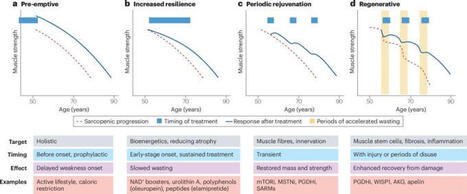
Strengthening muscle for healthy ageing: innovative treatments for sarcopenia
- Millions of people worldwide suffer from sarcopenia, a clinically recognized syndrome that is defined as the age-related loss of skeletal muscle mass and strength.
- This Review discusses advances in understanding of the cellular, molecular and metabolic mechanisms driving muscle wasting with ageing, while assessing emerging therapeutic approaches and agents in development.
- After the age of 50 years, humans lose 10% of their muscle mass per decade.
- The goal of sarcopenia research is healthy ageing: maintaining cognitive and physical capacity and remaining actively engaged with life. Critical to healthy ageing is the maintenance of skeletal muscle mass, quality and strength.
- There are currently no approved therapies for the syndrome, partly owing to its multifactorial aetiology, highlighting the need for therapies with pleiotropic beneficial effects on muscle function.
- Sarcopenia lacked both a clinical identity and a mechanistic framework to guide therapy; it now has both. The recognition that muscle wasting is driven by a complex network of geropathic changes, spanning metabolic, regenerative, neuromuscular and inflammatory dysfunctions, has shifted the therapeutic paradigm from single-target approaches towards interventions with pleiotropic mechanisms.
- As a result, there is now a rich pipeline of therapeutic candidates in clinical development, including NAD+ precursors, myostatin pathway inhibitors, mTOR modulators and gerozyme inhibitors. However, challenges persist, as gains in muscle mass often do not translate to gains in strength. The identification of robust biomarkers for sarcopenia will be critical to advance both preventive and interventional strategies for sarcopenia.
https://lnkd.in/e5c8ty5N
#muscle #ageing #drugdiscovery #science #biomarkers
|
|
Scooped by
Gilbert C FAURE
September 17, 10:18 AM
|
Universities can tell you how many papers they produced. We are not so good at telling you what those papers changed.
If public impact is part of the mission, that’s a measurement problem.
In one of our studies, we analyzed more than 1.2 million state bills introduced over two decades to see whether the science of adverse childhood experiences had entered policymaking.
We found 425 bills across 43 states used this specific framework for understanding early trauma. More than 100 of those have become law.
That isn’t of course the only measure of research impact. But it captures something our usual metrics often miss…whether our scientific ideas are actually being used to write laws.
What if we routinely tracked where research showed up after publication. Laws? Government Reports? Budgets?
We have built sophisticated systems for measuring research outputs. We have much weaker systems for measuring what happens next. And what universities measure shapes what they reward, invest in, and build capacity around.
If public impact is part of the mission, it should be part of the measurement system too. How do we build a culture of meaningful impact measurement??
|
|
Scooped by
Gilbert C FAURE
September 17, 5:55 AM
|
Un collaborateur qui consacre cinq minutes chaque matin à sa veille. Un grand contributeur qui y passe plusieurs heures par semaine. Un troisième qui a essayé de créer sa veille, sans y arriver, et qui a fini par abandonner.
Trois personnes, trois façons radicalement différentes de s'engager dans une même démarche de veille. Et c'est précisément là que beaucoup d'organisations se trompent : elles traitent tout le monde de la même manière.
Plus de 70 % des démarches collaboratives échouent faute d'une stratégie d'engagement claire. Souvent pour cette raison exacte.
Dans notre nouvel article, on décrit les 7 profils que vous croisez au quotidien, du sponsor au réticent, et surtout le levier à activer pour chacun. Avec un auto-diagnostic pour repérer ceux qui peuplent déjà votre organisation.
|
|
Scooped by
Gilbert C FAURE
September 16, 3:19 AM
|
IA et esprit critique, et si contre toute attente, les deux pouvaient être trés complémentaires mais pas dans le sens qu'on croit habituellement...
On parle beaucoup, à juste titre, du risque de délégation cognitive et de désapprentissage avec l’IA :
À force de lui demander de chercher, rédiger et parfois même décider, que reste-t-il exactement de notre propre raisonnement ?
Advait Sarkar, chercheur chez Microsoft Research, pose une question intéressante : Que pourrions-nous avoir demain : un outil qui pense à notre place ou un outil qui nous fait penser ?
Aujourd’hui, la plupart des IA sont pensées comme des assistants.
Microsoft Research explore une autre voie avec son programme "Tools for Thought" : concevoir une IA dont la fonction serait aussi de stimuler notre raisonnement.
Quelle en est la promesse ou en tout cas l'hypothèse de recherche ?
Au lieu de simplement répondre, l'IA pourrait repérer les contradictions entre 2 sources, distinguer ce qui est certain de ce qui l’est moins, nous demander quelles sont nos hypothèses humaines avant de répondre et ensuite demander
ce qui pourrait invalider notre hypothèse, détecter un raisonnement causal un peu rapide ... et nous obliger parfois à formuler notre propre position avant de nous donner la sienne !
Ici, le but ou la conséquence de l'usage de l'IA n'est plus du tout de diminuer l’effort cognitif.
Depuis le début de la "révolution" IA, nous avons largement associé progrès et réduction de l’effort.
Et le soucis, c’est que pour exercer son esprit critique ou apprendre, une certaine friction cognitive est nécessaire.
Il s'agit d'introduire suffisamment de contradiction, de questionnement ou de résistance pour maintenir l’utilisateur intellectuellement engagé (sans transformer chaque interaction en parcours du combattant !).
Cela ouvre une perspective assez différente pour les IA dans l'apprentissage, voire le travail plus globalement : Elles pourraient ainsi parfois nous dire :
« Avant que je te donne mon analyse, quelle est la tienne ? »
« Voici ma conclusion. Maintenant, cherchons ensemble trois raisons pour lesquelles elle pourrait être fausse. »
Finalement, c'est assez proche d'une attitude managériale qui consiste à ne pas "assister" le collaborateur et lui laisser de l'autonomie quand il a la compétence et l'expérience pour le faire.
En gros, comme un bon manager le ferait, l'IA sur les sujets où nous sommes compétents, pourrait nous dire "Je veux bien te donner ton avis mais il me semble que tu dois en avoir un aussi avant et ce serait dommage de ne pas le donner !"
La souveraineté cognitive passera par notre capacité à conserver notre jugement face aux machines mais aussi peut-être aussi par notre capacité à concevoir des machines qui nous obligent à continuer à l’exercer. 😀 | 20 comments on LinkedIn
|
|
Scooped by
Gilbert C FAURE
September 12, 8:40 AM
|
L'ANR, the French National Research Agency SoSHS (Science Ouverte pour les Sciences Humaines et Sociales), lauréat de l'appel à projet RESO, a récemment mis en ligne son site internet.
👉 https://lnkd.in/eQcQe3Rd
Celui-ci a pour but de présenter l'équipe de SoSHS et sert à informer des événements auxquels les membres de l'ANR prennent part.
À travers une démarche de recherche-action, le projet s’intéresse aux pratiques d’ouverture dans les disciplines de Scinces Humaines et Sociales et expérimente des leviers susceptibles de favoriser leur développement. Ainsi, une page "Ressources et Outils", mettra à disposition, des livrables opérationnels à destination des chercheurs, personnels d'appui et institutionnels.
Justine Richard, Guillaume Schuppert, Romain Pierronnet, Helene Delacour, Audrey Knauf, CEREFIGE - Centre Européen de Recherche en Economie Financière et Gestion des Entreprises, IAE Nancy School of Management, Centre de recherche sur les médiations (Crem), Universite de Lorraine
|
|
Scooped by
Gilbert C FAURE
September 10, 11:13 AM
|
Jako Olivier thank you for this mention and for all you do to support literacy and Metaliteracy! You continue to bring people together from around the world in support of open, inclusive and innovative learning. I hope that everyone reads your post. Thank you!
|
|
Scooped by
Gilbert C FAURE
September 10, 11:05 AM
|
“Teachers are those who can propagate the doctrine, impart professional knowledge, and resolve doubts (师者,所以传道受业解惑也),” wrote Han Yu (韩愈), a renowned scholar of the Tang dynasty. In 1985, China designated September 10 as Teachers’ Day, establishing a modern occasion to honor educators. Recognizing the value of teachers is deeply rooted in Chinese culture, which is inevitably reflected in the language. Here are a few idioms that describe teachers of all kinds: the good, the bad, and the especially memorable.
https://lnkd.in/eUn47B8i
|
|
Scooped by
Gilbert C FAURE
September 10, 10:58 AM
|
Universities have a responsibility to people who aren’t born yet.
Take long-term studies carried out by universities. In one of ours, we followed more than 300 children from preschool through the end of high school. Fourteen years.
The randomized trial tested an enrichment of Head Start focused on social, emotional, and language development. Children assigned to the enriched classrooms had fewer emotional and behavioral problems in high school than those in usual Head Start.
Today, that knowledge can inform investments in children who weren’t even born when the study began.
One generation’s commitment creates knowledge another generation can use. This is a public role of higher education we should make more visible. Some questions require commitments that extend across quarterly reports, election cycles, and changes in university leadership. The benefits of answering them are shared across families, schools, communities, and generations. Universities, sustained by public and philanthropic investment, provide that continuity.
We preserve what previous generations learned. We challenge it, build on it, and prepare people to take the work further. In higher-ed, part of our job is to sustain commitments whose full value may become clear after our own tenure ends. That requires decisions today about the people, partnerships, and research we will support over time.
How do we make more room for long-term vision, grounded in our history and what we already know? | 11 comments on LinkedIn
|
|
Scooped by
Gilbert C FAURE
September 10, 10:17 AM
|
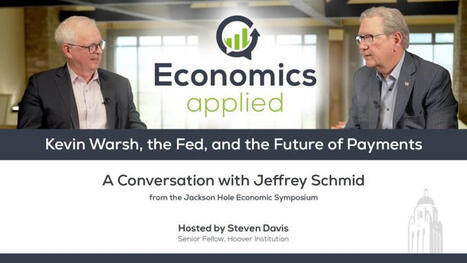
Kansas City Fed President and CEO Jeff Schmid spoke with Hoover Institution, Stanford University Senior Fellow Steven J. Davis on an episode of the Economics, Applied podcast.
Watch their conversation here: https://bit.ly/4xeVjoF
|
|
Scooped by
Gilbert C FAURE
September 10, 4:56 AM
|
Maybe it is time to stop calling ourselves Knowledge Managers.
For years, we have talked about managing knowledge — and struggled to explain what exactly that means.
Perhaps a better term is emerging: #Knowledge_Engineer.
We already speak naturally about software engineers, data engineers, and AI engineers. So why not knowledge engineers?
After all, we don't really "manage" knowledge.
We design the conditions and mechanisms for knowledge to be created, captured, structured, documented, connected, shared, retained, reused — and increasingly, embedded into AI and the flow of work.
That sounds much more like engineering to me.
The term Knowledge Engineer is not new. It has existed for decades, mainly in expert systems and AI. But perhaps its time has finally come — with a broader meaning.
Not engineering technology.
Engineering knowledge into organizational capability and value.
I have already taken one small step: I updated my LinkedIn profile to include Knowledge Engineering among what I do.
Could Knowledge Engineer be the next evolution of our profession?
#KnowledgeManagement #KnowledgeEngineering #AI #KnowledgeStrategy #FutureOfKM ROM Global Knowledge Management Global Network SIKM Leaders Community GO-TKM, Global Think-Tank of Organizational Tacit Knowledge Management | 45 comments on LinkedIn
|