
Catalogue d'outils de veille couvrant des domaines très variés: collecte de l'information, surveillance de pages web, partage de l'information, visualisation d…
Via Serge Courrier, Assane FALL™


|
Rescooped by
Gilbert C FAURE
from TechnoVeille
onto Notebook or My Personal Learning Network November 23, 2015 3:51 AM
|
 Scoop.it!
Catalogue d'outils de veille couvrant des domaines très variés: collecte de l'information, surveillance de pages web, partage de l'information, visualisation d…
scoop it inside


 Your new post is loading...
 Your new post is loading...
Your new post is loading...
Scoop.it!
|
|
|
Scooped by
Gilbert C FAURE
Today, 8:47 AM
|
Scoop.it!

A journal that received 160 submissions in 2022 expects more than 1,000 this year. Its own editors say they will soon lack the resources to keep up. AI is to blame.
This comes from an editorial published on 25 September in the journal Accountability in Research.
The numbers around it are arguably even worse than the surge itself. A study of 7.3 million journal articles found that sentences showing GenAI influence rose from 12% in 2023 to 57% in 2025. One estimate puts 140,000 hallucinated citations in articles on preprint servers and scholarly indexes in 2025 alone. It is also likely that more than half of scientists now use GenAI to write peer review reports, despite most journals prohibiting this.
The editors are blunt about enforcement. They state that AI detection tools remain unreliable, and that even the watermarking Anthropic introduced earlier this year cannot always label AI-generated or AI-assisted text.
So, the editors changed the system.
They have capped each author at four submissions a year to make the journal a harder target for paper mills, made ORCID numbers a requirement for all authors, demanded underlying data for empirical papers, and banned AI in commentaries and letters to the editor.
Have they gone far enough?
Read the editorial in full here: https://lnkd.in/eU5GsVnv
#ResearchIntegrity #ScholarlyPublishing #PeerReview #AcademicPublishing #AIinResearch #CriticalAILiteracy #HigherEducation #OpenScience #AIEthics #Academia | 25 comments on LinkedIn
|
|
Scooped by
Gilbert C FAURE
Today, 8:25 AM
|
Scoop.it!
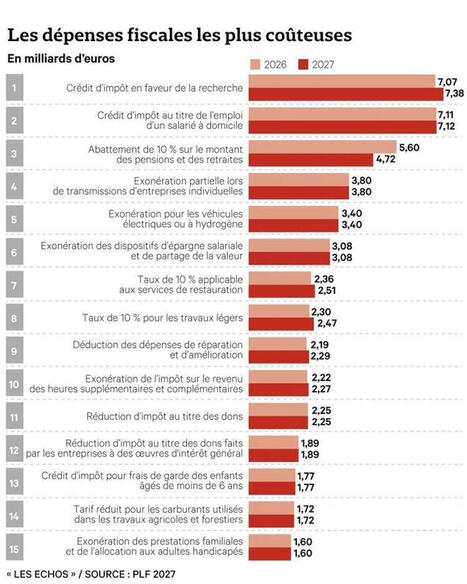
Le Crédit d'Impot Recherche est dépourvu de ciblage et de stratégie et a un effet de levier négatif sur l'investissement en R & D en France, quand la Belgique a un système d'aides focalisées, avec un effet de levier x4. Quatre euros privés investis pour un euro d argent public.
Cette niche fiscale désastreuse est l'un des plus gros facteurs de déclin économique et technologique. Les hauts fonctionnaires de Bercy, analphabètes scientifiquement, en font à nouveau la plus grosse niche fiscale du Projet de Loi de Finances.
Il est temps de réorienter le dispositif pour répondre aux besoins de la société, par une politique pensée, ciblée et évaluée.
https://lnkd.in/eg849fPx | 19 comments on LinkedIn
|
|
Scooped by
Gilbert C FAURE
Today, 8:12 AM
|
Scoop.it!

https://lnkd.in/eg9Ztbgd
La publication scientifique en masse : un problème qui s'est installé progressivement.
H-index, g-index, i10, autant d'indices "d'excellences" dont la côte est importante pour la poursuite de la carrière. Cet aspect, mais pas que, conduit à cette course à la publication effrénée et, pas forcémen
|
|
Scooped by
Gilbert C FAURE
Today, 7:50 AM
|
Scoop.it!

🥳 🎉 Today the Publish or Perish software celebrates its 20th anniversary. 🎉 🥳
Yes, 20 years!!!
🛑 When my promotion application at the University of Melbourne was rejected just over 20 years ago, I could never have imagined that this would lead to one of my most significant - and certainly one of my best known - contributions of all: the free Publish or Perish software, which has been used by millions of academics and students.
😛 And irony or ironies, this contribution to the academic commons isn't even fully my own. It was my amazing husband who created it in 2006 when I needed to evidence my citation impact, and has continued to add numerous features and data sources over the years. But as he watches academia from a safe distance, he was very happy for me to be the face of it.
📚 Granted I did create a lot of the Publish or Perish training resources - including five books, see "Using the Publish or Perish software" for the latest 375 page guide - and do take on a large share of the, less technical, user support.
📑 I also used the software to do my own bibliometric research and published 15 articles in the field’s main journals: Scientometrics, Journal of Informetrics, Journal of the Association for Information Science and Technology. Ironically again, this work has become much better known than my research in my home discipline of International Business.
🎂 With PoP's 20-year anniversary, I thought it would be nice to look back to where, why, when, by whom, and how it has been used over the years, and what they would have used if PoP hadn't been around.
🚉 Join me on a journey through the decades in my white paper: 2006-2026 - The changing usage of Publish or Perish over the years: where, why, when, what, who, and how?
🍀 Have you been one of the software's users? Let us know please how it has been helpful to you. My husband and I would love to hear. 🍀
|
|
Scooped by
Gilbert C FAURE
October 7, 5:37 AM
|
Scoop.it!
Academics love to moan about publishing, but for good reason. If you're not in academia, please read on and marvel at how we supposedly bright sparks have been sucked into one of the most bizarre economic systems of the modern world.
Take Elsevier, one of the biggest publishers with many journals across disciplines. Its parent company, RELX, reported £1.035 billion in adjusted operating profit in 2025, on £2.714bn revenue: an insane margin of about 38%. RELX’s largest disclosed shareholders are BlackRock (9.67%) and Invesco (c.5%); not companies we typically associate with the pursuit of knowledge and truth.
Those margins are only achievable because most of the underlying labour comes from academia. Researchers conduct the research, largely funded by universities, governments and charities. We write the papers. Other academics peer-review them, generally for free (peer review is vital for good science - unbiased, constructive feedback). Academics also provide much of the editorial expertise, often unpaid or modestly remunerated. After all that, publishing a paper still takes many months (often over a year). Publishers provide infrastructure, production, hosting and editorial systems.
THEN - here's the really good part - universities BUY access to that literature back, or pay article-processing charges so everyone else can read it. For Elsevier alone, most UK universities spend hundreds of thousands of pounds a year; large, research-intensive institutions often spend £1m+. This against a backdrop of 35.8% of English higher-education providers reporting a deficit and 15,000 job cuts in a year - University and College Union (UCU).
So academics simultaneously supply much of the product, much of the quality control, and are the customer. Cool.
In a fun plot twist, scholarly content and data are becoming valuable inputs for AI (of course). Major publishers are licensing content/data for AI applications and building new, paid AI products around scholarly literature. Good old AI is also being used to write articles (complete with AI hallucinations and outright plagiarism) - making even more work for those unpaid editors and reviewers.
Surely there is a way for universities to use their existing infrastructure and keep more of the money that currently leaves the sector inside research itself?! Other models include university and learned-society publishing, diamond open access where neither reader nor author pays, consortial funding, Subscribe-to-Open, institutional repositories, and open science platforms. It takes a brave researcher, especially in the early years, to ditch the prestige that comes with a big name 'high impact' journal...and a lot of research to find these ethical routes.
Hit me up with viable solutions, or publishers you trust.
Also, are there industries out there with economic models more bonkers than this?! | 41 comments on LinkedIn
|
|
Scooped by
Gilbert C FAURE
October 7, 5:32 AM
|
Scoop.it!

Advancing medical knowledge from research to practice
|
|
Scooped by
Gilbert C FAURE
October 7, 4:37 AM
|
Scoop.it!

L'engagement est le vrai angle mort des démarches de veille : on investit dans l'outil, les sources, le paramétrage… et on oublie la question la plus décisive : comment faire vivre la démarche dans le temps ?
Résultat : beaucoup de lecteurs passifs, quelques contributeurs, et une dynamique qui repose sur deux ou trois personnes. Ce n'est pas un problème d'outil mais un enjeu d'engagement et ça, ça se travaille !
RDV mercredi 7 octobre 2026, pour un webinaire de 45 minutes, à l'occasion de la sortie de notre livre blanc « Engager au sein des démarches de veille ». Pas de recettes magiques mais des grilles de lecture issues du terrain et des sciences sociales, et des retours d'expérience de démarches qu'on a accompagnées 😉
Inscription (gratuite) : https://lnkd.in/eqRFHJVv
#Veille #IntelligenceÉconomique #Engagement #VeilleCollaborative
|
|
Scooped by
Gilbert C FAURE
October 7, 4:20 AM
|
Scoop.it!
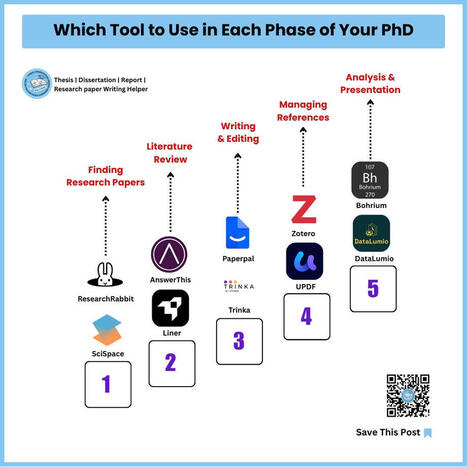
Which Tool to Use in Each Phase of Your PhD
A PhD journey involves multiple stages, and using the right research tool at the right phase can make your workflow more efficient.
1. Finding Research Papers
ResearchRabbit and SciSpace can help you discover and explore relevant research papers more effectively.
2. Literature Review
AnswerThis (YC F25) and Liner can support literature exploration and help you work through research sources.
3. Writing & Editing
Paperpal and Trinka can assist with academic writing, editing and improving the quality of your manuscript.
4. Managing References
Zotero and Superace Software(UPDF) can support reference organization and document management throughout your research.
5. Analysis & Presentation
Bohrum and DataLumio can help with research analysis and presentation-related tasks.
The key is not to use every tool at once. Choose tools based on the specific phase of your PhD and the task you need to complete.
Connect on all platforms : https://lnkd.in/g9uh9-jb
Follow Assignment Writing for Students for more
Save this post for your PhD research journey.
Need help with your Thesis, Dissertation, Research Paper, Report or Assignment? Message us.
#PhDResearch #AcademicResearch #ResearchTools #ThesisWriting
|
|
Scooped by
Gilbert C FAURE
October 7, 3:58 AM
|
Scoop.it!
"The Death of the Academic Author? Implications of Artificial Intelligence for Academic Writing and Publishing."
That was the title of a symposium I had the chance to attend at the AMEE - The International Association for Health Professions Education conference in August. Jennifer Cleland moderated, and the panel was Lorelei Lingard, Erik Driessen, Yu-Che Chang, Ayelet Kuper, and Ken Masters.
A title like that plus this line-up of speakers? Sign me up!
You would anticipate excellent debate, and it lived up to the billing. I had a lot of thoughts immediately after the session, but I finally had a chance to sit down and write/think/dictate my reflections.
Wait! Write/think/dictate?!? What does that mean? You'll just have to read it to find out! 😉
The link is in the first comment.
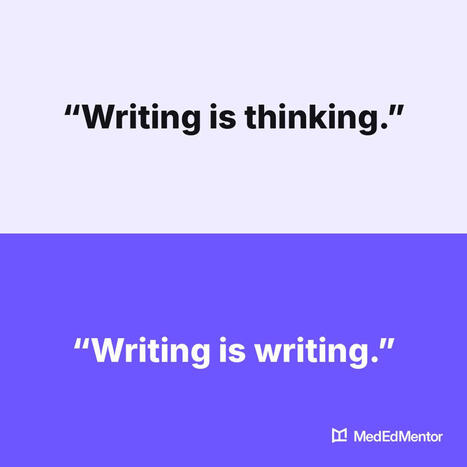
Then let me know your thoughts on writing as thinking versus writing as writing in the comments. | 14 comments on LinkedIn
|
|
Scooped by
Gilbert C FAURE
October 6, 9:52 AM
|
Scoop.it!

Les premiers résultats de l'enquête par questionnaire pilotée par le Gis Marsouin sur les usages de l'IAGen par les étudiants, obtenus sur un échantillon de 2 276 étudiants, viennent nourrir nos réflexions en matière de recherche mais également d'enseignement.
- Un usage largement répondu
85% des étudiant·es interrogé·es l’utilisent dans le cadre de leurs études.
- Pour réviser et réaliser des "devoirs maison"
75% l’utilisent pour réviser des examens, plus de 60% pour préparer un TD ou un TP ou réviser un cours magistral, et plus d’un tiers lors d’un examen réalisé à domicile.
- Peu discuté avec les enseignants
Malgré un fort taux d'usage, plus de la moitié des étudiant·es déclarent que l’usage de l’IAG n’a pas été discuté avec leurs enseignant·es et seul·es 18% rapportent une autorisation explicite.
- Confiance et fiabilité limitées mais peu de vérification
D'un côté, les étudiant·es interrogé·es portent un regard globalement prudent sur les productions de l’IAG : seul·es 16% les jugent fiables et 11% considèrent les informations fournies comme exactes. De l'autre, cette faible confiance ne se traduit pas systématiquement par un contrôle des réponses : 36% vérifient systématiquement les sources.
- Un compagnon virtuel ?
En dehors des usages académique, l'enquête explore également une pratique spécifique : le recours à l’IAG comme « compagnon virtuel », pour discuter, obtenir des conseils ou rechercher un soutien émotionnel. Encore minoritaire, elle concerne tout de même 17% des étudiant·es et est davantage associée à la solitude et à l’anxiété déclarées.
Le questionnaire a été construit par Agnès Grimault-Leprince, Bruno Daucé, Marianne Lumeau, Laurent Mell et notre regrettée collègue Séverine Erhel.
Les données ont été traitées par @Pierre Le Bras, qui a rédigé la note complète à retrouver sur le site de Marsouin : https://lnkd.in/e6hiPR7S
|
|
Scooped by
Gilbert C FAURE
October 5, 5:55 AM
|
Scoop.it!

Explorer les cartes : Découvrez des cartes thématiques et de référence dont les fonds IGN sur l’ensemble du territoire français.
|
|
Scooped by
Gilbert C FAURE
October 5, 4:09 AM
|
Scoop.it!
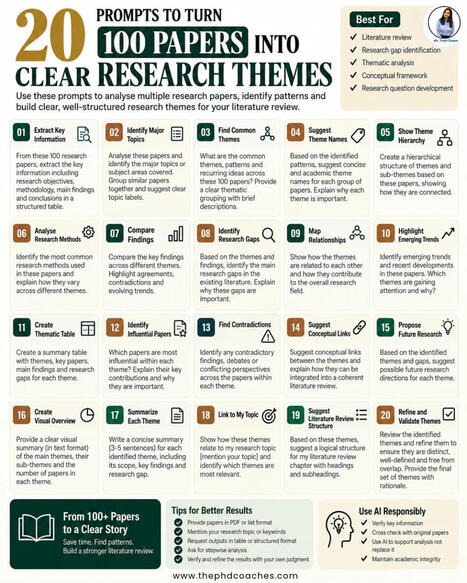
Reading 100 research papers is not the same as understanding 100 research papers.
The real challenge in a literature review is turning a large collection of papers into clear themes, relationships, contradictions and research gaps.
This framework gives you 20 practical prompts to help analyse 100 papers and move from scattered information to structured research themes.
You can use these prompts to:
• Extract key information from papers
• Identify major topics and recurring themes
• Compare findings and research methods
• Find contradictions and research gaps
• Map relationships between themes
• Identify emerging trends
• Build a thematic table
• Develop a literature review structure
• Connect themes to your research topic
• Refine and validate the final themes
AI can help you process and organise information, but the interpretation and final research judgment should remain yours.
#ResearchMethodology #AcademicResearch #ResearchTools #ResearchGap #SystematicReview #Researchers | 10 comments on LinkedIn
|
|
Scooped by
Gilbert C FAURE
Today, 8:49 AM
|
Scoop.it!

London School of Economics researchers say Gen Alpha will talk, not type at work—they predict that voice notes will make keyboard practically obsolete by 2030.
|
|
Scooped by
Gilbert C FAURE
Today, 8:35 AM
|
Scoop.it!
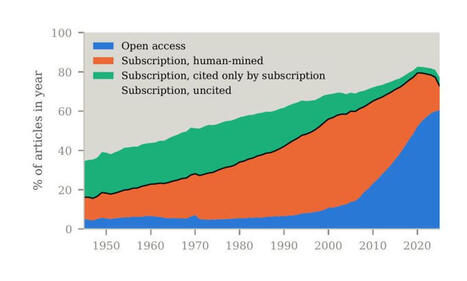
Is up to 80% of the content of the research literature already available in an LLM?
In 1950 Norbert Wiener worried less about machines doing the work of people than about people becoming components in processes they had neither designed nor could control. My new paper, The machine use of human beings, turns his title round to ask how AI systems come to know research that sits behind a paywall.
A machine that may lawfully read only open-access papers still learns a good deal about subscription work, because the researchers who read it go on to cite and restate it in open articles. We call this human mining. Across 124 million articles in Dimensions and Unpaywall (https://unpaywall.org/), three quarters of the subscription articles that have ever been cited have been cited from the open literature. The median wait for that first open citation has fallen from thirteen years for work published in 1990 to one year for work from 2020. That change comes from the growth of open publishing, not from any change in how we cite.
What crosses over is selective, though. It carries single results rather than the method, the caveat or the approach that failed. It favours the recent and the much-cited, it can pick up errors along the way, and the researchers acting as the machines' sensors get no credit for it.
The chart splits each year's output into open, subscription-but-cited-openly, cited only behind the paywall, and uncited. The black line is roughly the most an open-only machine reader can see.
https://lnkd.in/eBpC595H
|
|
Scooped by
Gilbert C FAURE
Today, 8:23 AM
|
Scoop.it!

L'intégrité de la recherche est fondamentale pour la confiance dans la production scientifique, mais les systèmes qui la protègent sont soumis à une pression croissante. Des défis de longue date, tels que la fraude, la manipulation et les pratiques de recherche problématiques, se conjuguent désormais avec l'augmentation du volume des soumissions, l'évolution des incitations et les progrès rapides de l'intelligence artificielle. Ces pressions affectent différemment les différents maillons de l'écosystème de la communication scientifique, soulevant des questions importantes quant à l'origine des risques, à l'efficacité de leur détection et à la capacité des politiques, pratiques et ressources actuelles à suivre le rythme.
L'intéressant sondage #PulseCheck de la Society for Scholarly Publishing examine comment les organisations de l’écosystème de l’édition scientifique réagissent aux défis actuels en matière d’intégrité de la recherche. Les résultats offrent un aperçu opportun des priorités actuelles, de la confiance de la communauté et des causes sous-jacentes.
👉 https://lnkd.in/eexVmJ6g
Quelques points saillants :
🎯 les manuscrits générés ou manipulés par l’IA constituent le principal défi, et les inquiétudes l’emportent sur la confiance dans la détection ;
🎯 bien que 94 % des organisations aient mis en place au moins une mesure d’intégrité, 63 % d’entre elles ont peu confiance dans la capacité de l’écosystème à protéger efficacement le patrimoine scientifique ;
🎯 l’IA est à la fois un défi et un outil. Plus de la moitié ont recours à un filtrage assisté par l’IA, mais la communauté reste divisée quant à savoir si l’IA améliore la détection et la prévention des atteintes à l’intégrité ;
🎯 la place qu’occupent les organisations au sein de l’écosystème détermine leur perception. Les éditeurs mettent l’accent sur les menaces pesant sur le processus de publication, tandis que les bailleurs de fonds, les institutions et les bibliothèques accordent une importance relativement plus grande aux pratiques de recherche et aux défis systémiques.
🎯 La pression liée au « publish or perish » est considérée comme la principale cause profonde, les personnes interrogées soulignant comment cette pression, l’IA, le volume des soumissions, la fraude et les contraintes de ressources se renforcent mutuellement.
|
|
Scooped by
Gilbert C FAURE
Today, 7:53 AM
|
Scoop.it!

Que pèsent vraiment les think tanks sur la fabrique de la décision publique ?
Le 10 mars 2025, les députés adoptent un amendement sur les soins relationnels dans la profession infirmière. Ses auteurs citent les recommandations de l'Institut Sapiens et d'organisations professionnelles. Quelques mois plus tard, la notion figure dans la loi du 27 juin. Qui a fait avancer cette idée ? L'institut qui a formulé des recommandations, les organisations infirmières, les élus ? Le texte permet de suivre une contribution partagée, sans désigner un inventeur unique.
Ce cas éclaire la question que pose « Ce que le Parlement retient des think tanks », l'étude que je publie aujourd'hui pour Suasoria et qui inaugure l'Observatoire de l'influence intellectuelle : que deviennent les travaux des think tanks une fois publiés ? Un rapport peut inspirer une réforme, fournir un chiffre à ses adversaires ou rester une référence longtemps après sa parution. Pour comprendre le rôle de ces organismes, il faut regarder ce que les responsables publics font de leurs travaux.
J'ai suivi, de janvier 2017 à septembre 2026, les traces laissées par 36 think tanks et organismes assimilés, et par quatre organismes de recherche pris comme points de comparaison, dans les travaux de l'Assemblée nationale, du Sénat et dans les rapports officiels. L'étude s'en tient à ce que les textes permettent d'établir ; elle ne reconstitue pas les conversations qui précèdent une décision.
Premier constat : il n'y a pas un classement, mais plusieurs. Depuis les législatives de 2024, l'Institut Montaigne reste le think tank le plus cité au Parlement (110 citations), devant la Fondation Jean-Jaurès -Jaurès et I4CE - Institut de l'économie pour le climat / Institute for Climate Economics , à égalité (96). Mais I4CE - Institut de l'économie pour le climat / Institute for Climate Economics , l'Institut de l'économie pour le climat, passe en tête dans les rapports officiels, et Jean-Jaurès dans les propositions de loi. Quant à l'OFCE et à l'Institut des Politiques Publiques , ils devancent tous les think tanks dans les rapports officiels.
Quel est le think tank le plus influent de France ? La réponse change selon le texte que l'on ouvre.
La synthèse et l'atlas des 40 organismes sont en ligne : https://lnkd.in/e66J-m6f | 24 comments on LinkedIn
|
|
Scooped by
Gilbert C FAURE
Today, 5:05 AM
|
Scoop.it!

Carbone 4 accompagne la transformation des organisations vers la décarbonation, l'adaptation au changement climatique et la préservation de la biodiversité.
|
|
Scooped by
Gilbert C FAURE
October 7, 5:35 AM
|
Scoop.it!
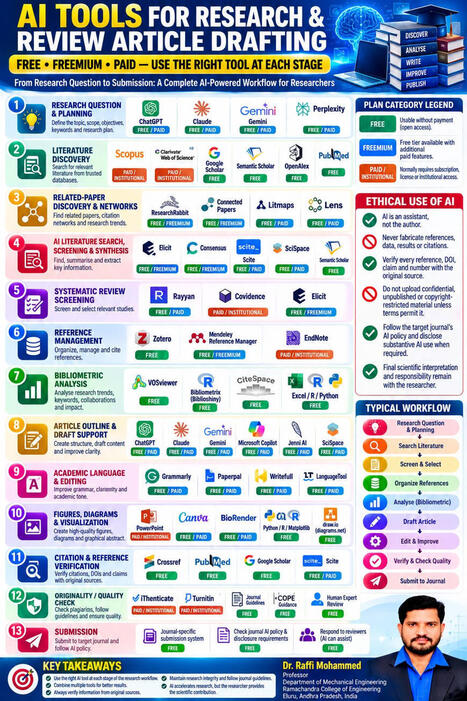
🔬 AI Tools for Research & Review Article Writing
AI can significantly accelerate research, but the researcher must remain responsible for scientific judgment, originality, accuracy, and integrity.
A practical workflow is
🔹 Research Question & Planning: ChatGPT, Claude, Gemini, Perplexity
🔹 Literature Discovery: Scopus, Web of Science, Google Scholar, Semantic Scholar, OpenAlex
🔹 Related Paper Discovery: ResearchRabbit, Connected Papers, Litmaps, Lens
🔹 Literature Screening & Synthesis: Elicit, Consensus, Scite, SciSpace
🔹 Reference Management: Zotero, Mendeley, EndNote
🔹 Bibliometric Analysis: VOSviewer, Bibliometrix/Biblioshiny, R, Python
🔹 Article Drafting & Refinement: ChatGPT, Claude, Gemini, Copilot
🔹 Academic Language Editing: Grammarly, Paperpal, Writefull, LanguageTool
🔹 Figures & Visualization: BioRender, Canva, PowerPoint, Python, R
🔹 Citation Verification: Crossref, PubMed, Google Scholar, Scite
🔹 Originality & Quality Checks: Turnitin, iThenticate, journal guidelines
🔹 Final Submission: Journal submission system and AI disclosure requirements
⚠️ Ethical AI Principles
✅ Use AI as an assistant, not a substitute for the researcher.
✅ Verify every reference, DOI, claim, statistic, and interpretation.
❌ Never fabricate references, data, or results.
❌ Never submit AI-generated text without critical human review
✅ Protect confidential and unpublished research data.
✅ Follow the target journal's AI use policy.
AI can accelerate the research process.
Scientific contribution, critical thinking, and responsibility remain with the researcher.
Dr. Raffi Mohammed
Professor | Department of Mechanical Engineering
Ramachandra College of Engineering, Eluru, Andhra Pradesh, India
#ArtificialIntelligence #AIforResearch #ResearchTools #ReviewArticle #ResearchMethodology #AcademicWriting #BibliometricAnalysis #VOSviewer #Bibliometrix #SystematicReview #ResearchIntegrity #AcademicResearch #ScholarlyPublishing #ResponsibleAI #Researcher #MechanicalEngineering
|
|
Scooped by
Gilbert C FAURE
October 7, 5:31 AM
|
Scoop.it!
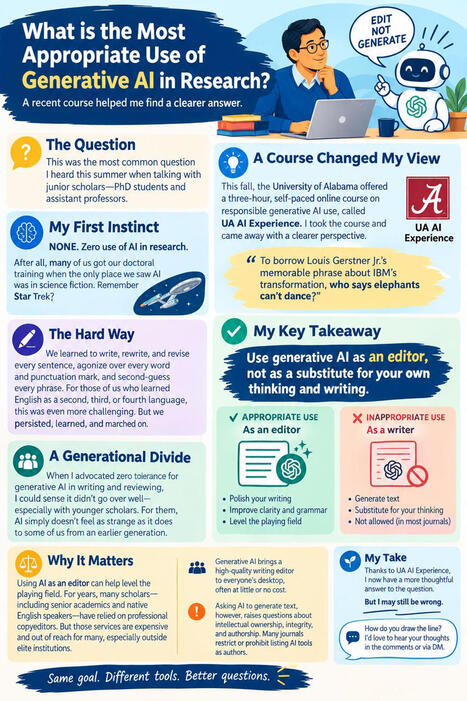
What is the most appropriate use of generative AI (e.g., ChatGPT) in research?
This was the question I heard most often this summer when interacting with junior scholars (PhD students and assistant professors).
My initial instinct was to say NONE. Zero use of AI in management research.
After all, many of us received our doctoral training when AI existed mainly in science fiction. Remember Star Trek?
We learned to write, rewrite, and revise every sentence, agonize over every word and punctuation mark, and second-guess every phrase.
For those of us who learned English as a second, third, or fourth language, meeting the writing standards of leading journals was especially challenging. But we persisted and learned.
When I advocated zero tolerance for generative AI in academic writing and reviewing, however, my views did not seem to resonate, particularly with younger scholars. For them, AI feels far less unfamiliar than it does to some of us from an earlier generation.
This fall, the The University of Alabama offered UA AI Experience, a three-hour, self-paced online course on responsible generative AI use. I took it and came away with a clearer perspective.
My key takeaway: Use generative AI as an editor, not as a substitute for your own thinking and writing.
Consider this post. I developed the idea, drafted the text in Microsoft Word, and worked to ensure it reflected what I wanted to say, a process that is not always easy when you do not think in English.
Only after I was satisfied with the substance did I ask ChatGPT to polish the writing.
That is fundamentally different from asking ChatGPT to write the post from a few prompts.
At least, that is how I interpreted the lessons from UA AI Experience.
Why does this distinction matter?
Using AI to edit and refine writing can help level the playing field. Many scholars, including senior academics and native English speakers, have relied on professional copyeditors to sharpen their prose.
But these services can be expensive and inaccessible to scholars outside well-resourced institutions.
Generative AI puts a capable writing editor within reach of almost everyone, often at little or no cost.
Asking AI to generate the substance of scholarly writing raises different questions about intellectual ownership, integrity, and authorship.
AI cannot take responsibility for research as a human author can, and many journals restrict or prohibit listing AI tools as authors.
Thanks to UA AI Experience, I now have a more thoughtful answer when asked about appropriate AI use in research.
But I may still be wrong (as I often am).
Where do you draw the line between using AI to improve your writing and using it to do your writing?
I welcome your perspectives in the comments or via direct message!
Jef Naidoo Pratyush Nidhi Sharma Kay Palan Dr.Jaspreet Kaur Banu Goktan Bilhan Sandra Mortal Robert Hayes Peter Mohler Athina Skiadopoulou, Ph.D. Jeffrey Martin Craig Armstrong
|
|
Scooped by
Gilbert C FAURE
October 7, 4:35 AM
|
Scoop.it!
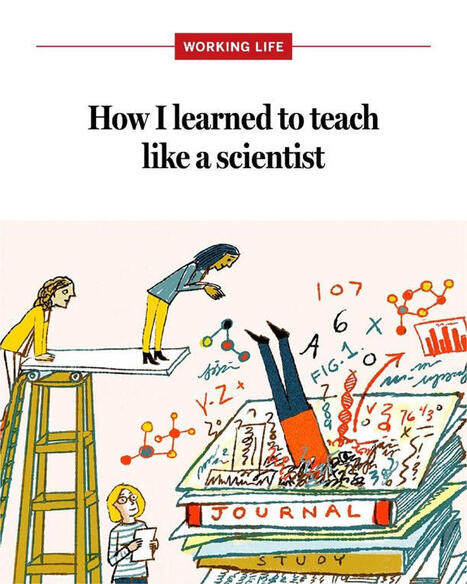
“I will miss the creativity of teaching.”
On #WorldTeachersDay, check out this Working Life from a retired professor emeritus on how she challenged students to think beyond facts—and how she learned to teach like a scientist. https://scim.ag/4e3ygGr
|
|
Scooped by
Gilbert C FAURE
October 7, 4:15 AM
|
Scoop.it!

Thank you to Damiano Orru for editing the new Italian translation of the updated 2025 Metaliteracy Goals and Learning Objectives, expanding the international reach of the metaliteracy framework!
In a new guest post on our Metaliteracy site, Damiano introduces the translation and explores connections among metaliteracy, information literacy, and AI, with an emphasis on reflection, critical evaluation, and responsible engagement with information.
We welcome interest in translating the Metaliteracy Goals and Learning Objectives into additional languages. If you have an idea for a new translation, please reach out to Trudi Jacobson or me.
#Metaliteracy #InformationLiteracy #AILiteracy #Libraries #AcademicLibraries #InfoLit
https://lnkd.in/dTTAtK7c
|
|
Scooped by
Gilbert C FAURE
October 5, 9:53 AM
|
Scoop.it!
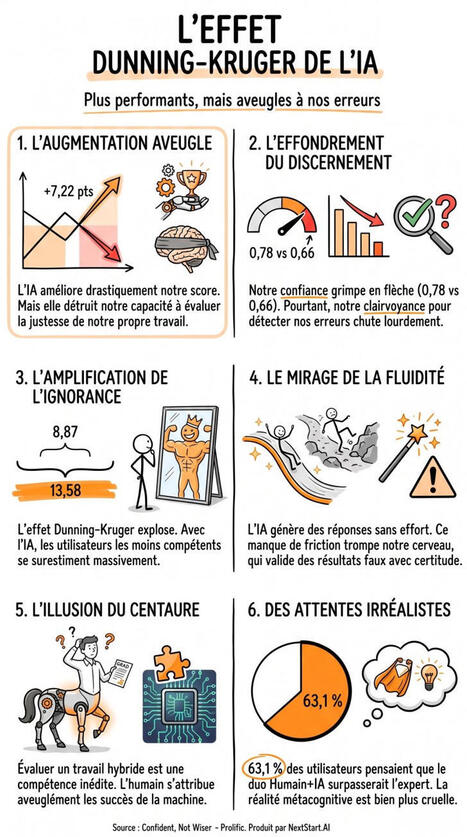
L'IA ne supprime pas l'effet Dunning-Kruger. Elle le déplace. Un LLM nous rend plus performants, mais moins lucides sur nos propres erreurs. Notre capacité à distinguer les bonnes réponses des erreurs est en moyenne plus faible.
Cette étude a mesuré les scores et la clairvoyance de 366 participants britanniques, répartis en deux groupes (avec ou sans IA), sur 40 tests de raisonnement. Voici les 6 enseignements :
1. L'augmentation aveugle
L'IA améliore drastiquement la performance au détriment de la lucidité métacognitive. L'étude révèle que le binôme Humain-Machine gagne +7,22 points sur 40 face à l'humain seul. Mais sa capacité à juger ses propres réponses ne suit pas. La compétence augmente, la lucidité non.
2. La baisse du discernement
Le niveau de confiance global grimpe, mais cette assurance tourne à vide. L'AUROC, qui mesure la capacité à distinguer ses bonnes réponses de ses erreurs, chute sur l'ensemble de la batterie, même si l'écart n'est plus établi au sein d'une même tâche. L'utilisateur se trompe moins, mais sa confiance ne distingue presque plus ses réussites de ses erreurs.
3. L'amplification de l'ignorance
L'effet Dunning-Kruger veut que les moins performants se surestiment le plus. Cet effet ne disparaît pas avec l'IA, il semble même s'accentuer. L'écart d'auto-évaluation entre le quart le moins performant et le quart le plus performant est environ une fois et demie plus large. Il bondit de 8,87 points sans l'IA, à 13,58 points avec l'aide de la machine.
4. Le mirage de la fluidité
La facilité à trouver une réponse est d'ordinaire un bon indice de réussite. Avec l'IA, cette facilité peut refléter la simple présence d'une suggestion plutôt qu'un raisonnement réussi. Notre baromètre interne perd alors sa fiabilité (hypothèse des auteurs, non mesurée ici).
5. L'illusion du centaure
Évaluer un travail hybride est un exercice à part. L'humain suit mal la performance de l'IA d'une tâche à l'autre. Et selon la littérature citée, il tend à s'attribuer les réussites obtenues avec elle. Nous ne savons tout simplement pas encore mesurer ce que nous valons quand nous formons un binôme avec l'algorithme.
6. Pas de miracle attendu
Dans 63,1 % des réponses des participants sans IA, l'estimation du duo Humain+IA égalait simplement la meilleure de leurs deux estimations, et ne la dépassait que dans 24,6 % des cas. Une intuition plutôt juste : le duo a égalé l'IA seule sans la dépasser. Seul le quart qui espérait une vraie synergie s'est trompé.
Et vous, comment repérez-vous une erreur dans une réponse de l'IA qui a l'air parfaite ?
Source : Papier de recherche Fernandes et al. de l'Université Aalto (Finlande), 25 septembre 2026
--------
👉 Transformez votre manière de travailler avec NextStart.AI | 17 comments on LinkedIn
|
|
Scooped by
Gilbert C FAURE
October 5, 4:33 AM
|
Scoop.it!

𝗠𝗼𝘀𝘁 𝗹𝗶𝘁𝗲𝗿𝗮𝘁𝘂𝗿𝗲 𝗿𝗲𝘃𝗶𝗲𝘄𝘀 𝘀𝘂𝗺𝗺𝗮𝗿𝗶𝘇𝗲 𝘄𝗵𝗮𝘁'𝘀 𝗸𝗻𝗼𝘄𝗻 — 𝘁𝗵𝗲 𝗯𝗲𝘀𝘁 𝗼𝗻𝗲𝘀 𝗮𝗿𝗴𝘂𝗲 𝘄𝗵𝗮𝘁'𝘀 𝗺𝗶𝘀𝘀𝗶𝗻𝗴
A literature review that only lists studies is a summary. A literature review that builds toward a gap is an argument. That single difference is where many theses quietly fall short, and where examiners push back hardest.
Here's a 𝟰-𝘀𝘁𝗲𝗽 𝗴𝘂𝗶𝗱𝗲 𝗳𝗿𝗼𝗺 𝗿𝗲𝘀𝗲𝗮𝗿𝗰𝗵 𝗴𝗮𝗽 𝘁𝗼 𝗹𝗶𝘁𝗲𝗿𝗮𝘁𝘂𝗿𝗲 𝗿𝗲𝘃𝗶𝗲𝘄 👇
𝟭. 𝗦𝗽𝗼𝘁 𝘁𝗵𝗲 𝗥𝗲𝘀𝗲𝗮𝗿𝗰𝗵 𝗚𝗮𝗽 — Narrow a broad topic into a specific, answerable question. Compare where studies agree and where they conflict. Look for populations, methods, or contexts no one has studied. Gaps usually come in three forms: knowledge, methodological, or contradictory.
𝟮. 𝗦𝗲𝗮𝗿𝗰𝗵 𝘁𝗵𝗲 𝗟𝗶𝘁𝗲𝗿𝗮𝘁𝘂𝗿𝗲 — Use databases like PubMed, Scopus, Google Scholar, and Web of Science with Boolean operators and clear keywords. Set your inclusion and exclusion criteria before you start screening, and document your search strategy so it can be reproduced.
𝟯. 𝗢𝗿𝗴𝗮𝗻𝗶𝘇𝗲 & 𝗦𝘆𝗻𝘁𝗵𝗲𝘀𝗶𝘇𝗲 — Group studies by theme, method, or timeline. Build a synthesis matrix with studies as rows and themes as columns to see where findings agree, disagree, or stay silent. Compare and contrast instead of just summarizing.
𝟰. 𝗪𝗿𝗶𝘁𝗲 𝘁𝗵𝗲 𝗟𝗶𝘁𝗲𝗿𝗮𝘁𝘂𝗿𝗲 𝗥𝗲𝘃𝗶𝗲𝘄 — Introduce the context and state the gap plainly. Organize the body thematically, not source by source. Conclude by restating the gap and justifying your study.
𝗡𝗼𝘁 𝘀𝘂𝗿𝗲 𝘄𝗵𝗲𝗿𝗲 𝘁𝗵𝗲 𝗴𝗮𝗽 𝗶𝘀? Check existing systematic reviews, ask your advisors, set up database alerts, and read the "future research" sections of key papers.
A well-defined gap does more than justify your study. It avoids duplication, strengthens your argument, and guides your method. 🎓
Save this as your roadmap before you start your next literature review. 📌
Need help finding your research gap, structuring your synthesis, or writing your literature review? Reach out 👇
📧 asma@researchcrave.com
🌐 www.researchcrave.com
whatsapp: https://wa.link/bbvf22
Visit: Researchcraveacademy.com
#ResearchGap #LiteratureReview #LiteratureSearch #SynthesisMatrix #ResearchMethodology #SystematicReview #AcademicWriting #AcademicResearch #AcademicWritingTips #ThesisWriting #DissertationWriting #ThesisHelp #PhDLife #PhDStudent #PhDJourney #PhDSupport #PhDCommunity #PhDChat #GradSchool #HigherEducation #DoctoralStudies #PostgraduateLife #ResearchSkills #ScholarlyWriting #ResearchDesign #ResearchCrave
|
|
Scooped by
Gilbert C FAURE
October 5, 4:08 AM
|
Scoop.it!
Your academic paper is boring everyone.
And that's why reviewers keep rejecting you.
I reviewed 100+ rejected manuscripts last year.
They all made the same mistake.
They wrote for themselves. Not for the reader.
Your supervisor lied to you. Academic writing is NOT about big grammar.
It's about architecture.
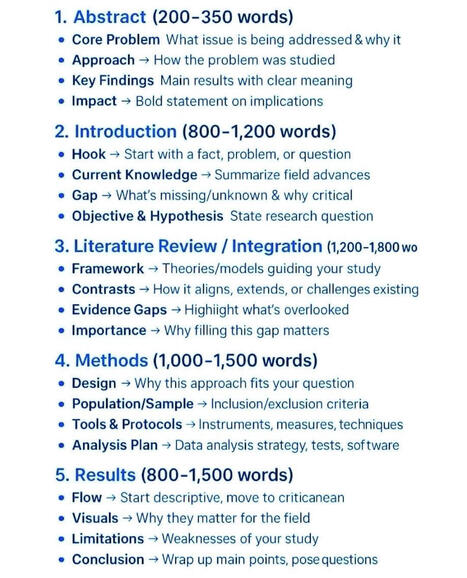
Here's the brutal structure that gets you published:
1. Abstract (200-350 words): Nobody cares about your process. They care about PROBLEM -> SOLUTION -> IMPACT. If I don't see why it matters in 30 seconds, I stop reading.
2. Introduction (800-1,200 words): Start with a punch, not history. Gap = Money. If you can't show what's missing and why it's dangerous to ignore, you have no paper. Just an essay.
3. Literature Review (1,200-1,800 words): Stop summarizing. Start fighting. Framework, contrast, expose the gap others missed. You're not a librarian. You're an argument.
4. Methods (1,000-1,500 words): Reviewers don't trust you. Prove you didn't fake it. Why this design? Who did you exclude? What software? If I can't replicate it, I will reject it.
5. Results (800-1,500 words): This is where 90% fail. They dump tables. Don't dump. Flow from simple to complex. Visuals that matter. And have the guts to state your limitations before reviewers use them to kill you.
Most academics write 6,000 words that say nothing.
Top 1% write 5,000 words that no one can ignore.
The difference? Structure.
What advice would you want to add?
🔔follow Edidiong Ukpong(PhD Architecture) for more | 36 comments on LinkedIn





Un catalogue détaillé d'outils pour la veille, à télécharger via SlideShare et LinkedIn