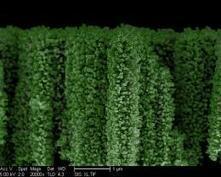
(PhysOrg.com) -- University of California, San Diego electrical engineers are building a forest of tiny nanowire trees in order to cleanly capture solar energy without using fossil fuels and harvest it for hydrogen fuel generation.
“Hydrogen is considered to be clean fuel compared to fossil fuel because there is no carbon emission, but the hydrogen currently used is not generated cleanly,” said Ke Sun, a PhD student in electrical engineering who led the project.
By harvesting more sun light using the vertical nanotree structure, Wang’s team has developed a way to produce more hydrogen fuel efficiently...
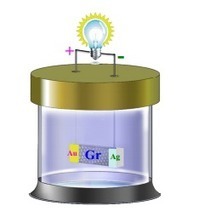
Physicists have built a graphene battery that harvests energy from the thermal movement of ions in solution...
The copper ions, which have a double positive charge, move through the solution at a rate of about 300 metres per second thanks to the thermal energy of the solution at room temperature.
When an ion smashes into the graphene strip, the collision generates enough energy to kick a delocalised electron out of the graphene.
The electron then has two options: it can either leave the graphene strip and combine with the copper ion or it can travel through the graphene strip and into the circuit.
It turns out that the mobility of electrons is much higher in graphene than it is through the solution, so the electron naturally chooses the route through the circuit. It is this that lights up the LED.
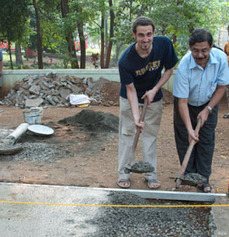
Cement making is very energy intensive. Materials have to he heated to 1,400 degrees C, so this new way of making cement without having to heat it, is certainly something that will help. Actually, it's not so new - the Egyptians and the Romans already used such cement, and their buildings are still standing...
from the article:
Drexel’s “green” variety is a form of alkali-activated cement that utilizes an industrial byproduct, called slag, and a common mineral, limestone, and does not require heating to produce. According to Dr. Michel W. Barsoum, professor of Materials Science and Engineering, this alternative production method and the ubiquity of the mix ingredients, lessens the cost of materials for Drexel’s cement by about 40 percent versus Portland cement and reduces energy consumption and carbon dioxide production by 97 percent.
interesting video on research that found cavitation bubble collapse to stimulate iron into releasing some of its nuclear energy without the production of radiation. Comparison with a conventional uranium reactor showed the iron reaction to be more energetic than the currently used uranium fission reaction.
When applied to radioactive thorium, the piezoelectric cavitation was found to *reduce* radioactivity, speeding up decay 1000-fold, indicating that the technology may be applied to cleaning up nuclear materials from conventional nuclear reactors.
How can we harness nature to produce sustainable building materials? This stool is made by microbes cementing together loose mineral material into solid forms. Without the use of harmful additives or lots of energy, A Radical Means proposes a vision of materials and manufacturing technologies able to produce unique form, colour and pattern by sustainable means.
Stefan Hartmann of Overunity.com has posted two videos of a Russian group (friends of Tariel Kapanadze) apparently powering a stand-alone engine on water. They drink from a bottle of water (of course, it could be Vodka), then pour the liquid into what appears to be a fuel tank. Then they start up the engine.
As it's running, they show the exhaust being clean. As they hold a cup at the exhaust, it collects liquid (assumed to be water), which they then drink.
Graphene, often described as a "miracle material", can be used to distil alcohol, according to a new study in the Science journal.
An international team created the membrane from graphene oxide - a chemical derivative of graphene.
They have shown that the membrane blocks the passage of several gases and liquids, but lets water through.
This joins a long list of fascinating and unusual properties associated with graphene and its derivatives.
Graphene is a form of carbon. It is a flat layer of carbon atoms tightly packed into a two-dimensional honeycomb arrangement.
Because it is so thin, it is also practically transparent. As a conductor of electricity, it performs as well as copper; and as a conductor of heat, it outperforms all other known materials.
The unusual electronic, mechanical and chemical properties of graphene at the molecular scale promise numerous applications.
Joe Justice presents at TEDxRanier how Team WIKISPEED has accomplished amazing results in producing a 100 Mile per Gallon (MPG) car using processes borrowed ...
...from the software world; Agile, Lean, Scrum and Extreme Programing. The result is that WIKISPEED now sells an affordable car that achieves 100 MPG that is is fast, fun and beautiful while also achieving a five star crash test rating equivalent.
My comment:
This is the future of real distributed manufacturing. Small shops, won't call them factories, that can make anything for you from a pickup truck to a neat new washing machine that uses ultrasound to clean the clothes, from sneakers like no one else has to a personal web server in a wall plug. The possibilities seem endless...
A new technique that paves the way for manufacturing affordable LED light bulbs is to be exploited in the UK, in a deal that researchers say could have a dramatic impact on carbon emissions.
Researchers estimate that a worldwide switch to LEDs, which are far more energy-efficient, would enable the closure of 560 power plants and result in annual CO2 savings equivalent to the output of all the cars on the planet.
LEDs are also being designed to give off a more natural quality of light, which will be better for people’s health.
“We’ve got higher efficiency for growing gallium nitride on silicon than anyone else we know,” Humphreys said. “Potentially this is a deal that puts Britain right at the forefront of LED research.”
“LED light bulbs currently cost as much as £40, but we expect to be able to reduce that cost by a factor of five by growing on silicon.
Experiments performed with a team of nano quadrotors at the GRASP Lab, University of Pennsylvania. Vehicles developed by KMel Robotics. Special thanks to Pro...
Neat but they will probably end up in the wrong hands...
While researchers have long known of the incredible strength of spider silk, the robust nature of the tiny filaments cannot alone explain how webs survive multiple tears and winds that exceed hurricane strength.
The study showed that, as one might expect, when any part of a web is perturbed, the whole web reacts. Such sensitivity is what alerts a spider to the struggling of a trapped insect. However, the radial and spiral filaments each play different roles in attenuating motion, and when stresses are particularly harsh, they are sacrificed so that the entire web may survive.
"The concept of selective, localized failure for spider webs is interesting since it is a distinct departure from the structural principles that seem to be in play for many biological materials and components," adds Dennis Carter, the NSF program director for biomechanics and mechanobiology who helped support the study.
- - -
There is much to learn by observing and trying to understand nature ... as Schauberger already used to say.
About the same size as a Mini Cooper and twice as fast, the Megacity Aviation concept was designed to transport goods rapidly through cities with major gridlock. The majority of the biofiber reinforced bioplastic frame is hollow like the bones of a bird, making it incredibly lightweight. Powered by two hydraulically operated coaxial rotors, it’s highly maneuverable and can carry up to 200kg.
A radical new camera that lets you adjust the focus after you take a picture began shipping this week.
"The consumer point-and-shoot camera has just been reinvented -- not tweaked, or remodeled, but actually re-thought from top to bottom," said Walt Mossberg in The Wall Street Journal.
My comment:
That camera is one of the very few instances where an important new development actually finds its way to the users. Point and shoot - change focus after you have downloaded the pictures to your computer...
Sterling Allan reports on his recent trip to South Africa to visit a company who has developed a 5 kilowatt Fuel Free Generator that will be available beginning March for their existing customers.
Magnetohydrodynamics (MHD) (magneto fluid dynamics or hydromagnetics) is an academic discipline which studies the dynamics of electrically conducting fluids. Examples of such fluids include plasmas, liquid metals, and salt water or electrolytes. The word magnetohydrodynamics (MHD) is derived from magneto- meaning magnetic field, and hydro- meaning liquid, and -dynamics meaning movement. The field of MHD was initiated by Hannes Alfvén,[1] for which he received the Nobel Prize in Physics in 1970.
The fundamental concept behind MHD is that magnetic fields can induce currents in a moving conductive fluid, which in turn creates forces on the fluid and also changes the magnetic field itself.
My comment:
Does anyone have knowledge of technical developments on this being made publically available? It seems that there is little information on technical progress on this, indicating that the whole field may have been "put under lock and key" - perhaps it is too disruptive to a certain energy monopoly that is still largely in control of energy policy and that is profiting from how we make energy today ...
Physicists at Purdue University and the University of New South Wales have built a transistor from a single atom of phosphorous precisely placed on a bed of silicon, taking another step towards the holy grail of tech research: the quantum computer.
We can obtain renewable, clean, safe, cheap energy by annihilation, for example, of an electron with an anti-electron (positron). An electron and positron are obtained by extracting them from atoms; the extraction consumes a negligible amount of energy. Then, the two particles are brought near one another (collision).
The phenomenon of annihilation occurs when particle rest mass is converted totally into energy (gamma photons). Gamma photons occur as much as needed to retrieve the total energy of the electron and positron...
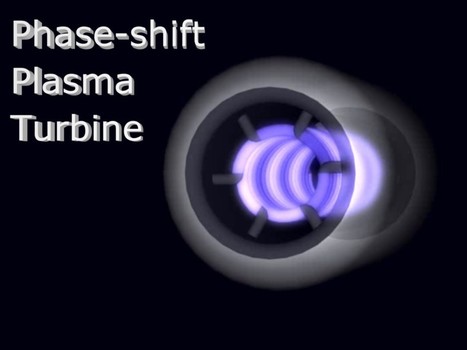
The Phase-shift Plasma Turbine is a modified version of the Electrodynamic Space Thruster in order to operate in atmospheric environments, mainly during takeoff, and in space to reuse exhaust gases from chemical rockets to boost the overall ISP, enhancing utilization of both energy and propellant.
The Phase-shift Turbine uses a set of concentric coils, axially rotated in relation to each other, and feed by phased RF sources, producing radial and longitudinal sequences, which results in helical moving force, ionizing intake gas/particle/ion, generating continuous unidirectional thrust.
Although there are several vertical axis wind turbines listed on greenterrafirma's page, the one built with 55 gallon drums was especially interesting to us.
Intel Corporation announced today its fastest, most robust client/consumer solid-state drive (SSD) to date, the Intel Solid-State Drive 520 Series (Intel SSD 520), a 6 gigabit-per-second (gbps) SATA III SSD produced using Intel compute-quality...
...25-nanometer (nm) NAND memory process technology. Aimed at delivering world-class performance for even the most demanding PC enthusiasts, gamers, professionals or small-medium businesses (SMBs), the Intel SSD 520 has fast throughput performance, new security features and unmatched reliability to meet even the most intensive user requirements.
Unlike a traditional hard disk drive (HDD) with spinning disks and moveable parts, an SSD is based on silicon, NAND flash memory specifically, to create a lower power, more reliable and drastically faster storage solution that can keep up with today's most demanding applications, Internet streaming and intense multi-tasking.
Sepp, hardly any news at all. SSDs have been available for several years inside all kinds of PCs and Macs. Your own MacBook Pro has offered a version with SSDs since a few years now, and anyone can swap his Mac hd for an SSD on the Apple Store. The MacBook Air has offered a native SSD version of its unit since its inception.
So, from my viewpoint, the only relevant news would have to be about capacity and cost, because these have been the real limitations for wider adoption.
I respect your interest for these technologies, but as an avid reader of your great news picks, I can't avoid voicing my little disappointment for this one. The story contains little valuable info and quite a bit of marketing stuff (....Aimed at delivering world-class performance for even the most demanding PC enthusiasts, gamers, professionals or small-medium businesses (SMBs), the Intel SSD 520 has fast throughput performance, new security features and unmatched reliability to meet even the most intensive user requirements....) which is of very little use to me as a reader.
My early childhood was defined by My father's excitement for His work in electrogravitics, then (1950's) being worked on openly by all major aerospace...
Electrogravitics (electrically mediated anti-gravity technology) has been actively developed since the 1950's but is being kept under wraps and used only in classified military and other black projects.
If you believe we should have access to this kind of technology, read Amaterasu Solar's description of his personal experience and his view of how releasing this technology could change the world. Sign the petition, if you think it's worth it...
Nottingham, UK (SPX) Feb 01, 2012 - A new way of generating wind energy which could see smaller, more efficient turbines on the landscape is being developed by a Derbyshire inventor with support from Nottingham Trent University.
Traditional wind turbines typically have three blades which rotate around a horizontal hub at the top of a steel tower. Most generate maximum output at an approximate wind speed of 30mph and shut down to prevent storm damage at 50mph or above, causing reduced efficiency of some turbines.
The new Wind Harvester is based on a reciprocating motion that uses horizontal aerofoils similar to those used on aeroplanes. It is virtually noise-free and can generate electricity at a low speed, which may result in less opposition to new installations. It will also be operational at higher wind speeds than current wind turbines.
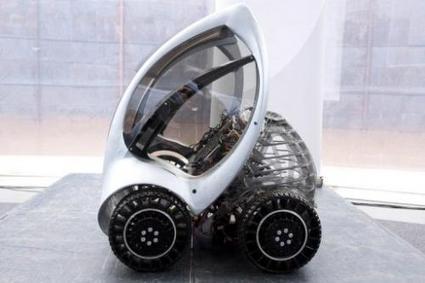
A tiny revolutionary fold-up car designed in Spain's Basque country as the answer to urban stress and pollution was unveiled Tuesday before hitting European cities in 2013.
Its makers are in talks with a number of European cities to assemble the tiny cars that can run 120 kilometres (75 miles) without a recharge and whose speed is electronically set to respect city limits.
They envisage it as a city-owned vehicle, up for hire like the fleets of bicycles available in many European cities, or put up for sale privately at around 12,500 euros.
Several cities have shows interest, including Berlin, Barcelona, San Francisco and Hong Kong. Talks are underway with Paris, London, Boston, Dubai and Brussels.
To get content containing either thought or leadership enter:
To get content containing both thought and leadership enter:
To get content containing the expression thought leadership enter:
You can enter several keywords and you can refine them whenever you want. Our suggestion engine uses more signals but entering a few keywords here will rapidly give you great content to curate.


 Your new post is loading...




![Piezonuclear reactions: Towards a new clean Nuclear Energy [Video] | Cool Future Technologies | Scoop.it](https://img.scoop.it/vLa_9oiJeUAuOWr3aBZ-CTl72eJkfbmt4t8yenImKBVvK0kTmF0xjctABnaLJIm9)

![Russian Team with Water-Fueled Engine [Video] | Cool Future Technologies | Scoop.it](https://img.scoop.it/z8xGFG2ImMYG26HdFFGO3jl72eJkfbmt4t8yenImKBVvK0kTmF0xjctABnaLJIm9)