Read about the latest future flying cars including reviews on the the Moller Skycar, the Transition, the Aerospace and more.
A flying car is both street legal on the ground and FAA compliant in the air. Sounds simple enough doesn't it? It would be if it weren't for those pesky wings. If you thought it was a pain to open up a Targa top, imagine how awkward it would be to remove a couple of wings. Automated collapsible wings would be the user-friendly solution to the problem, but how to accomplish this without compromising wing stability or driver safety?
Ultimately, flying cars are a fantastic idea that no one has quite figured out. And even if someone creates a viable model, who is going to buy one? A pilot's license requires a significant investment of time and money. Planes and helicopters are also expensive to maintain. Yearly inspections and regular overhauls are mandatory because, well, blowing a head gasket at 10,000 feet is a sigificant problem.
Despite the obstacles, the flying car is still a popular idea and several companies are pushing ahead with the dream.
In a landmark interview, Andrea Rossi, the inventor of the E-Cat (cold fusion energy catalyzer), announced many breakthroughs in the development of his technology, answered a wide range of questions, and shared many details regarding the upcoming...
...ten kilowatt heat unit for home use.
A FIRST: This is the first exotic free energy technology that we know of that has been submitted for UL certification, a major milestone prior to deployment to the market.
It seems every aspect of the E-Cat is advancing, and making the most of modern technology. From using robotics to automate the production lines, to using modern material science to eliminate the need of a hydrogen canister, to utilizing the skills of National Instruments to design a state of the art control system, he is taking nickel-hydrogen fusion technology to the next level.
NASA's Technology Gateway has posted a two-minute video that summarizes the emerging LENR field and the hope it brings for a world of clean, affordable energy.
Dr. Zawodny: "The easiest implementation of this would be for the home. You would have a unit that would replace your water heater. And you would have some sort of cycle to derive electrical energy from that. And then it would dump its waste heat into the water or air handing system for the building. So it would be a dual use thing. It would be sitting there producing heat; [and] you'd drive electricity from it to run your electronics, power the house, power the building, power the lights. And then the waste heat would be used for environmental control [e.g. heat pump / air conditioning] and warm water."
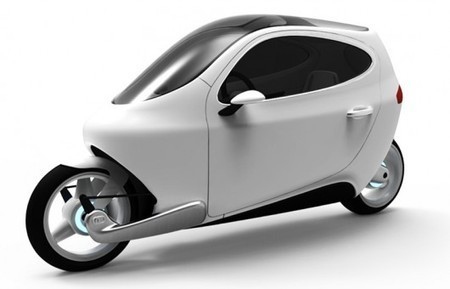
The C-1 is a proposed fully-electric and fully-enclosed self-balancing motorcycle.
As any avid biker will tell you, motorcycles have a lot of advantages over cars - they use less fuel, accelerate faster, are more maneuverable, can be parked in more places, and don't incorporate the weight of extra seating for passengers who are non-existent on solo commutes. As many other people will tell you, however, motorcycles also leave their occupants open to the rain and cold, and can potentially tip over and scatter those occupants across the road. That's where Lit Motors' C-1 comes into the picture. It's a proposed fully-enclosed two-passenger electric motorbike that uses an electronically-controlled gyroscopic stabilizing system to stay upright when stopped, or even when struck from the side in an accident.
A wireless square with sensors and a simple web app to set rules, Twine tells you what your things are doing by email, text or Twitter.
This is a kickstarter project, meaning the idea is there, the prototypes are there, but they guys developing it would like to get into production and need some finance for that. People have already pledged substantially more than what is required to start...
It's a utopian fantasy - discover a ghost town and rebuild it in line with your ideals-, but in Spain where there are nearly 3000 abandoned villages ...
Very low tech, but definitely future... more and more people leave the cities and go out in the countryside to build something.
This is amazing to see citizens take action as a community to seemingly desolate and dead place into a living, sustainable community. The buildings were intentionally renovated by the community so they have a personal connection and responsibility to it and to each other as a community. Also they exemplify a low cost model for an eco-community.
http://www.ted.com At TEDIndia, Pranav Mistry demos several tools that help the physical world interact with the world of data -- including a deep look at hi...
Does your government have an Internet kill-switch? Read our guide to Guerrilla Networking and be prepared for when the lines get cut.
Given enough time and preparation, your ham radio networks could even be adapted into your own ad-hoc network using Packet Radio, a radio communications protocol that you can use to create simple long-distance wireless networks to transfer text and other messages between computers. Packet Radio is rather slow and not particularly popular (don't try to stream any videos with this, now), but it's exactly the kind of networking device that would fly under the radar.
The idea is to twist radio waves like corkscrews and create multiple subfrequencies, distinguished by their degree of twistedness. Each subchannel carries discrete data sets. “You can tune the wave with a given frequency as you normally do, but there is also a fingerprint left by the twist,” Tamburini says. He and Swedish colleague Bo Thidé hit upon the approach while studying waves warped by the immense gravity of black holes. This past June, the scientists set up a custom dish in Venice and successfully broadcast video encoded in both twisted and normal radio waves across St. Mark’s Basin.
Concentrated solar therman power would be a benign type of energy that can actually replace nuclear reactors.
All that is needed is a sunny location and concentrating mirrors. The heat achievable is several hundred degrees, quite comparable to that generated in nuclear reactors. It can therefore drive the same type of steam turbines and electric generators.
The most important thing about the sun's energy is its abundance. In just six hours, more energy from the sun reaches the Earth's deserts than is consumed by all of humanity in an entire year. Consequently, it would take a relatively small area of desert land to produce all the electric power the world consumes.
The Kinecthesia is a Kinect wired to a set of motors that allows the blind to navigate a room or open space, relying on feedback through the motors to assess objects in their path.
The project, created by University of Pennsylvania students Eric Berdinis and Jeff Kiske, is worn like a belt and can sense objects in 3D space.
Obviously this is a bit clunky – the Kinect isn’t quite wearable just yet. They’re working on 2.0 of the project, using a slimmed-down Kinect removed from its case and a new processor, the Beagleboard (rather than the Beagleboard XM).
THE world may soon be able to buy one of the Far North's most controversial yet revolutionary inventions.
The Lutec draws its power from a bank of batteries, with the motor turning due to powerful permanent magnets at its core being attracted and then repulsed from steel cores of fixed coils.
It does not work via perpetual motion, rather it relies on natural magnetic forces and a pulsed electrical input.
The results of the generator were verified by independent engineers from SGS Australia following a test earlier this year, which confirmed the energy output from the generator was indeed greater than its input.
Mr Christie said he and Mr Brits were currently working on a production prototype to suit the domestic market, which they hoped to produce locally.
- - -
The article dates back to August 2010. I am not holding my breath for this one, but it would be neat if they actually got their stuff together and came out with a working product...
This is a Step by step video to make your own free energy collecting antenna, and how to convert it to your outlet. This technology is using Energy from a higher dimension, and creates a vortex to channel it into our 3D.
Something for technically inclined experimenters...
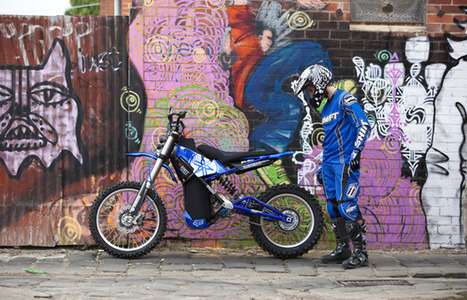
Based on the geometry of a 250cc motocrosser, the O2 Pursuit prototype uses the breakthrough engine technology developed by Angelo Di Pietro of Engineair.
Benstead, a recent graduate of the Royal Melbourne Institute of Technology (RMIT), has harnessed the power that exists in the air tanks to mechanically drive the vehicle.
According to Benstead, testing of the motorcycle showed close to a quarter of an hour running time with stops at around 25-45 km/h. During stationary testing, Benstead’s team timed the speed off the back wheel, registering over 100 km/h. Preliminary testing of the prototype was limited to an indoors factory environment on a circular track.
This past week saw at least 65 stories from 15 dedicated sites and 5 mainstream news sites.
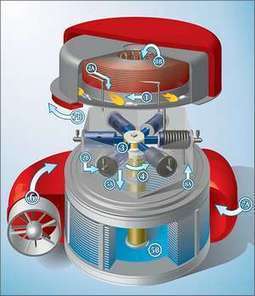
Something to ease your way into the reality that there is a new type of heat engine out there that does not depend on fossil fuels. It's real, it's being built and it has been demonstrated to function as promised...
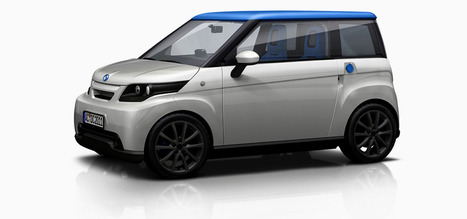
Designed and manufactured in a collaboration by more than 50 companies, the StreetScooter (which isn't actually a scooter) may show a new way of engineering and producing cutting edge vehicles.
A couple of things up front about the StreetScooter. First, it isn’t actually a “scooter” (see picture). It’s a German-made electric car with a range of about 80 miles, a price tag of about $6,000, and a top speed of 74 mph. Second: tThe most important thing about it isn’t its range, speed, or price (though it’s a lot cheaper than comparable models).
What’s special is how it was developed. More than 50 companies took part in the StreetScooter’s design and engineering, co-creating, and collaborating from scratch. Not a single large brand was involved, and many were small- and medium-sized firms. The process effectively turns traditional car development on its head. Instead of one manufacturer dictating its designs to suppliers, all the companies had equal status, and could provide input.
The roof of a city-owned downtown parkade will be converted to a high-tech vertical growing space capable of producing 95 tonnes of fresh vegetables a year.
Vancouver-based Valcent Products has entered into a memorandum of understanding with EasyPark, the corporate manager of the city’s parkades, to build a 6,000-square-foot greenhouse on underutilized space on the roof of the parkade at 535 Richards Street, in the heart of the downtown core.
(PhysOrg.com) -- Researchers from the National Renewable Energy Laboratory (NREL) have reported the first solar cell that produces a photocurrent that has an external quantum efficiency greater than 100 percent when photoexcited with photons from ...
THE wrong kind of wind? It’s a phrase that haunts those desperately trying to justify wind farms in Britain. However, apologists for the giant turbines now face the unpalatable truth that structures designed to operate in windy conditions literally fell flat on their faces when the wind became a bit too strong.
As storms battered Scotland on Thursday a 300ft turbine exploded like a giant Catherine wheel, showering the countryside with burning debris. Witnesses said fire erupted in the centre of the £2million turbine in Ardrossan, North Ayrshire, then flames covered the blades.
The day before, a turbine at Coldingham in the Scottish Borders was brought crashing down by the wind. Several homes had to be evacuated and a road closed. On Tuesday a turbine put up earlier this year fell in high winds at Scapegoat Hill near Huddersfield .
My comment:
Check out D B Parker's SandPiper 3 Spiral Airfoil and the Dynasphere from Earthships (further down). They rotate more slowly. Spiralairfoil also has an interesting graph of power diagrams on their site
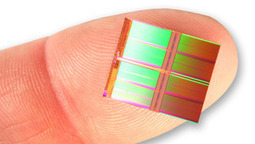
Intel and Micron have announced the creation of a 128 gigabit flash die. An SSD built from such parts could pack 2 TB into a 2.5" drive.
Intel and Micron's joint venture IMFT has announced that it has produced a 128Gb die. A package combining eight such dies together would be small enough to fit on a fingertip and boast an unprecedented 128GB capacity. Mass production will start in the first half of next year, and devices using the new dies are likely to start shipping in 2013.
For more eco ideas follow us on: http://www.facebook.com/ecoideasnet Can a plastic bottle full of water become a 60W lightbulb? Check out this simple and rev...
Someone has been spreading the word on this in the slums of the Philippines ... and now the UN is catching on...
Most of the talk about renewable energy is aimed at electricity production. However, most of the energy we need is heat, which solar panels and wind turbines cannot produce efficiently.
To power industrial processes like the making of chemicals, the smelting of metals or the production of microchips, we need a renewable source of thermal energy. Direct use of solar energy can be the solution, and it creates the possibility to produce renewable energy plants using only renewable energy plants, paving the way for a truly sustainable industrial civilization.
- - -
This is a rather long article advocating the use of solar heat (concentrated solar power) in industrial processes, where heat, not necessarily electricity, is required. This kind of use is still very much in its infancy...
Front on view of the SandPiper in action, because of the shutter speed at times it appears the SandPiper is barely moving when in reality it is flowing fine,...
De Be Parker of Spiral Foil is getting ready to start producing his highly efficient, even in low wind conditions, (and bird-safe) wind generator in small series... his website is
To get content containing either thought or leadership enter:
To get content containing both thought and leadership enter:
To get content containing the expression thought leadership enter:
You can enter several keywords and you can refine them whenever you want. Our suggestion engine uses more signals but entering a few keywords here will rapidly give you great content to curate.


 Your new post is loading...