


The 12th European Conference on Fungal Genetics, Seville (Spain) during March 23-27, 2014. http://www.ecfg12.com/

Plants and Microbes
401.5K views |
+23 today
Everything related to the science of plant-microbe interactions
Curated by
Kamoun Lab @ TSL
 Your new post is loading...
 Scoop.it! 
Bacterial flagellin molecules are strong inducers of innate immune responses in both mammals and plants. The opportunistic pathogenPseudomonas aeruginosa secretes an alkaline protease called AprA that degrades flagellin monomers. Here, we show that AprA is widespread among a wide variety of bacterial species. In addition we investigated the role of AprA in virulence of the bacterial plant pathogen Pseudomonas syringae pv. tomato DC3000 (Pst). The AprA-deficient Pst ∆aprA knockout mutant was significantly less virulent on both tomato and A. thaliana. Moreover, infiltration of A. thaliana Col-0 leaves with Pst ∆aprA evoked a significantly higher level of expression of the defense-related genes FRK1 and PR-1 than did wild-type Pst. In the flagellin receptor mutant fls2, pathogen virulence and defense-related gene activation did not differ between Pst and Pst ∆aprA. Together, these results suggest that AprA of Pst is important for evasion of recognition by the FLS2 receptor, allowing wild-type Pst to be more virulent on its host plant than AprA-deficient Pst ∆aprA. To provide further evidence for the role of Pst AprA in host immune evasion, we overexpressed the AprA inhibitory peptide AprI of Pst in A. thaliana to counteract the immune evasive capacity of Pst AprA. Ectopic expression of aprI in A. thaliana resulted in an enhanced level of resistance against wild-type Pst, while the already elevated level of resistance against Pst ∆aprA remained unchanged. Together, these results indicate that evasion of host immunity by the alkaline protease AprA is important for full virulence of Pst and likely acts by preventing flagellin monomers from being recognized by its cognate immune receptor. 
Scoop.it!

In contrast to the vast amount of genomic information, knowledge on the structure of protein-based molecular machines working within the cell, their interactions and processing is scarce and far more difficult to obtain. Structural methods, including molecular modeling and simulation shed light onto the molecular details of protein-protein and protein-peptide interactions proving useful in designing strategies to control the cellular processes in which these interactions occur. Hence structural approaches might become highly relevant for a better understanding and control ofplant-pathogen interactions. In particular, the Workshop "Structure-guided investigation of Effector function, action and recognition" aims to assess the state of the art and evaluate the potential of structural techniques in the field and in the effort of designing strategies to preventing pathogen infection. For this, the workshopwill focus on: - Effector and host proteins: identification, biophysics and biochemistry of protein action and interactions - Structural experiments on proteins involved in plant-pathogen interactions - Structural bioinformatics, probailistic modelling and experimental validation - Modelling protein-protein and interdomanin interactions using combined bioinformatics, structural analysis, experimental constraints and simulation
Scoop.it!

The YopJ-family of type III effector (T3E) proteins is one of the largest and widely distributed families of effector proteins whose members are highly diversified in virulence functions. In the present study, HopZ4, a member of the YopJ-family of T3Es from the cucumber pathogen Pseudomonas syringae pv. lachrymans is described. HopZ4 shares high sequence similarity with the Xanthomonas T3E XopJ and a functional analysis suggests a conserved virulence function between these two T3Es. As has previously shown for XopJ, HopZ4 interacts with the proteasomal subunit RPT6 in yeast and in planta to inhibit proteasome activity during infection. The inhibitory effect on the proteasome is dependent on localization of HopZ4 to the plasma membrane as well as on an intact catalytic triad of the effector protein. Furthermore, HopZ4 is able to complement loss of XopJ in Xanthomonas as it prevents precocious host cell death during a compatible interaction of Xanthomonas with pepper. The data presented here suggest that different bacterial species employ inhibition of the proteasome as a virulence strategy by making use of conserved T3Es from the YopJ-family of bacterial effector proteins. Via Suayib Üstün
Scoop.it!

The Type IV Secretion System (T4SS) is the only bacterial secretion system known to translocate both DNA and protein substrates. The VirB/D4 system from Agrobacterium tumefaciens is a typical T4SS. It facilitates the bacteria to translocate the VirD2-T-DNA complex to the host cell cytoplasm. In addition to protein-DNA complexes, the VirB/D4 system is also involved in the translocation of several effector proteins, including VirE2, VirE3 and VirF into the host cell cytoplasm. These effector proteins aid in the proper integration of the translocated DNA into the host genome. The VirD2-binding protein (VBP) is a key cytoplasmic protein that recruits the VirD2–T-DNA complex to the VirD4-coupling protein (VirD4 CP) of the VirB/D4 T4SS apparatus. Here, we report the crystal structure and associated functional studies of the C-terminal domain of VBP. This domain mainly consists of α-helices, and the two monomers of the asymmetric unit form a tight dimer. The structural analysis of this domain confirms the presence of a HEPN (higher eukaryotes and prokaryotes nucleotide-binding) fold. Biophysical studies show that VBP is a dimer in solution and that the HEPN domain is the dimerization domain. Based on structural and mutagenesis analyses, we show that substitution of key residues at the interface disrupts the dimerization of both the HEPN domain and full-length VBP. In addition, pull-down analyses show that only dimeric VBP can interact with VirD2 and VirD4 CP. Finally, we show that only Agrobacterium harboring dimeric full-length VBP can induce tumors in plants. This study sheds light on the structural basis of the substrate recruiting function of VBP in the T4SS pathway of A. tumefaciens and in other pathogenic bacteria employing similar systems.
Scoop.it!

The Arabidopsis immune receptor FLS2 senses the bacterial flagellin epitope flg22 to activate transient elevation of cytosolic calcium ions, production of reactive oxygen species (ROS), and other signaling events to coordinate antimicrobial defenses, such as stomatal closure that limits bacterial invasion. However, how FLS2 regulates these signaling events remains largely unknown. Here we show that the receptor-like cytoplasmic kinase BIK1, a component of the FLS2 immune receptor complex, not only positively regulates flg22-triggered calcium influx but also directly phosphorylates theNADPH oxidase RbohD at specific sites in a calcium-independent manner to enhance ROS generation. Furthermore, BIK1 and RbohD form a pathway that controls stomatal movement in response to flg22, thereby restricting bacterial entry into leaf tissues. These findings highlight a direct role of the FLS2 complex in the regulation of RbohD-mediated ROS production and stomatal defense. Via Suayib Üstün, Guogen Yang, Dr.donkey, Jim Alfano
Scoop.it!

The importance of pathogen-associated molecular patterns (PAMPs)-triggered immunity (PTI) against microbial pathogens has been recently demonstrated. However, it is currently unclear if this layer of immunity mediated by surface-localized pattern recognition receptors (PRRs) also plays a role in basal resistance to insects, such as aphids. Here we show that PTI is an important component of plant innate immunity to insects. Extract of the green peach aphid (GPA) Myzus persicae triggers responses characteristic of PTI in Arabidopsis. Two separate eliciting GPA-derived fractions trigger induced-resistance to GPA that is dependent on the leucine-rich repeat receptor like kinase (LRR-RLK) BRASSINOSTEROID INSENSITIVE1-ASSOCIATED KINASE1/ SOMATIC-EMBRYOGENESIS RECEPTOR-LIKE KINASE3 (BAK1/AtSERK3), which is a key regulator of several LRR-containing PRRs. BAK1 is required for GPA elicitor-mediated induction of reactive oxygen species (ROS) and callose deposition. Arabidopsis bak1 mutant plants are also compromised in immunity to Acyrthosiphon pisum (pea aphid) for which Arabidopsis is normally a non-host. Aphid-derived elicitors induce expression of PHYTOALEXIN DEFICIENT 3 (PAD3), a key cytochrome P450 involved in the biosynthesis of camalexin, which is a major Arabidopsis phytoalexin that is toxic to GPA. PAD3 is also required for induced-resistance to GPA, independently of BAK1 and ROS production. Our results reveal that plant innate immunity to insects may involve early perception of elicitors by cell surface-localized PRRs leading to subsequent downstream immune signaling.
Scoop.it!

The conference will be held in Poland's premier mountain resort of Zakopane, the beautiful and picturesque capital of the Polish High Tatra Mountains. Zakopane is a town in the south of Poland, approximately 110km south of Krakow and close to the border with Slovakia. Abstract deadline 12th March 2014
Scoop.it!

Phytoplasmas are insect-transmitted bacterial phytopathogens that secrete virulence effectors and induce changes in the architecture and defense response of their plant hosts. We previously demonstrated that the small (± 10 kDa) virulence effector SAP11 of Aster Yellows phytoplasma strain Witches' Broom (AY-WB) binds and destabilizes Arabidopsis CIN (CINCINNATA) TCP (TEOSINTE-BRANCHED, CYCLOIDEA, PROLIFERATION FACTOR 1 AND 2) transcription factors, resulting in dramatic changes in leaf morphogenesis and increased susceptibility to phytoplasma insect vectors. SAP11 contains a bipartite nuclear localization signal (NLS) that targets this effector to plant cell nuclei.To further understand how SAP11 functions, we assessed the involvement of SAP11 regions in TCP binding and destabilization using a series of mutants.SAP11 mutants lacking the entire N-terminal domain, including the NLS, interacted with TCPs but did not destabilize them. SAP11 mutants lacking the C-terminal domain were impaired in both binding and destabilization of TCPs. These SAP11 mutants did not alter leaf morphogenesis. A SAP11 mutant that did not accumulate in plant nuclei (SAP11ΔNLS-NES) was able to bind and destabilize TCP transcription factors, but instigated weaker changes in leaf morphogenesis than wild-type SAP11.Overall the results suggest that phytoplasma effector SAP11 has a modular organization in which at least three domains are required for efficient CIN-TCP destabilization in plants. Via Jim Alfano
Scoop.it!

This book presents an overview of Phytophthora diseases. Taking into account the needs of graduate students, scientists, and agricultural professionals, this volume integrates guides to literature, background information, physiology and genetics, the effect of environmental factors on disease, control by biological and cultural means, resistant cultivars, fungicides, and techniques for recognizing, identifying, and isolating Phytophthora pathogens. Featured are detailed descriptions of 59 species, including photomicrographs and drawings, and discussion of related diseases, their development and control, and distribution. Generously illustrated and printed on high-quality enamel stock, this volume will be welcome by plant scientists and libraries worldwide.
Scoop.it!

Bacterial leaf streak of rice, caused by Xanthomonas oryzae pv. oryzicola (Xoc) is an increasingly important yield constraint in this staple crop. A mesophyll colonizer, Xoc differs from X. oryzae pv. oryzae (Xoo), which invades xylem to cause bacterial blight of rice. Both produce multiple distinct TAL effectors, type III-delivered proteins that transactivate effector-specific host genes. A TAL effector finds its target(s) via a partially degenerate code whereby the modular effector amino acid sequence identifies nucleotide sequences to which the protein binds. Virulence contributions of some Xoo TAL effectors have been shown, and their relevant targets, susceptibility (S) genes, identified, but the role of TAL effectors in leaf streak is uncharacterized. We used host transcript profiling to compare leaf streak to blight and to probe functions of Xoc TAL effectors. We found that Xoc and Xoo induce almost completely different host transcriptional changes. Roughly one in three genes upregulated by the pathogens is preceded by a candidate TAL effector binding element. Experimental analysis of the 44 such genes predicted to be Xoc TAL effector targets verified nearly half, and identified most others as false predictions. None of the Xoc targets is a known bacterial blight S gene. Mutational analysis revealed that Tal2g, which activates two genes, contributes to lesion expansion and bacterial exudation. Use of designer TAL effectors discriminated a sulfate transporter gene as the S gene. Across all targets, basal expression tended to be higher than genome-average, and induction moderate. Finally, machine learning applied to real vs. falsely predicted targets yielded a classifier that recalled 92% of the real targets with 88% precision, providing a tool for better target prediction in the future. Our study expands the number of known TAL effector targets, identifies a new class of S gene, and improves our ability to predict functional targeting. Via dromius
Scoop.it!

Nuclear calcium oscillations are a hallmark of symbiotically stimulated plant root cells. Activation of the central nuclear decoder, calcium- and calmodulin-dependent kinase (CCaMK), triggers the entire symbiotic program including root nodule organogenesis, but the mechanism of signal transduction by CCaMK was unknown. We show that CYCLOPS, a direct phosphorylation substrate of CCaMK, is a DNA-binding transcriptional activator. Two phosphorylated serine residues within the N-terminal negative regulatory domain of CYCLOPS are necessary for its activity. CYCLOPS binds DNA in a sequence-specific and phosphorylation-dependent manner and transactivates the NODULE INCEPTION (NIN) gene. A phosphomimetic version of CYCLOPS was sufficient to trigger root nodule organogenesis in the absence of rhizobia and CCaMK. CYCLOPS thus induces a transcriptional activation cascade, in which NIN and a heterotrimeric NF-Y complex act in hierarchical succession to initiate symbiotic root nodule development Via Francis Martin
Scoop.it!

Bacterial pathogens of plant and animals share a homologous group of virulence factors, referred to as the YopJ effector family, which are translocated by the type III secretion (T3S) system into host cells during infection. Recent work indicates that some of these effectors encode acetyltransferases that suppress host immunity. The YopJ-like protein AvrBsT is known to activate effector-triggered immunity (ETI) in Arabidopsis thaliana Pi-0 plants; however, the nature of its enzymatic activity and host target(s) has remained elusive. Here we report that AvrBsT possesses acetyltransferase activity and acetylates ACIP1 (forACETYLATED INTERACTING PROTEIN1), an unknown protein from Arabidopsis. Genetic studies revealed that Arabidopsis ACIP family members are required for both pathogen-associated molecular pattern (PAMP)-triggered immunity and AvrBsT-triggered ETI duringPseudomonas syringae pathovar tomato DC3000 (Pst DC3000) infection. Microscopy studies revealed that ACIP1 is associated with punctae on the cell cortex and some of these punctae co-localize with microtubules. These structures were dramatically altered during infection. Pst DC3000 or Pst DC3000 AvrRpt2 infection triggered the formation of numerous, small ACIP1 punctae and rods. By contrast, Pst DC3000 AvrBsT infection primarily triggered the formation of large GFP-ACIP1 aggregates, in an acetyltransferase-dependent manner. Our data reveal that members of the ACIP family are new components of the defense machinery required for anti-bacterial immunity. They also suggest that AvrBsT-dependent acetylation in planta alters ACIP1's defense function, which is linked to the activation of ETI.
|
Scoop.it!

Hosts and their symbionts are involved in intimate physiological and ecological interactions. The impact of these interactions on the evolution of each partner depends on the time-scale considered. Short-term dynamics – ‘coevolution’ in the narrow sense – has been reviewed elsewhere. We focus here on the long-term evolutionary dynamics of cospeciation and speciation following host shifts. Whether hosts and their symbionts speciate in parallel, by cospeciation, or through host shifts, is a key issue in host–symbiont evolution. In this review, we first outline approaches to compare divergence between pairwise associated groups of species, their advantages and pitfalls. We then consider recent insights into the long-term evolution of host–parasite and host–mutualist associations by critically reviewing the literature. We show that convincing cases of cospeciation are rare (7%) and that cophylogenetic methods overestimate the occurrence of such events. Finally, we examine the relationships between short-term coevolutionary dynamics and long-term patterns of diversification in host–symbiont associations. We review theoretical and experimental studies showing that short-term dynamics can foster parasite specialization, but that these events can occur following host shifts and do not necessarily involve cospeciation. Overall, there is now substantial evidence to suggest that coevolutionary dynamics of hosts and parasites do not favor long-term cospeciation.
Scoop.it!

Plant-Pathogen Interactions: Methods and Protocols, Second Edition by Paul Birch, John Jones, Jorunn Bos (Editors) expands upon the first edition with current, detailed protocols for the study of plant pathogen genome sequences. It contains new chapters on techniques to help identify and characterize effectors and to study their impacts on host immunity and their roles in pathogen biology. Additional chapters focus on protocols to identify avirulence and resistance genes, investigate the roles of effector targets and other defence-associated proteins in plant immunity. Written in the highly successful Methods in Molecular Biology series format, chapters include introductions to their respective topics, lists of the necessary materials and reagents, step-by-step, readily reproducible laboratory protocols and tips on troubleshooting and avoiding known pitfalls.
Scoop.it!

Given the demonstrated importance of the non-RD class of kinases in the immune response, and the large number of these proteins in monocots (rice has approximately 10 times as many non-RD receptor kinases as Arabidopsis), there is great interest in exploring cereal PRR-mediated immunity. This workshop will be modeled after the highly successful NSF-supported Plant Phosphorylation Workshop that serves as a forum for researchers from as many as 45 laboratories to interact and share research ideas and results.
Scoop.it!

Mitogen-activated protein kinase cascades are key players in plant immune signaling pathways, transducing the perception of invading pathogens into effective defense responses. Plant pathogenic oomycetes, such as the Irish potato famine pathogen Phytophthora infestans, deliver RXLR effector proteins to plant cells to modulate host immune signaling and promote colonization. Our understanding of the molecular mechanisms by which these effectors act in plant cells is limited. Here, we report that the P. infestans RXLR effector PexRD2 interacts with the kinase domain of MAPKKKε, a positive regulator of cell death associated with plant immunity. Expression of PexRD2 or silencing MAPKKKε inNicotiana benthamiana enhances susceptibility to P. infestans. We show that PexRD2 perturbs signaling pathways triggered by or dependent on MAPKKKε. By contrast, homologs of PexRD2 from P. infestans had reduced or no interaction with MAPKKKε and did not promote disease susceptibility. Structure-led mutagenesis identified PexRD2 variants that do not interact with MAPKKKε and fail to support enhanced pathogen growth or perturb MAPKKKε signaling pathways. Our findings provide evidence that P. infestans RXLR effector PexRD2 has evolved to interact with a specific host MAPKKK to perturb plant immunity–related signaling. Via Suayib Üstün

's comment March 14, 2014 8:42 PM
Indeed! A crazy week. You guys belong to an excellent generation of scientists.
Scoop.it!

Innate immunity relies on the perception of pathogen-associated molecular patterns (PAMPs) by pattern-recognition receptors (PRRs) located on the host cell’s surface. Many plant PRRs are kinases. Here, we report that the Arabidopsis receptor kinase EF-TU RECEPTOR EFR, which perceives the elf18 peptide derived from bacterial elongation factor Tu, is activated upon ligand binding by phosphorylation on its tyrosine residues. Phosphorylation of a single tyrosine residue, Y836, is required for activation of EFR and downstream immunity to the phytopathogenic bacterium Pseudomonas syringae. A tyrosine phosphatase, HopAO1, secreted by P. syringae, reduces EFR phosphorylation and derails subsequent immune responses. Thus host and pathogen battle to take control of PRR tyrosine phosphorylation used to initiate anti-bacterial immunity. Via Jim Alfano

Jim Alfano's curator insight,
March 13, 2014 6:21 PM
Very interesting finding - A long sought target of the HopAO1 effector. HopAO1 also suppresses ETI - so additional targets remain undiscovered.
Scoop.it!

The rapid production of reactive oxygen species (ROS) burst is a conserved signaling output in immunity across kingdoms. In plants, perception of pathogen-associated molecular patterns (PAMPs) by surface-localized pattern recognition receptors (PRRs) activates the NADPH oxidase RBOHD by hitherto unknown mechanisms. Here, we show that RBOHD exists in complex with the receptor kinases EFR and FLS2, which are the PRRs for bacterial EF-Tu and flagellin, respectively. The plasma-membrane-associated kinase BIK1, which is a direct substrate of the PRR complex, directly interacts with and phosphorylates RBOHD upon PAMP perception. BIK1 phosphorylates different residues than calcium-dependent protein kinases, and both PAMP-induced BIK1 activation and BIK1-mediated phosphorylation of RBOHD are calcium independent. Importantly, phosphorylation of these residues is critical for the PAMP-induced ROS burst and antibacterial immunity. Our study reveals a rapid regulatory mechanism of a plant RBOH, which occurs in parallel with and is essential for its paradigmatic calcium-based regulation.

Steve Marek's curator insight,
March 13, 2014 9:54 AM
Elegantly simple and effective. What about other PRRs?
Scoop.it!

Plant pathogens secrete effectors to manipulate their host and facilitate colonization. Fusarium oxysporum f. sp. lycopersici is the causal agent of Fusarium wilt disease in tomato. Upon infection, F. oxysporum f. sp.lycopersici secretes numerous small proteins into the xylem sap (Six proteins). Most Six proteins are unique to F. oxysporum, but Six6 is an exception; a homolog is also present in two Colletotrichum spp. SIX6expression was found to require living host cells and a knockout ofSIX6 in F. oxysporum f. sp. lycopersici compromised virulence, classifying it as a genuine effector. Heterologous expression of SIX6did not affect growth of Agrobacterium tumefaciens in Nicotiana benthamiana leaves or susceptibility of Arabidopsis thaliana towardVerticillium dahliae, Pseudomonas syringae, or F. oxysporum, suggesting a specific function for F. oxysporum f. sp. lycopersici Six6 in the F. oxysporum f. sp. lycopersici– tomato pathosystem. Remarkably, Six6 was found to specifically suppress I-2-mediated cell death (I2CD) upon transient expression in N. benthamiana, whereas it did not compromise the activity of other cell-death-inducing genes. Still, this I2CD suppressing activity of Six6 does not allow the fungus to overcome I-2 resistance in tomato, suggesting that I-2-mediated resistance is independent from cell death.
Scoop.it!

The origins of many plant diseases appear to be recent and associated with the rise of domestication, the spread of agriculture or recent global movements of crops. Distinguishing between these possibilities is problematic because of the difficulty of determining rates of molecular evolution over short time frames. Heterochronous approaches using recent and historical samples show that plant viruses exhibit highly variable and often rapid rates of molecular evolution. The accuracy of estimated evolution rates and age of origin can be greatly improved with the inclusion of older molecular data from archaeological material. Here we present the first reconstruction of an archaeological RNA genome, which is of Barley Stripe Mosaic Virus (BSMV) isolated from barley grain ~750 years of age. Phylogenetic analysis of BSMV that includes this genome indicates the divergence of BSMV and its closest relative prior to this time, most likely around 2000 years ago. However, exclusion of the archaeological data results in an apparently much more recent origin of the virus that postdates even the archaeological sample. We conclude that this viral lineage originated in the Near East or North Africa, and spread to North America and East Asia with their hosts along historical trade routes.
Scoop.it!

The sessile plants have evolved a large number of receptor-like kinases (RLKs) and receptor-like cytoplasmic kinases (RLCKs) to modulate diverse biological processes, including plant innate immunity. Phosphorylation of the RLK/RLCK complex constitutes an essential step to initiate immune signaling. Two Arabidopsis plasma membrane-resident RLKs, flagellin-sensing 2 and brassinosteroid insensitive 1-associated kinase 1 (BAK1), interact with RLCK Botrytis-induced kinase 1 (BIK1) to initiate plant immune responses to bacterial flagellin. BAK1 directly phosphorylates BIK1 and positively regulates plant immunity. Classically defined as a serine/threonine kinase, BIK1 is shown here to possess tyrosine kinase activity with mass spectrometry, immunoblot, and genetic analyses. BIK1 is autophosphorylated at multiple tyrosine (Y) residues in addition to serine/threonine residues. Importantly, BAK1 is able to phosphorylate BIK1 at both tyrosine and serine/threonine residues. BIK1Y150 is likely catalytically important as the mutation blocks both tyrosine and serine/threonine kinase activity, whereas Y243 and Y250 are more specifically involved in tyrosine phosphorylation. The BIK1 tyrosine phosphorylation plays a crucial role in BIK1-mediated plant innate immunity as the transgenic plants carrying BIK1Y150F, Y243F, or Y250F (the mutation of tyrosine to phenylalanine) failed to complement the bik1 mutant deficiency in immunity. Our data indicate that plant RLCK BIK1 is a nonreceptor dual-specificity kinase and both tyrosine and serine/threonine kinase activities are required for its functions in plant immune signaling. Together with the previous finding of BAK1 to be autophosphorylated at tyrosine residues, our results unveiled the tyrosine phosphorylation cascade as a common regulatory mechanism that controls membrane-resident receptor signaling in plants and metazoans. Via Suayib Üstün, Jim Alfano
Jim Alfano's curator insight,
February 18, 2014 3:07 PM
Does the P. syringae HopAO1 tyrosine phosphatase effector act on BIK1?
Scoop.it!

Agroinfiltration and PVX agroinfection are two efficient transient expression assays for functional analysis of candidate genes in plants. The most commonly used agent for agroinfiltration is Agrobacterium tumefaciens, a pathogen of many dicot plant species. This implies that agroinfiltration can be applied to many plant species. Here, we present our protocols and expected results when applying these methods to the potato (Solanum tuberosum), its related wild tuber-bearing Solanum species (Solanum section Petota) and the model plantNicotiana benthamiana. In addition to functional analysis of single genes, such as resistance (R) or avirulence (Avr) genes, the agroinfiltration assay is very suitable for recapitulating the R-AVR interactions associated with specific host pathogen interactions by simply delivering R and Avr transgenes into the same cell. However, some plant genotypes can raise nonspecific defense responses to Agrobacterium, as we observed for example for several potato genotypes. Compared to agroinfiltration, detection of AVR activity with PVX agroinfection is more sensitive, more high-throughput in functional screens and less sensitive to nonspecific defense responses to Agrobacterium. However, nonspecific defense to PVX can occur and there is a risk to miss responses due to virus-induced extreme resistance. Despite such limitations, in our experience, agroinfiltration and PVX agroinfection are both suitable and complementary assays that can be used simultaneously to confirm each other's results.
Scoop.it!
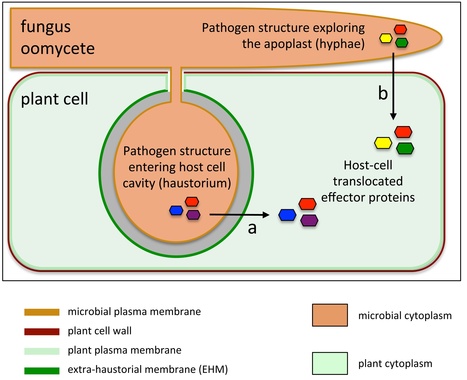
Fungal and oomycete plant parasites are among the most devastating pathogens of food crops. These microbes secrete effector proteins inside plant cells to manipulate host processes and facilitate colonization. How these effectors reach the host cytoplasm remains an unclear and debated area of plant research. In this article, we examine recent conflicting findings that have generated discussion in the field. We also highlight promising approaches based on studies of both parasite and host during infection. Ultimately, this knowledge may inform future broad spectrum strategies for protecting crops from such pathogens.
Scoop.it!

A sketch from the Phytophthora notebook, in honor of new followers: pic.twitter.com/ZqwbjpuMdU
|






