Wearable Tech and the Internet of Things (Iot)
22.8K views | +0 today
Wearable Tech and the Internet of Things (Iot)
Your new post is loading...
Rescooped by Richard Platt from Objets connectés & automesure | Wearables, capteurs & quantified self — Pharmageek
May 15, 2015 2:46 PM
Scoop.it!

Wearables 2015: Defining digital medicine

Wearables 2015: Defining digital medicine | Wearable Tech and the Internet of Things (Iot) | Scoop.it
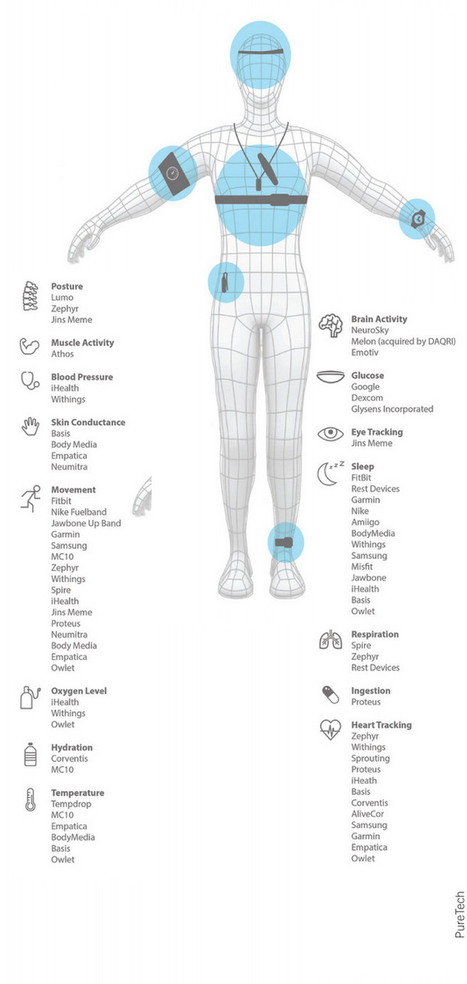
Digital medicine is poised to transform biomedical research, clinical practice and the commercial sector. Here we introduce a monthly column from R&D/venture creation firm PureTech tracking digital medicine's emergence.


Technology has already transformed the social fabric of life in the twenty-first century. It is now poised to profoundly influence disease management and healthcare. Beyond the hype of the 'mobile health' and 'wearable technology' movement, the ability to monitor our bodies and continuously gather data about human biology suggests new possibilities for both biomedical research and clinical practice. Just as the Human Genome Project ushered in the age of high-throughput genotyping, the ability to automate, continuously record, analyze and share standardized physiological and biological data augurs the beginning of a new era—that of high-throughput human phenotyping.


These advances are prompting new approaches to research and medicine, but they are also raising questions and posing challenges for existing healthcare delivery systems. How will these technologies alter biomedical research approaches, what types of experimental questions will researchers now be able to ask and what types of training will be needed? Will the ability to digitize individual characteristics and communicate by mobile technology empower patients and enable the modification of disease-promoting behaviors; at the same time, will it threaten patient privacy? Will doctors be prescribing US Food and Drug Administration (FDA)-cleared apps on a regular basis, not just to monitor and manage chronic disease but also to preempt acute disease episodes? Will the shift in the balance between disease treatment and early intervention have a broad economic impact on the healthcare system? How will the emergence of these new technologies reshape the healthcare industry and its underlying business models? What will be the defining characteristics of 'winning' products and companies?


These are just some of the questions we plan to ask over the coming months. In the meantime, we introduce here some of the key themes shaping R&D in the digital medicine field and focus on what they might mean for the biopharmaceutical and diagnostic/device industries.


Via Dr. Stefan Gruenwald, Lionel Reichardt / le Pharmageek
Ed Crowley's curator insight, May 17, 2015 8:30 AM

Wearable medical technology is quickly changing the potential for health research, and with IoT, health management. 

Be-Bound®'s curator insight, May 18, 2015 9:54 AM

And this is just the beginning ! 

Kim Flintoff's curator insight, April 12, 2016 3:04 AM
Big data is impacting on every industry. Health and personal monitoring devices are increasingly linked and the questions raised in this piece tie together big data, computational thinking and IoT considerations. Shrugging in exasperation is less helpful than modelling innovative new apporahces to problem-solving. Therein lies some of the promise of a data-driven culture.
Rescooped by Richard Platt from Future Technology
May 11, 2015 7:12 PM
Scoop.it!

Identity, Control, Safety: The next generation of Wearable Tech

Identity, Control, Safety: The next generation of Wearable Tech | Wearable Tech and the Internet of Things (Iot) | Scoop.it
Identity, control, safety – these are the three areas where wearable technology will evolve in its next generation, according to Sonny VU, CEO of wearables company Misfit. “Right now, in a current world of wearables, we’re still very much in a 1.0 world”, he says.”If you think about it, the use cases for wearables right …

Via TechinBiz
Richard Platt's insight:

Identity, control, safety – these are the three areas where wearable technology will evolve in its next generation, according to Sonny VU, CEO of wearables company Misfit. “Right now, in a current world of wearables, we’re still very much in a 1.0 world”, he says.”If you think about it, the use cases for wearables right …

Moolahonly's curator insight, May 8, 2015 1:27 PM

These are the types of wearable devices we would like help get funding on our crowdfunding platform www.moolahonly.com


Please support our Headtalker campaign at http://bit.ly/1EjTMyU

Scooped by Richard Platt
May 11, 2015 12:41 AM
Scoop.it!

China's military warns troops wearable tech poses security risk

China's military warns troops wearable tech poses security risk | Wearable Tech and the Internet of Things (Iot) | Scoop.it
Ditch the smartwatches and intelligent glasses, military mouthpiece tells soldiers - the enemy could be pinpointing your location with them
Richard Platt's insight:

Leave your smartwatches and fitness trackers at home, the military has told its soldiers - the enemy can tap into such devices and pinpoint troop location or take photos and recordings that can be sent over the internet.  -  The warning, which was carried in the military's PLA Daily mouthpiece, comes amid a push by the mainland to bolster cybersecurity and eliminate security threats potentially posed by foreign-owned technology.   -  Intelligent glasses that come equipped with a high-definition camera and microphone can shoot photos, record videos and independently process data, which all could be used to discover the military's whereabouts, the Daily cited unnamed army experts as saying.   -  Smart wristbands, such as fitness trackers, also pose a danger to soldiers. The devices can detect and track activity throughout the day and automatically put the information in the cloud on the internet, it said.  -  Some wearable devices could also be used to establish a wireless network. The PLA maintains an independent network that is isolated from the public internet, according to the Daily. Access to an outside network was strictly controlled and only permitted using highly encrypted connections.

No comment yet.
Scooped by Richard Platt
May 10, 2015 1:45 PM
Scoop.it!

6 things Android Wear smartwatches can do that the Apple Watch can't

6 things Android Wear smartwatches can do that the Apple Watch can't | Wearable Tech and the Internet of Things (Iot) | Scoop.it
Google's Android Wear 5.1.1 gives Android Wear smartwatches a slight edge over the Apple Watch in terms of useful features.
Richard Platt's insight:

Top 3 reasons (1) Custom Watch Face, (2) Always-on app (soon) (3) Works over any Wi-Fi network - whereas you need to have the iPhone and Apple Watch connected to the same network, you always have to carry both.

No comment yet.
Scooped by Richard Platt
May 10, 2015 12:18 AM
Scoop.it!

Insurance firms adopting wearables to get closer to customers, says Accenture

Insurance firms adopting wearables to get closer to customers, says Accenture | Wearable Tech and the Internet of Things (Iot) | Scoop.it
Sixty-three percent of survey repsondents believe that wearable technologies will be
Richard Platt's insight:

"While insurers have traditionally based their underwriting and pricing processes on a limited view of certain customer variables, emerging technologies such as wearables and other connected devices can help insurers break from their traditional business models and provide outcome-based services for their customers," said John Cusano, senior managing director of Accenture's global insurance practice.   -  "For instance, one leading insurer recently announced that it will provide new policyholders with a free fitness band to track their health progress - and then reward their healthy living with a reduction in life insurance premiums."

No comment yet.
Scooped by Richard Platt
May 8, 2015 10:01 PM
Scoop.it!

The BBC Reviews Apple v Android: Which watch wins after week of wear?

The BBC Reviews Apple v Android: Which watch wins after week of wear? | Wearable Tech and the Internet of Things (Iot) | Scoop.it
Many young people do not wear any kind of watch - but will smartwatches change that? BBC Click's Dave Lee puts them on trial.
Richard Platt's insight:

Great analysis and video, worthwhile to watch the comparison

No comment yet.
Rescooped by Richard Platt from Internet of Things & Wearable Technology Insights
May 8, 2015 11:48 AM
Scoop.it!

Android Wear's New Strategy For Success In The Apple Watch Era

Android Wear's New Strategy For Success In The Apple Watch Era | Wearable Tech and the Internet of Things (Iot) | Scoop.it

Although Apple hasn’t revealed any official sales numbers—and says it doesn’t plan to—several unofficial estimates claim that Apple has at least cracked the 1 million sales mark. Google's Android Wear platform only shipped 720,000 units in all of 2014, according to Canalys.

Just as it did with smartphones and tablets, Apple has essentially created the smartwatch market. But don't write off Android Wear just yet. Through a series of seemingly low-key changes, Google is quietly positioning itself for a stronger second act....


Via Jeff Domansky
Richard Platt's insight:

Just as it did with smartphones and tablets, Apple has essentially created the smartwatch market. But don't write off Android Wear just yet. Through a series of seemingly low-key changes, Google is quietly positioning itself for a stronger second act.  -  A few weeks ago, Google announced Android Wear 5.1.1, and while the version number doesn't suggest major improvements, the update will make third-party apps much more useful.  -   When Android Wear first launched, Google seemed to deliberately hide their launcher, preferring that app makers focus on actionable notifications. But developers say Google may have gotten ahead of itself with that plan.  -  "My guess is they went a bit too fast going notification-only, and they found users are confused by the lack of structure," says Q42 developer Taco Ekkel, who created an app for controlling Philips Hue lightbulbs. "The notification-instead-of-apps model is the future, but people (both users and many app developers) need time to get there."

Jeff Domansky's curator insight, May 7, 2015 5:51 PM

Stay tuned as Google plays catch up.

Moolahonly's curator insight, May 8, 2015 3:06 PM

These are the types of wearable devices we would like help get funding on our crowdfunding platform www.moolahonly.com


Please support our Headtalker campaign at http://bit.ly/1EjTMyU

Scooped by Richard Platt
May 8, 2015 12:59 AM
Scoop.it!

Wearable cognitive assessment devices a step closer as Cambridge Cognition file new patents

Wearable cognitive assessment devices a step closer as Cambridge Cognition file new patents | Wearable Tech and the Internet of Things (Iot) | Scoop.it
The combination of bio-behavioural measures and results from touch-screen cognitive tests would be used to build up a picture of a person’s mental function...
Richard Platt's insight:

Smartwatches represent a clear opportunity because of their potential to continuously monitor day-to-day activities alongside biometric parameters such as pulse, movement, and voice and compare these measurements to a baseline that is normal for the individual. If the measured parameters deviate from the baseline Cambridge Cognition believe this event could then be used to trigger quick and specific cognitive tests for the individual to take through mobile and wearable devices. The combination of bio-behavioural measures and results from touchscreen cognitive tests would be used to build up a picture of a person’s mental function, identifying the very earliest signs of mental health issues that could indicate a range of neurological conditions including Alzheimer’s disease, depression, stress or anxiety disorders and many others.

Moolahonly's curator insight, May 8, 2015 1:57 PM

These are the types of wearable devices we would like help get funding on our crowdfunding platform www.moolahonly.com


Please support our Headtalker campaign at http://bit.ly/1EjTMyU

Scooped by Richard Platt
May 8, 2015 12:09 AM
Scoop.it!

Inside the Apple Watch / Technical Teardown

Inside the Apple Watch / Technical Teardown | Wearable Tech and the Internet of Things (Iot) | Scoop.it
Richard Platt's insight:

Awesome and in depth technical analysis on the components of the Apple Watch.  Discovered the design win by STMicroelectronics for the 6 axis sensor for acceleration and roll, pitch and yaw (gyroscope). This is the first time that we see a true 6X sensor in an Apple product that doesn’t require an external accelerometer. In the iPhone 6 and 6+ we saw an Invensense 6 axis sensor and a Bosch 3 axis accelerometer. Here in an even more compact design, the Apple Watch, we finally have a solution for all 6 axis in a single component. We have some more indepth photos of the STMicroelectronics 6 axis sensor today to share with you. From the side view x-ray you can see two die stacked together; the MEMS sensor and the control ASIC. The plan view image looking down shows the wire bond attach area on the lower device. Later we hope to bring you some additional images of the ASIC and the MEMS die once we have separated them…

Some of the key findings so far:
  • The new Apple APL0778 application processor measures 5.2 mm x 6.2 mm and is fabbed on Samsung’s 28 nm LP process.
  • Dialog has the PMIC socket for the watch, but Maxim got the codec and amplifier sockets. What happened to Cirrus? They had been the incumbent in iPhones and iPads for several generations.
  • NXP scored the NFC and secure element and interface socket and Austria Micro Systems got the NFC signal booster
  • STMicroelectronics not only grabbed the 6-axis sensor, but they also have an ST32 MCU within the S1, as well as the optical emitter/sensor encoder die under the shaft of the Digital Crown.
  • Texas Instruments has 6 wins in the S1 ranging from battery management to opp amps.
  • Skyworks Wi-Fi LNA + switch and PA


No comment yet.
Scooped by Richard Platt
May 7, 2015 3:02 PM
Scoop.it!

Unstainable shirts are the latest example of wearable tech. But do they work?

Unstainable shirts are the latest example of wearable tech. But do they work? | Wearable Tech and the Internet of Things (Iot) | Scoop.it
An American clothing company claims to have invented a completely unstainable shirt. Does it work? We tried it out
Richard Platt's insight:

A stack engineer called Juan is behind the technology, which is pretty self-explanatory: the unstainable shirt is made from crepe de chine, so it looks normal enough, but it’s actually covered in a series of tiny fibres. These fibres use nanotechnology to repel virtually any water-based or oil-based liquid – beetroot, coffee, gob or sweat – making it evaporate before even touching the fabric. Still with me? Because each fibre is 100,000 times smaller than a grain of sand, you can’t see or feel them, but they’re there, suspending the spilled liquid above the fabric and stopping it from ever reaching the shirt  -  So how wearable is this? A shirt is a shirt, but it’s nicely fitted and colours are pretty enough, if pastel or white is your bag. It feels hot and synthetic, but entirely wearable without making its wearer feel like a matchstick. More important, though, is whether it works. Does it actually repel liquid? We tested it out with a glass of beetroot juice at the Guardian office kitchen.

No comment yet.
Rescooped by Richard Platt from Scinnovation
May 6, 2015 6:29 PM
Scoop.it!

Apple Pursues DNA Data

Apple Pursues DNA Data | Wearable Tech and the Internet of Things (Iot) | Scoop.it

The iPhone could become a new tool in genetic studies.Of all the rumors ever to swirl around the world’s most valuable company, this may be the first that could involve spitting in a plastic cup.


Via S. Diez de Medina Ph.D.
Richard Platt's insight:

The first five ResearchKit apps, including one called mPower that tracks symptoms of Parkinson’s disease, quickly recruited thousands of participants in a few days, demonstrating the reach of Apple’s platform.  -  “Apple launched ResearchKit and got a fantastic response. The obvious next thing is to collect DNA,” says Gholson Lyon, a geneticist at Cold Spring Harbor Laboratory, who isn’t involved with the studies.  -  Nudging iPhone owners to submit DNA samples to researchers would thrust Apple’s devices into the center of a widening battle for genetic information. Universities, large technology companies like Google (see “Google Wants to Store Your Genome”), direct-to-consumer labs, and even the U.S. government (see “U.S. to Develop DNA Study of One Million People”) are all trying to amass mega-databases of gene information to uncover clues about the causes of disease (see “Internet of DNA”).

No comment yet.
Scooped by Richard Platt
May 5, 2015 11:38 PM
Scoop.it!

Building the Business Case for Business Wearables

Building the Business Case for Business Wearables | Wearable Tech and the Internet of Things (Iot) | Scoop.it
Channel will be instrumental in helping enterprises put smart wearables to good use
Richard Platt's insight:

As it turns out, wearable technology avails itself to quite a diverse array of business applications.  -  In law enforcement, the benefits of wearable technology are indisputable. Head- and wrist-mounted screens provide police officers and military personnel hands-free access to critical data. The same holds true for emergency workers, search-and-rescue teams and environmental disaster teams.  -  In manufacturing, wearables can be used to manage equipment remotely - assembly-line machinery, for example - rendering processes more efficient and increasing worker safety.

Any technician needing to consult a manual would most likely appreciate a wearable device that leaves one's hands free, and so would anybody who wants to share what they're seeing with customers, or with colleagues for training purposes, be it in healthcare, construction, automobile repair, or another area where 'show and tell' plays a key role.  -  In the sales arena, many believe that having fast, reliable access to data via wearables can enhance customer service. Salesforce.com execs have been especially bullish on the idea. With its Salesforce Wear initiative, launched in 2014, the company is committed to working alongside Accenture and partnering with a number of vendors to develop "contextually aware sales apps" for an array of wearable devices.

Moolahonly's curator insight, May 8, 2015 1:30 PM

These are the types of wearable devices we would like help get funding on our crowdfunding platform www.moolahonly.com


Please support our Headtalker campaign at http://bit.ly/1EjTMyU

Scooped by Richard Platt
May 5, 2015 11:33 PM
Scoop.it!

Zing wearable technology offers fun alternative to Apple Watch

Zing wearable technology offers fun alternative to Apple Watch | Wearable Tech and the Internet of Things (Iot) | Scoop.it
IF you're in the mood to buy some wearable technology, then a new gadget being launched by a Cambridge firm could be right up your street. The Zing is the first of a range of products being...
Richard Platt's insight:

Zing was meant as a fun, alternative to high-end products such as the Apple Watch, and at a price of £49.99 (~$75.00) it will certainly be better for your bank balance.

Moolahonly's curator insight, May 8, 2015 2:02 PM

These are the types of wearable devices we would like help get funding on our crowdfunding platform www.moolahonly.com


Please support our Headtalker campaign at http://bit.ly/1EjTMyU

Rescooped by Richard Platt from MarketingHits
May 11, 2015 9:19 PM
Scoop.it!

Browsing the web on an Apple Watch is the worst user experience ever

Browsing the web on an Apple Watch is the worst user experience ever | Wearable Tech and the Internet of Things (Iot) | Scoop.it
Yearning to browse the web directly from your wrist on Apple Watch's tiny 1.32-inch screen? You're not alone. A developer known by the nickname Comex has somehow managed to run a fully-fledged web browser on an Apple Watch.

Via Brian Yanish - MarketingHits.com
No comment yet.
Rescooped by Richard Platt from Technology in Business Today
May 11, 2015 7:09 PM
Scoop.it!

Apple Watch and The Future of App Design

Apple Watch and The Future of App Design | Wearable Tech and the Internet of Things (Iot) | Scoop.it
The launch of the Apple Watch represents the latest proof point that we’re only going to have more devices to consider when designing mobile apps. Not only..

Via TechinBiz
Richard Platt's insight:

The fact that Apple Watch is designed to be used alongside an iPhone raises another important consideration – your users will not experience your application in isolation on a single a device. They will likely pick and choose the device to interact with, moving from one to another, to meet their needs at a given point in time.  -  As such, it becomes really important to think about system-based design – that is, spending time up-front on a project, considering all the different touch points that your users will engage with your application, and creating a set of related experiences that are clearly designed as one, but that take advantage of and are contextual to each of the device form factors.

No comment yet.
Scooped by Richard Platt
May 11, 2015 12:39 AM
Scoop.it!

This story is all about the quantified selfie

This story is all about the quantified selfie | Wearable Tech and the Internet of Things (Iot) | Scoop.it
Forget about strapping a Fitbit to your wrist. The next generation of activity/health trackers will need to be swallowed.
Richard Platt's insight:

Smarr keeps track of more than 150 parameters. Some, such as his heartbeat, movement and whether he's sitting, standing or lying down, he measures continuously in real time with a wireless gadget on his belt. Some, such as his weight, he logs daily. Others, such as his blood and the bacteria in his intestines, he tests only about once every month.  -  Smarr compares the way he treats his body with how people monitor and maintain their cars: "We know exactly how much gas we have, the engine temperature, how fast we are going. What I'm doing is creating a dashboard for my body."

One weekday afternoon in his lab, Smarr studied his life on an 5.5-by-2.5-metre monitor that spans most of the room. On the board were 150 key variables about his body over a 10-year period, displayed in coloured rectangles. Most were green, meaning they fall within the expected, healthy range. But some were yellow (one to 10 times outside the healthy range), and a handful were red (10 to 100 times outside the healthy range).  -  Once, Smarr was most renowned as the head of the research lab where Marc Andreessen developed the web browser in the early 1990s.   -  Now 66, Smarr is the unlikely hero of a global movement among ordinary people to "quantify" themselves using wearable fitness gadgets, medical equipment, headcams, traditional lab tests and homemade contraptions, all with the goal of finding ways to optimise their bodies and minds to live longer, healthier lives - and perhaps to discover some important truth about themselves and their purpose in life.

No comment yet.
Scooped by Richard Platt
May 10, 2015 1:34 PM
Scoop.it!

Why so many Apple Watch apps suck

Why so many Apple Watch apps suck | Wearable Tech and the Internet of Things (Iot) | Scoop.it
It's not the tiny screen, it's the upload time.
Richard Platt's insight:

It’s not the tiny screen, it’s the upload time.  On the front page of Sunday’s New York Times travel section, Stephanie Rosenbloom tells a story about the first time she tried to order a Uber ride through the company’s Apple Watch app. The app seemed to be frozen — until it wasn’t.  “Suddenly,” she writes, “it was ordering me car after car in what seemed like a digital-age version of the ‘I Love Lucy’ candy factory episode.”   Welcome to the world of first-generation third-party apps, the ones giving the Apple Watch a bad name. I’m not the only early user who’s complained about how slow and buggy they seemed.

No comment yet.
Scooped by Richard Platt
May 10, 2015 12:16 AM
Scoop.it!

Amid the flood of wearable devices, a movement to quantify lifestyles is evolving into big business

Amid the flood of wearable devices, a movement to quantify lifestyles is evolving into big business | Wearable Tech and the Internet of Things (Iot) | Scoop.it
Spearheaded by the flood of wearable devices, a movement to quantify consumers’ lifestyles is evolving into big business with immense health and privacy ramifications
Richard Platt's insight:

Critics point to the brouhaha in 2011, when some owners of Fitbit exercise sensors noticed that their sexual activity — including information about the duration of an episode and whether it was “passive, light effort” or “active and vigorous” — was being publicly shared by default.  -  They worry that wearables will be used as “black boxes” for a person’s body in legal matters. Three years ago, after a San Francisco cyclist struck and killed a 71-year-old pedestrian, prosecutors obtained his data from Strava, a GPS-enabled fitness tracker, to show he had been speeding and blew through several stop signs before the accident. More recently, a Calgary law firm is trying to use Fitbit data as evidence of injuries a client sustained in a car crash.  -  More sophisticated tools in development, such as a smartphone app that analyzes a bipolar person’s voice to predict a manic episode, and injectables and implants that test the blood, offer greater medical benefit but also pose greater risks.  -  Des Spence, a general practitioner in the United Kingdom, argues that unnecessary monitoring is creating in­cred­ible anxiety among today’s “unhealthily health-obsessed” trackers.

No comment yet.
Scooped by Richard Platt
May 8, 2015 7:08 PM
Scoop.it!

Apple Watch’s Heart Rate Sensor As Good As Mio's Alpha

Apple Watch’s Heart Rate Sensor As Good As Mio's Alpha | Wearable Tech and the Internet of Things (Iot) | Scoop.it
The performance of the heart rate sensor app on the Apple Watch is almost in line with that of the the Mio’s dedicated Alpha monitor, claims Mac and iOS developer Brad Larson. The comparison was done
Richard Platt's insight:

Almost similar results:  The data shown by both devices was almost same, even though the Alpha showed some of the sharper peaks, says the expert. Both wearables run on optical sensors that use reflected light to gauge blood flow. According to Larson, the sensor on the watch collected readings after every 5 seconds while in workout mode, slowing after every 10 minutes in regular use.

Apple was recently in dispute when it confirmed that the watch might measure inappropriate data for those with tattoos as it uses optical technology. There was a support page developed to show that the ink, pattern and saturation of some tattoos can make it difficult for the watch to read.

No comment yet.
Rescooped by Richard Platt from Mobile Technology
May 8, 2015 11:44 AM
Scoop.it!

Samsung will reportedly unveil its real Apple Watch rival this fall with the Galaxy Note 5

Samsung will reportedly unveil its real Apple Watch rival this fall with the Galaxy Note 5 | Wearable Tech and the Internet of Things (Iot) | Scoop.it

“Although Samsung never gave us a firm release window for its round-faced smartwatch (supposedly called the Gear A), it looks like any hope of seeing it before the end of the summer has been eradicated.”


Via Jesús Hernández
Richard Platt's insight:

As for the features of the watch, earlier reports indicate the Gear A will be equipped with a 14nm Exynos 7420 chip, crown-shaped power button, rotating bezel ring and wireless charging capabilities. AT&T, Sprint, T-Mobile and Verizon will all reportedly carry 3G models of the watch.  -  No release date, yet but if Samsung does end up launching the Gear A alongside the Galaxy Note 5, we can probably expect to see it on store shelves in September or October.

Moolahonly's curator insight, May 8, 2015 3:07 PM

These are the types of wearable devices we would like help get funding on our crowdfunding platform www.moolahonly.com


Please support our Headtalker campaign at http://bit.ly/1EjTMyU

Scooped by Richard Platt
May 8, 2015 12:51 AM
Scoop.it!

Too cool for wearable tech: Why Britain is behind the smartwatch times

Too cool for wearable tech: Why Britain is behind the smartwatch times | Wearable Tech and the Internet of Things (Iot) | Scoop.it
There's no two ways about it: Brits aren't fussed about wearables. When British Gas conducted a study on its Hive connected thermostat, it discovered that, while more than half of Britons thought smart home technology was worth having, just a quarter felt the same way about wearables. Contrast that with the attitudes in America polled…
Richard Platt's insight:

Matthew Drinkwater, Head of Fashion Innovation Technology at the London College of Fashion, said that there's huge cultural differences driving those trends, and that there's a long way to go until wearables become Brit friendly.  -  "What you see in London is a vibrancy and an energy which is very different to New York or Paris where there is a much more conservative attitude towards the way that you dress, "A lot of the wearable products at the moment are very corporate looking and fit in nicely with that kind of mindset. But what would work better in London is a much more aspirational product.  "London has always been perceived as a very creative city, way above commerciality. London has been one of the drivers of street style; it's a very multicultural city with a huge ability for people to wear what they want and not worry about how they look."

Moolahonly's curator insight, May 8, 2015 1:58 PM

These are the types of wearable devices we would like help get funding on our crowdfunding platform www.moolahonly.com


Please support our Headtalker campaign at http://bit.ly/1EjTMyU

Scooped by Richard Platt
May 7, 2015 3:04 PM
Scoop.it!

Overtaken by Wearable Tech, Ford Halts Health Monitoring Plans

Overtaken by Wearable Tech, Ford Halts Health Monitoring Plans | Wearable Tech and the Internet of Things (Iot) | Scoop.it
Ford is reportedly scrapping a project to develop seats that can detect heart attacks and other health issues because wearable tech devices already accomplish those tasks
Richard Platt's insight:

The new lesson: Ford has reportedly decided to scrap a project to develop seats that can detect heart attacks and perform other health-monitoring functions, because wearable digital devices already accomplish those tasks.  Automakers are learning that they still can’t move quickly enough to keep up with the consumer electronics industry, which now dictates so much of what goes on inside cars.


Moolahonly's curator insight, May 8, 2015 2:00 PM

These are the types of wearable devices we would like help get funding on our crowdfunding platform www.moolahonly.com


Please support our Headtalker campaign at http://bit.ly/1EjTMyU

Scooped by Richard Platt
May 7, 2015 2:59 PM
Scoop.it!

Woman beats amazing odds thanks to wearable technology

Woman beats amazing odds thanks to wearable technology | Wearable Tech and the Internet of Things (Iot) | Scoop.it
An Ark-La-Tex woman is grateful to be alive after she experienced "Sudden Cardiac Arrest." It's a testimony of how technology is helping to save lives.The chances of survival when a person's heart ...
Richard Platt's insight:

Due to the weakened state of her heart from surgery, Jarratt went into fibrillation and collapsed. Thankfully, within 60 seconds, the vest she was wearing determined she needed defibrillation and applied the treatment she needed by zapping her heart back into rhythm.  -  Dr. Veerareddy says without it she wouldn't likely wouldn't have made it.  -  "The shock is the very key to survival. When it comes to sudden cardiac death, 90 percent of people don't make it to the hospital," he explained.  -  Jarrat says she's grateful to be alive and with her family. She says she's learned from the experience and encourages others to go get checked.  "I know how vital it is. Don't hesitate to do it. It might be uncomfortable, but it's worth it," she said.

No comment yet.
Scooped by Richard Platt
May 5, 2015 11:40 PM
Scoop.it!

Why wearables are the hardest gadgets to build

Why wearables are the hardest gadgets to build | Wearable Tech and the Internet of Things (Iot) | Scoop.it
If there's been one theme of wearable tech through 2014 and 2015, it's been delays. The Razer Nabu, Jawbone UP3 and even the Apple Watch have all left consumers waiting empty handed, and while you might excuse the first two companies for being unable to meet demand, it's all the more surprising when Apple can't…
Richard Platt's insight:

"I think wearable tech is exposed more because it's on the body 24/7 so it's exposed to the elements. Wearables are exposed to wear and tear to a greater extent than other consumer tech. When you put something on the body it means it has to be more robust," he said.  -  As well as having to make wearables capable of surviving the rigours of everyday life, providing the data and features we've come to expect and last a usable amount of time on minuscule batteries, Godfrey also explained that it's essential to make them wearable.  -  Advanced wearables are heavily sophisticated, with powerful processors capable of complex computing on your wrist. For a company like Jawbone it's a priority to produce that in a small and comfortable design and form factor as possible. The UP3 is around 30% smaller than equivalent multi-sensor trackers and UP2 is 45% smaller than the UP24.  -  "That's where you get 24/7 wearability, when it disappears on the wrist,"

Moolahonly's curator insight, May 8, 2015 1:28 PM

These are the types of wearable devices we would like help get funding on our crowdfunding platform www.moolahonly.com


Please support our Headtalker campaign at http://bit.ly/1EjTMyU

Scooped by Richard Platt
May 5, 2015 11:36 PM
Scoop.it!

Desert Valley Medical Center First to Use Leaf Patient-Wearable Technology to Help Reduce C-Sections, Speed Labor

PLEASANTON, Calif., May 5, 2015 /PRNewswire/ -- Desert Valley Medical Center, named a Top 100 Hospitals® in...
Richard Platt's insight:

"We believe the Leaf technology has applications far beyond pressure ulcer prevention," said Dr. Barrett Larson, Chief Medical Officer of Leaf Healthcare. "For example, in Labor and Delivery, Leaf can help make sure that patients with epidurals are turning sufficiently, which has been shown to help with the laboring process."  -  The Leaf system is comprised of a small, lightweight, wearable sensor that electronically monitors a patient's position and movements. Data collected by the sensor is communicated wirelessly to central monitoring stations or mobile devices so that caregivers can check on patient position and movement. The system provides alerts when necessary to ensure that all patients wearing a Leaf Sensor are repositioned according to their prescribed turning schedules to reduce incidence of pressure ulcers. The device has been cleared for sale by FDA 510(k).

WHY IMPORTANT - THE PROBLEM IT SOLVES:

The national U.S. cesarean rate in 2012 was 32.8%, which has remained fairly constant for several years. Cesarean sections are the most common operating room procedure in U.S. hospitals. Overuse of this procedure is associated with excess morbidity in women and babies. For both commercial and Medicaid payers, total maternal-newborn costs are about 50% higher for cesarean compared with vaginal births.

No comment yet.