


Dot should hit the market for less than $300, with pre-orders staring this year.

 Your new post is loading...
 Scoop.it! Dot should hit the market for less than $300, with pre-orders staring this year. 
No comment yet.
Sign up to comment
Scoop.it!

From
fcw

The push to put processing power on the network's edge can be a valuable complement to cloud computing.
Richard Platt's insight:
“When distributed computing via PCs gained prominence, it was highly disruptive to the mainframe computing model,” Hall added. “The big difference this time around is that cloud and fog are deeply integrated and complementary.” - As the Internet of Things balloons to 50 billion devices by 2020 and data streams threaten to grow faster than the networks that support them, fog computing seems poised to prove a crucial consideration — and not just when it comes to big data. “Everyone is fixated on ‘big data,’ which by my definition requires data to be centralized, either physically or virtually, [but big data] analytics does not solve all classes of problems,” Younkers said. “Fog computing provides analytics at the edge, which allows for some very clever and innovative solutions.”
Scoop.it!

How do we feel about the latest wearable technology? A new show explores the possibilities in sporting our emotions quite literally on our sleeves
Richard Platt's insight:
As the consumer technology industry is using fashion to sell us more technology, Making Patterns, a new exhibition from Brooklyn-based arts and tech collective Eyebeam, wants us to question our relationship with technology, interfaces, networks and the people around us by bringing together technology-infused items of clothing designed to open up discussion. Kaho Abe’s Hotaru, Prototype #1: with two gauntlets embedded with Android smartphones and a projection dome, the piece is as much a video game as a fashion statement. In a world ruined by pollution, two players must cooperate to defeat darkness. One player shoots and the other collects power, and they must hold hands to transfer light between them. Elsewhere, artists examine the future possibilities of 3D printing in creating clothes, and the unique bespoke forms and material options that presents. Billy Dang, Andrea van Hintum, and Hilary Sampliner’s Poseidon is a wearable 3D printed garment that moves with the body. Inspired by denticles – the teeth of a shark – it is a chainmail-like, protective exoskeleton that guards the wearer from the elements. The garment is composed of hundreds of intricate, hinge-like, movable scales but, incredibly, it was printed in one piece. Cardinal, a GPS-equipped felt cowl (see above) that investigates how technology-infused clothing might enhance our sense of directional awareness and social connection. The patterns on the front, back and sides of the garment change colour depending on which way you are facing in relation to people and places connected via a distant GPS beacon, perhaps placed in your home or carried by a family member. Heat pads facing the direction of the beacon heat up, changing the colour of the thermochromic ink so that you’re reminded of your origins, your home, or wherever is important to you while navigating your daily life, and allowing you to turn and face them at anytime. As outlandish as the designs look at first glance, in many ways they are the most effective works on display at Making Patterns because the designs’ functionality feel like an extension or exaggeration of existing consumer technologies.
Scoop.it!

There's a new sports wearable in town designed by Portugal-based company Kinematix called TUNE, a running tracker with a bit of a difference.
Richard Platt's insight:
The TUNE wearable device, developed by Portugal-based company Kinematix, goes one step further by analysing the position of both feet as you run, looking for weaknesses before developing personalised training plans to improve. TUNE is composed by a pair of very thin (2mm) sensor-equipped insoles (to be placed underneath the shoes insoles) that each have an out-shoe connective dock where the TUNE device must be loaded before each run. Runners launch the TUNE app on their smartphones (with GPS and Bluetooth Low Energy) and can start running as TUNE devices combine the information extracted by the feet about running technical parameters: footstrike (heel-strike, midfoot strike), ground-contact time, heel-contact time and cadence; with GPS measurements that quantify the runner performance: speed, pace (time/km or mile) distance and timed runs. TUNE allows users to compare the variation of technical running parameters with the variation of the running performance parameters, driving to a cause-consequence analysis that makes the runner understanding what provokes a positive or negative result. TUNE measures what makes a runner moving forward: the interaction of both feet with the ground. It qualifies that interaction uniquely, as the behaviour of the feet on the ground can significantly affect the result or performance. For example, with TUNE it is easier to detect if both feet are behaving symmetrically or asymmetrically, and detect the performance variations of eventual corrections on that. TUNE algorithms interpret the technical parameters variations over the time and use that information to provide a personalised training plan, with exercise drills to be done for some minutes during each training session, but adapted to the needs of that runner. Furthermore, the runner can assess the effect of those drills on the evolution of the performance and technical parameters. - This is a far better way to measure and manage the performance (and from an human factors perspective) of an athlete than the methods used by smartwatches that we've seen so far, e,g, Apple's Watch --- just saying
Scoop.it!

Samsung Electronics is an innovation laboratory and it has come up with a few odd and wonderful ideas in the past years. Today, a patent application for a technology that adjusts itself according to the user's needs has been unearthed.
Richard Platt's insight:
Remember, as I pointed out in my presentation on Samsung as a consummate innovator and that patents are actually a lagging indicator of innovative capability of a firm, patent submission is a leading indicator. Patently Mobile found the patent application for a smartwatch screen that moves by itself to adjust to the user's eyesight. With the proposed watchface, Samsung wants the screen to move completely to where the user is looking. Samsung is integrating a configuration in that will be able to track the position of the user's eyesight and adjust itself accordingly so that the contents on screen will still be visible. In addition, the watch face can also be moved towards another person's line of eyesight which is perfect for when the user wants to show a content to someone else. The patent application suggests that this feature will be able to adjust automatically via face recognition or can be manually adjusted through the use of verbal commands like "go gadget face display" or simply "display. From the article: "Samsung Electronics is an innovation laboratory and it has come up with a few odd and wonderful ideas in the past years. Today, a patent application for a technology that adjusts itself according to the user's needs has been unearthed. We're still undecided whether this new idea for wearable devices from Samsung is brilliant or plain pointless, but it definitely will be the first in the industry if it ever becomes a reality."

ANTINO's curator insight,
August 2, 2015 12:14 PM
Remember, as I pointed out in my presentation on Samsung as a consummate innovator and that patents are actually a lagging indicator of innovative capability of a firm, patent submission is a leading indicator. Patently Mobile found the patent application for a smartwatch screen that moves by itself to adjust to the user's eyesight. With the proposed watchface, Samsung wants the screen to move completely to where the user is looking. Samsung is integrating a configuration in that will be able to track the position of the user's eyesight and adjust itself accordingly so that the contents on screen will still be visible. In addition, the watch face can also be moved towards another person's line of eyesight which is perfect for when the user wants to show a content to someone else. The patent application suggests that this feature will be able to adjust automatically via face recognition or can be manually adjusted through the use of verbal commands like "go gadget face display" or simply "display.
From the article: "Samsung Electronics is an innovation laboratory and it has come up with a few odd and wonderful ideas in the past years. Today, a patent application for a technology that adjusts itself according to the user's needs has been unearthed. We're still undecided whether this new idea for wearable devices from Samsung is brilliant or plain pointless, but it definitely will be the first in the industry if it ever becomes a reality."
Scoop.it!

A report on Friday floated more doom and gloom sales estimates for Apple Watch, noting a key component supplier ASE failed to meet its "break-even volume" of two million units per month in the second quarter. It also doesn't plan to reach that level in the third or fourth quarters.
Richard Platt's insight:
Piper Jaffray's Gene Munster, for example, estimates Apple moved 2.5 million Watches last quarter and will ship the same amount for the upcoming three-month period. On the high side, Canalys believes Apple shipped 4.2 million units in the prior quarter. Noted analyst Ming-Chi Kuo, who forecast some of the lowest estimates for Apple Watch, predicts Apple will ship 4 million units during the upcoming quarter. - At this point analysts, pundits and mainstream media reports are extrapolating from supposition, hearsay and cherry-picked data to the detriment of readers and themselves. Apple refuses to break out Apple Watch sales numbers to prevent competitors from gaining unwanted operational insight, and instead lumps the wearable in with iPod, Apple TV, Beats hardware and accessories in an "Other" accounting category. Interestingly, the segment turned a profit for the first time last quarter, the first to include Apple Watch, jumping 56 percent sequentially.
Scoop.it!

It’s hardly news that wearable technology is big business, and as the hyped industry grows, it may even play a role in making us healthier.
Richard Platt's insight:
80% of UK doctors agreed that digital health was here to stay, and according to Ipsos Mori new tools help solve the challenge of ageing populations and limited health budgets. However, it seems most doctors are still unsure of what role these will play, as seven out of ten doctors say they don’t know exactly what they want from digital health solutions. Most disagreed that new technology could ever replace physical check-ups, but it does seem that it could complement them. More doctors agreed than disagreed that health and lifestyle apps would “form part of” treatment plans in future. It’s not all rosy, however, as a quarter of doctors are concerned that mobile apps for patients will create more conflicts between doctors and patients. The biggest concern is that patients will misunderstand the information.

Lionel Reichardt / le Pharmageek's curator insight,
August 2, 2015 2:48 AM
80% of UK doctors agreed that digital health was here to stay, and according to Ipsos Mori new tools help solve the challenge of ageing populations and limited health budgets. However, it seems most doctors are still unsure of what role these will play, as seven out of ten doctors say they don’t know exactly what they want from digital health solutions. Most disagreed that new technology could ever replace physical check-ups, but it does seem that it could complement them. More doctors agreed than disagreed that health and lifestyle apps would “form part of” treatment plans in future. It’s not all rosy, however, as a quarter of doctors are concerned that mobile apps for patients will create more conflicts between doctors and patients. The biggest concern is that patients will misunderstand the information.
Lionel Reichardt / le Pharmageek's curator insight,
August 2, 2015 2:49 AM
80% of UK doctors agreed that digital health was here to stay, and according to Ipsos Mori new tools help solve the challenge of ageing populations and limited health budgets. However, it seems most doctors are still unsure of what role these will play, as seven out of ten doctors say they don’t know exactly what they want from digital health solutions. Most disagreed that new technology could ever replace physical check-ups, but it does seem that it could complement them. More doctors agreed than disagreed that health and lifestyle apps would “form part of” treatment plans in future. It’s not all rosy, however, as a quarter of doctors are concerned that mobile apps for patients will create more conflicts between doctors and patients. The biggest concern is that patients will misunderstand the information.
Scoop.it!

The IDTechEx Wearable USA event, a unique international conference and exhibition that focuses on wearable technology requirements from big brands and industries, is set to take place in Santa Clara, US, from 18-19 November.
Richard Platt's insight:
The Way forward for wearables: In most cases, the way forward is to abandon the 100 year old components in a box approach of almost all manufacturers of wearable technology today, according to organisers. “Instead, we shall use structural electronics where smart materials are key. This will be a cornucopia for manufacturers of electronic and electrically functional materials that can be made into structures using those increasingly crucial intermediate materials,” they report.
IDTechEx Research expects that in 2025 US 25 billion will be spent on formulations and intermediate materials, of the US 74 billion wearable technology industry.
Scoop.it!

The NIH is currently asking for pubic feedback on using smartphones and wearables to collect health and lifestyle data for its Precision Medicine Initiative — an initiative that hopes to collect data on more than 1 million individuals. The NIH’s Precision Medicine Initiative is described as:
What exactly that means is a bit nebulous, but a New England Journal of Medicineperspective sheds some light:
Qualified researchers from many organizations will, with appropriate protection of patient confidentiality, have access to the cohort’s data, so that the world’s brightest scientific and clinical minds can contribute insights and analysis.
The NIH is specifically asking the following:
Willingness of participants to carry their smartphone and wear wireless sensor devices sufficiently throughout the day so researchers can assess their health and activities.Willingness of participants without smartphones to upgrade to a smartphone at no expense.How often people would be willing to let researchers collect data through devices without being an inconvenience.The kind of information participants might like to receive back from researchers, and how often.Other ways to conveniently collect information from participants apart from smart phones or wearable devices.
It’s exciting to see the NIH see the potential of digital health. They specifically mention how smartphones and wearables can be utilized to collect a wide variety of data: location information, mobile questionnaires, heart rate, physical activity levels, and more.
There is already a robust discussion taking place in the comments section at the NIH website, and we encourage our readers to contribute.
Richard Platt's insight:
The NIH is specifically asking the following:
Lionel Reichardt / le Pharmageek's curator insight,
July 31, 2015 1:31 AM
The NIH is specifically asking the following:
Scoop.it!

The trend towards wearables in enterprise means another step towards a seamless digital experience for employees
Richard Platt's insight:
Nothing really new in this article, but what I did notice was that someone is highlighting the very real issue of email overload and if it was possible to lower that productivity hit that emails have upon employees, read below. Bye-bye email!?! - Did you know most employees spend about 11 hours of the workweek responding to emails? Wearable technology in the workforce may replace mundane emails – especially when process-based mobile applications with a strong social interface are integrated with wearable technology. Cutting email overload means that employees will be able to spend more time with work-related tasks instead of replying to multiple emails. Pairing: This one’s specifically true for companies that use Apple products in their BYOD strategy. As an extension of the iPhone rather a stand-alone device, it is exceedingly easy for employees to start pairing up the Apple Watch with their already corporate-approved iPhones. In that way, companies are already taking steps toward a unified digital enterprise. On-the-go: The promise of wearables has always been to make information more accessible on-the-go. Unfortunately, most enterprises also face the same issues when adding wearables to their enterprise mobility plan: security. The solution is simple: Begin with an application platform for business operations that can negate unknown security threats. Application platforms enable companies to create specific applications that can work natively on any device, wearable or otherwise.

Miguel Acero's curator insight,
July 31, 2015 10:55 AM
Nothing really new in this article, but what I did notice was that someone is highlighting the very real issue of email overload and if it was possible to lower that productivity hit that emails have upon employees, read below.
Bye-bye email!?! - Did you know most employees spend about 11 hours of the workweek responding to emails? Wearable technology in the workforce may replace mundane emails – especially when process-based mobile applications with a strong social interface are integrated with wearable technology. Cutting email overload means that employees will be able to spend more time with work-related tasks instead of replying to multiple emails. Pairing: This one’s specifically true for companies that use Apple products in their BYOD strategy. As an extension of the iPhone rather a stand-alone device, it is exceedingly easy for employees to start pairing up the Apple Watch with their already corporate-approved iPhones. In that way, companies are already taking steps toward a unified digital enterprise. On-the-go: The promise of wearables has always been to make information more accessible on-the-go. Unfortunately, most enterprises also face the same issues when adding wearables to their enterprise mobility plan: security. The solution is simple: Begin with an application platform for business operations that can negate unknown security threats. Application platforms enable companies to create specific applications that can work natively on any device, wearable or otherwise.
Scoop.it!

There’s little stopping teachers experimenting with ‘wearables’ such as virtual reality headsets in lessons. Journalist David Nield explores what’s out there
Richard Platt's insight:
“The creativity we have seen from teachers, and the engagement from students, has been incredible,” says Google’s Ben Schrom, product manager for Expeditions. They are using Expeditions, a new classroom initiative unveiled by Google in May. The inexpensive cardboard contraption – literally a folded piece of cardboard with lenses attached – turns a smartphone into a VR viewer. More than 100 classes have already used it to transport students to places such as Verona in Italy to study Romeo and Juliet and California to explore a coral reef. One of a small number of teachers already working with wearables in the classroom is Margaret Powers, a technology coordinator from Pennsylvania, US. Her 365 Days of Glass blog is an exploration of how the experimental AR Google Glass headset can make a difference to education, by documenting field trips and conducting experiments, for example. “Glass works best for capturing documentation of student learning and discovery, either from a student’s perspective or from the teacher’s,” Powers says. “I think other devices like the Apple Watch and Google Cardboard offer some exciting possibilities for education. I envision teachers or even students using wearables to help monitor when they need to take a brain break and stretch and run, or practise some mindfulness. There is a lot of potential for innovation.” - Powers adds that these devices could empower students and teachers to look at learning throughout the day and reflect on their working patterns. She also hopes they will enable more global partnerships between classrooms, so after touring another country on a virtual field trip through Cardboard, students could use Glass to have a Google Hangout with students there.
Scoop.it!

A study into flu treatment suggests we could do away with needles, using a dissolvable patch to administer vaccines instead | no needles Via TechinBiz
Richard Platt's insight:
A study into flu treatment suggests we could do away with needles, using a dissolvable patch to administer vaccines instead. There are plenty of people out there with a fear of needles, reportedly one in five people suffer from what’s called trypanophobia. To be honest, even the rest of us who aren’t afraid of them would still rather a situation that didn’t involve a needle being shoved into our arms. Research by Osaka University academics in Japan that points to a future of no needles, for some cases, should be welcomed by many. No needles: A novel approachBut Nakagawa used water to make the patch, and hyaluronic acid to create the needles – hyaluronic acid is something that humans naturally produce to cushion their joints. When the patch is applied like a plaster, the needles pierce the top layer of skin without causing pain and dissolve into the body, taking the vaccine with them. “Because the new patch is so easy to use, we believe it will be particularly effective in supporting vaccination in developing countries,” said Professor Nakagawa, professor of biotechnology and therapeutics at Osaka University. By testing the patches with flu vaccines, the results seemed positive, with results showing that patients had at least as much a reaction as those treated traditionally — the paper doesn’t detail who, of those treated, subsequently got the flu.
Scoop.it!

Virgin Active CIO believes fitness bands will soon be a thing of past.
Richard Platt's insight:
CIO of international health club operator Virgin Active, Andy Caddy believes these high-end bands are already about to die. Talking to Computing, Caddy said he doesn’t think fitness bands would be around in the next two years or so. - “I’ve seen the fitness band market evolve over the last few years but I don’t think it’s going to last much longer in terms of the $100 bands,” Caddy believes wearables are actually in a transition phase at the moment, which may result in products that can compute multiple functions or into clothing. After the launch of smartwatches, the signs of shift are becoming more evident. The high-end watches, especially the Apple Watch, come with all the functionalities of these smart bands, as they have built-in fitness and health apps, in addition to the typical smartphone features. Caddy said Virgin Active has special interest in the wearable domain, but he believes the market is currently immature. What it really needs is a consumer-centric set of standards to which all the bigger technology vendors agree. He said, “What I’d like to see is some of the big guys like Samsung, Apple and Google really come up with some standards because there aren’t really many standards in this space"
|
Scoop.it!

Nokia smartwatch 1Nokia has just launched its new Nokia Technologies business practice called “Digital Media” with “Nokia OZO“, as its first product. A related great news, that will be welcomed by all Nokia enthusiasts is that Nokia will manufacture OZO in Finland and this doesn’t come as a surprise to us, because Nokia had made it amply clear that if they see a breakthrough product, they can think of manufacturing it themselves.Now coming to something that will bring more cheer to Nokia fans and more legitimacy to many of our leaks & reporting about Nokia pursuing smart wearables related to health and wellbeing. During the Q2 earnings call a statement made by CEO Suri revealed a new Nokia Technologies practice that we may see taking shape soon. “Digital Health” as the name suggests will be Nokia’s entry to smart wearables related to health and wellbeing. We have all the reasons to belive that Nokia will take manufacturing of Digital health devices itself as we have seen in the case of OZO. As per Suri, Via Alex Butler
Richard Platt's insight:
Nokia jumps into the wearable craze, with its new Nokia Technologies business practice called “Digital Media”with “Nokia OZO“, as its first product. Nokia will manufacture OZO in Finland and made it amply clear that if they see a breakthrough product, they can think of manufacturing it themselves. Nokia is actively pursuing smart wearables related to health and wellbeing. During the Q2 earnings call a statement made by CEO Suri revealed a new Nokia Technologies practice that we may see taking shape soon. “Digital Health” as the name suggests will be Nokia’s entry to smart wearables related to health and wellbeing. We have all the reasons to believe that Nokia will take manufacturing of Digital health devices itself as we have seen in the case of OZO.
Scoop.it!

From wearables to HoloLens, we have to ask: What do these technologies really have to offer, and who can find their best use cases?
Richard Platt's insight:
Telematics—the use of software and hardware technology in cars—can help us avoid accidents, can place our own entertainment at our fingertips, can improve our gas mileage, and now even hit the brakes for us when we get too close to the car in front. It can flag us when it’s time for service, sense when it’s raining so it can automatically turn on the wipers, and even sense how we drive to help us reduce our insurance costs if we drive cautiously enough. There are so many other applications in so many other verticals: We derive healthcare benefits when sensors can communicate with medical professionals, hospitals and even pharmacies to keep us healthy. Unfortunately, healthcare seems to be the only place that wearables are having an impact. There are now all manner of health-related wearable devices—from Fitbit and Pebble to offerings from Apple, Garmin and Rogue Fitness—that count our steps, monitor our heart rate and breathing, and some that even monitor the blood sugar levels of diabetics at regular intervals. We do not mean to belittle the value of these devices. They are perhaps the most important kind of human-device interaction that we can have: little machines that help us stay healthy, fit and alive. But to truly gain wide traction beyond the fitness buffs among us, wearable devices are going to have to offer more.
Scoop.it!
Richard Platt's insight:
This challenge seeks to identify wearable technology concepts and mobile application solutions that can transform healthcare outcomes by addressing behavior management in patients with chronic disease. Chronic diseases account for 70% of deaths in the U.S. Totaling more than 80% of total healthcare costs, the existing U.S. care delivery model is poorly constructed to help manage this issue. “Chronic disease is a particularly serious health and community concern in Louisiana, which is ranked fifth in the nation for the highest rates of diabetes and heart disease, and fourth in the nation for the highest rates of cancer and high blood pressure,” - Phase 1 of the challenge, which kicks off today, will identify up to 10 winners for a cumulative prize pool of $10,000 USD. The winners of Phase 1 will then be eligible to participate in Phase 2, where 3 finalists will receive additional development funding from a discretionary prize pool of $15,000 USD. The overall winner will be announced at New Orleans Entrepreneur Week, March 11-18, 2016.
Scoop.it!

The boundaries separating fashion and technology are only limited by the confines of the human imagination. Read all about Toronto's Electric Runway and how its recent showing explores the integration of these two important elements in modern life.
Richard Platt's insight:
There is always a space within the realm of innovation of all types for those who wish to push conventional boundaries to new and unexpected dimensions. It is this platform from which new ideas are born and change is initiated. - This special show has three distinct segments. Those products that are currently available on today's market comprise the first. Stylekick, the inspirational shopping app for both men and women's fashions, is the curator of the second category which concerns the many influences of modern fashion. Prototypes and concept performance pieces comprise the show's third section. - The Electric Runway display consists of 'smart' garments, 3-D printed jewelry, brain-sensing headbands and everything and anything that can light up except for maybe Christmas trees. Wearable tech has expanded its boundaries to heretofore unexpected and incredible heights.
Scoop.it!

Nike+: The original wearable technology for athletes.
Richard Platt's insight:
The original wearable technology for athletes. Long before Fitbit and the Apple Watch, there was the Nike+iPod Sport Kit, a pedometer that fit into a shoe and transmitted data to an iPod Nano. Introduced in 2006, the pioneering device was the first in a series of products released under the Nike+ banner. Within a year and a half, Nike’s FuelBand was competing against a new wave of more versatile devices. Products like the Fitbit Flex and Misfit Shine also collected exercise data, but their smaller size and additional features like sleep tracking broadened their appeal to non-athletes. It’s What’s Inside That Counts: While countless wearable fitness gadgets have hit the market since the Nike+, the same core tech drives them all. * Accelerometer - Measures vibrations associated with non-gravitational acceleration to detect movement and speed. * Gyroscope - Determines orientation by indicating rate of rotation around an axis. * GPS receiver - Communicates with satellite networks to track geographical location, speed, and elevation. * Optical sensor - Measures heart rate by detecting the volume of vascular blood flow.
Scoop.it!
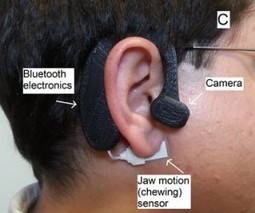
Do you want to change your eating patterns? Would you like to lose some weight? Do you have an eating disorder? In
Richard Platt's insight:
The device calculates the energy content and mass of the food based on the pictures of the meal and how many times the person chewed and swallowed during a meal. Sazonov said that the number of chews is proportional to ingested mass and energy intake. At the moment the images taken by the camera are analyzed by a nutritionist who identifies the food and then gives an estimate on the size of each portion but that should be automated in the future by a computer doing a 3D analysis of the images.
Scoop.it!

From smart clothing to wristwatches, wearables that extract biological data are pouring into the digital health domain. Major consumer electronics...
Richard Platt's insight:
These are questions about how to apportion value to devices, raw data, analytics, and behavioral change in support of truly improved health outcomes and lower costs. Among them: * What is the value of consumer-generated biological data, and to whom and when? * What are the relevant data points and insights that impact consumer health and should cause a change in behavior? * What is the value of modified consumer behavior that improves health, and who captures that value? Consumers expect wearable health technologies to be engaging, intelligent, and integrated into their daily activities, just as mobile technologies have helped transform how we socialize, shop, and bank. Most importantly, these devices’ wearers use the captured data to understand differences and translate those differences into knowledge and actions that improve health. Historically, only trained physicians and nurses, with their years of training and rounds of appointments, had the ability to apply perpetual learning in healthcare. Wearable health solutions, and the learning they provide, collapse the information asymmetry that has existed between the health practitioner and the consumer.
Scoop.it!

Google is launching a new version of Glass, but it's for the working world.
Richard Platt's insight:
If everything goes according to plan, Google will have businesses actively using this version of Glass by the fall. You may have to wait much longer for the fabled consumer-friendly device, though. If you ask the WSJ's sources, the mainstream version is "at least" one year off. The one consolation is that it might not be nearly as expensive as the $1,500 Explorer Edition. The enterprise unit is expected to cost "well below" the Explorer's price point, and we can't imagine that a less exacting standard model would sell for more.
Scoop.it!

The enterprise wearables market may have more demand than that for consumers in the short term.
Richard Platt's insight:
Not really a new point here, that (been saying that for awhile) "Business, not consumers, will grow wearables sector.", what we can say that will work is better definition and execution of NPD (New Product Development) and in particular the Front End of Development, something that we've not seen the academics or the Big Consulting firms be able to effectively wrap their head around.
Scoop.it!

Wearable technology could make its mark in the enterprise in the near future, with hands-free police and military pilot projects already under way
Richard Platt's insight:
Business applications: For instance, one European telco is employing smartglasses for fieldwork. The difficulty is that its infrastructure is ageing just as much as its personnel. This means not only that different chunks are under almost constant repair while upgrade work takes place, but also that its workforce is starting to retire, taking their skills and knowledge with them. Examples: * The telco is therefore starting to send more junior engineers into the field equipped with smartglasses, which display a series of tasks for them to complete in sequence. They can also access a knowledge base and connect to experts in real-time, using the devices if they hit any problems. * Another example of current usage is the London Metropolitan Police’s deployment of body cameras that are roughly the size of a cigarette packet. The aim here is to try and rebuild public trust in a force that has been embroiled in controversy following incidents such as the shooting of Jean Charles de Menezes as a suspected terroristand the killing of Mark Duggan, which triggered the London riots. Despite some privacy concerns, a trial with 1,000 officers across 10 London boroughs seems to have shown the value of the cameras in helping to scrutinise police behaviour. The cameras were also helpful in gathering evidence of offences, leading to more early guilty pleas and thereby speeding up the justice process. As a result, most of the Met’s 20,000 uniformed officers will now be issued with the cameras by March 2016.
Scoop.it!

CEO Kevin Plank said : “We are growing our community at more than 30 percent year over year and so far in 2015 these users have voluntarily logged over 1 billion workouts and more than 5 billion foods.” Via Olivier Janin
Richard Platt's insight:
The dashboard Under Armour is building, within UA Record, will focus on four key metrics: sleep, fitness, daily activity, and nutrition. “We think the consumer needs a dashboard that just says ‘How am I doing?’,” Plank said. “If I can look on my cellphone and I can figure out my bank balance, my stock price, or the weather in any given city — the fact that I have no measure or barometer of my health except for going to see a doctor ever 12, 1,8 or 24 months, we think is really a crime.” - Another element to the health dashboard that they are focusing on is defining success for the consumer and providing the user with context. - “This isn’t just about knowing that I took 8,000 steps yesterday,” Plank said. “But because I took 8,000 steps, how did it make me feel? And more importantly, how did that work with how I slept or what I ate that day? And we think that having that information is going to allow them to make better decision to live healthier and enriched lives — affecting ultimately, obviously, fitness, but we think there’s an outlook for us to affect global health, which gets us so excited.”

Olivier Janin's curator insight,
July 28, 2015 10:42 AM
Comparatively Fitbit sold 11 millions unit last year.
Scoop.it!

From
phys
UOW's Institute for Superconducting and Electronic Materials (ISEM) has successfully pioneered a way to construct a flexible, foldable and lightweight energy storage device that provides the building blocks for next-generation batteries needed to power wearable electronics and implantable medical devices.
Richard Platt's insight:
ISEM PhD student Monirul Islam said. "But the biggest challenge is to charge storage in a small volume as well as being able to deliver that charge quickly on demand." - To solve this problem, a team of PhD students, led by Dr Konstantin Konstantinov under the patronage of ISEM Director Professor Shi Xue Dou and with the support of Professor Hua Kun Liu, the head of ISEM Energy Storage Division, have developed a three-dimensional structure using a flat-pack self-assembly of three components: graphene, a conductive polymer and carbon nanotubes, which are atom-thick lattice-like networks of carbon formed into cylinders.
The solution was to flat-pack the components by building the 3D shape layer-by-layer, much like a miniature exercise in cake decoration. The graphene in liquid form was mixed with the conductive polymer and reduced to solid and the carbon nanotubes carefully inserted between the graphene layers to form a self-assembled flat-packed, wafer-thin supercapacitor material. "The real challenge was how to assemble these three components into a single structure with the best use of the space available," PhD student Monirul Islam said. "Getting the proportions or ratios of the components appropriately in order to obtain a composite material with maximum energy storage performance was another challenge."
|







On the surface, Dot sounds like a fairly standard smartwatch: It resembles a Fitbit and features a messaging system, navigation functions, Bluetooth 4.0, an alarm and, of course, a timepiece. Dot is remarkable because it's a braille smartwatch -- the world's first braille smartwatch, in fact. Its face features a series of dull pins that rise and fall at customizable speeds, spelling out words in braille as the user places a finger on top. With this system, Dot allows users to read ebooks without throwing down thousands of dollars for a portable braille reader. The watch should hit the market for less than $300, with pre-orders staring this year. Plus, Dot has an active battery life of 10 hours, according to inhabitat, so get ready for some serious reading time. However, building a braille smartwatch comes with a catch: The US-based National Federation of the Blind estimates that just 10 percent of visually impaired people actually learn braille, while the UK's Royal National Institute of Blind People reports literacy figures of less than 1 percent. That's why it's so handy that Dot also features a braille-learning system.