


HP has conducted a security study on 10 of the most popular smartwatches and found that all of them are vulnerable to hackers. The company says the findings are 'disappointing, but not surprising.'

 Your new post is loading...
 Scoop.it! HP has conducted a security study on 10 of the most popular smartwatches and found that all of them are vulnerable to hackers. The company says the findings are 'disappointing, but not surprising.' 
No comment yet.
Sign up to comment
Scoop.it!

All in all the Watch is a great piece of technology, but let's not forget this is Version 1. It will get a lot more interesting with time.
Richard Platt's insight:
Wish I'd seen this list earlier, but it only confirms my own bias about smartwatches, they're a good idea, just not a good business idea for the time being anyway. Just an opinion sure, but it would seem that the market agrees with me.
Scoop.it!

We've set a low expectation level for the accuracy of fitness trackers.
Richard Platt's insight:
Bottom Line: Activity trackers are not accurate and thus misrepresent the data presented to users. - Nike and Apple have agreed to settle in a class action lawsuit alleging that the two sold the Nike FuelBand fitness tracker knowing that the device’s biometrics measurements were inaccurate. As a result, Nike will pay out $2.4 million in claims to people who bought the FuelBand between January 2012 and June 2015. Apple, which sold the FuelBand in its stores up until March of this year, will pay nothing. The plaintiffs in the class proved to the court that the calorie burn, steps and overall activity measurements in the device’s “NikeFuel” dashboard were inaccurate, and that Nike and Apple continued marketing the product knowing that. This is the dirty little secret of fitness trackers in general. Certainly many of them present accurate information, but many do not. All one needs to do is wear several types of trackers for a day and compare the results. They won’t be the same, and may be wildly different. But the devices have met with very little scrutiny over the data they present. Trackers often claim to present data like “calorie burn” based on several sensor readings and an algorithm. But they overreach. The reading of an accelerometer can’t possibly gather enough data about the user’s body and activity to claim to measure weight loss or blood pressure, or to make statements about the quality of sleep.
Scoop.it!

Google Glass, no longer available to consumers, is gaining fans in the workplace.
Richard Platt's insight:
“In the enterprise, Glass is solving a problem, where in the consumer world it’s a luxury,” he says. “In the enterprise people have been trying to solve the hands-free workforce problem for 20 years.” - Glass is also finding a number of uses in the medical world. Augmedix, a San Francisco-based startup, uses Glass to let doctors stream visits with patients to remote health consultants who help fill out electronic medical records that doctors would otherwise spend up to a few hours a day working on. Doctors can also utter voice commands to get Augmedix’s software to show patient information like lab results or charts on Glass’s small head-up display. - Augmedix CEO and cofounder Ian Shakil says it has “hundreds” of doctors using smart glasses with its software, the “vast majority” of which are using Glass; they pay a monthly fee in the “low single-digit thousands” of dollars for the hardware, software, and technical support. - One of Augmedix’s customers, Albuquerque, New Mexico-based ABQ Health Partners, which has 15 doctors using Glass, says it saves doctors about three hours per day that they can use to see more patients and follow up on phone calls and lab results.
Scoop.it!

You’d be forgiven for thinking that wearable technology might be a passing fancy. Yes; they have been used to bring
Richard Platt's insight:
Wrist-worn wearables tend to grab the most headlines these days, but progress is also being made on other types of wearables that don’t require such prominent placement on the body. Appropriately, the world of professional athletes is already among the earliest adopters. Wearable Technology and the NFL: Last year, it was reported that 17 NFL stadiums had partnered with Zebra Technologies to outfit players with RFID chips in their uniforms. The move was intended to allow better tracking of the players on the field—to provide “deeper stats,” if you will, but that only scratches the surface of what these devices will be capable of in the long term. The real advantage here lies in being able to better assess how much stress players’ bodies are subjected to during games. In other words, the same technology that can track players’ movements in three dimensions can also give a sense of how athletes’ bodies are moving and performing under duress. According to Cleveland Browns wide receiver Andrew Hawkins, the benefits are already becoming obvious: “I remember feeling like I was getting pounded in practice, and [the RFID chips] confirmed what I was feeling.” Thanks to the feedback provided by the chips, Hawkins’ training regimen was stepped down appropriately, preventing a potential injury and giving him time to recover. The National Football League has also partnered with General Electric and even the United States military to explore how wearable technology could help prevent concussions. To round out our look at proactive wearables, we’ll need to take a look at one of America’s most overworked professions: nursing. Nurses in America tend to work hideously long hours with insufficient pay—a fact that seems to be reported on regularly without any substantive changes in sight. The resulting physical and mental stress can sometimes lead to errors—errors that can result in injury, or worse. According to a recent survey, it turns out that “nurse fatigue” is a real problem in America’s healthcare industry. More than 27% of survey respondents—healthcare professionals, all of them—admitted that they had made an error at work due to fatigue. Nearly 65% indicated that they had almost made a mistake as a result of fatigue. Remember the motion tracking software being looked at by the NFL? There’s no reason it couldn’t also be applied to America’s most vulnerable workers.
Scoop.it!

Google may give Google Glass a slight design makeover. A new report suggests the next version of the wearable will feature a more rugged frame complete with a foldable design and water-resistance. Oth
Richard Platt's insight:
A new report suggests the next version of the wearable will feature a more rugged frame complete with a foldable design and water-resistance. Other than the rumored design changes, the new Glass won't look much different from the original Explorer Edition. Google Glass's Enterprise Edition keeps a few features the original version had: a stretchy band fitting across the forehead, computer tech in a compartment located on the frame's right side, and a tiny display in front of the right eye. One of the most important things to know about Google Glass for enterprise is that it won't be designed as a stylish accessory. Google created a device to wear in medical centers or factories. - "The overall design of the computer side is more robust as well, built to withstand normal drops and bumps that could occur in less-than-ideal workplace environments. Sources have also said that the device is more water resistant, built with fewer places for water and other outside material to seep in." The device also includes improved internals such as 5 GHz support, a better battery, heat management, a larger prism display, and an Intel Corp Atom processor.
Scoop.it!

Wearable tech businesses, as with other technology businesses, have a heavy reliance on their intellectual property (IP).
Richard Platt's insight:
Lots of important elements for the design manager / engineer (software or hardware) to understand when designing a wearable or an IoT device in this article, well worth the read. Wearable tech businesses, as with other technology businesses, have a heavy reliance on their intellectual property (“IP”). The difference between a successful wearable tech business and a failing one, may well be its approach to harnessing, protecting and enforcing its IP. In that regard, there is a bundle of overlapping IP rights to consider, including copyright, database rights, trade marks, patents, design rights and confidential information. But not everything “clever” can be patented. A patentable invention must be:
Bear in mind also that software is generally not considered patentable in the UK and EU. - However, source code will be protected by copyright laws instead, provided the code is original. It will only protect the code itself, but not entitle its owner to prevent the replication of functionality, if the new program is coded from scratch.
But what about protecting the data itself? The only right that can be said to protect the data itself is the right to ‘confidence’. Information not already known or disclosed to the public must be kept confidential if it is made clear, when passed on, that (i) it is confidential information, and (ii) it is being imparted in confidential circumstances.
Scoop.it!

Apple Inc tried to reassure investors on Tuesday that its new smartwatch was not a flop, a message that was met with a mixed reception on Wall Street.Reporting results for its third
Richard Platt's insight:
Apple tried to reassure investors on Tuesday that its new smartwatch was not a flop, a message that was met with a mixed reception on Wall Street. Reporting results for its 3rd financial quarter, Apple executives delivered several positive data points about the progress of the Apple Watch, the performance of which has been obsessively tracked since its debut in April. - Without disclosing specific figures, Apple Chief Financial Officer Luca Maestri said in an interview with Reuters that sales of the Apple Watch exceeded the company's expectations. He noted that in the nine weeks since its launch in late April, the device has sold better than either iPhones or iPads over a similar period after their launch. During a call with investors, Apple Chief Executive Officer Tim Cook suggested that the watch's performance was particularly impressive because it initially was for sale only online and supply trailed demand. - He added that sales of the watch were best in June, contradicting reports that sales dropped off sharply after the gadget debuted. - "We believe that the possibilities for Apple Watch are enormous,"
Scoop.it!

Advances in health IT and IoT have the potential to change the face of health care.
Richard Platt's insight:
IoT is the next stage in the evolution of smart technologies, where devices “talk” to each other and to humans. For example, Defense Health Agency (DHA) health information technology (HIT) is working on a project that focuses on theater mobile computing applications that will report injuries sustained on the battlefield through automated alerts to medical staff. IoT has also enabled DHA HIT to develop self-powered biosensors capable of monitoring a person’s vital signs, activities, and how much sleep they’re getting. The sensors are placed inside clothing and are comfortable for longtime wear. Both of these projects are being managed by the DHA’s Pacific Joint Information Technology Center (Pacific JITC), which focuses on rapid development, research and testing of warfighter medical solutions and products.
Scoop.it!

Microsoft band or Apple Watch, which is the best wearable technology you should opt for? A smartwatch or a smart band, a comparison you must
Richard Platt's insight:
Microsoft Band vs Apple Watch
Scoop.it!

The Misfit Flash Link is a new fitness wearable for everyone.
Richard Platt's insight:
"For the wearable industry, the one thing holding back the beast is cost. Would you pay $100 for something you wear during a run? Or that you can lose at the beach? Somehow, Misfit has priced its new Flash Link wearable (at right in picture above) at just $20, which is cheap enough for an impulse buy when you are wandering through Target looking for a vacuum cleaner or browsing for books on Amazon. - I like how the device syncs, too. When you use the new Misfit Link app, you can snap a photo or take a Snapchat (if you are into that sort of thing), control music playback, and — in a future update — control the Logitech Harmony remote for your TV and even trigger IFTTT functions, which is the holy grail of the connected home (e.g., triggering lights with a tap-tap and freaking people out when they don't see you have a wearable). - Misfit claims to have the lowest-priced wearable on the market, and it’s a long way from the hefty price of the Apple Watch, which I kind of hate. I’ve tested every Misfit on the market, and I’ll be requesting one of the new Misfit Link models to test. The iPhone app is already available; Android users have to wait a few weeks. It’s quite a killjoy for a few of the spendier gadget companies. - I believe low-cost (wearable) tech is going to be huge. Instead of gold-accented smartphones and watches that sell for five figures, we will start seeing these devices as much more expendable. That’s already true with laptops. These days, I just grab whichever one is lying around and fire up the Chrome browser. I don’t care if it even has that much storage as long as the thing isn’t loaded down with crapware. More and more, I’m using a Chromebook Pixel because it has so little overhead. - For the past year, I’ve been wearing the original clip-on Fitbit. It’s become part of my wardrobe. One of the most important reasons I still use one is that I don’t pay attention to it at all. It’s barely there and no one notices. If I lost it tomorrow, I’d buy another one."
Scoop.it!

Wearable tech - Samsung Galaxy Gear 2015 will not be the year of wearable tech but better luck next year, says Simon Holt, Strategic Alliance Marketing Man
Richard Platt's insight:
Four suggested barriers 1. Lack of concrete standards 2. Charging, power and battery life 3. Over-reliance on smartphone ‘tethering’ 4. Issues of social acceptability
Scoop.it!

Now-a-days the weather is cliché to speak about, but important in deciding what clothing to wear. Instead, it is cool to analysis the temperature inside and around the body.
Richard Platt's insight:
Wearables for health monitoring will change the future of healthcare. No longer will you need to sit in the emergency room for a small common cold. You can simply wear your health monitor and send the data to your physician, where they can prescribe you the necessary medication for you to recover quickly
|
Scoop.it!
Richard Platt's insight:
"The idea is if the wearable device only needs to reflect the Wi-Fi signal from a router or cell tower, instead of generate it, the power consumption can go way down (and the battery life can go way up)," Adrian Tang of NASA's Jet Propulsion Laboratory said. He and M.C. Frank Chang at the University of California, Los Angeles, have been working on microchips for wearable devices that reflect wireless signals instead of using regular transmitters and receivers. Their solution transmits information up to three times faster than regular Wi-Fi. The challenge for Tang and his colleagues is that the wearable device isn't the only object in a room that reflects signals - so do walls, floors, ceilings, furniture and whatever other objects happen to be around. The chip in the wearable device needs to differentiate between the real Wi-Fi signal and the reflection from the background. To overcome background reflections, Tang and Chang developed a wireless silicon chip that constantly senses and suppresses background reflections, enabling the Wi-Fi signal to be transmitted without interference from surrounding objects. The technologists have tested the system at distances of up to 20 feet (6 meters). At about 8 feet (2.5 meters), they achieved a data transfer rate of 330 megabits per second, which is about three times the current Wi-Fi rate, using about a thousand times less power than a regular Wi-Fi link. FYI - NASA and JPL uses TRIZ methods
Scoop.it!

The Apple Watch is already showing signs of brilliance, but the list of things that need to be added, subtracted, or fixed is just too long.
Richard Platt's insight:
Basically it's a distraction and doesn't do enough to add value to one's life. "The Apple Watch is solid first draft of a new kind of product. It’s already showing signs of brilliance, but the list of things that need to be added, subtracted, or fixed is just too long right now. And the app developer community needs to learn more about device before they can create apps that make it really sing."
Scoop.it!

With wearable health technology tracking a person's every move and heartbeat, some experts are concerned by what's not covered by HIPAA, while others don't see a threat.
Richard Platt's insight:
The HIPAA Security Rule is concerned with PHI (personal health information) and, according to the Human Research Protection Program at the University of California, San Francisco, there are 18 criteria defining what PHI is under HIPAA includes information such as the patient's name, address, phone number and Social Security number. "So someone's name is likely a HIPAA-protected data element, but blood pressure alone is likely not, unless it is linked to a patient," Although a blood pressure reading is something many people associate as sensitive health information, "HIPAA in and of itself generally … is not worried so much about anything other than identifying the patient." - Read on for a more informed p.o.v. about this important element of healthcare related wearable information.
Scoop.it!

I arrive at the counter and put in my order: one white Americano. The barista asks for two British pounds. Little does he know that social conventions are about to burst into flames. We've now locked in a complex social and subconscious dance. He's looking for my reaction. He wants me to pull my wallet…
Richard Platt's insight:
Bottom Line: Barclay's new wearable bPay isn't a serious product – it's another standard-bearer for the payment revolution and a exercise for Barclaycard to show it's a forward thinking bank (which doesn't support Apple Pay). While contactless cards moved us away from old chip-and-pin, bands like this are primers for a future where our bank cards no longer exist at all. The bPay wristband is a great publicity tool – but the furthest from a usable and desirable solution. Given the lack of need for any kind of technology whatsoever, it's actually slightly bemusing why the bPay band is so large. But its size and similarity to a prisoner's day release tracker are not the most awkward thing about it. It's that silence, the one that myself and the barista are still locked in. - "I'm going to pay by contactless," became my stock request to overcome those silences, a subtext for "JUST TURN ON THE CONTACTLESS MACHINE AND STOP STARING ALREADY". Standing there gormlessly or raising the cuff of my jacket to reveal the bracelet became something I came to dread. What we learned about wearable payments. It's not a problem that's just Barclaycard's. Using Apple Pay also means you have to endure the same thing – although as it becomes more widely recognised the problem should dissipate. I will flash the Watch, they will know that's how I need to pay. The bPay will never enjoy the same ubiquity. That's already starting to happen. During a failed Apple Pay payment at our local store (resulting from not quite being able to fully contort my arm to make a good connection with the payment reader) the guy behind me asked "have you actually got that to work yet?" He was genuinely interested. He made the awkward situation okay.
Scoop.it!
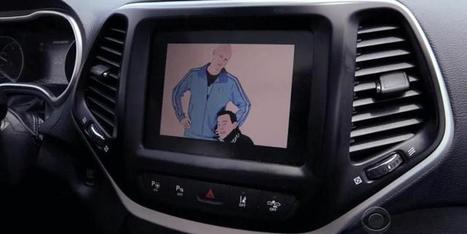
In a video for Wired, cybersecurity experts demonstrated how they could hack into a Jeep and disable its brakes. CBS News correspondent Kris Van Cleave reports on the threat and what Congress plans to do about it.
Richard Platt's insight:
Video on the Fiat Chrysler Jeep Hack, and how the hackers did it.
Scoop.it!

A handful of personalized air-quality monitors and apps are turning users into citizen scientists and helping city dwellers avoid pollution pitfalls.
Richard Platt's insight:
The Use Case of Wearable Tech: (Pollution Monitoring): "Hamish Stewart bikes the streets of London, he clips a tiny digital device to his shirt collar or pants pocket. The wearable technology isn’t tracking the distance he travels or the calories he burns: Instead, it measures how many toxic pollutants from cars, buses and factories are sullying Stewart’s commute. - Just in case you didn't know, London has a lot of pollution to contend with - parents of children want them to be healthy - All the data his device collects uploads to a crowdsourced air-quality map. Shades of red, yellow and blue indicate parts of the city where levels of particulate matter are especially high, raising the risk of asthma attacks and long-term lung and heart problems. Stewart consults the colorful map on his smartphone before riding his bike or stepping out with his infant daughter. “Some streets are really bad, and I don’t take her there in the stroller as a result,” he says. “I avoid certain places in the city.” - Stewart is an early adopter of the “enviro-tracker,” a personalized air-quality monitor from a San Francisco-based startup called Tzoa. It's one of a handful of gadgets and apps that are turning users into citizen scientists. By gathering hundreds of hyperlocal readings each day, wearers can track their exposure to harmful pollution in the same way others chart their sleep patterns, jogging routes and heart rates. Developers say their nascent devices are more than just another way to quantify the mundane details of daily life. They’re building technologies that are cheaper and easier than heavy-duty air monitors so that everyday users can limit their exposure to pollution.
Scoop.it!

Some technology pundits have declared the device a flop, but Apple has a history of using incremental improvements to make its products indispensable.
Richard Platt's insight:
Technology pundits tend to be a rash bunch, though, so there has been no shortage of prognostication about the Apple Watch, a device that went on sale three months ago. Because reviews (including mine) were mixed and the device hasn’t proved to be culturally revolutionary, some are declaring the watch dead on arrival. - Apple has declined to provide sales figures for the watch, its newest product. In its earnings report for the fiscal third quarter, released on Tuesday — CEO Tim Cook,saying the device had “a great start.” - Analysts’ estimates vary wildly, with many originally predicting that Apple sold three million to five million watches from April to the end of June. After studying Apple’s opaque earnings report, several analysts revised their estimates down to about 1.5 million to three million watches. Even at the lower end, that’s the opposite of instant death: Luca Maestri, Apple’s chief financial officer, pointedly said the watch sold more in its first nine weeks on the market than either the iPhone or the iPad did in that same period. - Yet the future of the Apple Watch will not be determined by first-quarter sales. Apple’s product debuts tend to follow a well-worn script: A first-generation device is always criticized as overpriced and a bit lacking in utility and is often vulnerable to the charge that it is a solution in search of a problem. Then, over a few years, Apple and its customers figure out the best uses for the gadget, and the company methodically improves design and functionality to meet those needs. It also tends to lower its prices. Correspondingly, sales explode. - Given this history, the question to ask about the Apple Watch isn’t how well it has sold so far, but how well Apple is following that script. Is it moving quickly to address the early criticism of the watch and to expand access to and functionality of the device?
Scoop.it!

After Fitbit’s (FIT) successful IPO last month and the recent release of the iWatch, wearables seemed destined to become a mainstay in gyms across the country. In D.C., however, the wearable...
Richard Platt's insight:
Four of the five Washington D.C.-area gyms interviewed by DC Inno estimated that fewer than 10% of their clients use wearables in their workouts. Where the Use Case for Smartwatches in Gyms Fall Down:
Scoop.it!

From
wtvox

What is wearable technology, where does it come from, who invented the wearable technology, what is the future of wearable technology? These are questions we are asked every day. The words "wearabl...
Richard Platt's insight:
Definitely a worthwhile read for those who realize that they need to understand the fundamentals of an engineering system like wearables before they can properly / effectively design for a modern wearable device today
Scoop.it!

When I was attending UC Berkeley, my morning route to campus was a 10-minute walk down College Avenue, past a hodgepodge of dwellings and the occasional homeless pop-up shelter. Media attention surrounding college campus assaults is also on the rise, and it got me thinking about my own experience (off campus) and wondering if mine could have been prevented with today’s technological advances. Product designers and tech companies are serving up quite a platter of tempting options, and though mo
Richard Platt's insight:
"One product that caught my eye was Siren (www.sirenring.com), a wearable alarm disguised as a fashionable ring that delivers a piercing 110-decibel sound when the center stone is twisted. Manhattanite Kat Alexander came up with the idea when she was accosted late one night. She instinctively twisted the ring she was wearing, and the idea was born. - Alexander and other personal-safety device designers like Joe Parisi of Guard Llama (www.theguardllama.com) believe that a cell phone isn’t accessible enough to prevent or deter an attack. “I strongly feel that the best protection in an emergency should always be hidden in plain sight and effortless to activate in a time of need,”Alexander says. Similar to Guard Llama is Oakland’s Safeti (www.safeti.me). Both are palm-size personal safety devices that notify a safety concierge and designated cell phone circle when clicked. Safeti isn’t tethered to one’s cell phone (and subsequently Bluetooth or WiFi). Instead, it uses GPS satellite technology to track users in real time. Apps like CharmSafe (www.charmsafe.com) and bSafe (www.getbsafe.com) also provide a level of security for teens and young adults who can’t seem to detach themselves from their phones. - But, as much as we arm ourselves with the most thoughtful, well-meaning products, crime doesn’t discriminate, and tracking is discretionary. Many teens don’t think about their security, especially when shopping for colleges. Burlingame professional counselor Jean-Marie Buckley hasn’t seen more interest in campus safety from her high school-age clients. “There’s a naivete happening in suburban life. A lot of my kids don’t think about the awfulness of life,” Buckley says. “Today, I asked one of my students, a young woman, about safety, and she said, ‘I thought that I would never not be safe,’ admitting that she hadn’t factored how safe a campus is into her college search.” Buckley adds: “Dinner-table conversations with ‘what do you think’ and ‘what would you do’ prompts aren’t happening and this is affecting safety awareness.”
Scoop.it!

Real-time data in a coach’s hand is a powerful tool that will allow coaches to optimize each swimmer’s training program.
Richard Platt's insight:
The Triton units are small devices that clip onto the back of a swimmer’s goggles and automatically calculate a dozen key performance metrics and transmit them in real-time to a coach’s tablet. The data is stored online for further analysis and for tracking over-time. Metrics include splits, stoke count, stroke rate, distance-per-stroke, turn time, distance underwater, and more. - For the first time, coaches can now accurately and easily monitor all their athletes during practice, enabling them to give more specific feedback to each swimmer. Coaches can also look at a swimmer’s metrics over-time to help them develop more effective training programs, resulting in faster racing. - Several swim teams have been using TritonWear with dramatic results. Kevin Anderson, the Head Coach of Mississauga Swim Club, has been using the Triton units with his team. “The TritonWear system is like having 20 assistants constantly gathering performance data, allowing me to move away from my stopwatch during test sets so I can focus on my athletes and spend more time fixing technique issues than ever before, while still having critical workout data recorded for each athlete.” - Head Coach of the University of Waterloo Swimming, Jeff Slater, said TritonWear “will allow [coaches] to try technical changes and see how they affect stroke, pacing and other aspects in both real-time and over many workouts with a large group of swimmers”. - Mike Thompson, the Head Coach of Wilfred Laurier University Swimming, states that “TritonWear takes a lot of the guess work out of what is happening during a set and helps me work with facts rather than opinion.”. Our Take: The use of wearables by coaching and training staff in the domain of sports performance enables more effective coaching and performance in the execution by athletes doing their job, and likewise the same goes for the application of wearables in the business domain, this is where wearables work best when they're applied towards achieving specific functions and tasks for people that we all have to do in our daily work. It is also explains why the PC was and will continue to be mainstay of knowledge worker tools, it helps us do things (achieve specific goals in the execution of what we do). Wearables are new to our world, but they must help us in what we actually are doing in our lives, otherwise they're kitch and not worth the investment. Hence why at this point smartwatches have yet to take off, they haven't figured out what task they're supposed to be helping us do. -- Just saying.
Scoop.it!

Wearable tech may start staying on longer. As part of Microsoft's WearDrive project, researchers have found a way to increase the battery life of wearable technology, such as fitness trackers, using a RAM-based system that doesn't rely on a new…
Richard Platt's insight:
The improved battery life is made possible by pairing the wearable with a smartphone via Wi-Fi or Bluetooth. The wearable's more energy intensive operations are subsequently processed on the smartphone, prolonging its battery life. - The WearDrive energy saving system was tested on an Android phone, with the researchers noting a "negligible" impact on the smartphone's battery life and an improvement of over three times in energy conservation for the wearable. The paired wearable also experienced more than eight times faster than normal application runtimes. - The WearDrive system conveniently deactivates when it's not in reach of a paired smartphone. So you're more than welcome to go on a workout without taking your phone.
|






In HP study, analyzing 10 of the best-selling smartwatches currently available on the market, looking at their security features "from an attacker's perspective." As the company explains, the study takes into account the management capabilities of a smartwatch, as well as network posture and mobile and cloud interfaces, among other things.
"The results of our research were disappointing, but not surprising. We continue to see deficiencies in the areas of authentication and authorization along with insecure connections to cloud and mobile interfaces," HP points out. "Privacy concerns are magnified as more and more personal information is collected (including health information). Issues with the configuration and implementation of SSL/TLS that could weaken data security were also present." HP notes that it tested the 10 smartwatches for the security features the Open Web Application Security Project recommends and found that only half the smartwatches come with a lock function to prevent unauthorized data access and nine of the watches send unencrypted data. Moreover, a third of the devices allowed unlimited login attempts, which could allow someone to guess the password, and two of the devices allowed for easy pairing with a different phone.