Your new post is loading...

|
Scooped by
MED-Amin
July 12, 2016 3:30 AM
|
Climate variability is increasing the frequency and intensity of extreme weather events such as droughts and floods. Linked to El Niño, the recent floods in Central and Southern China are a reminder to the negative impacts of climate change-it is feared the floods are the worst in decades.
These severe and devastating floods have costly impacts. According to media reports, about 33 million people have been affected so far, close to 200 have lost their lives and more than 40 are missing. The economic losses have been just as distressing. More than 50,000 homes have been destroyed, forcing many to evacuate, and about 1.9 million hectares of cropland damaged, leading to losses of over 38 billion yuan ($5.7 billion). Many farmers have had to abandon their property and livestock. And there is little doubt food security and nutrition of poor households will be affected.
Recurring floods increase the vulnerability of the poor, especially small farmers. Extreme weather events threaten not only their livelihoods, but also their food security and nutrition. It is true that China has made tremendous progress in coping with weather shocks. The infrastructure, such as flood control facilities, was strengthened following the devastating floods of 1998. By subsidizing agricultural insurance, the government also has ensured that smallholders are protected, making their incomes more resilient. Additionally, climate adaptation was incorporated into the country's National Comprehensive Agriculture Development Program.
Yet China's agriculture sector remains vulnerable and smallholders continue to face high weather-related risks. So more needs to be done.
|
|
Scooped by
MED-Amin
July 12, 2016 3:26 AM
|
Egypt will allow up to 0.05 percent ergot, a common grains fungus, in wheat shipments beginning on Tuesday, confirming the end of a months-long standoff just before the country re-enters the international wheat market.
Reuters exclusively reported on July 4 that a ministerial decree would allow the world's top wheat importer to apply the 0.05 percent international standard to purchases, ending a zero-tolerance policy that has puzzled global trade.
The confirmation, in the form of decree number 1117/2016 issued in the state gazette on Monday, is set to take effect one day after publication, the document showed.
|
|
Scooped by
MED-Amin
July 11, 2016 3:39 AM
|
Morocco’s wheat production is forecast to decline from 3.7 million tonnes in 2015-16 to 2.8 million tonnes in 2016-17 and barley output is expected to fall from 1 million tonnes to 900,000 tonnes, the U.S. Department of Agriculture’s (USDA) Foreign Agricultural Service (FAS) said in a June 18 report. The decline in total production is about 66% lower compared to the previous year due to the severe drought during the entire planting season.
The report’s estimate in March assumed a somewhat normal rainfall during the spring time (March-April) which was not the case in some key production areas: Chaouia (Settat), Khouribga, Safi, El Jadida. As a result, most of the fields that were planted late (December/January), suffered dramatically from the lack of rain during the spring and were not able to yield any production, and many farmers converted to sunflower instead of soft wheat, the report said.
|
|
Scooped by
MED-Amin
July 7, 2016 5:32 AM
|
Turkey’s total wheat production is forecast at 17.5 million tonnes in market year 2016-17. Harvest time is between mid-May and end of June.
Yields and quality are changing by regions and by fields due to irrigation and precipitation differences. Central Anatolia, Cukurova and some parts of southeast Turkey, especially unirrigated fields, were hit by the drought weather condition. It is forecasted that yield losses will be reach 60% in some parts of Konya in Central Anatolia where harvest will finish around mid-July. Increasing production in Thrace is not sufficient to compensate for losses of other regions.
Despite serious drought after sowing during November and December 2015, rainfall in May was significantly higher than the previous year throughout the whole country. Average rainfall in the Thrace region in May was 58.6 millimeters. This amount of rainfall is about 50% more than the long-term average for that region, and 131% more than last year. Due to excessive rain in May and June, weed problems were common in wheat fields. Although the wheat has high protein content, some energy concerns were reported in the Thrace region.
The first harvest in the Mediterranean coast started in the second week of May. According to field reports, the Cukurova region had yields between 15 kilograms per hectare and 50 kilograms per hectare (depending on irrigation) which was less than the long-term average and last year.
|
|
Scooped by
MED-Amin
July 7, 2016 5:32 AM
|
La première source de l'alimentation des Algériens, à savoir les céréales, continue à poser de sérieux problèmes sur le plan de la production, de la disponibilité et de la maîtrise de sa facture d'importation. Car, le complément d'importation est toujours là, variant d'une année à une autre, mais se situant toujours au-dessus de 40%.
Pour les quatre premiers mois de l’année 2016 (de janvier à avril), il a été importé 4,39 millions de tonnes (pour un montant de 940,89 millions de dollars), contre 4,85 millions de tonnes pour la même période de temps en 2015. Notons que la facture des céréales a baissé à un rythme plus important par rapport aux quantités. Cela s’explique par une certaine baisse des cours sur les marchés mondiaux des céréales, entamée déjà en 2015, suite aux récoltes abondantes enregistrées sur les territoires de prédilection de cette culture (France, Canada, États-Unis, Russie).
|
|
Scooped by
MED-Amin
July 7, 2016 5:03 AM
|
The latest edition of the Market Monitor sees the AMIS crops more volatile than in previous months. Unsettled weather and overall economic uncertainty following the UK's vote to leave the European Union translated into elevated risks to global commodity markets. However, the overall supply and demand outlook for 2016/17 has changed little, with tightening prospects for soybeans, but rising wheat surpluses and generally balanced maize and rice markets.
|
|
Scooped by
MED-Amin
July 5, 2016 4:09 AM
|
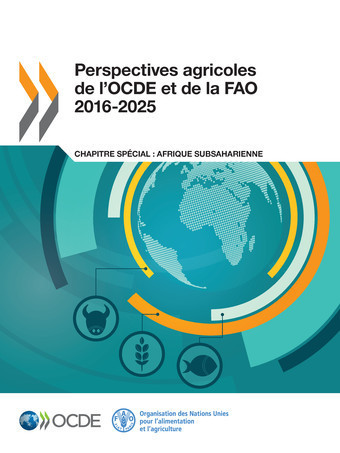
Le rapport des Perspectives agricoles de l'OCDE et de la FAO 2016-2025 présente une analyse des marchés nationaux, régionaux et mondiaux de produits agricoles de 41 pays et 12 régions, dont les pays membres de l’OCDE (l’Union européenne est représentée comme une région) et d’importants producteurs agricoles, tels que l’Inde, la Chine, le Brésil, la Fédération de Russie et l’Argentine. Le chapitre spécial de cette édition est consacré aux perspectives et aux défis du secteur agricole en Afrique subsaharienne. Cette édition représente la douzième année de coopération entre les deux organisations.
|
|
Scooped by
MED-Amin
July 5, 2016 4:01 AM
|
In 2016, the general grain harvest in Russia will reach 110 mln tonnes, which will become the record index for the country, announced the Deputy Director of the strategic management department at Rusagrotrans CJSC, Igor Pavensky on July 4.
According to the expert, Rusagrotrans raised its estimations of the index from 108.1 mln tonnes to 110 mln tonnes. If the forecast comes true, in 2016 Russia will produce the record harvest in the post-Soviet period, and exceed the previous maximum index of 2008 (108.2 mln tonnes).
In particular, the harvest volumes of wheat can also reach the historical maximum at 65.3 mln tonnes, exceeding the results of 2008 (63.8 mln tonnes). At the same time, winter wheat areas faced rather low loss rates in the winter, and mainly developed in favorable weather conditions in the spring and summer period, said I.Pavensky.
Also, corn harvest will break another record, and its production volumes will increase to 13.8 mln tonnes, up nearly 4.5% compared with the previous peak reached last year.
Rusagrotrans forecasted the growth of barley production by 0.4 mln tonnes compared with last year - to 17.9 mln tonnes.
All major grain-producing regions of Russia will increase its production indices in the current year, the expert added.
0
|
|
Scooped by
MED-Amin
July 5, 2016 3:52 AM
|
Egypt's agricultural quarantine authority settled a months-long dispute on Monday over wheat import specifications that have hampered the country's massive state purchasing programme ahead of an anticipated new buying season.
Egyptian quarantine authorities' earlier refusal to let in wheat infected with even the slightest amount of ergot, a fungus that can lead to hallucinations and irrational behaviour in large quantities but at trace levels is deemed harmless to humans, wreaked havoc in the market for supplying the world's largest wheat buyer.
The quarantine authority said a new ministerial decree would allow it to accept imported wheat shipments containing up to 0.05 percent ergot, finally ending a long-standing zero tolerance policy that has puzzled global trade.
"A ministerial decision was taken and 0.05 percent ergot tolerance will now be endorsed," Ibrahim Imbaby, head of the quarantine authority told Reuters by phone.
|
|
Scooped by
MED-Amin
July 4, 2016 3:41 AM
|
Poursuivant ses achats réguliers de blé pour le renforcement et la reconstitution des stocks stratégiques du pays, l’Office algérien interprofessionnel des céréales (OAIC) est sorti une nouvelle fois sur le marché international pour l’acquisition de pas moins 300 000 tonnes de blé, a indiqué, jeudi dernier, l’agence Reuters sur son site.
Selon les traders spécialistes des marchés des céréales, la quantité achetée par l’Algérie serait inférieure aux volumes habituellement demandés en cette période, soit 450 000 à 500 000 tonnes. Commandé pour livraison en septembre, le blé acheté par l’OAIC ne serait pas d’origine française, compte tenu du prix largement compétitif payé par l’Office, à savoir 199 dollars la tonne.
La France est traditionnellement le principal pays fournisseur de l’Algérie en blé, malgré la rude concurrence qui prévaut depuis quelques années sur le marché international des céréales, où des pays de l’Europe de l’Est, comme l’Ukraine, et d’Amérique, comme le Canada et le Brésil, tentent de s’imposer avec leurs produits à des prix compétitifs.
Depuis 2016, on signale une baisse de 48% du blé importé de France, l’Algérie s’étant tournée vers d’autres fournisseurs, notamment l’Allemagne, la Suède, la Pologne et le Royaume-Uni, en raison de la baisse de la qualité du blé français, observée depuis 2005. Cette chute de la qualité est due à la baisse du taux de protéine dans le blé français qui est passé, en 10 ans, de 12,3% à 11,1%, pour s’établir à 11% en 2015.
Depuis quelques années, l’Algérie dépense entre 2 et 2,5 milliards de dollars par an pour l’achat de céréales.
|
|
Scooped by
MED-Amin
July 4, 2016 3:38 AM
|
Près d'un (1) million d'hectares semés en céréales pour la campagne 2016 ont été perdus suite au déficit hydrique enregistré durant l'hiver dernier, a appris l'APS auprès du directeur général de l'Institut technique des grandes cultures, Omar Zaghouane.
"Ce stress hydrique a fait que plus d'un tiers de la superficie ensemencée se trouve sinistré et perdu. Donc la production qui sera récoltée représente les deux tiers de la superficie semée laquelle est estimée à 3,3 millions hectares", avance le même responsable.
En outre, des gelées (en dessous de 0°) observées début mai à Tiaret, Tissemsilt et Chlef ont accru les superficies sinistrées puisque "les plantes ont été complètement éclatées", fait-il savoir.
En conséquence, le volume de la récolte céréalière, dont la campagne de moisson se terminera à la fin août prochain, ne sera pas très différent de celui de l'année 2015 qui avait enregistré une production de 40 millions de quintaux.
La sècheresse qui a sévi ces trois dernières années s'est répercuté négativement sur la récolte céréalière du fait de sa forte dépendance des pluies.
Néanmoins, les pluies tombées en février dernier ont permis aux cultures de reprendre et de sauver quelque peu la campagne: "Les agriculteurs ont continué à y croire dont certains avaient même semé une deuxième fois en janvier après l'ensemencement de novembre".
|
|
Scooped by
MED-Amin
July 4, 2016 3:36 AM
|
London wheat and cocoa futures soared, bucking the global trend, as the pound tumbled, after the UK shocked financial markets worldwide by voting to leave the European Union.
London wheat futures for November delivery closed 4.2% higher at £120.00 a tonne, as a collapse in sterling, which earlier hit a 30-year low of $1.32 to £1, boosted the competitiveness of UK exports.
Sterling recovered some ground to stand at $1.372 to £1 in late deals, down 7.8% on the day.
The drop in sterling also boosted prices of cocoa, the other big agricultural commodity traded in pounds as well as dollars, which for September delivery, the best-traded contract, closed up 2.6% at £2,319 a tonne, the highest finish for a nearest-but-one contract in six months.
Earlier, the contract touched a five-year high of £2,333 a tonne.
'Fundamentals on the back seat'
By contrast, strength in the dollar, as investors rushed for assets deemed as safe havens, depressed values of dollar denominated commodities, including New York-traded cocoa futures - which stood down 5.0% at $3,024 a tonne in late trading, for September delivery.
The dollar stood 1.4% higher against a basket of currencies, reducing the affordability of dollar-denominated exports.
"The most important factor" in agriculture markets today "is likely to be the significantly firmer US dollar, which makes US products less competitive", Commerzbank said.
Paris-based broker Agritel said: "The result of this referendum, against the odds, will put [crop supply and demand] fundamentals on the back of the stage for now at least."
|
|
Scooped by
MED-Amin
July 1, 2016 3:47 AM
|
USDA's Risk Management Agency has announced the completion of the final round of crop insurance provisions stemming from the 2014 farm bill.
In an announcement that will be published in the Federal Register on Thursday, RMA's Federal Crop Insurance Corporation will leave its 2014 proposal largely untouched save for some native sod provisions. The final rule will clarify an exception allowing producers to break up to five acres of native sod without receiving reduced premium subsidies on coverage of native sod acreage.
RMA Administrator Brandon Willis said the updated rules will help ensure American producers “are able to better manage risks so they can continue to farm even after years of severe weather.” According to a USDA release, RMA began implementation of the provisions for the 2015 crop year, but the final rule “enables RMA to continue to offer and expand on the farm bill provisions for the federal crop insurance program.”
|
|
|
Scooped by
MED-Amin
July 12, 2016 3:27 AM
|
International wheat prices rose in June but remained below last year’s level on account of good supply prospects. Maize prices increased as a result of fast shrinking export supplies in South America and in the Black Sea region. Tight availabilities continued to lend support to rice quotations in most Asian origins, but gains were contained by subdued demand.
In Africa, cereal prices rose sharply in South Sudan underpinned by high inflation and insecurity, and in Nigeria mostly due to the depreciation of the local currency. In South Africa, domestic prices of yellow maize increased further and were nearly 50 percent higher than in June last year as a result of tight domestic availabilities and currency weakness.
In South America, prices of yellow maize increased and were well above their year-earlier levels in most countries of the subregion, particularly in Argentina and Brazil, underpinned by a strong pace of exports and a 2016 reduced output, respectively.
|
|
Scooped by
MED-Amin
July 11, 2016 3:43 AM
|
L’OMC vient de lancer un nouvel Indicateur des perspectives du commerce mondial (WTOI), qui vise à fournir des renseignements “en temps réel” sur les tendances du commerce mondial. L’indicateur WTOI a été dévoilé le 8 juillet à Shanghai (Chine), juste avant une réunion des ministres du commerce du G-20.
Combining a variety of trade-related indices, the WTOI is designed to give an early signal of the current direction of world trade and where it is likely to go in the near future. In this way the WTOI should signal turning points in world merchandise trade volume. It complements existing tools such as the WTO’s longer-term trade forecasts, and other statistical releases.
The WTOI gives a headline figure to show performance against trend. A reading of 100 would indicate trade growth in line with recent trends, a reading greater than 100 would suggest above trend growth, while a reading below 100 indicates below trend growth. The WTOI will be updated on a quarterly basis.
|
|
Scooped by
MED-Amin
July 11, 2016 3:38 AM
|
Nord-Céréales, the second largest port silo in France, exported a record amount of 3.225 million tonnes of grain in 2015-16.
Nord-Céréales is located in the central zone of the Port of Dunkisrk. The terminal has 222,000 tonnes of vertical storage and 110,000 tonnes of horizontal storage. The facility has output capacity of 1,600 tonnes per hour. Its input and output capacity consists of road, waterway and rail.
The facility is located near three regions in Dunkirk that account for 40% of domestic grain production.
|
|
Scooped by
MED-Amin
July 7, 2016 5:32 AM
|
Le cabinet de conseil Agritel estime la production française de blé tendre en 2016 à 37,26 millions de tonnes au 25 juin, soit une baisse de 9,2 % par rapport à celle de l’an dernier.
Agritel a annoncé ce mardi 5 juillet 2016 dans un communiqué son estimation de production de blé tendre français pour 2016. Au 25 juin, le cabinet estimait la production française à 37,26 millions de tonnes (Mt), une estimation permise à la suite d’un « crop-tour » (tour de plaine) réalisé par ses équipes sur 13 départements représentant près de 40 % de la production française.
|
|
Scooped by
MED-Amin
July 7, 2016 5:31 AM
|
Comment évolueront les surfaces agricoles dans les prochaines décennies ? Sous l’influence de quels facteurs ? Comment s’exprimeront les tensions entre sécurité alimentaire et atténuation du changement climatique ? Élaborée par des scientifiques du Cirad et de l’Inra avec l’appui d’experts internationaux, l’étude prospective Agrimonde − Terra tente de répondre à ces questions grâce à cinq scénarios d’évolution des usages des terres et de la sécurité alimentaire.
Les résultats de l’étude prospective Agrimonde − Terra, présentés le 24 juin à Paris, mettent en relief les principaux leviers d’action, en particulier la nécessité d’une gouvernance mondiale des usages des terres intégrant non seulement les secteurs agricole et alimentaire, mais aussi les autres secteurs économiques. Celle-ci devra être menée avec l’ensemble des acteurs concernés, et aboutir à des régimes alimentaires plus diversifiés, de nouvelles règles pour le commerce international, des systèmes de culture et d’élevage mieux intégrés et un accès sécurisé à la terre pour des structures agricoles variées.
|
|
Scooped by
MED-Amin
July 7, 2016 5:03 AM
|
The Group on Earth Observations Global Agricultural Monitoring initiative (GEOGLAM) became the eleventh member of the AMIS Secretariat. The AMIS Steering Committee unanimously approved GEOGLAM’s request for full membership at its meeting on Wednesday, 22 June, which formalizes and further strengthens an already close collaboration between both initiatives.
GEOGLAM was launched alongside AMIS at the G20 Agriculture Ministers meeting in 2011 as part of the G20 Action Plan on Food Price Volatility. Since then, the initiative has helped to reinforce the international community's capacity to produce and disseminate relevant, timely and accurate forecasts of agricultural production by using Earth Observation data. For AMIS, GEOGLAM developed the Crop Monitor, which provides regular updates of crop growing conditions in the main producing regions of the AMIS crops, synthesized in the AMIS Market Monitor.
Going forward, both initiatives seek to extend and strengthen their partnership, including at the country level. Against this background, national focal points of AMIS and GEOGLAM have been invited to explore areas for closer collaboration such as enhancing the use of satellite observations within current systems for area and yield estimation and integrating earth observations into early warning market indicators.
|
|
Scooped by
MED-Amin
July 5, 2016 4:08 AM
|
La demande alimentaire est appelée à augmenter pendant la prochaine décennie alors que les gains de production ne suffiront pas à éradiquer la faim
4 juillet 2016, Rome - La récente période de prix élevés des produits agricoles de base est très probablement terminée, estiment l'OCDE et la FAO dans la dernière édition de leurs Perspectives à dix ans. Mais les deux organisations appellent à la vigilance, car la probabilité d'une forte fluctuation des prix reste importante.
Publiées aujourd'hui, les Perspectives agricoles de l'OCDE et de la FAO 2016-2025 projettent que les prix corrigés de l'inflation des produits agricoles de base demeureront relativement stables au cours de la décennie qui vient.
Cela dit, les prix des produits animaux devraient augmenter par rapport à ceux des produits végétaux. A la faveur de la hausse des revenus, notamment dans les économies émergentes, la demande de viande et de produits halieutiques et aquacoles s'élèvera sensiblement. Cela entraînera un accroissement de la demande d'aliments pour animaux, en particulier de céréales secondaires et de tourteaux protéiques, dont le prix montera comparativement à celui des produits destinés à la consommation humaine, comme le blé et le riz.
Globalement, le surcroît de demande d'aliments pour nourrir une population plus nombreuse et plus aisée devrait
|
|
Scooped by
MED-Amin
July 5, 2016 3:59 AM
|
Aux premières heures de l’ouverture des guichets, c’est la grande bousculade et une forte pression est palpable tant chez les employés de la coopérative que chez ses clients.
Les automobilistes et piétons qui passent par la RN 16, précisément au lieu-dit Terrig-Djedida, ne savent pas trop s’ils sont devant un signe de bonne santé pour la production céréalière à Souk Ahras où s’ils doivent condamner ceux qui sont à l’origine d’une situation peu commode.
Des dizaines de camons semi-remorques portant des quantités impressionnantes de céréales sont quotidiennement parqués devant la Coopérative des Céréales et des Légumes Secs (CCLS), et ce sont les agriculteurs qui en pâtissent.
«Je dois passer la nuit ainsi que le chauffeur du véhicule loué auprès d’un particulier pour pouvoir préserver ma position par rapport aux autres livreurs qui débarquent des quatre régions de la wilaya», a déclaré Laïd B., un agriculteur de Merahna qui est à sa troisième nuit à la belle étoile. Il attend son tour avec une grande patience mais se demande, toutefois, si cette richesse n’est pas celle de toute la wilaya et préconise une meilleure mobilisation pour libérer les clients de la CCLS qui auraient d’autres récoltes en phase de livraison vers cette dernière.
|
|
Scooped by
MED-Amin
July 4, 2016 3:43 AM
|
Las cosechadoras arrancaron ya en Andalucía y los primeros datos apuntan a que esta campaña finalmente estará entre las tres mejores de los últimos 16 años pero no será récord. "En el sur, sobre todo en el trigo, hay zonas muy irregulares que se creían que estaban mejor, debido a enfermedades como el mosquito, lo que variará a la baja, algunas de las estimaciones que se realizaron", comenta Juan Carlos Bermejo, portavoz de la Sectorial de Cultivos herbáceos de Cooperativas Agro-Alimentarias de España. Más noticias en la revista gratuita elEconomista Agro
Para este año, las previsiones de Cooperativas Agro-Alimentarias es que se alcancen 23.451.000 toneladas de cereales superando la cosecha del año 2008, que fue muy buena, (22.764.166) pero que no llegó a las cifras de las dos más productivas de los últimos 15 años. La del año 2000, donde se alcanzaron los 23.700.000 toneladas y la que ostenta hasta ahora el récord, la 2013 con un total de 24.109.430 toneladas.
|
|
Scooped by
MED-Amin
July 4, 2016 3:41 AM
|
Egypt appointed a new head on Sunday for its state wheat-importing body - one of the most influential positions in the global wheat market - as it remains mired in a dispute over the quality of grain it will buy.
Minister of Supply Khaled Hanafi told Reuters Ahmed Youssef has been formally appointed as the new vice chairman of the General Authority for Supply Commodities (GASC), having said earlier on Sunday that he was the top candidate for the job.
Reuters exclusively reported on Tuesday that the world's largest wheat importer was changing the head of GASC, its main state grain buyer.
The appointment comes as GASC gets ready for a new wheat importing season with no resolution to a long-standing dispute over the amount of ergot, a common grain fungus, it will allow in wheat purchased from abroad.
Ahmed Youssef used to head the central administration of purchasing at GASC before Sunday's appointment.
|
|
Scooped by
MED-Amin
July 4, 2016 3:37 AM
|
French wheat condition is steadily declining, in the wake of heavy rains over the past month.
Yields are being threatened at the same time as Algeria, the biggest importer of French wheat, cuts yields.
But prices in Paris remain under pressure from heavy world stocks and production.
Condition drop
FranceAgriMer, the French farm office, reported that the proportion of wheat rated good or excellent was down 6 points week on week, at 65%.
This follows a 4 point drop in quality in the previous week's report.
Winter barley condition also fell, with the French crop rated 62% good or excellent, a 5 point drop from the previous week.
Algerian demand
The decline in French production comes as demand from Algeria, the main export destination for French wheat, is likely to increase.
Algeria imposes strict protein controls on wheat imports, as most wheat is used in bread and cous cous, which require higher grade grain.
|
|
Scooped by
MED-Amin
July 4, 2016 3:36 AM
|
The forecast world wheat surplus just keeps getting bigger and bigger, as the International Grains Council once again lifted ideas of global production in 2016-17.
The IGC's forecast for total wheat production was lifted by 7m tonnes from a month ago, to 729m tonnes.
The global wheat market is now expected to be 9m tonnes in surplus, compared to the 3m tonnes deficit that was being forecast just three months ago.
Prospects for barley production were also raised, helping to push the forecast for total grain stocks to a new record high.
Improving prospects
"Although still placed lower year on year, prospects for wheat production continue to improve," the IGC said.
But the council warned that "the wet finish to the growing season in several countries will likely have a negative impact on average quality," the IGC said.
There is expected to be an increase in the use of wheat for livestock feed, the council said.
"Amid heavy supplies, attractively-priced wheat is capturing some feed demand from alternatives, including maize, although use of the latter is still seen at its highest ever," said the IGC.
But even with heavier use of wheat in animal feed, the world wheat balance is now expected to be comfortably in surplus, with world production outstripping demand by 3m tonnes.
|