Your new post is loading...

|
Scooped by
CIHEAM News
August 7, 2017 3:27 AM
|
Paris corn futures are "priced too low", Commerzbank said, even as the best-traded November contract hit a 16-month low – despite expectations of European Union imports of the grain hitting a record high.
The futures curve for the Paris corn contract "by no means reflects the shortage of corn in the EU", Commerzbank said, citing a downgrade by the European Commission on Friday of nearly 4m tonnes to its forecast for the bloc's own production of the grain this season.
The bank noted that "much lower yields as a result of hot and dry conditions in the EU's south eastern countries are the reason for the drastic downward revision", which has left the bloc looking at production of 58.4m tonnes this year, according to the commission.
That would be a five-year low, and well below last year's 61.1m-tonne result.
And it would mean the EU importing 15.3m tonnes of the grain in 2017-18, on a July-to-June basis - a record high, and well above last season's 12.94m-tonne figure.
|
|
Scooped by
CIHEAM News
July 28, 2017 3:50 AM
|
The International Grains Council (IGC) on July 27 lowered its forecast for total grains production in 2017-18 to 2.038 billion tonnes, down from 2.049 billion tonnes in June, and down from 2.126 billion forecast for 2016-17. Total consumption was lowered to 2.083 billion tonnes from 2.084 billion tonnes.
“At (2.038 billion tonnes), global total grains (wheat and coarse grains) production in 2017-18 is forecast to be 4% below the previous season’s all-time peak, with both harvested areas and average yields expected to be lower y/y,” the IGC said in its report. “Adverse dryness continued in a number of countries over the past month and rains would likely be too late to reverse damage in some areas. Although record opening stocks will help to cushion the fall in output, overall availabilities are expected to shrink by about 2% y/y. In the wheat sector, there are particular concerns about a tightening outlook for supplies of premium grade milling wheats.”
|
|
Scooped by
CIHEAM News
July 28, 2017 3:49 AM
|
* Trade Ministry unit was put in charge early this year
* Agriculture quarantine previously imposed zero-ergot policy
* Trading firms asking for inspectors to travel to ports of origin (Adds context, trade comment)
DUBAI/CAIRO, July 27 (Reuters) - Egypt's agriculture quarantine service has received a court order putting it back in charge of inspecting wheat imports for the world's largest buyer, sources said on Thursday, after the Trade Ministry took control this year.
The same Egyptian court last month decided to suspend a new food inspection system designed to strip the process away from the quarantine service after the latter imposed a zero-tolerance policy on the grain fungus ergot, a measure that led trading houses to boycott state purchase tenders last year.
Government sources told Reuters the quarantine service was consulting legal experts on how to proceed with inspections in light of the latest court order, which the government has not said whether it will implement.
The case was raised by quarantine inspectors who argued the new system illegally handed inspections to a body ill-equipped to oversee the process, allowing imports to enter with hazardous contaminants harmful to animals and plants.
|
|
Scooped by
CIHEAM News
July 27, 2017 3:29 AM
|
The Philippines’ state grains agency purchased 250,000 tonnes of rice in a tender yesterday from suppliers in Vietnam, Thailand and Singapore, rushing to boost thinning state stockpiles.
Vietnamese rice suppliers, including state-run Vietnam Southern Food Corp or Vinafood II, won most of the deals, cornering a total volume of 175,000 tonnes.
Singapore trader Olam International Ltd. won a deal for 50,000 tonnes while Thai rice supplier Capital Cereals Co Ltd. bagged a deal for 25,000 tonnes.
The winning bids ranged from $409 to $431.70 a tonne, below the National Food Authority’s (NFA) ceiling price of $451.08 per tonne.
Delivery should be completed between August and September, NFA spokeswoman Marietta Ablaza said, to boost its stockpile which is just enough to cover four days of national requirement.
The NFA is required to maintain a minimum 30-day buffer stock during the country’s lean harvest season from July to September.
|
|
Scooped by
CIHEAM News
July 27, 2017 3:28 AM
|
gypt's strategic wheat reserves are sufficient to last for six months, a supply ministry official told Reuters on Wednesday following a string of large purchase tenders intended to boost stocks after a smaller local harvest than in the past few years.
The world's largest wheat importer's strategic reserves stand at 4.6 million tonnes, supply ministry spokesman Mamdouh Ramadan said.
Egypt has been buying up a lot of wheat on international markets this month, with state grain buyer GASC booking 1.25 million tonnes in July, or about 20 percent of its 6.2 million tonne target for the 2017-18 fiscal year which began in July.
In contrast, GASC bought just 300,000 tonnes in two tenders in July 2016.
Ramadan said the buying spree was a result of a "decline in local supply this season compared with the previous season."
"Total supply amounted to 3.4 million tonnes compared with about 5.2 million tonnes last season. We have a deficit of about 1.8 million tonnes," he said.
|
|
Scooped by
CIHEAM News
July 25, 2017 10:26 AM
|
Les dernières moissonneuses-batteuses sont encore dans les champs. Mais l’essentiel de la moisson de blé est engrangé. Une récolte qui se termine en avance par rapport au calendrier habituel. Et qui redonne le sourire à beaucoup de céréaliers. Ou en tout cas à la filière céréalière dans son ensemble.
Même si le bilan n’est pas définitif, on s’achemine vers « un rendement moyen de 70 à 71 quintaux de l’hectare, soit dans la moyenne des cinq dernières années », affirme Rémi Haquin, président du conseil spécialisé de la filière céréalière de l’organisme public FranceAgriMer. Un résultat, en volume, qualifié donc de « moyen » par Philippe Pinta, président de l’AGPB (Association générale des producteurs de blé).
Mais il est à nuancer. « On constate une très grande hétérogénéité entre régions, voire entre exploitations voisines avec des rendements variant de 40 à 100 quintaux l’hectare », explique M. Haquin. Là où les sols se dessèchent vite, les cultures ont souffert. La Lorraine, la Bourgogne, comme la Haute-Marne, ont été particulièrement touchées.
Un grain de bonne qualité
Il est vrai que le soulagement de la filière intervient après des moments de grande inquiétude. La sécheresse du printemps a coupé quelques épis. Surtout, raconte M. Haquin : « Nous avons eu très peur en juin avec les fortes chaleurs. L’état des cultures était toutefois suffisamment avancé pour absorber le choc ».
Mais le véritable motif de satisfaction n’est autre que la qualité du grain. Et là, le satisfecit est général. Il n’est pas humide, gage d’une bonne capacité de conservation. Son poids volumique est tel qu’il réduira les coûts de transport. Enfin « le taux de protéine est élevé. Il est supérieur à 12 %. Sur mon exploitation, il atteint même 13 %, du jamais-vu », se réjouit M. Pinta. Un paramètre-clé pour satisfaire les boulangers, mais aussi les marchés étrangers. En particulier pour répondre aux cahiers des charges des pays du Maghreb, premier bassin d’exportation du blé français, qui exigent des taux de protéines supérieurs à 11,5 %.
|
|
Scooped by
CIHEAM News
July 25, 2017 3:52 AM
|
Canada's 2017/18 wheat production is marked down from last month by its official analyst, but its export volumes could still be higher than last year's, despite reports of dry conditions in its prairie states.
Agriculture and AgriFood Canada has reduced its wheat production forecast by nearly 1.3 million tonnes from the June figure, in line with a reduced planted area estimate from Statistics Canada.
It now predicts a 22.7m tonne Canadian wheat crop (excluding durum), down 5% on the 23.96m tonnes harvested for 2016/17. The fall is largely due to an assumption of trend yields of 3.3 tonnes/ha after last year's exceptional 3.68 tonnes/ha yield.
Canada's wheat exports up 3%?
But higher carry-out stocks and a reduced domestic usage – last year's high volume but poorer quality crop saw more crop diverted from export markets to Canada's animal feed mills – means exports should be up on 2016/17. The AAFC expects exports to increase by 3% year-on-year to 16.6m tons from 15.6m tons last year, although they will be limited by supply.
|
|
Scooped by
CIHEAM News
July 25, 2017 3:51 AM
|
Egypt’s Cabinet surprisingly decided to set the buying price of rice from the farmers in the new season starting in August based on supply and demand mechanisms.
“We will not determine the buying price of rice and will adopt the supply and demand mechanisms, allowing competition between public sector and private mills,” Minister of Supply and Internal Trade Ali Meselhi told Daily News Egypt.
The question is can the government succeed in implementing its plans to liberalise the price of rice, and set it based on the supply and demand mechanisms, especially that Egypt has never suffered from a shortage of supply of rice?
The government will extend the rice export ban to secure the local market needs
The Cabinet decided to extend the ban on exporting rice during the coming season, in a move to secure the needs of the local market.
|
|
Scooped by
CIHEAM News
July 25, 2017 3:51 AM
|
As of July 24, Russian agrarians harvested grains and pulses throughout the general areas of 6.9 mln ha (in 2016 - 9.1 mln ha), and produced 30.1 mln tonnes of grains, with the average yield of 4.36 t/ha (in 2016 - 36.2 mln tonnes, and 3.98 t/ha), declared the Ministry of Agriculture of the Russian Federation.
In particular, the Southern Federal District harvested 20.9 mln tonnes of grains throughout 4.7 mln ha. The yield totaled 4.45 t/ha.
The North Caucasian District harvested grains throughout 1.9 mln ha, and produced 8.1 mln tonnes. The average yield totaled 4.16 t/ha.
The Volga District harvested grains throughout 54.7 thsd ha. The production totaled 145.8 thsd tonnes, with the yield at 2.72 t/ha.
The Central District harvested grains throughout 191.2 thsd ha. The production reached 887.3 thsd tonnes of grains, with the average yield at 4.64 t/ha.
As of the reporting date, Russian agrarians harvested winter and spring wheat throughout 5.4 mln ha, and produced 24.3 mln tonnes of the grain, with the average yield of 4.52 t/ha.
Russia harvested 3.4 mln tonnes of winter and spring barley throughout 878.9 thsd ha. The average yield totaled 3.83 t/ha.
Agrarians harvested winter rapeseed throughout 70.7 thsd ha, and produced 144.3 thsd tonnes of the oilseed. The average yield totaled 2.04 t/ha.
|
|
Scooped by
CIHEAM News
July 20, 2017 3:09 AM
|
Buyers looking to Canada for high-quality wheat to make bread as drought roils output in the northern United States may be thwarted, as dry weather has also hit crops there.
Wheat plants with the high protein content needed to bake bread have shrivelled in the United States, one of the world's top exporters, creating a rare tight spot in a world awash with grain after four years of bumper harvests.
Supplies are so short and demand so strong that the United States itself could rack up its third-highest level of wheat imports in the year from June 1, according to the US Department of Agriculture (USDA).
The biggest importers of US high protein spring wheat are Japan and the Philippines, and they are already shopping around.
Just this month, buyers from the Philippines who are normally US customers bought three Canadian spring wheat cargoes for autumn delivery, said Rhyl Doyle, director of export trading at Winnipeg-based Paterson Grain.
But in the southern Canadian Prairies, some farmers are giving up on failed spring wheat crops, said Larry Weber, president of Saskatchewan-based Weber Commodities.
"There are some absolutely horrible crops. We're not going to have an average crop in Western Canada," he said.
|
|
Scooped by
CIHEAM News
July 20, 2017 3:07 AM
|
Snapshot of the global export markets for grains, oilseeds and edible oils as reported by government and private sources as of the end of business on Tuesday:
WHEAT PURCHASE: Egypt's state grain buyer, the General Authority for Supply Commodities (GASC), said on Tuesday it had bought 300,000 tonnes of wheat in a tender.
WHEAT TENDER: Japan's Ministry of Agriculture is seeking to buy a total of 89,443 tonnes of food-quality wheat from the United States and Australia in a regular tender that will close late on Thursday.
CORN PURCHASE: Algerian state agency ONAB purchased about 70,000 tonnes of corn to be sourced from optional origins in a tender which closed last week, European traders said on Tuesday.
|
|
Scooped by
CIHEAM News
July 18, 2017 3:35 AM
|
La « pause » dans la construction du canal Seine-Nord-Europe, annoncée par Nicolas Hulot et Elisabeth Borne, respectivement ministres de la transition écologique et des transports, inquiète la filière céréalière, et en particulier le comité régional des céréales Hauts-de-France, le développement du réseau fluvial étant crucial pour les importations et exportations de grains.
La filière céréalière des Hauts-de-France s’inquiète de la « pause » annoncée dans le chantier du canal Seine-Nord-Europe. Lors de sa séance plénière du 7 juillet 2017, sous la Présidence de Jacques de Villeneuve, le Comité régional des céréales des Hauts-de-France a « réaffirmé son attachement à la réalisation du Canal Seine-Nord et émis le voeu qu’en aucun cas, le calendrier des travaux ne soit remis en cause. »
Pour FranceAgriMer et le comité régional des céréales des Hauts de France, le projet de canal Seine-Nord constitue « un investissement structurant pour la région mais aussi tout le nord de l’Union européenne qui importe des volumes importants de céréales françaises. » « Cet investissement, cofinancé par l’Union européenne à hauteur de 1,7 milliard d’euros, permettra aux céréaliers d’utiliser la voie fluviale, mode de transport plus propre et moins polluant, dans la droite ligne de l’accord de Paris sur le climat ».
|
|
Scooped by
CIHEAM News
July 18, 2017 3:33 AM
|
Algeria's grain production is expected to increase to 4.6 million tonnes for the 2017 season versus 3.3 million in 2016 thanks to good levels of rain, a
source at ministry of agriculture told.
"We are expecting a little more than 3 million tonnes durum and soft wheat, and around 1.5 million tonnes of barley," the source said.
Official figures should be released by the end of July. The output rise is due to a better rain fall, particularly in December and January, the source said.
Algeria's total land used for grain is estimated at 3.5 million hectares for this season compared with 3.3 million hectares in 2016.
|
|
|
Scooped by
CIHEAM News
August 7, 2017 3:27 AM
|
The drought-hit US spring wheat crop has deteriorated to its worst since at least 1994, as Idaho too succumbed to high temperatures – even as Midwest soybeans showed unexpected improvement.
The US Department of Agriculture rated at 31% the proportion of US spring wheat rated in "good" or "excellent" condition as of Sunday, a drop of 2 points week on week.
That was the lowest reading for a spring wheat crop on data going back to 1995, falling below 32% figures recorded late in the 2006 growing season.
The latest decline reflected in part a further 3-point drop, to 29%, in the proportion of spring wheat rated good or excellent in North Dakota, typically responsible for half US output.
However, it also reflected this time a 10-point decline to 53% good or excellent in the reading in Idaho, where the crop had held out pretty well.
|
|
Scooped by
CIHEAM News
July 28, 2017 3:50 AM
|
India is in talks with the EU voicing the concerns of Indian rice exporters on the tightening of regulations on the usage of pesticide in Basmati rice that will impact exports to the region.
The European Commission has revised the maximum residue limit (MRL) and brought down the level of fungicide Tricyclazole to 0.01 mg per kg in basmati rice starting next year.
“We are discussing the matter with them. Some European countries also use this pesticide,” Commerce Secretary Rita Teaotia told reporters in New Delhi on Tuesday.
All India Rice Exporters' Association (AIREA) has said that stricter norms by the European Commission will badly impact the rice exports from India as trade worth more than Rs.1,700 crore could be shifted to Pakistan.
The Rice Exporters body has said that the European Commission has virtually put a ban on the Indian basmati rice imports by cutting down 100-fold the MRL level of Tricyclazole and added that it is impossible to cut down the pesticides level to nearly zero all of a sudden.
|
|
Scooped by
CIHEAM News
July 28, 2017 3:49 AM
|
Egyptian orders of French wheat, harvest-time German rains, North African wheat import markets, UK rapeseed harvest results are in focus as European experts give their view of market moves.
Global Grain
France wins Egyptian order, but German rains a concern
Black Sea wheat prices are still on the rise, while futures markets have fallen sharply.
France has been seen to secure a shipment of wheat to Egypt - this is very unusual for this time of year and shows how competitive French wheat is at present. The quality of the wheat harvested before the recent rain is excellent.
Recent rain, however, had a negative effect on quality still to be harvested across the Parisian Basin.
North of the River Seine, the quality is exceptional.
With the world needing Germany's high-protein wheat to replace lost spring wheat output in North America, heavy rainfalls over the past month (90mm) will likely keep high quality wheat premiums very firm.
We are concerned about crop quality here as more rain is forecast.
|
|
Scooped by
CIHEAM News
July 27, 2017 3:28 AM
|
Ukraine has threshed 14.5 million tonnes of grain so far during this year’s harvest with an average yield of 3.36 tonnes per hectare, the agriculture ministry said.
Farmers had harvested 4.3 million hectares of grain as of July 21, the ministry said.
Ukraine has sowed 14.3 million hectares of grain this year, including 6.28 million of wheat, 4.47 million of maize, 2.46 million of barley and around 1 million of other grains and cereals.
The ministry said farmers had harvested 9.1 million tonnes of wheat from 2.5 million hectares and 4.6 million tonnes of barley from 1.4 million hectares. They have also collected 741,000 tonnes of peas from 76 percent of the sown area and 1.1 million tonnes of rapeseed from 56 percent of the sown area.
The ministry gave no forecast for the full 2017 grain harvest, which analysts and weather forecasters estimate at between 59 million and 62 million tonnes, including 23 million to 25 million tonnes of wheat.
Ukraine harvested a record 66 million tonnes of grain in 2016.
|
|
Scooped by
CIHEAM News
July 27, 2017 3:26 AM
|
We thank Italy for this generous contribution to WFP's emergency operation in Libya, which will help alleviate the suffering of people living in difficult conditions with little access to food and other life-saving assistance," said Wagdi Othman, WFP Libya Country Director.
This represents the second contribution made by Italy for WFP's food assistance programme in Libya since 2016. WFP will use these funds to deliver food rations to almost 80,000 people in the country. Each ration provides a family of five with a one-month supply of rice, pasta, wheat flour, chickpeas, vegetable oil, sugar and tomato paste.
In 2017, WFP aims to reach 175,000 people in Libya affected by hunger and ongoing conflict. Priority is given to the most vulnerable people, particularly those who have been internally displaced, returnees and refugees, as well as households headed by unemployed women.
The humanitarian situation in Libya continues to deteriorate because of ongoing conflict and political and economic instability, all of which negatively affect families' livelihoods and their ability to meet their basic needs, including food. As a result, people have resorted to measures such as cutting meals, taking children out of school, or cutting healthcare expenses.
WFP urgently requires US$9.5 million to continue providing vital food assistance to families in Libya for the next six months. While political instability and insecurity hinder WFP's ability to operate in the country, the greatest challenge remains the lack of funding
|
|
Scooped by
CIHEAM News
July 25, 2017 3:52 AM
|
Ukraine exported 61.5 KMT of wheat bran in May 2017 that is up 67.5% from May 2016 (36.7 KMT).
Ukrainian exporters supplied a total 568.2 KMT of wheat bran to foreign markets in July-May 2016/17, or 1.4% more than at the same time last season (560.4 KMT in July-May 2015/16).
Turkey remained the top importer of Ukrainian wheat bran in 2016/17 season – its purchases have even increased considerably. Turkey’s share in wheat bran exports from Ukraine reached a record 95% and 541.3 KMT (11.5% more than Turkey imported in MY 2015/16).
The diversification of end markets observed last season was canceled out by the shipments to the Turkish market. Only China and the European Union witness comparatively steady arrivals of Ukrainian wheat bran. Its deliveries to the other destinations dropped substantially or stopped at all. These include the markets of Egypt, Morocco, Israel and Saudi Arabia.
|
|
Scooped by
CIHEAM News
July 25, 2017 3:51 AM
|
Egypt's General Authority for Supply Commodities (GASC) set a tender on Monday to buy an unspecified amount of wheat from global suppliers for shipment from Sept 1-10.
GASC Vice Chairman Ahmed Youssef said the authority was seeking to buy cargoes of soft and/or milling wheat from the United States, Canada, Australia, France, Germany, Poland, Argentina, Russia, Kazakhstan, Ukraine, Romania, Bulgaria, Hungary and Paraguay.
Tenders should reach GASC by noon local time (1000 GMT) on Tuesday. The results should come out after 3:30 p.m. local time (1330 GMT) on the same day. Wheat bids should be free-on-board, with a separate freight offer.
At its last wheat tender on July 18, GASC bought 120,000 tonnes of Russian wheat, 120,000 tonnes of Romanian wheat and 60,000 tonnes of French wheat.
|
|
Scooped by
CIHEAM News
July 25, 2017 3:51 AM
|
Russian wheat export prices were mixed last week after nine straight weeks of growth due to concerns over a lack of high quality wheat and strengthening competition with France for wheat supplies to Egypt.
Black Sea prices for Russian wheat with 12.5 percent protein content and for August delivery were at $196 a tonne on a free-on-board (FOB) basis at the end of last week, up $1 a tonne from a week earlier, IKAR agriculture consultancy said in a note.
“The quality of the crop is not better than a year ago, according to the preliminary data. It was not too good last year,” Dmitry Rylko, the head of IKAR, said.
Prices for wheat with 11.5 percent protein content were at $185 per tonne, down $3, due to rising supply, it added.
According to SovEcon, another Moscow-based consultancy, Russian wheat prices were also under pressure last week due to rising competition for the Egyptian wheat market.
Egypt is the world’s largest wheat importer and the largest buyer of Russian wheat. At the latest state tender, Egypt’s GASC bought 300,000 tonnes of wheat, including 120,000 tonnes of Russian wheat and 120,000 tonnes of Romanian wheat. It also purchased 60,000 tonnes of French wheat.
Russia has agreed to supply a large amount of wheat to the GASC in recent months, and once these contracts are fulfilled, Russian wheat prices may go down as the wheat crop in its southern regions – the main producing area for Russia’s Black Sea exports – is so far as high as a year ago, a trader said.
|
|
Scooped by
CIHEAM News
July 24, 2017 4:19 PM
|
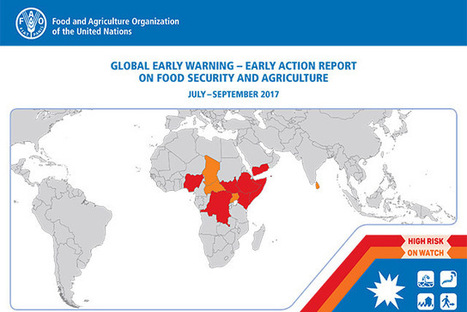
The Global Early Warning - Early Action System (EWEA) report on food security and agriculture is developed by the Food and Agriculture Organization of the United Nations (FAO) through its EWEA. The system aims to translate forecasts and early warnings into anticipatory action.
This report specifically highlights:
HIGH RISK: Yemen (risk of famine), South Sudan (risk of famine due to conflict), Nigeria – northeast (risk of famine due to conflict), Somalia (risk of famine due to drought), Democratic Republic of Congo (localized conflict), Kenya & Ethiopia (drought)
ON WATCH: Africa – Fall Armyworm (outbreak), Uganda (displacement), Sri Lanka (prolonged drought and localized floods), Central African republic (escalation of localized conflict driving displacements), Chad (displacement and deteriorating food security) and El Niño (droughts, floods and cyclones).
|
|
Scooped by
CIHEAM News
July 20, 2017 3:07 AM
|
Plusieurs produits alimentaires, tels que la poudre de lait, le sucre roux et les huiles brutes, ont connu une hausse sensible des prix au premier trimestre 2017. En même temps, le prix des céréales a reculé.
Les prix moyens des produits alimentaires importés par l’Algérie ont, dans l’ensemble, connu une hausse durant le premier trimestre 2017, par rapport à la même période de 2016. Selon des données rendues publiques par le ministère du Commerce et reprises hier par l’APS, les prix moyens à l’importation des matières premières destinées à l’industrie agro-alimentaire ont été marqués globalement par une tendance haussière variant entre 0,63% et 477%.
Ainsi, le prix moyen à l’importation des poudres de lait a augmenté à 2892 dollars/tonne (usd/t) (+17,13% par rapport au même trimestre 2016) et celui du sucre roux à 494 usd/t (+45,3%), et les matières grasses de lait à 4604 usd/t (+24,8%). Quant aux différentes huiles brutes (de soja, palme, coco, sésame...), leurs prix à l’importation ont augmenté entre 7,3% et 477%, sauf l’huile brute de tournesol qui a baissé de 2,03%.
En revanche, les prix à l’importation des céréales ont reculé à 342 usd/t pour le blé dur (-0,87%) et à 202 usd/t pour le blé tendre (-0,5%), mais le prix du maïs a grimpé à 203 usd/t (+13,41%). Pour les produits d’épicerie, la quasi-totalité de leurs prix à l’importation a connu des hausses à l’exception du café torréfié qui a baissé de 18,4% (14 808 usd/t), le simple concentré de tomate qui a reculé de 15,42% (988 usd/t) et les pâtes alimentaires de 7,4% (1529 usd/t). Le prix du café non torréfié a été de 2544 usd/t (+21,03%), du sucre blanc à 856 usd/t (+71%), du lait infantile à 7224 usd/t (+6,5%) et du thé à 2383 usd/t (+11%), du riz à 579 usd/t (+12%).
|
|
Scooped by
CIHEAM News
July 18, 2017 3:36 AM
|
Retenant comme définition que le dumping consiste à exporter une production à un prix inférieur aux coûts de production, le think tank américain IATP (institue for Agriculture and Trade Policy) a cherché à mettre en évidence le phénomène sur les principales cultures aux Etats-Unis. Si la méthode employée est le fruit d’hypothèses forcément simplificatrices donc discutables, il en résulte que l’écart entre les coûts de production et le prix est, pour l’année 2015, de 32% pour le blé, 10% pour le soja, 12% pour le maïs et 2% pour le riz.
Plus que ces seuls résultats, l’intérêt de cette étude de l’IATP dont nous reproduisons ci-dessous l’introduction et la conclusion1 est qu’elle propose une analyse des causes du dumping nettement plus équilibrée que les propos caricaturaux parfois entendus sur le sujet où il suffirait de supprimer les subventions pour que les prix reviennent à l’équilibre de marché. En effet, S. Murphy et K. Hansen-Kuhn centrent leur analyse sur les raisons qui poussent un agriculteur à continuer à produire alors même que l’ensemble de ses coûts de production ne sont pas couverts. De la sorte les subventions sont davantage vues comme les conséquences des imperfections de marché que comme les causes du dumping : « le système est structuré de telle manière qu’il […] pousse les agriculteurs à travailler à perte, ce qui maximise les profits plus bas dans la chaîne (de valeur) » et « dévaste les agriculteurs des pays importateurs, en particulier ceux des pays à faible revenu qui n’ont pas assez de pouvoir politique pour défendre leurs marchés ».
Critiquant les règles actuelles de l’OMC qui sont trop focalisés sur les subventions et pas assez « sur la concentration oligopolistique du commerce international des grains et sur le problème de surproduction », S. Murphy et K. Hansen-Kuhn en appellent à une nouvelle approche du commerce international basée notamment sur le principe que chaque gouvernement est dans l’obligation d’assurer la sécurité alimentaire aux siens et sur le besoin de recourir à des outils de maîtrise de l’offre pour stabiliser les prix en période de marché déprimé. Au final, les chercheuses regrettent la légèreté des Etats-Unis sur le sujet du dumping, car dans la situation actuelle « attaquer les politiques agricoles des autres pays (les Etats-Unis ont chalengé la Chine à l’OMC) est hypocrite et assombrit les perspectives d’une issue fructueuse au débat à l’OMC sur les nécessaires réformes ».
|
|
Scooped by
CIHEAM News
July 18, 2017 3:34 AM
|
Les cours européens du blé étaient en baisse lundi après midi sur le marché européen, des perspectives de pluies sur les bassins de production nord-américains levant les craintes que faisait peser la sécheresse sur les récoltes.
L'annonce de précipitations sur la zone de production de blé aux États-Unis a pesé sur les cours des céréales européennes. (©Terre-net Média)
Peu après 16 h 00 (14 h 00 GMT), les cours du blé étaient en baisse de 0,50 euro à 173,50 euro la tonne pour l'échéance des septembre, et de 0,25 euros à 180,50 euros la tonne pour l'échéance de décembre. Le volume d'échange était supérieur à 23 500 lots.
À la même heure, les cours du maïs reculaient aussi de 0,75 euro la tonne à 169 euros pour l'échéance d'août, et de 0,5 euro à 168,75 euros pour l'échéance de novembre, dans un volume d'échanges supérieur à 2 200 lots.
Les prévisionnistes attendent désormais des précipitations sur une partie de la Corn Belt, ce qui devrait atteindre le coeur de la zone de production de blé de printemps.
Début juillet, les cours du blé avaient dépassé la barre des 180 euros la tonne pour l'échéance septembre, tirés notamment par les perspectives de sécheresse dans des zones de production comme l'Ohio par exemple.
|


 Scoop.it!