Your new post is loading...

|
Scooped by
CIHEAM News
April 26, 2018 5:19 AM
|
CAIRO - 17 April 2018: Egypt is planning to import 7 million tons of the grain in the 2018-2019 financial year, according to a budget proposal document seen by Reuters. Egypt hopes to pay an average price of $220 a ton cost and freight for the wheat during the same year, the proposal said. A policy of tying local wheat purchase prices to global ones is also set to continue, according to the document. Egypt annually consumes 14.5-15 million tons of wheat, exported and local, according to the state’s official statements. The government plans to buy 4 million tons of wheat from local farmers during the current harvest season.
|
|
Scooped by
CIHEAM News
April 26, 2018 4:56 AM
|
L'amélioration des conditions logistiques est un enjeu majeur de la rénovation des économies agricoles à l'échelle d'un pays. Le Plan Maric Vert s'est attaché à faciliter la logistique afin d'acheminer au mieux les denrées agro-alimentaires importées au consommateur marocain et celles exportées vers les ports de l'Atlantique ou de la Méditerranée. Des moyens logistiques importants sont engagés dans l’acheminement des céréales de production locale ou d’importation vers le consommateur final. Ces moyens logistiques concernent aussi bien le transport et la manutention des matières premières et des produits finis que les opérations de transit, de stockage et de transformation. Des investissements importants en logistique de réception ont été réalisés par le secteur privé et par la SOSIPO, filiale de l’Office national interprofessionnel des céréales et légumineuses (ONICL). L’importation transite par les silos portuaires de Nador, Casablanca, Safi, Jorf et Agadir.
This paper presents an evaluation framework followed to identify cost-efficient alternatives to extend the MARS Crop Yield Forecasting System (MCYFS), run by the European Commission Joint Research Centre since 1992, to other main producing areas of the world: Eastern European Neighbourhood, Asia, Australia, South America and North America. These new systems would follow the principles and components of the MCYFS Europe: a meteorological data infrastructure, a remote sensing data infrastructure, a crop modelling platform, statistical tools, a team of analysts and a crop area estimation component. The framework designed evaluates the performance of the possible MCYFS-like system realizations against six defined objectives and their costs. Possible monitoring systems are based on a combination of different technical solutions for each of the MCYFS components, and are evaluated through an automatic algorithm that calculates the expected system performance –relying on a priori expert judgement–, the costs, and possible risks to construct some technical solutions, to finally identify the cost-efficient ones. A baseline system, achieving the minimum required performance, was identified as the most efficient starting point for the MCYFS extension in all the geographical areas. Such system would be built upon: (i) near real-time reanalysis meteorological products; (ii) remote sensing data from low-resolution (~1 km) platforms with a long-term product archive; (iii) crop models based on crop-specific model calibration from experimental data published in scientific literature; (iv) statistical methods based on trend and regression analysis applied to national level; (v) a team of analysts with specific technical profiles (on meteorology, remote sensing, and agronomy); and (vi) digital classification of very high resolution imagery supported by non-expensive ground surveys for area estimation. In countries where accessibility to local data and resources is high the baseline system can be upgraded enhancing some of the components: sub-national statistical analysis with additional statistical methods like multiple regression or scenario analysis; recruitment of experts on local agricultural conditions in the team of analysts; local calibration of crop models with experimental data; and exploiting high and low resolution biophysical products from remote sensing for crop monitoring.
|
|
Scooped by
CIHEAM News
April 24, 2018 4:36 AM
|
ALGER - Le secteur de l’agriculture et de la pêche prévoit des évolutions significatives de la production d’ici 2022, selon les données communiquée. La production attendue dans la filière céréale est de 53 millions de quintaux (qx) en 2022 contre une moyenne de 50,1 millions de qx entre 2009 et 2012. Globalement, le secteur de l’agriculture représente une valeur ajoutée dans le PIB de 12,3 % en 2016 contre 8,77% en 2000...
|
|
Scooped by
CIHEAM News
April 24, 2018 4:27 AM
|
Restoration of agriculture is central component of reconstruction efforts in Iraq. Even before the conflict, agriculture’s contribution to the Iraqi economy had been declining due to ineffective policies. And the conflict has pushed the agricultural sector into further disarray. Assessing the damage alone is a complex task. But today, there are signs that Iraq’ agriculture maybe coming back, as it begins to employ more people. ICARDA has been expanding conservation agriculture in Ninawa province in northern Iraqi city of Mosul. Conservation agriculture is an approach to managing agro-ecosystems for improved and sustained productivity, while simultaneously preserving and enhancing the environment...
|
|
Scooped by
CIHEAM News
April 24, 2018 3:57 AM
|
During the harvesting season in Egypt, it is common to see grains scattered across routes used by transport vehicles. This is due to bumpy roads, too many bags of wheat stacked on these vehicles, or bad packaging. A truck designed locally to put an end to wheat losses during transport from fields to storage silos is set for testing in Egypt this summer. According to the Ministry of Supply and Internal Trading, the wheat lost during transport currently amounts to one-sixth of the local harvest, and was almost half three years ago. The country loses 15 per cent of the grain destined for its silos, costing the government about 2 billion Egyptian pounds (approximately US$1.1 million)...
|
|
Scooped by
CIHEAM News
April 20, 2018 9:08 AM
|
The XV International Conference "Black Sea Grain-2018" concluded its work. On April 18-19 in Kiev, Ukraine was successfully held the XV Anniversary International Conference “Black Sea Grain: Moving Up the Value Chain” organized by consulting agency UkrAgroConsult. The 15th Anniversary conference once again proved its status of one of the largest global grain forums, having brought together over 700 delegates from 400+ companies and 50 countries. Among them were Ukrainian and international crop producers and processors, traders, agricultural holdings, investment companies and banks, logistics, insurance, legal and other firms. It is important to remind that Ukraine is about to be one of the main grain producer in the world ( in particular for wheat), exporting to all around the world like its neighbour Russia is.
|
|
Scooped by
CIHEAM News
April 20, 2018 8:46 AM
|
EU Crops Market Observatory - Cereals released by the EU DG Agri. It shows in particular the consequences of extreme weather events (rain surplus) in coastal Maghreb (Argelia, Morocco), Apennin and Alpes regions (Italy and France), the Balkans, plus some parts of Turkey, Spain and Portugal.
|
|
Scooped by
CIHEAM News
April 20, 2018 2:27 AM
|
En 2018, l'appli Destination céréales évolue ! Mais sa vocation reste la même : faire passer plus vite la route des vacances tout en enrichissant la culture générale des vacanciers sur les cultures qui défilent à travers la vitre.
|
|
Scooped by
CIHEAM News
April 19, 2018 4:15 AM
|
The Call for proposals is now closed for the sections on Management of Water, Farming Systems and Agro-food Value Chain. PRIMA consists of European Union Member States, Horizon 2020 Associated Countries and Mediterranean Partner Countries on an equal footing basis (co-ownership, co-management and co-funding) with the Participation of the European Commission. Among the 19 Mediterranean countries currently participating in this program, all the CIHEAM countries are involved except Albania. The overall objective of the PRIMA programme is to build research and innovation capacities and to develop knowledge and common innovative solutions for agro-food systems, to make them sustainable, and for integrated water provision and management in the Mediterranean area, to make those systems and that provision and management more climate resilient, efficient, cost-effective and environmentally and socially sustainable, and to contribute to solving water scarcity, food security, nutrition, health, well-being and migration problems upstream.
|
|
Scooped by
CIHEAM News
April 19, 2018 3:20 AM
|
The Mediterranean countries utilize many of the same healthy ingredients but each country has a unique way of creating recipes with those same ingredients. The local bread is a form of hearty, thick, gluten-rich pita bread called eish baladi. This bread is made from a simple recipe that forms the backbone of the Egyptian cuisine. It is consumed at almost all Egyptian meals; a working-class or rural Egyptian meal might consist of little more than bread and beans. Although many rural people still make their own cheese, notably the fermented mish, mass-produced cheeses are becoming more common. Cheese is often served with breakfast, it is included in several traditional dishes, and even in some desserts...
|
|
Scooped by
CIHEAM News
April 19, 2018 2:49 AM
|
High levels of food insecurity persist in the world, due largely to conflicts and to adverse climatic shocks that are taking a toll, particularly in East African and Near East countries, where large numbers of people continue to be in need of humanitarian assistance, a new FAO report notes. Some 37 countries are in need of external assistance for food, unchanged from three months ago, according to the Crop Prospects and Food Situation report issued today. Civil war and insecurity are direct reasons for high hunger rates in 16 of those countries, ranging from Burundi to Yemen. Conflict is displacing millions of people, hampering agricultural activities and, in many cases, also driving basic food prices up sharply, the report notes. Inflation in the Democratic Republic of Congo more than doubled in 2017 to a 42 percent annual rate. Violence has disrupted traditional trade routes around the Sahel, driving up prices, while food shortages are reported around southern and eastern Libya. Meanwhile, inadequate and erratic rainfall poses a growing threat to food security in Southern Africa as well as in Eastern Africa, where many rural households have suffered from four consecutive drought-affected agricultural seasons.
|
|
Scooped by
CIHEAM News
April 12, 2018 4:57 AM
|
La Commission européenne, tirant les leçons de la polémique autour du renouvellement de la licence du glyphosate dans l’Union européenne (UE), a dévoilé mercredi 11 avril des propositions visant à rendre plus transparent le processus d’évaluation scientifique sur lequel se basent les autorisations en matière de sécurité alimentaire. La réforme proposée par la Commission veut rendre publiques et accessibles les études d’évaluation des risques « à un stade précoce de la procédure ». Un registre serait créé, pour compiler toutes les études commandées par des entreprises requérant une autorisation, afin de « garantir qu’elles ne cachent pas des études défavorables ».
|
|
|
Scooped by
CIHEAM News
April 26, 2018 5:12 AM
|
Since 2016, fourteen new sites have been designated as Globally Important Agricultural Heritage Systems, including the first ones in Europe. As with other designated sites, these systems highlight agricultural traditions that promote sustainability, safeguard biodiversity and protect the environment while supporting the social and economic development necessary for stable, decent livelihoods. An heritage to preserve and transmit to next generations. The current list of 14 sites range from oases to rice terraces, wasabi cultivation to raisin production. They are fascinating places that have shaped landscapes into works of art and have protected sustainable ways of living and producing food. Among them, the Agricultural System of Valle Salado de Añana and the Malaga Raisin Production System in La Axarquía, Spain and the Siwa Oasis, Egypt. In 2018 the Barroso Agro-sylvo-pastoral System in Portugal has been designated with 3 other sites. Many other sites in the Mediterranean are potentially concerned by this international recognition!
|
|
Scooped by
CIHEAM News
April 25, 2018 2:37 AM
|
Rice farmers in Kafr Ziada village in the Nile River Delta have ignored planting restrictions aimed at conserving water for years, continuing to grow a medium-grain variety of the crop that is prized around the Arab world. A decision thousands of kilometers to the south is about to change that, however, in another example of how concern about water, one of the world’s most valuable commodities, is forcing change in farming, laws and even international diplomacy. Far upstream, close to one of the sources of the Nile, Ethiopia is preparing to fill the reservoir behind its new $4 billion Grand Renaissance Dam, possibly as soon as this year...
S’appuyant sur le chapitre 6 de l’ouvrage MOND’Alim 2030 rédigé par le Centre d’études et de prospective, cette note présente les principales évolutions des modes de gouvernance et de régulation des systèmes alimentaires mondiaux.
|
|
Scooped by
CIHEAM News
April 24, 2018 4:31 AM
|
Composante principale du Pilier II du Plan Maroc Vert (PMV), l’agriculture solidaire et plus particulièrement les produits du terroir connaitront cette année une montée en gamme. La multiplication des projets s’appuie notamment sur le lancement de 4 nouvelles plateformes logistiques en 2018, ainsi que sur le renforcement du e-commerce dans les circuits de distribution. Le Maroc regorge de potentialités en matière de biodiversité et de savoir-faire en ce domaine. Des études régionales ont permis d’identifier plus de 200 produits du terroir", précise Al Mahdi Arrifi, DG de l’Agence pour le développement agricole (ADA), véritable locomotive de l’investissement agricole dont la principale mission consiste en l’ingénierie et l’accompagnement, notamment financier, des projets développés dans le cadre du Plan Maroc Vert. L’essor des produits du terroir marocain sous le PMV est le fruit d’une stratégie idoine du ministère de tutelle, qui repose sur deux axes majeurs: -Le renforcement des produits : production, packaging, tarification et promotion, labellisation…, -L’amélioration des conditions d’accès aux marchés, au Maroc comme à l’international. Près de 200 références bénéficient à ce jour du label collectif "Terroir du Maroc" développé par l’ADA et qui est une reconnaissance officielle par l’Etat marocain de l’authenticité de ces produits. Parallèlement, d’autres produits du terroir sont estampillés SDOQ (signes distinctifs d’origine de qualité). Le Maroc compte, en 2018, 43 produits IGP (indication géographique protégée), 5 AOP (appellation d’origine protégée) et 5 labels agricoles (garantie d’une qualité supérieure).
|
|
Scooped by
CIHEAM News
April 24, 2018 4:08 AM
|
Les importantes précipitations qui se sont abattues sur le Maroc durant ces derniers mois et les chutes de neiges enregistrées dans plusieurs régions du Royaume augurent d'une bonne campagne agricole 2017-2018. Les cumuls pluviométriques ont été abondants et ont permis de refaire la plupart des réserves des barrages à usage agricole. Ces conditions ont un impact bénéfique sur l’ensemble du secteur agricole, aussi bien pour la production végétale que pour la production animale. La production de céréales devrait atteindre des records cette année! C'est aujourd'hui que s'ouvre même le 13è SIAM, Salon international de l'agriculture du Maroc à Meknès...
|
|
Scooped by
CIHEAM News
April 20, 2018 10:51 AM
|
MARS bulletins - crop monitoring in Europe - The European Commission's science and knowledge service In particular, it shows how extreme meteorological conditions affect the spring sowing campaign in some EU and Mediterranean regions. Yields could be slightly affected...
|
|
Scooped by
CIHEAM News
April 20, 2018 9:02 AM
|
A comprehensive Agricultural Policy for the Maltese Islands was requested by various stakeholders in order to provide a strategic national direction for this dynamic sector.
The agricultural sector in the Maltese Islands has been significantly re-shaped following Malta’s accession to the European Union and changes throughout its various facets are still ongoing. Thus, this ten-year policy is intended to steer the agricultural sector into a more sustainable direction by providing the means along which it can develop and flourish, whilst remaining within the parameters of the Common Agricultural Policy and other pertinent regulations. The Agricultural Policy for the Maltese Islands 2018-2028 is intended to provide...
|
|
Scooped by
CIHEAM News
April 20, 2018 2:38 AM
|
Monthly report of April 2018. The Market Monitor tracks current and expected future trends in international food markets including market and policy drivers, and detects conditions that warrant the attention of policy makers.
|
|
Scooped by
CIHEAM News
April 19, 2018 8:31 AM
|
SERVIR, a joint initiative of A joint development initiative of National Aeronautics and Space Administration (NASA) and United States Agency for International Development (USAID), has released a new global geospatial dataset for agriculture and food security around the world.
|
|
Scooped by
CIHEAM News
April 19, 2018 3:30 AM
|
(released in 2016 and still up-to-date!) Existing strategies that are publicly available and accessible and the opinions and perceptions of key Green Economy and Sustainability practitioners were the basis of the assessment. In a nutshell, the main outcome of the study is that the large majority of Mediterranean countries have out-dated or incomplete national GE/SD strategies. Often they are vague, not giving clear definitions or indicators. Among the 22 Mediterranean countries monitored, we can see many differences in the detail of strategies and supporting legislation.
|
|
Scooped by
CIHEAM News
April 19, 2018 3:02 AM
|
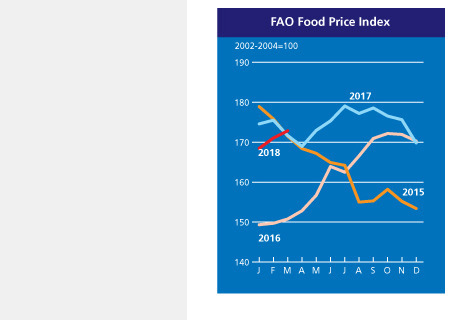
FAO, 5 April 2018, Rome The FAO Food Price Index rose in March, driven by robust increases in grains and dairy prices. In March, the Index averaged 172.8 points, 1.1 percent higher than in February and 0.7 percent above its value a year earlier. Declines in price quotations for sugar and most vegetable oils were more than offset by increases for maize, wheat and most dairy products. The trade-weighted price index tracks international market prices for five major food commodity groups. Worldwide cereal production hit a record level in 2017, up 33 million tonnes from 2016, to nearly 2 646 million tonnes, according to FAO's latest estimate in the Cereal Supply and Demand Brief, also released today. However, FAO's anticipates this year's world maize and wheat production to decline based on early forecasts.
|
|
Scooped by
CIHEAM News
April 19, 2018 2:36 AM
|
Habib Ayeb is a founder member of the NGO Observatory of Food Sovereignty and Environment (OSAE) and Max Ajl is a sociologist, activist and an editor at Jadaliyya and Viewpoint. In recent years, the issue of food sovereignty has begun to appear in academic and non-academic debates, and in research as well – although more tentatively – in all the countries of the region. That said, the issue of food and thus agriculture has always been important, both in academic research and public debate, as well as the academy, political institutions, and elsewhere. During the 1970s and 1980s, in Tunisia and throughout what was called the Third World, we spoke mainly of food self-sufficiency. This was, in a way, and at that time, a watchword of the left – a left that was modernist, developmentalist and statist. Following Green Revolution policies in the context of a Cold War, experiences of agrarian reforms and agricultural co-operatives in Tunisia (from 1962), in Egypt (from 1953) and in many other countries had proliferated. From 2011 on, spaces and opportunities for debate would greatly expand, touching upon a multitude of topics and diverse themes – even if the rural world, and more specifically, agricultural and food topics, remain relatively marginalized, or often forgotten. Nevertheless, the issue of food sovereignty has seen some fairly significant actions and initiatives. In Egypt...
|