


CIHEAM Report on COVID-19 impacts in the Mediterranean Region The effects of the COVID-19 on the economy of the Mediterranean region are barely emerging but they are likely to have an unprecedented impact. As in every crisis, it is the poo

 Your new post is loading...
 Scoop.it! CIHEAM Report on COVID-19 impacts in the Mediterranean Region The effects of the COVID-19 on the economy of the Mediterranean region are barely emerging but they are likely to have an unprecedented impact. As in every crisis, it is the poo 
No comment yet.
Sign up to comment
Scoop.it!

South Africa will likely harvest 37% more maize in 2020 compared with the previous season after favourable weather conditions boosted yields, a Reuters survey of six analysts and traders showed on Monday. South Africa’s Crop Estimates Committee (CEC) is expected to forecast the 2019/2020 maize production at 15.461 million tonnes, up from 11.275 million tonnes harvested in the 2018/2019 season, which was impacted by dry weather conditions. The estimate is slightly lower than the CEC’s June forecast of 15.514 million. “The yields are relatively good across the country. Already over 50% of the crop has been delivered to commercial silos,” said Wandile Sihlobo, an economist with South African agribusiness association Agbiz. The crop is expected to consist of 9.081 million tonnes of white maize, used mainly for human consumption, and 6.443 million tonnes of yellow maize used mainly in animal feed.
Scoop.it!

Les moissons sont en avance. Mais les rendements dans beaucoup d’endroits ont pâti des aléas climatiques ou des bio-agresseurs. Bilan: des rendements globalement en repli. Dans les régions Bourgogne – Franche-Comté, Centre – Val-de-Loire, Nouvelle-Aquitaine, Pays-de-Loire, 20 à 30% des surfaces de blé tendre ont souffert de conditions de culture jugées mauvaises ou très mauvaises, selon FranceAgrimer. L’appréciation est plus sévère encore pour l’orge d’hiver. Conséquence logique: les rendements en 2020 diminuent dans ces régions. Les moyennes nationales de rendement présentées par Agreste début juillet ont révélé des pertes de rendements allant de 20 à 30% selon les régions. Le rendement du blé tendre est estimé à 71,1q/ha, en baisse de – 8 quintaux par rapport à 2019. En colza, on passerait de 31,6q/ha à 30,3q/ha.
Scoop.it!

Le président Tebboune a ordonné pour que soit mis en place, en extrême urgence, un institut spécialisé dans l’agriculture saharienne...
Scoop.it!

La météo plus clémente en juin a permis d’atténuer en partie les dommages causés par un automne trop humide et un printemps trop sec. Les perspectives de rendement de certaines cultures de l’Union européenne pour la récolte 2020/21 s’améliorent dans plusieurs régions.
Scoop.it!

From
www

29 July 2020, Rome - The Food and Agriculture Organization of the United Nations (FAO) today unveiled a comprehensive platform to help the global community step up action to reduce food loss and waste as the UN agency and partners call for increased efforts and gear up for the International Day of Awareness of Food Loss and Waste - to be marked for the first time on 29 September 2020. The Technical Platform on the Measurement and Reduction of Food Loss and Waste brings together information on measurement, reduction, policies, alliances, actions and examples of successful models applied to reduce food loss and waste across the globe. "Wasting food means wasting scarce natural resources, increasing climate change impacts and missing the opportunity to feed a growing population in the future," said FAO Director-General QU Dongyu at the launch of the platform...
Scoop.it!

La sécheresse est de retour en France et met à risque les cultures de maïs et de tournesol ainsi que les semis de colza. La Chine et le Canada souffre à l’inverse d’un fort excès hydrique, tandis que les pluies se font attendre dans l’hémisphère Sud.
Scoop.it!

La récolte française de blé tendre chute cette année en dessous des 30 Mt, d’après Agritel. C'est la troisième fois depuis vingt ans et déjà la deuxième en cinq ans. Ainsi, seulement 29,22 Mt de blé devraient être produites. Si la moisson 2020 se caractérise par une forte hétérogénéité de rendements, la qualité est en revanche au rendez-vous.
Scoop.it!
From
www
This year, the report includes a special focus on transforming food systems for affordable healthy diets. It analyses the cost and affordability of healthy diets around the world, by region and in different development contexts. New analysis is presented on the “hidden” health and climate-change costs associated with our current food consumption patterns, as well as the cost savings if we shift towards healthy diets that include sustainability considerations. The report also offers policy recommendations to transform current food systems and make them able to deliver affordable healthy diets for all – crucial to all efforts to achieve Zero Hunger – SDG2.
Scoop.it!

The seed industry is truly globalised: A seed lot can be expected to travel through several countries for multiplication, production, processing and packaging before it reaches a farmer. It is also time sensitive, with defined periods for sowing and harvesting different crops. As such, the necessary restrictions on movement and transport put in place by governments to protect their people from COVID-19 have the potential to seriously affect the production, certification, distribution and cost of seed.
Scoop.it!

The COVID-19 pandemic quickly evolved from a health crisis to a large-scale global economic crisis. Like most of the world’s countries, Tunisia is facing a new unfamiliar challenge. Tunisia’s government quickly realized the critical health challenge of COVID-19 and took measures to contain the virus including imposing a full lockdown and providing new equipment to the health facilities.
Scoop.it!

La pandémie de coronavirus a mis en lumière l’importance stratégique de l’alimentation. Les appels se multiplient pour rebâtir la souveraineté alimentaire et manger français. L’équation est complexe. Un article de notre partenaire, Ouest-France.
|
Scoop.it!
Article by Pr. Mohammed Sadiki (President of the CIHEAM Governing Board) and Mr Plácido Plaza (Secretary-General of the CIHEAM) on the occasion of the publication of the CIHEAM Report “The COVID 19 Pandemic: Threats to Food Security in the Mediterranean Region”. (29/07/2020).
"The effects of the COVID 19 pandemic on the economies of countries in the Mediterranean region are starting to be visible and are likely to have unprecedented consequences and impact. As in every crisis, it is, of course, the poorest and fragile populations who suffer the most serious consequences. Among the most fragile, the vulnerable populations of rural and agricultural areas of the Mediterranean region, who are already suffering for several years from climate change impacts, the reduction of natural resources but also from development inequalities ...
CIHEAM News's insight:
Scoop.it!
India has authorised imports of 500,000 tonnes of corn this year at a concessional 15% import tax, the government said late on Tuesday, as New Delhi tries to augment supplies of the animal feed for the poultry industry.
Scoop.it!

The International Grains Council (IGC) raised its forecast for global wheat production in the 2020/21 season, with improved outlooks for Australia and China more than offsetting a downward revision for the European Union. At 2,237 Mt, total grains production in 2020/21 is projected to be up by 62m y/y, led by a jump in maize output (+55 Mt) to a new peak, but with wheat (+6 Mt) also at a record. With outlooks for production and consumption of total grains (wheat and coarse grains) trimmed, the International Grains Council (IGC) raised its forecast for world stocks at the end of 2019/20 slightly m/m (month-on-month).
CIHEAM News's insight:
Scoop.it!

La récolte française de blé tendre chute cette année en dessous des 30 Mt, d’après Agritel. C'est la troisième fois depuis vingt ans et déjà la deuxième en cinq ans. Ainsi, seulement 29,22 Mt de blé devraient être produites.
Scoop.it!

La récolte de blé russe est au cœur des préoccupations ces dernières semaines, avec des estimations qui ne cessent d’évoluer. L'agence nationale des statistiques de la Russie (Rosstat) a créé la surprise lundi : les surfaces de blé tendre russe sont record cette année.
Scoop.it!

From
lematin
Le Matin - Comment la nouvelle stratégie agricole entend révolutionner le monde rural...
Scoop.it!

Canada's durum exports in the 10 months ended May 31 surged 17% from a year earlier amid lackluster crops in Europe and North Africa.
Scoop.it!

Fruit de la collaboration entre l’Organisation de coopération et de développement économiques (OCDE) et l’Organisation des Nations Unies pour l’alimentation et l’agriculture (FAO), les Perspectives agricoles de l'OCDE et de la FAO 2020‑2029 s’appuient aussi sur le concours et les connaissances de pays membres et d’organisations internationales spécialisées dans les produits de base. Elles présentent des projections de l’offre et de la demande des principaux produits agricoles, des biocarburants et des produits halieutiques et aquacoles sur les marchés nationaux, régionaux et mondiaux. Au moment où les Perspectives agricoles de l'OCDE et de la FAO 2020‑2029 ont été établies, les effets précis de la pandémie de COVID‑19 sur les marchés agricoles restaient en grande partie inconnus et n’ont donc pas été pris en compte dans les projections de référence. Néanmoins, cette édition s’attache à dessiner les contours des voies de transmission de ces effets sur les différentes filières agricoles et alimentaires.
Scoop.it!
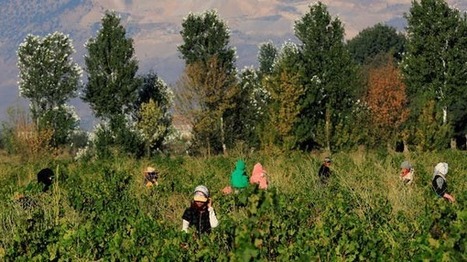
The Lebanese agriculture and food production industry has come under multiple threats, and the coronavirus-spurred economic contraction has exacerbated the hit already laid upon the sector by the ongoing currency crisis. Experts warn that compounding issues in the country could lead to production decreases and further price increases in the coming months.
Scoop.it!

Minister of Water Resources and Irrigation Mohamed Abdel Aaty and Minister of Agriculture and Land Reclamation El Sayed El Kosayer met on Wednesday to discuss implementation of modern irrigation systems in New Valley governorate.
Scoop.it!

The “Malta Farm Map” aims to support local farmers sell their local fruits and vegetables by connecting farmers and customers directly in this time of crisis. Farmers put a lot of work and passion into growing food, and we want citizens to get a glimpse of that. Right now people want to support local farmers but are finding it hard to purchase from them. Customers can now locate their nearest friendly farmer and buy their fresh local produce directly. In that way they will be promoting the local farming community which had already been struggling even before the current crisis.
Scoop.it!

Les quatre organisations internationales, FAO, Fida, PAM et Banque mondiale, estiment que le travail agricole et l’approvisionnement en intrants sont perturbés. Et que cela fera « payer un lourd tribut aux personnes vivant dans les pays les plus pauvres ».
|






https://www.ciheam.org/wp-content/uploads/2020/07/COVID-rapport-FINAL.pdf