Your new post is loading...

|
Scooped by
Kim Flintoff
May 9, 2015 10:13 PM
|
Low cost, high resolution, 3D bioprinters revolutionizing the field of regenerative medicine. What is BioBots?
Biobots is the future of regenerative medicine - a high resolution desktop 3D bioprinter that builds functional three dimensional living tissue.
|
|
Scooped by
Kim Flintoff
May 8, 2015 2:07 AM
|
Combining ultrasound and 3D-printing technologies leads to a wondrous moment for an expectant Brazilian mom.
|
|
Rescooped by
Kim Flintoff
from Into the Driver's Seat
May 6, 2015 8:31 PM
|
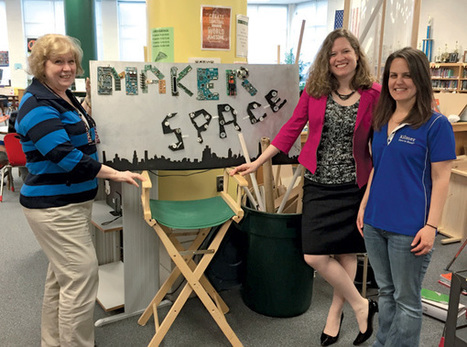
In this 4-week online workshop, you’ll learn from library and industry experts how to build a maker program at your library to engage your community and fuel lifelong learning. Guest speakers appear each week, live via web video, in interactive sessions where you can ask questions. You’ll work in small groups with facilitators experienced in the maker movement and we’ll challenge you to complete assignments and field research in your library that will have your maker program up and running by the end of the course.
Via Jim Lerman
|
|
Rescooped by
Kim Flintoff
from K-12 School Libraries
May 5, 2015 8:29 PM
|

|
Scooped by
Leah Irving
May 5, 2015 1:22 AM
|
Already, the lived reality of big data is suffused with a kind of surveillant anxiety — the fear that all the data we are shedding every day is too revealing of our intimate selves but may also misrepresent us. Like a fluorescent light in a dark corridor, it can both show too much and not enough.
|
|
Scooped by
Kim Flintoff
May 4, 2015 10:33 PM
|
Maker space workshop guides educators and librarians through the nuts and bolts Seizing hold of the booming maker movement, a new four-day workshop will walk educators through the steps of designing, equipping, and operating successful, safe and inspirational public maker spaces. Called, the TechShop Maker Space Academy, the workshop is based on TechShop’s maker space model. Institutions will receive comprehensive hands-on training on installing, teaching, and maintaining tools such as 3D printers, laser cutters, and others, as well as the license to use TechShop’s curriculum.
Communication is a vital part of science, and visualisation of data and scientific results is a key part of that process. A visualisation should engage the audience, conveying the methods and results of the study and providing a conceptual link to real-world phenomena and processes. 3D printers are now cheap and widely available, including in schools and higher education institutions, and could potentially be used to create novel, engaging, physical representations of data.
The aim of this submission was to explore ways of transforming GBIF data into 3D-printed representations, as a novel approach to data visualisation.
|
|
Scooped by
Kim Flintoff
May 4, 2015 9:47 PM
|
At Arthur Olsen’s Molecular Graphics Lab at the Scripps Research Institute in La Jolla, California, research teams model biological viruses – including HIV – and attempt to work out what kind of proteins and ligand molecules can latch onto them, to see which might inhibit or disable them.
As Olsen shows in this video, 3D printing allows them to create accurate plastic models of virus segments and the potential drug molecules. For calculating which drug will likely connect with a receptor area using the least energy, augmented reality comes into play: using small webcam targets on the model virus, they can map it to a computerised model of itself so the researcher can see it move on screen.

|
Suggested by
Learning Futures
May 3, 2015 10:39 PM
|
Very helpful collection of resources. -JL
|
|
Suggested by
Learning Futures
May 3, 2015 10:37 PM
|
This week’s post is an inteview with John Burke, Library Director and Principal Librarian at Gardner-Harvey Library at Miami University Middletown. John is the author of Makerspaces: A Practical Guide for Librarians, has conducted a survey on makerspaces in libraries, and has created a number of other resources and presentations on the topic of makerspaces and libraries. Be sure to visit his website to find out more.
|
|
Suggested by
Learning Futures
May 3, 2015 10:36 PM
|
The open hardware community is steadily building on the foundation laid by the free and open source (FOSS) community. Open hardware really took off with the low-cost, easy-to-learn Arduino microcontroller. Of all the amazing projects it enables, perhaps the most interesting was the open source RepRap 3D printer, which stands for self-replicating rapid prototyper. The goal of the RepRap project is to produce a 3D printer completely capable of making itself. It is about halfway there, and most of the non-printable components can be found in a hardware store.
The course essentially distilled the RepRap ethos and formalized it as an introduction to distributed additive manufacturing. We used "Open Source Lab: How to Build Your Own Hardware and Reduce Research Costs" as the textbook to cover the material from an engineering scientist perspective. The course covered the hardware, firmware, slicing, and printer controller software for operating and maintaining the device—all of which are free and open source. The class followed a blended learning format, meaning students often did design project "homework" in class and a lot of reading at home Jim Lerman's insight: What a great article! Well worth a read if you're into the future of making.
|
|
Suggested by
Learning Futures
May 3, 2015 10:34 PM
|
"Making allows students to learn by doing and solve problems by tinkering, trial and error. Minecraft is a 3D sandbox game, which has made its way into classrooms because it engages students across a range of subjects. Imagine the learning that happens when these two popular education movements are combined.
"The outcome is a powerhouse of student engagement, says Mike Washburn, head of computer science at Richmond Hill Montessori & Elementary Private School in Toronto, Ontario, Canada. In his mind, games shouldn’t be relegated to the fringes in classrooms. Educators should leverage them to engage students and drive new ways of thinking.
"And when it comes to teaching social studies, a subject that often gets a bad rap when supported by only worksheets and textbook reading, incorporating Minecraft can create an explosion of learning. Game playing takes the “boring” right out of it and can be a highly successful way to teach social studies, Washburn argues."
|
|
|
Scooped by
Kim Flintoff
May 9, 2015 9:45 PM
|
Where to Start
It was so much fun seeing the excitement of all these proud media center parents as they shared the triumphs, trials, and tips of creating a makerspace. Most of them have just started the process of the transformation, so what would they say to other media specialists just joining the journey themselves? Don’t make it a competition. Your makerspace doesn’t have to look like anyone else’s.Keep it free or cheap. Involve your PTSA, your Facebook friends, and your faculty in donating items that will make the space come alive.Pinterest is the place! Even if you’re more of a bookworm than a creative type, you can jump on board easily once you see the amazing ideas that are already created for you.Ask for grant money. If you’ve never written a grant, it’s worth it to help you create curriculum-connected making that integrates with your library programs.Advertise and train. Many students are unaware of this maker movement that’s starting in their media centers. Provide lunch and learn sessions and advertise on the morning news; students who are excited will be your biggest referral source, too.
|
|
Scooped by
Leah Irving
May 7, 2015 7:25 PM
|
Six Sci-Fi Disruptive Technologies That Will Change The World Technology is changing the world as we know it. We all know it and have experienced incredibl
|
|
Scooped by
Kim Flintoff
May 6, 2015 2:13 AM
|
Making music could be as easy as firing up your 3D printer. Here are 11 instruments you can create with the simple push of a button.
|
|
Scooped by
Kim Flintoff
May 5, 2015 2:52 AM
|
Libraries have long been community gathering spaces where all members of society can gather around the pursuit of knowledge or the entertainment of a good read. But the outmoded function of the library as a giant warehouse for physical books means that architects are now obliged to focus on designing tech-forward, eco-friendly community hubs to keep them viable in a digital world.
|
|
Scooped by
Leah Irving
May 4, 2015 11:32 PM
|
I tend to see things less in terms of limitation, and more in terms of possibilities, with many new options in terms of materials, detail, scale and durability of printable items.
|
|
Scooped by
Kim Flintoff
May 4, 2015 10:34 PM
|
TechShop is a membership-based do-it-yourself workshop that provides members with the use of tools and equipment, classes and a vibrant and creative community of people so they can build the things they have always wanted to make.
A few months ago I shared a review of a 3D printer from the Wall Street Journal which incorporated a 3D data visualization. Here’s a look at someone making this more than just an oddity, but rather a serious attempt at improving visual communication of data visualizations. – Dean Meyers.
Big data volume continues to grow at unprecedented rates. One of the key features that makes big data valuable is the promise to find unknown patterns or correlations that may be able to improve the quality of processes or systems. Unfortunately, with the exponential growth in data, users often have difficulty in visualizing the often-unstructured, non-homogeneous data coming from a variety of sources. The recent growth in popularity of 3D printing has ushered in a revolutionary way to interact with big data. Using a 3D printed mockup up a physical or notional environment, one can display data on the mockup to show real-time data patterns. In this poster and demonstration, we describe the process of 3D printing and demonstrate an application of displaying Twitter data on a 3D mockup of the Massachusetts Institute of Technology (MIT) campus, known as LuminoCity.
|
|
Scooped by
Kim Flintoff
May 4, 2015 9:46 PM
|
One of the most exciting uses of 3D Printing is in data visualisation.
It’s been almost eight months since the massive 9.0 T?hoku earthquake hit Japan, leaving devastation in its wake. In an attempt to extract art and beauty out of that terrible event, British artist Luke Jerram has created a 3D-printed sculpture of the seismogram from that earthquake.
|
|
Suggested by
Learning Futures
May 3, 2015 10:38 PM
|
An uncommonly large collection of resources from 2014. -JL
|
|
Suggested by
Learning Futures
May 3, 2015 10:37 PM
|
"The Autodesk 123D community is a place to design, create and share anything. No matter your technical skills and experience, you will always have a place to get the latest tools and information to support your adventures in 3D printing.
"You can start by looking through the existing models made by our other users to get inspired, then try it yourself by using the apps. Read the blog for the latest stories, videos, and tips. You are always ready to 3D print – we just help you get there! Register here to learn more."
|
|
Rescooped by
Kim Flintoff
from :: The 4th Era ::
May 3, 2015 10:34 PM
|
'MakerSpace is a new social media network for exclusively for makers. The goal of the online community is to connect makers with one another to share projects, follow other makers’ work, or collaborate on a project. MakerSpace is the official online community of Maker Faire. Users interested in joining MakerSpace can request an invitation on the site.'
Via Jim Lerman
|