Your new post is loading...

|
Rescooped by
Kim Flintoff
from Into the Driver's Seat
May 27, 2015 8:56 PM
|
by Betsy Corcoran "Making represents the kind of informal learning that happens mostly outside of school. Part of me didn't want to see it in school because it would lose its magic if it was to become defined as curriculum. I want making to flourish as something we do because we discover it and love to do it -- not because we are forced to do it. I've also come to think that rather than having making fit into school, we should transform our schools so that this kind of informal learning is given greater emphasis and so-called formal learning de-emphasized.
"Certainly, I would like more and more young people to have the opportunity to become makers, and having makerspaces in schools and library seems like the best way to reach more of them. I've been excited by the progress I'm seeing. I have to say that making is the only thing in education that is getting adopted as the result of grassroots initiatives. It's bottom-up, not top-down.
"I believe that one of the lasting impacts of the maker movement is to transform our education system, replacing a standardized curriculum and testing with learn-by-doing experiential learning. Kids will lead the way, saying "I don't learn the way they are teaching." That's how the next generation will learn that they have the freedom to become productive and creative."
Via Jim Lerman

|
Scooped by
Karen Miller
May 25, 2015 11:25 PM
|
Former MakerBot CEOs Bre Pettis and Jenny Lawton have invested in Glowforge, a company manufacturing a laser cutter that will be sold for less than $2,500.
|
|
Scooped by
Kim Flintoff
May 25, 2015 6:58 PM
|

|
Suggested by
Learning Futures
May 25, 2015 1:50 AM
|
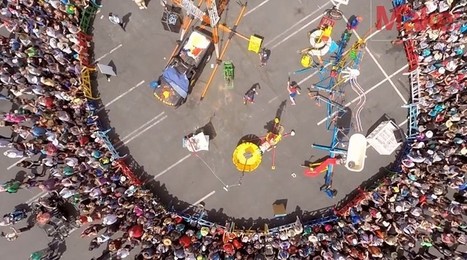
Walking the packed grounds of the San Mateo County Fairgrounds this past weekend with my son to attend the 10th anniversary edition of the Bay Area Maker Faire, I couldn’t help thinking I was seeing a vision of the future.
|
|
Suggested by
Learning Futures
May 21, 2015 8:19 PM
|
Welcome to MakerZone. Where you can bring amazing ideas to life with MATLAB and Simulink. MATLAB and Simulink project resources for Arduino, Raspberry Pi, and LEGO MINDSTORMS."
|
|
Rescooped by
Kim Flintoff
from Into the Driver's Seat
May 21, 2015 7:31 PM
|
Making something from scratch is a great skill to have. It requires confidence and imagination. For students who are into making new creations, these terrific apps and other digital products can help them develop their creative chops.
Via Jim Lerman
|
|
Scooped by
Kim Flintoff
May 20, 2015 2:44 AM
|
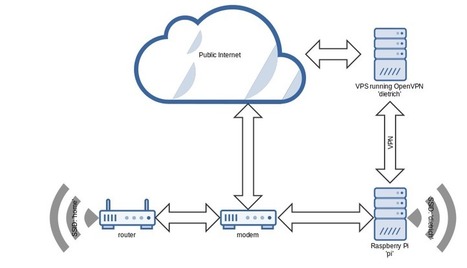
This project had a number of interesting challenges, but the biggest was the fact that this is not a single-purpose Raspberry Pi. I also use it as a home server for incoming email, file syncronisation with syncthing, and a few other random tasks. This means that the pi must remain accessible to my LAN, and through it, my public IP, while at the same time NATting traffic from its WAN over the VPN. This turns out to be not entirely straightforward.
|
|
Scooped by
Kim Flintoff
May 15, 2015 2:29 AM
|
Nüdel is an online evolutionary making system that allows community members to create and order custom construction kits
|
|
Scooped by
Kim Flintoff
May 14, 2015 10:54 PM
|
A year ago, we announced Spark and our intention to design and manufacture a 3D printer. At the time, we didn't even have a name for the printer, but we did have a vision for providing an extensible platform and sharing the source of our work to inspire others to create new approaches to 3D printing software, hardware, and materials. Today, we're taking another step on that path, and I'm excited to share Ember's mechanical design files. The full design of Ember in Fusion 360 is now available for you to freely view, download, inspect and modify. I've been having a blast with the explode model function! We're sharing these designs under a Creative Commons Attribution-ShareAlike license, the same license Arduino uses to share their design files. Just like the formulation for our resin, we're explicitly inviting you to understand, remix, and remake Ember.
|
|
Scooped by
Kim Flintoff
May 12, 2015 2:51 AM
|
4D printing is unfolding as technology that takes 3D printing to an entirely new level. University of Wollongong‘s ARC Centre of Excellence for Electromaterials Science (ACES) are setting the pace in the next revolution in additive manufacturing. They are taking 3D printing to an entirely new level with, 4D printing, where time is the fourth dimension. 4D-printed objects are 3D-printed objects that can change their shape over time, under the influence of factors, such as temperature, magnetic field, pressure or vibrations. This means that researchers could soon be able to not only custom-design and print objects but also give it the ability to change forms, fold itself or self-assemble.
|
|
Scooped by
Kim Flintoff
May 11, 2015 10:38 PM
|
New technologies from humanoid robots to 3D printers will be part of a new concept hub at Monash University that has been erected to rapidly prototype the innovations of the future.
The university will open its new sensiLab facility tomorrow, connecting IT and engineering to creative and business expertise. SensiLab director Jon McCormack said the hub was a first in Australia and aimed to be “genuinely interdisciplinary”, like the US-based MIT Media Lab.
|
|
Scooped by
Kim Flintoff
May 11, 2015 1:55 AM
|
Abstract:
The process of manual material manipulation is disappearing from daily life.
Why is it that we still have an educational and social environment that does not put the same priority on practical and theoretical knowledge as is does on virtual academics? This disconnect is particularly poignant in a field such as design that should demand the mastery of both. As a modern nation, we have repressed manual skill and incremental learning by fostering an educational climate geared solely towards the desire for white-collar status. We base the accreditation of our grade schools on the rate of their college placement and that mentality carries over to society at large. This trend has been going on long enough that the students currently in college have no longer had the opportunity to witness their fathers or even their grandfathers doing something as simple as changing the oil in the family car. Traits of competency and creativity that might actually have been hereditary at one point in time have been repressed to the point that successive generations are not even aware of them. Students have not been exposed to the possibilities and honor contained within these activities. We have a generation and a half of people who exhibit no mastery of their stuff and we have students getting to their senior year of college before realizing that there is a creative outlet that makes use of the material intelligence they seek. They learn to tap threads in a hole at the age of twenty-one and I end up teaching middle school shop to college seniors.
In the field of design, this lack of understanding carries over to the products created. Designers who don't make for themselves do not consider the values of object interaction that would be appreciated by an individual who makes. This results in crop after crop of products that help perpetuate a cycle of material unawareness, of waste and of limited development of the user/object relationship.
|
|
Scooped by
Kim Flintoff
May 10, 2015 9:40 PM
|
"Life is the oldest and most efficient manufacturing technology that we as people know of. It's become clear over the past several decades as scientists have
|
|
|
Scooped by
Kim Flintoff
May 25, 2015 7:15 PM
|
Learning how to make stuff is made easy with the Humble Maker Book Bundle Join the Maker Movement! If you like making stuff, then make it a point to check out this bundle! Name your price for Making Makers: Kids, Tools, and the Future of Innovation, Tinkering: Kids Learn by Making Stuff, Making Simple Robots: Exploring Cutting-Edge Robotics with Everyday Stuff, Make: Technology on Your Time Volume 41: Tinkering Toys, and LEO the Maker Prince: Journeys in 3D Printing. If you pay more than the average price, you'll also get Make: Rockets: Down-to-Earth Rocket Science, Make: Electronics (Learning by Discovery), Fashioning Technology: A DIY Intro to Smart Crafting, Make: Basic Arduino Projects: 26 Experiments with Microcontrollers and Electronics, Make: School's Out Summer Fun Guide, Make: Getting Started with Raspberry Pi, 2nd Edition, DIY Coffee, Make: Technology on Your Time Volume 20, and Make: Maker Projects Guide. If you pay $15 or more, you'll receive all of the above plus The Best of MAKE and Zero to Maker: Learn (Just Enough) to Make (Just About) Anything. Pay what you want. The contents of this bundle would cost you up to $233 if purchased separately, but here at Humble Bundle, you pay what you want.
|
|
Rescooped by
Kim Flintoff
from A Random Collection of sites
May 25, 2015 3:21 AM
|
This guide has been designed to help you learn more about the equipment the JML has as part of its Thinkers and Tinkers Space.
|
|
Scooped by
Kim Flintoff
May 21, 2015 8:32 PM
|
Librarians are showing growing interest in the 'maker movement' as their roles shift from collectors of information to facilitators of project-based learning.
|
|
Suggested by
Learning Futures
May 21, 2015 7:31 PM
|
One of the basic tenets and strengths of the maker movement is its emphasis on constructive and collaborative learning through hands-on, trial-and-error experimentation. While a live mentor demonstrating and leading activities is the gold standard, a growing number of titles offer inspiration, support, and clarification for a wide variety of maker topics. The following list of recommended books was crowdsourced by librarians running maker spaces and/or offering maker programming in their libraries or schools.
|
|
Suggested by
Learning Futures
May 21, 2015 7:30 PM
|
Short Circuit is an after-school experience with a fresh approach to electronics and physical computing for young people. The Short Circuit Curriculum Guide includes seven informal learning activity modules that encourage students to express their creativity and develop DIY digital media skills by exploring innovative uses for physical and digital materials, like circuits, conductive inks, LEDs and the latest programming languages
|
|
Scooped by
Kim Flintoff
May 18, 2015 7:05 AM
|
The program, called “Future Engineers,” challenges students to create a digital 3D model of a container for space. Astronauts need containers of all kinds,” according to the challenge’s website, “from advanced containers that can study fruit flies to simple containers that collect Mars rocks or store an astronaut’s food.” 3D printing gives astronauts the ability to fabricate necessities on the fly, even in space, opening up new opportunities for research and learning. The container could be intended for use on the International Space Station or for a different, even hypothetical, space mission.
|
|
Scooped by
Kim Flintoff
May 14, 2015 10:55 PM
|
A few months ago we told you about Autodesk's commitment to enriching the 3D printing ecosystem by way of establishing a $100 million dollar investment fund. We firmly believe that the new industrial revolution will not succeed on software alone, and that the days of taking a top-down approach to innovation in additive manufacturing are behind us. Hence, we have been striving to support ideas that push the boundaries of 3D printing and nurture the companies that can bring new ideas to market.
|
|
Scooped by
Kim Flintoff
May 12, 2015 12:03 AM
|
|
|
Scooped by
Kim Flintoff
May 11, 2015 2:27 AM
|
As with many schools in the United States, the shop program at Analy High School in Sebastopol, California, had become largely irrelevant. The main shop room had become little more than a glorified storage room. The school’s priorities were firmly focused on college readiness and success at standardized tests, and vocational programs had taken a backseat. Sebastopol is also the home of Make magazine, one of the leading voices of the maker movement, a community of inventors and do-it-yourselfers that has blossomed on YouTube and shows up in the tens and sometimes hundreds of thousands at Maker Faires all over the world. Make proposed that a group of students from Analy come to their offices to explore the possibilities involved in creating things with 3-D printers, computer-aided design, and more. The program was so popular that soon Make could no longer accommodate it in their offices, so they agreed to donate equipment to Analy if the school would ramp up their vocational program.
|
|
Scooped by
Kim Flintoff
May 10, 2015 9:41 PM
|
“by Ishmam Ahmed
”
In this post, we’re going to take you through some of the basics behind using one of our 3D bioprinters. What does it look like? How does it work? Well, it all comes down to three simple steps.
|