


From
twitter
Via John Evans

 Your new post is loading...
 Scoop.it! 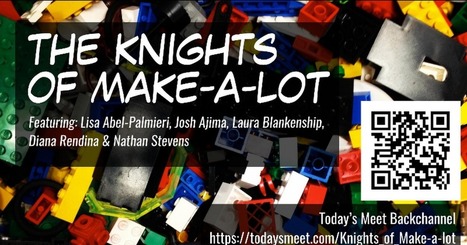
Awesome Presentation shared by @Learn21Tech @DianeLRendina @DesignMakeTeach @LBlanken at #ISTE2015 Via John Evans 
Scoop.it!
A mobile Marker Space at Curtin uses games, both traditional and technology-driven for collaborative learning, design and creativity.
Scoop.it!

Read the article to see how it relates to An Australian mine is at the forefront of producing a magical material that could revolutionise the way we make everything around us.
Kim Flintoff's insight:
From left field comes an interesting speculation that could transform making as we know it. The article refers to 3D printing applications.
Scoop.it!
Creating innovative inquiry-based learning spaces for our students today and tomorrow. Explore spaces that work with MakerEd, STEM, and coding and robotic programs for kids K-12. Share in this hands-on session’s new tools enhancing spaces for teaching and learning! Via John Evans
Scoop.it!

'MakerBot in the Classroom: An Introduction to 3D Printing and Design' includes an introduction to 3D printing and a range of hands-on 3D design lesson plans. Via Becky Roehrs

Becky Roehrs's curator insight,
June 19, 2015 8:33 PM
Don't know where to start? Check out free materials you can download and Maker lessons.. 
Maggie McGuirk Veres's curator insight,
June 24, 2015 2:57 PM
Contemplating getting a 3D printer in the ERC.
Scoop.it!

Forming and supporting professional learning groups can be particularly important in maker-centered contexts, as maker-based activities often occupy a precarious space in the structure and curriculum of traditional schools. That maker education is not yet a formal discipline and does not have the backing of a professional and organized network makes it especially important to develop learning communities that scaffold and connect educators who often work in isolated siloes.
Scoop.it!

"In June 2014, I attended the second Design Do Discover conference at Castilleja School in Palo Alto, CA. This June, the third DDD was held at Marymount School in New York City. Both times, the amazing Angi Chau from Castilleja andJaymes Dec from Marymount were the fantastic organizers, and both times I was honored to have been asked to participate as a coach to support teams of participant teachers.
"The first year was a wonderful learning experience for everyone – coaches and participants alike. But this year blew it out of the water. Hit it out of the park. Nailed it on the head.
"The premise is simple: start with a quick tour of the facility and very brief show-and-tell of the tools (less than 30 minutes!), follow with a group brainstorming session around project ideas (less than 30 minutes!), then form groups to jump into projects. Even before lunch on the first day, groups were already sketching and tinkering with Hummingbird Robotics kits, MaKeyMaKeys, cardboard and MakeDo’s, and more. For two days, I jumped in to help groups, learned new tools myself (LittleBits!), fetched tools and supplies as needed (copper tape! wire strippers!), recommended resources and suppliers (Sparkfun! DigiKey!), and acted as cheerleader for teachers pushing themselves to learn incredible new skills and create amazing artifacts of their learning.
"The final projects blew ALL of us coaches away! The absolute best part, from my perspective, is that every single project was immediately applicable back in the participant’s classroom. Most of them are generally applicable in any learning environment! Serious high school science content, literature and history, elementary grades, even social/emotional learning… This was absolutely the most excellent collection of practical and academically-oriented maker projects I’ve seen!"
Scoop.it!

Recently, Hewlett Packard announced that the Sprout “immersive computer”, the first of its kind in the world, will also be equipped with scanning capabilities. With the new 3D Capture Stage, HP is hoping that Sprout’s integrated desktop 3D scanner will make it easy and quick for users to produce 3D content.
Scoop.it!

The general consensus, and my own personal idea, for FFF technology evolution is that of moving away from a 3-axis cartesian or delta extrusion head 3D printers and into robotic assembly systems that operate through one or more multi-axis robotic arms. These systems already exist in various sizes; however, in the future, they may become smaller, more precise, and more importantly, affordable.
Scoop.it!

In some instances I think it's hard for some library staff to articulate the gains that teens make as a result of the making programs we provide. And, as a result it ends up that we talk about the actual printing activity and the printer and not the skills learned and/or improved on. It certainly can be difficult to speak to the learning instead of the "coolness" of the making. But it can be done. For example, think about: Via John Evans
Scoop.it!

"The Public Library of Mount Vernon and Knox County is a small to medium sized library in a fairly conservative and small(ish) Midwest town. It’s landlocked and there isn’t a lot of floor space to revamp into a MakerSpace. But that doesn’t mean we can’t encourage Makers. So in order to better incorporate the Maker movement into our library, we have done or are doing 3 things: -Mobile MakerSpace -Circulating Maker Collection -Circulating Maker Kits"
Scoop.it!

Politics isn’t only about who gets elected, or the day to day “action” on Capitol Hill, it’s a negotiation of power in any relationship – who has it, who can use it, and over how many other people. The Maker Movement is about sharing ideas and access to solutions with the world, not for money or power, but to make the world a better place. It’s about trusting other people, many times people you don’t know, to use these ideas for good.
|
Scoop.it!

Technology, Engineering, and Computing Conference August 15th 2015Exploring the implementation of cutting edge technology across all fields and disciplines of study, research, and industry.
Kim Flintoff's insight:
ECU Alumni at student rates.
Scoop.it!
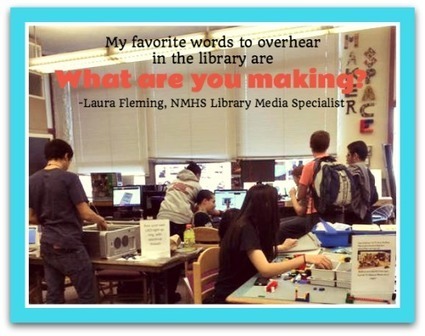
What is the best strategy for starting a makerspace in your school? How long should you take to plan your makerspace before you get started? Is flying by the seat of your pants a good idea or a bad one? What are the key features of an 8 foot tall DIY teeter totter? Stay tuned for the answers in today’s podcast. Via John Evans
Scoop.it!

Like myself, students with learning difficulties—from dysgraphia to ADD—respond well to visual or tactile learning and activities that allow physical participation,
Scoop.it!

Stratasys partners with Dunwoody College of Technology to incorporate additive manufacturing into curriculum.
Scoop.it!

Researchers have developed a new high-resolution 3D printer that layers special inks to form tiny 3D forms, some as small as just 0.001 millimeters.
Scoop.it!

"Tools, organization, student projects of the makerspaces at Marymount in NYC, Ann Richards STARS in Austin, and Edmonds CC in Seattle."

kathymcdonough's curator insight,
June 26, 2015 10:26 AM
'shelves arranged by “Invent Something” or “Prototype Something.”'
Scoop.it!

Apart from its size, what makes this machine so unique are its ten interchangeable toolheads, which, in fact, turns the machine into several different devices:
* a 3D printing head for ceramics (1 liter of material)
Kim Flintoff's insight:
The scope and scale of new fabrication technologies is astounding.
Scoop.it!

What would happen if you pit similar 3D printing services against each other?
Scoop.it!

More than a 3D printer, more than a 3D scanner, more than a milling machine. The FABtotum is the world’s first personal fabricator
The FABtotum is a 3D multi-purpose personal fabrication device. Print, Cut, Mill, Scan, Manipulate. Rinse and repeat. A seamless interaction between the physical and digital world
Scoop.it!

Get your 3D printing capabilities up and running quickly, efficiently, and cost-effectively with the MakerBot Starter Lab.
Scoop.it!
"In this talk, I will address these issues by presenting several examples of research projects in my lab that are trying to study what students learn when then make, build, program, and do inquiry science. We use methods from design-based research together with learning analytics and educational data mining to inquire into the complex, multimodal activities that students engage in science labs, and makerspaces. For example, in some studies, we examine the impact of maker activities in students’ STEM identity, career choice, and problem solving skills. In another set of studies, we evaluated a model which we termed the “flipped flipped classroom,” in which students explored a problem *before* they watch a video. In other studies, we use computational techniques to examine 100,000+ snapshots of computer code generated by students in a programming course, or second-by-second actions when students are building engineering projects. Taken together, these studies are trying to determine the value of constructivist education in the context of STEM education and in the “maker” movement, in order to make them possible equalizers of educational opportunity, rather than an instrument to further increase the educational gap in our society."
Jim Lerman's insight: Blikstein's research is fascinating in its design and execution and the social/political considerations he is dealing with stand at the fault line between equity and discrimination. I recommend this video highly.
video recorded Feb. 3, 2014 Via Jim Lerman
|






Very relevant pedagogy for each way of innovating learning. Great summer read.