


The creative possibilities of a school makerspace will become obvious once you find the space, find the money, find the tools, and find the students.

 Your new post is loading...
 Scoop.it! The creative possibilities of a school makerspace will become obvious once you find the space, find the money, find the tools, and find the students. 
No comment yet.
Sign up to comment
Scoop.it!
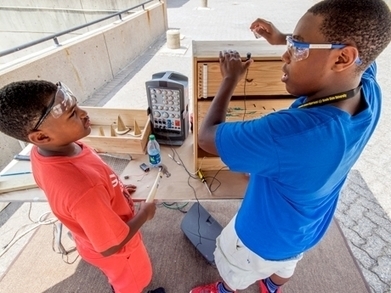
Once you've created a makerspace, create some excitement around it by engaging students with possibilities, supporting colleagues in exploring it, and innovatively using the space.
Scoop.it!

Here's how some of the world's oldest cultural institutions are using drones and 3D printing to bring their collections to life.
Scoop.it!

CfP for ICFA-36
The deadline for proposals for ICFA 36 is October 31, 2014. The Scientific Imagination will be the theme for ICFA 36. Join us as we explore the possibilities and intersections of science and imagination—from Faust and Frankenstein, through the Golden Age and the New Wave, to steampunk and mash-ups—in all their guises, including fiction, film, television, music, theater, comics, visual art, and social media. Papers might explore topics such as rationalism vs. belief, science for good and ill, alternate and speculative technologies and biologies, futurism, imaginary sciences, time travel, and the tensions inherent in discovery, among other topics. We welcome papers on the work of our guests: Guest of Honor James Morrow (winner of the Sturgeon Award, the World Fantasy Award, and two Nebula Awards) Guest of Honor Joan Slonczewski (winner of two Campbell Awards), and Guest Scholar Colin Milburn (author of Nanovision: Engineering the Future). We also welcome proposals for individual papers and for academic sessions and panels on an aspect of the fantastic in any media. The deadline for proposals is October 31, 2014. We encourage work from institutionally affiliated scholars, independent scholars, international scholars who work in languages other than English, and graduate students.
Scoop.it!
Patrick Yott is Associate Dean, Digital Strategies and Services at Northeastern University Libraries.
Scoop.it!

Your Makerspace may not need much of a budget to operate, if you have a space you can use for free, tools to borrow, and materials found or donated. For some Makerspaces, the ones with lots of parental involvement, many of the projects are self-funded. But if your Makerspace takes place at a school without as much family support, or if you simply do not have this all in place, you may need to research community or family foundation grants to fill in the gap. Via John Evans
Scoop.it!

Why not encourage and inspire students in constructive engagement by building creative thinking into the very design and tools of their classroom environment?
Scoop.it!

A new 3,000-square-foot MakerBot Innovation Lab at Florida International University's College of Architecture + The Arts will soon support innovation and entrepreneurship both for students and the local community. Supported by a $185,000 grant from the John S. and James L. Knight Foundation, the makerspace will supply 3D printers and 3D scanners for public programs, private innovation explorations and educational opportunities across all age groups. Uses will range from dual enrollment programs for local high school students to for-credit classes for FIU students and start-up programs for recent graduates. The space will also be available for community members to develop new products, conduct research or launch personal projects.
Scoop.it!

Like myself, students with learning difficulties—from dysgraphia to ADD—respond well to visual or tactile learning and activities that allow physical participation,
Scoop.it!

From
nuzzel

At the White House Maker Faire recently, where President Obama invited “makers” of all ages to display their creations, the President investigated a robotic giraffe, a red weather balloon and shot a marshmallow cannon made by a… Via Dr. Tom D'Amico (@TDOttawa)

Robert Proctor's curator insight,
July 6, 2015 10:07 AM
Would "tinkering" fit in your curriculum? Share your ideas here.
Scoop.it!

With the explosion of 3D printing in schools around the world, the variety and impressiveness of things that students and teachers are printing with this powerful technology grows every day. Via John Evans, Suvi Salo
Scoop.it!
Scoop.it!

Florida International University’s College of Architecture + The Arts (CARTA) will be the first and only arts/design college in nation to house a MakerBot Innovation Creative Lab.
|
Scoop.it!

Eighth-grader Quin uses his passion for electronics to teach fellow students about 3D printing, arduinos, and other hands-on lessons in STEM skills.
Scoop.it!

"Making is not just about STEAM, reserved for science class, or even meant to be just an activity for after school. Making across the curriculum can change the way students are thinking, interacting, collaborating, and engaged. Gather some simple materials, offer students the chance to design, create, and dream up a new way to engage and connect with the world. For example, integrating making into reflecting on a favorite book, creating to demonstrate a concept visually, investigating and interpreting the use of materials to show thinking? It takes learning to a whole new level, allows students to drive, and best of all? It can be FUN! It can be overwhelming to look at the products and projects floating around the internet and people often ask, “Where do I even begin?” Here are a few simple ways to get started with making in your classroom – no matter what subject you teach!" Via John Evans
Scoop.it!

From
3dprint
Nature is the ultimate designer; what else can we imagine could design something that is self-replicating, converts the energy of the sun to food, creates oxygen, and can last for hundreds of years? From the incredible ability of the gecko to climb vertical surfaces to the self-cleaning capabilities of the water lily, people have been amazed and inspired by the ingenuity with which nature creates solutions to problems that no amount of artificial engineering ability seems to master.
Scoop.it!

Simplified structure. Portable so you can take it anywhere. Quality prints at breaking low price. | Crowdfunding is a democratic way to support the fundraising needs of your community. Make a contribution today!
Kim Flintoff's insight:
Kit form from $299 or $349 assembled.
Scoop.it!
A round-up of the top 10 3D printers from innovative tech expert and 3D printer distributor, Douglas Krone.
From building breakthrough prosthetic limbs to designing fun gadgets, 3D printing provides endless opportunities for innovation, creation and learning.
Each 3D printer on the market today is unique; they come in various shapes and sizes designed to fit the needs of each user and classroom. Dynamism, a provider of next-generation technology, offers a variety of 3D printers that feature sleek design, user-friendly display and capacity for endless creation; as well as expertise on these models.
Kim Flintoff's insight:
Probably in the realm of advertorial. Mentions some printers I've not encountered elsewehere.
Scoop.it!

Introduction
Scoop.it!

From
www
The maker movement was front and center at the 2015 ISTE conference—and that’s a good thing for me. After following maker initiatives with great interest for some time now, I have the opportunity to design a maker space this year for 6th–12th grade students at my school, Worcester (MA) Academy.
Via John Evans
Scoop.it!
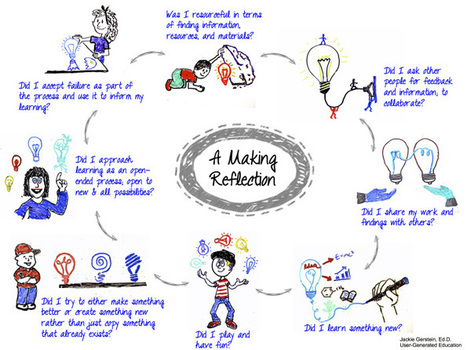
Here are some graphics, Thinglinks, and the slideshow I created for my Mindset of the Maker Educator Workshop: Via John Evans
Scoop.it!
What could be more fun than learning about sensors, actuators, building and coding your own bot. On the final day the robots have to be coded to go through a ...
Scoop.it!
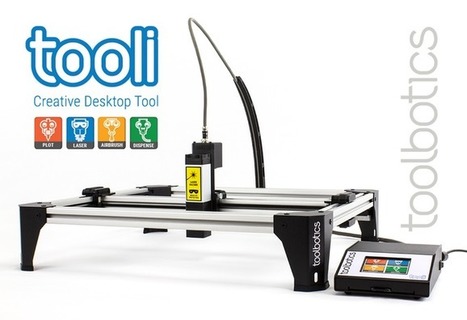
An intelligent and versatile creative desktop tool for artists and makers. Plot, Airbrush, Laser and Dispense.
Kim Flintoff's insight:
A convergence of technologies into one integrated maker unit - developed in Australia and shows promise.
Scoop.it!

Pastoralists and traditional owners benefit from model
|






