


Makerspaces, libraries and education
9.9K views |
+0 today
 Your new post is loading...
 Scoop.it! 
In response to the question of what one actually learns from 3D printing, I thought more deeply about the work we do in our school. While I know conceiving an idea and shepherding it into a tangible form is significant, it is important to be able to articulate its value within an educational setting. It’s also important to reveal the many stages in digital fabrication, especially illuminating the often hidden design process where much of the learning takes place. Via John Evans 
Scoop.it!

These are project options and ideas for students working in our "Maker Studio." In STEM class students alternate working in the Maker Studio and learning in our STEM "Learning Lab." Maker Studio projects are also available for students in our after-school Maker's Club. Via John Evans

ManufacturingStories's curator insight,
September 15, 2015 3:39 PM
Tons of #STEM #Resources for all grades. #Classroom #STEAM
Scoop.it!

I believe that every child has the right to invent, tinker, create, innovate, make, and do. The maker movement has created opportunities for all educators to give students authentic learning opportunities that go beyond the typical classroom experiences and to rethink traditional learning environments to include those that nurture the kinds of creativity and innovation that will benefit our students both in school and beyond. We know children learn by exploring and playing and doing and making and that these kinds of things lead to deeper engagement. The maker movement embodies opportunities for experimentation and innovation to occur across all grade levels and all content areas. Via John Evans
Scoop.it!

The 3-D printing revolution is not taking off as fast as expected, but changing the target market might help reverse the trend. MassChallenge finalist Makers Empire is hoping to popularize 3-D printing in elementary and middle school classrooms, seeking to emulate the way personal computers warmed up the consumer market by hooking students.
Kim Flintoff's insight:
I suspect the educational affordances of simply downloading other people's designs is limited. Engaging with the design process and prototyping is more likely to foster educational outcomes. A little bit of cynicism arises when I hear businesses saying they want to "hook students" - the language of drug dealers?
Scoop.it!
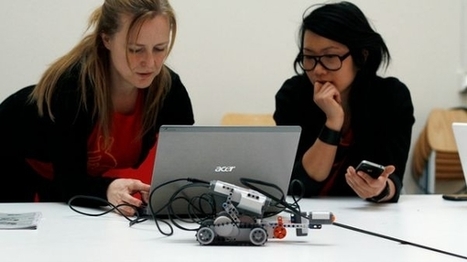
AS A kid Jia-Ying Choong had never considered engineering as a career option.
Scoop.it!
Intel’s “MakeHers: Engaging Girls and Women in Technology through Making, Creating and Inventing” report was created in consultation with experts including the Girl Scouts and Maker Education. It is Intel’s latest effort to support the maker community and increase access to and interest in computer science and engineering, especially among girls and women. The report indicates that girls and women involved with making, designing and creating things with electronic tools may build stronger interest and skills in computer science and engineering. Read the full report at www.intel.com/girlsintech. Via John Evans

June Rumiko Klein's curator insight,
August 13, 2015 1:59 PM
Intel has proven leadership in breaking down barriers in this area. Bravo.
Scoop.it!
Kim Flintoff's insight:
A presentation slideset from the WA School Librarians Association Conference in Perth August 8, 2015.
Scoop.it!

An inspiring inside peek into the Kaechele Library Maker Space, part of the TinkerSpace series that looks at art studios and maker spaces. Via Bookmarking Librarian
Scoop.it!

Makernow is a digital fabrication laboratory (FabLab). As a resource of people and digital equipment Makernow aims to inspire and support individuals, communities or businesses who want to use digital tools to achieve their goals. Whether it’s a prototype product, a one-off artwork, a device to solve a local or personal problem, Makernow can help. We provide a creative and open environment to learn and make, we have a team of skilled and experienced practitioners providing expertise from design and craft through to electronics and programming.
Scoop.it!

Have a look around the science cupboard to see what datalogging equipment you can find, plug it into a laptop and install the software (if you can find it – otherwise it can usually be downloaded from the manufacturer's website). Most software has a 'dashboard' screen (see photo) where you can see the current readings of temperature, light and sound displayed in various ways. Have a play with the datalogger to see the effect on the readings. Then find the 'live graph' screen and start a log running to see a line graph of data being produced (you can usually choose which sensor to look at so you only have one line). Then try taking 'snapshots' to produce a bar chart. Unplug the data logger from the laptop and try logging remotely, then plug it back in and try uploading the data. You're now ready to use it with children!
Scoop.it!

Over the past year more and more schools across the globe have embraced the concept of making to learn. This phenomenon trickled into schools as the Maker Movement became more popular and natural connections to learning became quite evident. To begin to understand the educational value of making we must look at the roots of this movement. A recent article in Newsweek sums it up nicely:
|
Scoop.it!

Right now, the typical 3D printer is a tool for making plastic objects. Assembling them in layers according to a pre-programmed plan, the printers can quickly make weirdly shaped parts, but they're often limited to working with just one material at a time. Additive manufacturing, as 3D printing is also known, offers so much more. A new printer, created by MIT's Computer Science and Artificial Intelligence Laboratory (CSAIL), can print up to 10 materials into a single object —and incorporat
Scoop.it!

Forming and supporting professional learning groups can be particularly important in maker-centered contexts, as maker-based activities often occupy a precarious space in the structure and curriculum of traditional schools. That maker education is not yet a formal discipline and does not have the backing of a professional and organized network makes it especially important to develop learning communities that scaffold and connect educators who often work in isolated siloes. Via John Evans
Scoop.it!

Be among the first in the world to own a desktop electronics printer.This is a self assembly kit and requires approximately 20hrs to assemble. All kits include one of each ink cartridge and a starter kit of substrates.
Kim Flintoff's insight:
Blending 3D printing with electronics manufacture - and when you introduce code and design you can have a comprehensive engagement with STEAM education.
Scoop.it!

Surgeons, hackers, on mission to provide near-free medical tech to developing world
Kim Flintoff's insight:
Flies available under open-source agreement via Github: https://github.com/GliaX/Stethoscope
Scoop.it!

Literacy from Scratch, joint project with schools in London and Prague
Scoop.it!

Australian made and owned
Australian support! Contact us or chat on our 3D printer forum about any problems or technical questions.
Scoop.it!

In three months, Xavier University in Ohio expects to open a new business venture that it hopes will be a trailblazer for institutions of higher education. The business will merge state-of-the-art technologies in 3D printing, cutting-edge ideas born out of business innovation and a large dose of good-fashioned capitalism.
Scoop.it!

The latest Tweets from Makerspaces.com (@Makerspaces_com). Coming 2015 #Makerspace #Makers #Makerspaces #MakerED #Edtech #Edchat #3DPrinting #3DPrinter #Makerfaire #Arduino #STEM #STEAM
Scoop.it!

Making something from scratch is a great skill to have. It requires confidence and imagination. For students who are into making new creations, these terrific apps and other digital products can help them develop their creative chops. Via John Evans
ManufacturingStories's curator insight,
August 8, 2015 2:54 PM
#APP #Apps #CODE #MAKE #Education #Games 
Daniel Lobo Ríos's curator insight,
August 9, 2015 8:01 AM
I'm going to check these Apps, I think it are interesting to work the mind. Thank you!
Scoop.it!

The Catalan collective GynePunk wants to decolonize the female body and develops first aid gynecological tools, for socially disadvantaged women, refugees, sex workers.
|









A small curated slection that includes making, arduino and other related links.