


|
Rescooped by
Kim Flintoff
from BYOD and mobile learning
November 6, 2015 6:14 PM
|

No comment yet.
Sign up to comment

 Your new post is loading...
 Scoop.it! No comment yet.
Sign up to comment
Scoop.it!

Things you love are Made with Code. Code your first creative project and meet music producers, fashion designers, humanitarians, and animators who are coding the world they want to see.
Scoop.it!
From
medium

How to rebuild the self-efficacy of students everywhere.
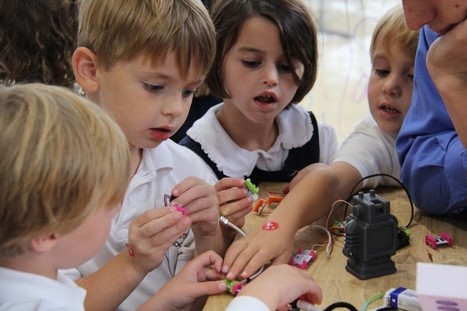
While In college I learned about engineering in a makerspace. I learned how to communicate in a makerspace. I learned how to organize people in a makerspace. But it took a year of operating a mobile makerspace to realize the true value of these environments.
Scoop.it!

Desktop Metal, a Cambridge, MA-based 3D printing startup, announced it raised $14m in a first round of funding.
Scoop.it!

PocketLab - the wireless sensing and analytics platform for science experiments. A portable, inexpensive, and easy-to-use science laboratory for students, educators, and citizen scientists.
PocketLab connects with a single button to a smart phone, tablet, or Chromebook and instantly streams measurement data that you can see and record. PocketLab measures acceleration, force, angular velocity, magnetic field, pressure, altitude, and temperature. Using our cloud software, you can easily analyze your data, create graphs, and integrate your data with other software. PocketLab has the same features as lab equipment that costs thousands of dollars but is low cost and intuitive to use.
Scoop.it!

Open educational resources (OER) are a boon to maker activities, according to library media specialist Laura Fleming, who provides related tips and links to fun, cost-effective projects.
Scoop.it!

Bee-Bot is an exciting new robot designed for use by young children. This colorful, easy-to-operate, and friendly little robot is a perfect tool for teaching sequencing, estimation, problem-solving, and just having fun! Bee-Bot moves in 6” steps and 90º turns. Compact size and durable materials make Bee-Bot child- and classroom-friendly. Bee-Bot is equally adaptable to home and school environments and boosts enthusiasm for experimentation and learning wherever it is used. Bee-Bot is powered by a built-in rechargeable battery. Recharging is done via a standard USB recharger or USB computer port. A USB recharger cable comes with each Bee-Bot.
Scoop.it!

As the way we learn and work has evolved, teaching styles, curriculum and classroom spaces must change as well. Our students need to think “like innovators” in order to solve increasingly complex, global and multi-disciplinary problems. These problems require skills like flexible thinking, resilience and curiosity — skills that are not nurtured in today’s traditional educational models. As architects, we know that design can profoundly affect and enhance teaching and learning. School design must not only accommodate 21st century learning methods, but also reinforce the skills students will need for an evolving society. Thoughtful, creative and flexible design of these spaces is critical in realizing the learning goals. Via John Evans
Scoop.it!

This year’s K12 Online Conference will feature a strand on Maker Ed. This strand will be keynoted by Stephanie Chang from MakerEd and will include sessions on Minecraft, etextiles, the Cardboard Challenge, STEM, and much more!
Watch the promo video on Vimeo - https://vimeo.com/138027648 ; Via John Evans
Scoop.it!

From a distance, it looks as though an alien craft has landed on Beijing. Massive, white, and luminous, the mysterious structure is both beautiful and spooky.
Scoop.it!
The “maker” movement has swept across schools in California and beyond. Can it fundamentally change K-12 education?
Kim Flintoff's insight:
Taking an atelier model into schools...
Scoop.it!

Perfect Storm: an expression that describes an event where a rare combination of circumstances will aggravate a situation drastically. The term is also used to describe an actual phenomenon that happens to occur in such a confluence, resulting in an event of unusual magnitude. Via John Evans
Scoop.it!

Libraries were always seen as a warehouse for information, filled with books, magazines, and videos. Recently however libraries across the country have started to incorporate maker spaces and provide maker classes for their patrons. Some say that this is part of the library’s natural evolution. Does it make sense for libraries to start offering maker classes? As someone who frequents the library, I believe so! Via John Evans
|
Scoop.it!
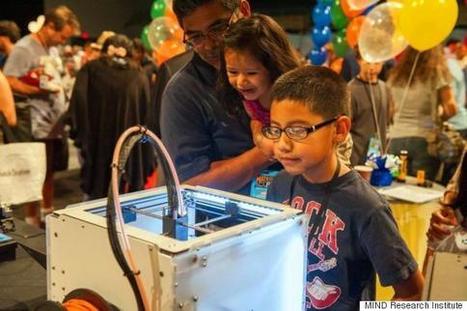
At the nonprofit MIND Research Institute we are very excited about the possibilities 3D printers bring to specifically to math education. We've got our own in house Makerspace with seven 3D printers running around the clock. However, instead of printing cars, we're creating tools to foster hands-on math learning experiences. Via John Evans
Scoop.it!

How have you used littleBits in the past? What’s worked best?
Scoop.it!
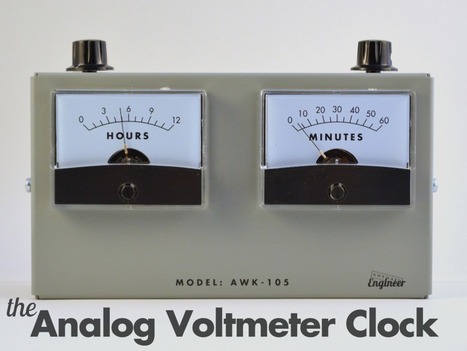
After a successfully funded Kickstarter, the Analog Voltmeter Clock is now in stock and ready to ship! The Voltmeter Clock uses dual analog meters to tell time
Kim Flintoff's insight:
Now there's a Maker challenge..
Scoop.it!

Wouldn’t it be great if new organs could be printed out and used in surgical operations to save people’s lives? As it turns out, a group of Carnegie Mellon researchers have managed to do almost precisely this, producing models of a variety of human organs and body parts using a hacked 3D printer bought off the shop shelves. The new research, published in the journal Science Advances, demonstrates that it is possible to replicate the heart through 3D printing.
Scoop.it!

As many of you know I have been melting plastic up a storm with my Polar 3D printer. I am excited to see how many schools and classrooms are starting to get 3D printers for their classes. Having st… Via Dr. Tom D'Amico (@TDOttawa)
Scoop.it!

"I have a recent interest in both Growth Mindsets and Maker Education; and have blogged and presented on both of these topics. As such and because of my passion for both of these area, I have been thinking about the intersection between the two. This intersection, I found, is strong and powerful." Via John Evans

Debbie Rogers's curator insight,
October 23, 2015 1:16 PM
Purposeful playful promotes comprehension leading to higher level applications! Consider your current mindset!
Scoop.it!

Last year, at an event where teens showcased apps that they created for a competition, I spoke with the high school boys who won first prize. They expressed surprise at their achievement. “We built something, thought it worked, tested it, only to find out that there were snags,” one of them said. “We started again, got a little farther along, and had to stop again. This happened over and over.” Via John Evans
Scoop.it!

Making, tinkering and designing are not new concepts in formal education. From Jean Piaget to Gary Stager, both theorists and practitioners across decades of practice have shown the power of ‘learning by doing.’ Making and tinkering, two relatively new terms in education, are based on these theories of both learning and instruction. Inspired by the Maker Movement, there is a growing push for educators to incorporate making and tinkering as a part of their practice in order to increase student engagement and deepen understanding through hands-on application of skills and concepts. While making and tinkering are powerful learning tools in their own right, it is when they are combined with the design thinking process that their potential can be truly harnessed.
We believe in the power of making, tinkering, and design thinking in education and business.
Hence our name: Design, Make, Learn."
Via John Evans
Scoop.it!
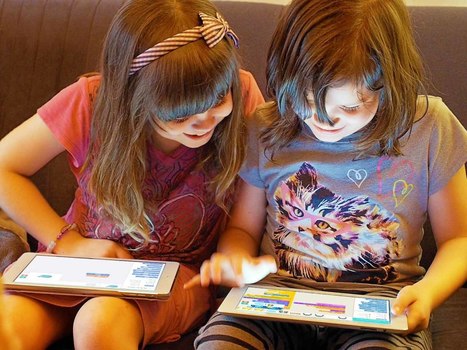
Program the real world, wirelessly. Seamlessly connect to Arduino, Dash & Dot, Star Wars BB-8 Droid, Sphero (SPRK), Ollie, Parrot mini drones Rolling Spider, Airborne Cargo/Night, & Jumping Sumo/Race/Night, and Philips Hue smart lighting systems from your iPad using the latest Bluetooth 4.0 and Wi-Fi technologies. Utilize sensors in these devices to have them sense and interact with each other! Easy to learn, yet incredibly powerful! Start learning programming the same way as Computer Science courses at Harvard and UC Berkeley. Tickle is used by makers and designers around the world to create custom robots and interactive projects, including Stanford University computer scientists.
Scoop.it!

So that's it. Oogoo is corn starch and clear silicone caulk mixed together and then molded by hand or by forms to create just about anything you can imagine that needs to be adhesive initially and solid yet flexible when cured.
Scoop.it!

Pennsylvania State University is opening a new exploration lab designed to foster student creativity and inventiveness.
|







Not all mobile solutions rely on smart phones. SMS/TXT solutions are more viable in some economies.