Your new post is loading...

|
Scooped by
Kim Flintoff
September 27, 2015 9:30 PM
|
Today in the Uni makerspace we held a MEGA-BUILD day. First year Zoology, Animal Behaviour, Wildlife Conservation, Biology and Forensic Anthropology students have been working on a variety of projects over these past few weeks to learn about statistics and so @ka81 and I thought we’d spend the day with them making.
"The Youth Makerspace Playbook is a resource providing context and support around planning spaces for youth to make. It offers practical suggestions on finding spaces to make, outfitting spaces with tools and materials, exploring the possible educational approaches within spaces, and sustaining spaces in the long-term. Accompanying the Youth Makerspace Playbook is “Makerspaces: Highlights of Select Literature,” a selection of the latest thinking emerging from the growth of makerspaces and their developing roles in education and communities. "
Via John Evans
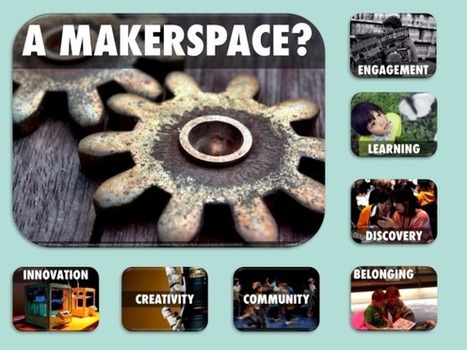
The library is a place of engagement, learning, discovery, belonging, community, creativity and innovation.
A makerspace is a place of engagement, learning, discovery, belonging, community, creativity and innovation.
In schools, the library is the only learning space not limited by curriculum; it is an open learning space, which can be interpreted in many ways, and I suggest that this is why so often makerspaces find their place there. Outside of schools, public libraries are increasingly one of the only ‘3rd places‘ where people can feel free to meet, collaborate and learn, without the pressure to spend (even coffee shops move you along if you linger without a coffee in front of you). Not to mention that library staff are often the most open to new, exciting and innovative ways of interacting and engaging with learning and technology!
Via John Evans
|
|
Scooped by
Kim Flintoff
September 25, 2015 8:18 PM
|
An all-girls private school in New York City and a Texas district are among the first to provide littleBits' programmable electronics kits to all students or libraries.
|
|
Scooped by
Kim Flintoff
September 23, 2015 3:10 AM
|
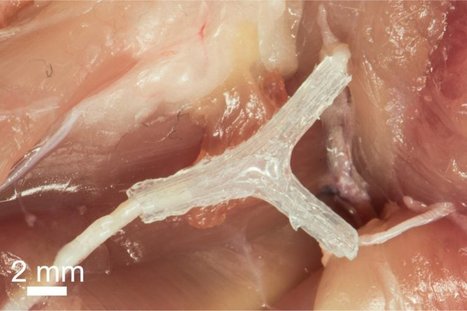
3D printing has some amazing possibilities for architecture and design, not the least of which is engineering personalized tissue – in this case, printing a personalized nerve scaffold for your post-injury healing.
|
|
Scooped by
Kim Flintoff
September 21, 2015 4:49 AM
|
Part of why engaging with 3D A team of researchers have created a first-of-its-kind 3D printed guide that helps restore sensory and motor functions to damaged nerves.
|
|
Scooped by
Kim Flintoff
September 15, 2015 7:39 AM
|
Spaces for makers, hackers and coworkers on campus could support better learning, and entrepreneurial, outcomes. But what do they look like?
maker-spaces-innovationDesignated spaces for “tinkering” at some of the country’s most prestigious institutions may not only spur lifelong learning habits, but also produce social and technological innovations critical to today’s economy, says a new report.
Thanks to more broad access to the internet, as well as “breakthroughs” in manufacturing, innovation has been democratized, says a new research report by HermanMiller, in turn creating a “new driver for the economy.”
|
|
Scooped by
Kim Flintoff
September 13, 2015 7:50 PM
|
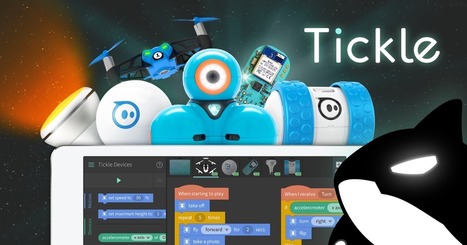
The easiest way to learn electronics and Arduino programming.
Successfully launching a school makerspace includes community buy-in, generating a student buzz, finding cheap or free resources, and building maker activities into the curriculum.
Via John Evans
In this 4-week online workshop, you’ll learn from library and industry experts how to build a maker program that fits your budget and fuels community engagement and lifelong learning. Guest speakers appear each week, live via web video, in interactive sessions where you can ask questions. You’ll work in small groups with facilitators experienced in the maker movement to complete assignments and field research in your library that will have your maker program up and running by the end of the course.
Via John Evans
|
|
Scooped by
Kim Flintoff
September 2, 2015 9:16 PM
|
Sierra College in Rocklin, CA, a suburb of Sacramento, has helped a Hacker Lab open near its campus and has already seen its students start to benefit.
The maker space that also offers co-working space, courses, meet-ups and events is a spin-off of the original Hacker Lab that opened in Sacramento four years ago. Sierra College helped facilitate the opening of the second lab to give both students and those who live nearby the opportunity to get hands-on experience with the technology they are learning back in their community college classrooms.
The entire concept is really quite simple. The Mobile MakerSpace carts that line the hallway leading into our Media Center are capable of transporting new opportunities and tools to virtually any space in our school. Whether it’s high-tech 3D printing and modular robotics or low-tech knitting and plastic construction blocks…the carts contain tools that elicit collaboration and unleash student creativity.
Via John Evans
|
|
Scooped by
Kim Flintoff
September 2, 2015 6:37 PM
|
This summer, MakerSquare and Uber formed a partnership to teach our students about the Uber API, and connect MakerSquare graduates with the Uber’s world-class engineering team.
On July 25th and 26th, MakerSquare SF hosted the very first Uber/MakerSquare hackathon. Here’s a look inside the event.
Current MakerSquare students and graduates teamed up to build projects using the Uber API
|
When I think of 3D printers, I am instantly taken back to the days of watching George Jetson: Imagine pressing a button and opening a magic door to exactly what you had asked for. While 3D printing technology seems frighteningly close to that futuristic memory, the truth is, there is HUGE potential for 3D printing to impact math education in a variety of ways.
Via John Evans
My second-grader cries when he needs help with his math homework. He’s good at math. And with ease, he has been able to handle most of the homework that’s come home under the new Common Core math curriculum. But when the answers don’t come easily, he gets upset and doesn’t want to try. The idea that you have to get things wrong a few times, sometimes many times, in order to get to the right answer is not a lesson he’s yet learned.
He’s only eight, but as a parent, I hope he’ll have more opportunities to get the answer wrong, and to have to find his own way, as he grows older.
Experts like Angela Duckworth, an associate professor at the University of Pennsylvania who studies the importance of “grit,” says these are experiences my son will need in order to develop the kind of higher-order thinking skills necessary in our rapidly changing world. Duckworth defines “grit” as the “tendency to sustain interest in and effort toward very long-term goals.”
Duckworth says she’s seen lots of very smart kids who don’t know how to fail. “They don’t know how to struggle, and they don’t have a lot of practice with it,” she said.
Via John Evans
|
|
Rescooped by
Kim Flintoff
from Edu-Vision- Educational Leadership
September 25, 2015 9:11 PM
|
While libraries and makerspaces are both interdisciplinary, resource-filled places of informal learning, each serves distinct purposes for enriching student experience and school culture.
Via Dean J. Fusto
|
|
Scooped by
Kim Flintoff
September 24, 2015 6:54 PM
|
Harvard researchers have designed new printheads for 3-D printers that can simultaneously handle multiple materials with different properties, allowing for 3-D printing wearable devices, flexible electronics, and soft robots.
To print a flexible device, including the electronics, a 3-D printer must be able to seamlessly transition from a flexible material that moves with the wearer’s joints for wearable applications, to a rigid material that accommodates the electronic components. It would also need to be able to embed electrical circuitry using multiple inks of varying conductivity and resistivity, and precisely switching between them while changing composition and geometry. And do it all in real time.
|
|
Scooped by
Kim Flintoff
September 21, 2015 10:57 PM
|
Spaces for makers, hackers and coworkers on campus could support better learning, and entrepreneurial, outcomes. But what do they look like?
Designated spaces for “tinkering” at some of the country’s most prestigious institutions may not only spur lifelong learning habits, but also produce social and technological innovations critical to today’s economy, says a new report.
Thanks to more broad access to the internet, as well as “breakthroughs” in manufacturing, innovation has been democratized, says a new research report by HermanMiller, in turn creating a “new driver for the economy.”
Here's 100 Engineering Projects For Kids to get that them excited about construction, design, electronics, and more.
Via John Evans
|
|
Rescooped by
Kim Flintoff
from 21st Century Learning and Teaching
September 14, 2015 8:01 PM
|
Our Makerspace has changed, grown and evolved since it was first conceived and started in January 2014. Follow along with the story of our journey here. Hopefully it will inspire you to start your own Maker journey
Via John Evans
|
|
Scooped by
Kim Flintoff
September 7, 2015 9:28 AM
|
Experiential education is all the rage. No longer confined to internships or study abroad, it now includes service learning opportunities, freshman research experiences, and, most ambitiously, project-based learning at all levels of the curriculum. A growing number of campuses have created special “maker spaces” for innovative projects. UCLA’s Institute for Digital Research and Education has its “Technology Sandbox,” a computing facility where innovators can work collaboratively on projects involving computer modeling, GIS, web authoring, web programming, graphics, animation, image processing, compression and archiving. Columbia University’s Butler Library has created a Digital Humanities Center, where faculty and students can incorporate computer-based textual, bibliographic, image, and video information into their research and teaching. The University of Michigan has instituted the Digital Innovation Greenhouse, the Learning, Education, and Design (LED) Lab, and the Digital Education and Innovation Lab.
|
|
Scooped by
Kim Flintoff
September 3, 2015 9:51 PM
|
Why won’t my daughter engage with school? Is she lazy? Is it too hard? Does she have issues with authority? The answers to these questions lies in her hobbies and the different learning environments she has for each one.
With so much authentic interest-driven opportunity in the outside world, it is incumbent on schools to help kids engage deeply. i
|
|
Scooped by
Kim Flintoff
September 2, 2015 9:15 PM
|
3D printing and additive manufacturing will be the prime topic of research and development at a new center opening at the Rochester Institute of Technology (RIT). The Additive Manufacturing and Multifunctional Printing (AMPrint) Center will draw participation from multiple university and corporate partners. Funding is coming from Empire State Development, New York's state economic development agency.
""18 Lesson Plans for Maker Educators from @NASA that are great for #makerspaces " 18 Lesson Plans for Maker Educators from @NASA that are great for #makerspaces
Via John Evans
|