


Let's be honest, we've all been there. Your 3D print failed half-way, and you are frustrated over the lack of resources to help you troubleshoot the issue.

 Your new post is loading...
 Scoop.it! Let's be honest, we've all been there. Your 3D print failed half-way, and you are frustrated over the lack of resources to help you troubleshoot the issue. 
No comment yet.
Sign up to comment
Scoop.it!

More schools are transforming their traditional libraries into innovative makerspaces, giving students the chance to experiment and grow in new and exciting ways. Via Dr. Tom D'Amico (@TDOttawa)

Sorrell Williams's curator insight,
January 22, 2016 5:08 PM
As the world evolves so should the libraries. 
Gert Nilsson's curator insight,
January 25, 2016 4:16 AM
Detta är kanske något som både våra skolbibliotek och kommunala bibliotek ska tänka på inför framtiden?? #makerspace 
Tony Guzman's curator insight,
January 28, 2016 11:34 AM
This article asks and answers the question: Where do libraries fit into the future of learning?
Scoop.it!

A makerspace is a collaborative work space inside a school, library or separate public/private facility for making, learning, exploring and sharing that uses high tech to no tech tools. These spaces are open to kids, adults, and entrepreneurs and have a variety of maker equipment including 3D printers, laser cutters, cnc machines, soldering irons and even sewing machines. A makerspace however doesn’t need to include all of these machines or even any of them to be considered a makerspace. If you have cardboard, legos and art supplies you’re in business. It’s more of the maker mindset of creating something out of nothing and exploring your own interests that’s at the core of a makerspace. These spaces are also helping to prepare those who need the critical 21st century skills in the fields of science, technology, engineering and math (STEM). They provide hands on learning, help with critical thinking skills and even boost self-confidence. Some of the skills that are learned in a makerspace pertain to electronics, 3d printing, 3D modeling, coding, robotics and even woodworking, Makerspaces are also fostering entrepreneurship and are being utilized as incubators and accelerators for business startups. There have already been some amazing success stories that have come out of makerspaces to date. Via John Evans

Dan Finn's curator insight,
January 13, 2016 8:16 PM
What a powerful tool for educators in our schools. A real opportunity to be co-learners and co-creators. 
Kirstin Beckett's curator insight,
January 15, 2016 10:32 PM
Makerspaces also figure in our list of top 5 big trends in e-learning and education technology for 2016, including coding in classroom, internet of things connected classroon, OERs, Makerspaces and Microlearning. Read more on http://www.assignmenthelp.net/blog/new-edtech-trends/ ;
Scoop.it!

This kit has everything you need to set up your interactive maker project. Easily and quickly add lights and sensors to school projects, models and art installations. There are enough connecting wires and LEDs for 2 to 6 projects, depending on how many LEDs you use in each project. The HyperDuino can control a maximum of 12 LEDs and 6 photocells in any one project, using 2 connecting wires for each LED or photocell. However some projects may use less than these quantities, so you’ll have some available for the next project. See the “HyperDuino Accessory Kit” for how to purchase additional sets of LEDS, photocells and connecting wires.
Scoop.it!

As the needs and opportunities surrounding 3D printing grow, colleges and universities find innovative ways to leverage — and fund — the technology.
Scoop.it!

One need not look to superstars such as Mark Zuckerberg or Bill Gates to justify reasons for using code and programming logic in the classroom. There's plenty of literature that illustrates its positive learning outcomes. Coding in the classroom is linked to improved problem solving and analytical reasoning, and students who develop a mastery of coding have a "natural ability and drive to construct, hypothesize, explore, experiment, evaluate, and draw conclusions." Via John Evans
Scoop.it!

After finding a fully functional laptop discarded in a rubbish skip near their home, Bethany Koby and Daniel Hirschmann realized this was the spark they were looking for to create a new kind of technology education startup. The wife and husband team created ‘Technology Will Save Us’ (TWSU) in 2012 to put together hardware and software ‘making’ in a way that hadn’t been done before. The design-led company today announces the closing of its $1.8M financing round led by SaatchInvest, with participation from European seed-stage VC fund Backed and an (as yet unnamed) “substantial retail investor”. The funds will be used to expand the product range and build on existing retail partnerships such as the UK retail giant John Lewis, Urban Outfitters, The Conran Shop and the MoMA Design Store in New York.

Camilo Lopez's curator insight,
December 18, 2015 6:10 PM
Tech will save us is another example on the new push be entrepreneurs and product developers to integrate software innovation with hardware.
In the last decade majority of companies have focused on developing software products like smartphone apps, SaaS tools for consumers and enterprise. We are now starting to see a trend in startups and companies developing products that blend hardware and software. Blending the virtual/digital world with our physical world will be a leading trend in the next decade.
Some cool products in this space I like are our local friends @Sphero, @Revolar @occipital
Scoop.it!

A LINUX AUDIOPHILE MUSIC PLAYER FOR EVERYONE VOLUMIO IS A FREE AND OPEN SOURCE LINUX DISTRIBUTIONIT TURNS EMBEDDED SYSTEMS INTO AN AUDIOPHILE MUSIC PLAYERIT IS DESIGNED TO BE SIMPLE. TO SOUND AMAZING. TO BE WHAT YOUR MUSIC DESERVES.
Scoop.it!
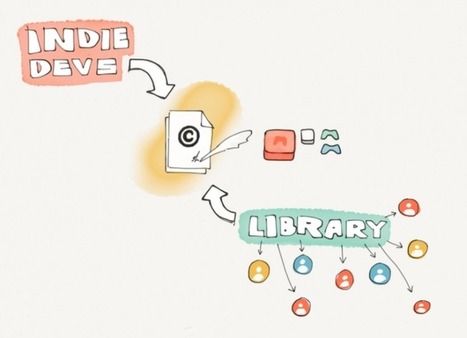
INDIE GAMES FOR LIBRARIES (PROJECT REPORT FOR THE KNIGHT FOUNDATION)
Scoop.it!

A workshop presentation for Future Science 2015 - the annual conference of the Science Teachers Association of Western Australia (STAWA).
Scoop.it!

CT examines the impact of makerspaces with Penn State's Director of Education Technology Kyle D. Bowen.
Scoop.it!

I continue learning with my students by applying designing thinking strategies and the thinking process of the 6 Cs . We keep on evolving with the process where the students become the specialists as they apply and reflect on their thinking progressions. As we unfold the process through designing and making, the students embrace the development of skills and perseverance along their daily explorations. Via John Evans
Scoop.it!

"Want a job in computer science when you graduate? Want an all-new (and cheap!) way to bring hands-on learning into the classroom? Think you could build your own robot? Via John Evans
|
Scoop.it!

Just like his beloved grandfather, Avi Reichental is a maker of things. The difference is, now he can use 3D printers to make almost anything, out of almost any material. Reichental tours us through the possibilities of 3D printing, for everything from printed candy to highly custom sneakers.
Scoop.it!

There is so much good stuff going on in education these days, isn’t there? I’m excited when I get to walk into a classroom or lurk a learning space through someone’s blog or tweets and see the innovative ways students are learning. One trend that I’ve been thinking about is the inclusion of maker spaces in classrooms and in programming.
Scoop.it!

About this Series
HR: "Every Thursday in January, I'll be hosting a maker-ed Hangout on air at 4 PM Pacific. A very juicy roster of maker educators from schools, libraries, after school programs."
Scoop.it!

danah: It’s frustrating when youth practices are dismissed by adults because they don’t conform to normative understandings of learning. On the flip side, I also meet a lot of young people who have been socialized into a world where any form of adult validation is viewed as negative. Sometimes, this perspective is shaped by broader communities. More often, I run into situations where parents and other family members teach young people not to trust non-family members, including teachers. I recognize how validation by people in power can be quite beneficial for some youth, but I don’t think we should take this as a given. It does create new questions and challenges, such as how should we think about diverse mechanisms of validation?
Scoop.it!

It’s an exciting time to be a maker educator. It seems like everywhere I look, there’s inspirational work happening in community fab labs, a school launching a new innovation program, or a library incorporating STEAM into its space. At St. Gabriel’s in Austin, Texas, we entered the fray last fall with STEAM by Design, an approach to constructivist learning that uses classroom space in conjunction with a dedicated fab lab. Via John Evans

GwynethJones's curator insight,
December 28, 2015 7:51 AM
Great advice - Step aside & let the kiddos shine! Invite parents to learn WITH their kids!
Scoop.it!

DIY technology kits you can make at home. Shop the collection online now, including Electro Dough, the DIY Gamer Kit, DIY Speaker kit and more.
Kim Flintoff's insight:
Another player in maker-code-tech space...
Scoop.it!

We would love to hear what you are doing with coding within your school community. What programs and apps are you using? What books and eResources are you using? When does it take place? Are they coding at home to? Do you have special clubs? Give us the scoop....We will be sharing these stories in an upcoming webinar. Thank you so much, Shannon Via John Evans
Scoop.it!
PINE A64 is the world's first 64-bit expandable Quad Core 1.2Ghz supercomputer, tablet, media center, and more... starting at just $15.
Scoop.it!

I like and have always used games in my classrooms. One of my current educational interests is maker education. As such, I have begun creating games for maker education - see my first one, a board ...
Scoop.it!

It sounds like the stuff of science fiction - machines that can "print" solid objects - but 3D printing isn't really printing at all, at least not in the traditional sense.
Scoop.it!

"Making" experts share the basics of building spaces for collaboration, innovation and hands-on learning.
Scoop.it!

I like the idea of giving out 3D Printed trinkets which are relevant for people - like a logo of the product they work on or a product they love - or a personalized keychain with their twitter handle. Via John Evans
|






