Your new post is loading...

|
Scooped by
Kim Flintoff
February 29, 2016 9:16 PM
|
This burgeoning demand is being fuelled by newfound appetites for the Pi. While early sales were driven by hobbyist makers and tinkerers, in recent years schools and businesses have began using the boards in serious numbers.
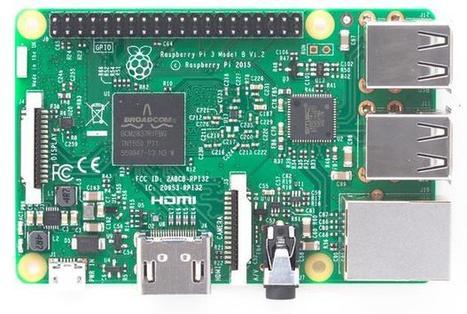
It's easy to see that momentum continuing, as from today you'll be able to get far more Pi for your buck. Monday marks the launch of the Raspberry Pi 3 Model B - a machine some 50 percent faster than the Pi 2 that came out just last year.
The Pi 3's release comes somewhat out of the blue. In the first three years following the Pi's release there were no major updates to the board but over the past year its capabilities have surged, with the release of the Pi 2 and now the Pi 3.
|
|
Scooped by
Kim Flintoff
February 28, 2016 4:30 AM
|
Public libraries can become community centers again & places of CREATION if we start adding #makerspaces to them. pic.twitter.com/j2mOZXYhwA
|
|
Scooped by
Kim Flintoff
February 24, 2016 6:50 PM
|
They're the keepers of knowledge and silence. Go librarians!
|
|
Scooped by
Kim Flintoff
February 22, 2016 7:26 PM
|
Make the Future! Create a Virtual Makerspace
Join us as we explore hosting a virtual makerspace. During this session, we explain and discuss makerspaces and how to leverage the maker movement in online education.
Do you have an activity, project, creation or game that you’d like to share? Show your ideas and creations by sharing your links, favorite tools, and wonderful stories.
Date & Time
February 25, 2:00 PM HAST
|
|
Scooped by
Kim Flintoff
February 19, 2016 12:23 AM
|
4th gr explained her home creation with her science teacher #littlebits @aub75229 @mars2bartlett @RandalRhodus pic.twitter.com/oQY3TIN3PM
|
|
Scooped by
Kim Flintoff
February 18, 2016 8:17 PM
|
If you haven't been living under a rock for the last few years you have probably heard all the cool stuff that is going on with 3d printing. We are now capable of printing almost anything provided we have a 3d model to work from. There are many ways to make a 3d model, but one of the coolest is to 3d scan an existing object. With a 3d scan and the right printer you can reproduce any object at any size from a house to an earring. You can also use the scan as a starting point for a new creation. Think of everything you can do with a picture in Photoshop. Now you can do that in 3d with real stuff as well.
The most amazing thing about 3d scanning is that you probably already own the best tool there is for it. It might be in your pocket, or you may be staring at it as we speak (so to speak. . .actually I'm writing and you are reading, but you know what I mean). This tool, which will allow you to capture the world in amazing 3d, is a simple camera. Combined with a little technique and some inexpensive or even free software, your camera becomes the world's most versatile 3d scanner. Stay tuned and I'll show you how.
|
|
Scooped by
Kim Flintoff
February 17, 2016 10:00 PM
|
Creating a physical hub of innovation on campus can support creativity, collaboration and entrepreneurship. Here are things to consider before getting too far into the process.
|
|
Scooped by
Kim Flintoff
February 11, 2016 2:15 AM
|
In what is being hailed as the next great advancement in 3D printing, scientists have been able to get a 3D printed shape to change form when it is exposed to water, bringing 3D printing squarely into the realm of the fourth dimension. Although the only examples we’ve seen so far are with relatively flat prints (which arguably subtracts one “D” from the claim) the new procedure is one which is groundbreaking for the technology.
The process uses cellulose fibers which, when aligned in a particular way and exposed to water, swell in order to change shape. This is similar to how a bimetallic strip in a thermostat works, but they really took their inspiration from biological processes in plants that allow them to change shape according to environmental conditions. It’s hard to tell if this new method of printing will forever alter the landscape of 3D printing but, for now, it’s an interesting endeavor that will be worth watching. The video after the break shows a fast-motion print using the technique, followed by a demo of the print submersed in water.
|
|
Scooped by
Kim Flintoff
February 9, 2016 7:41 AM
|
Being dumb in the existing educational system is bad enough. Failing to create a new way of learning adapted to contemporary circumstances might be a national disaster. A New Kind of Learning Lab Learning by an original and personal process of discovery is a trend on many US university campuses, like Stanford University, MIT, and Arizona State University. It also shows up in middle school, high school and after school programs, as in the programs supported by the ArtScience Prize, a more curricular intensive version of the plethora of innovation prizes that have sprung up in the last years around the world. Students and participants in these kinds of programs learn something even more valuable than discovering a fact for themselves, a common goal of “learning discovery” programs; they learn the thrill of discovering the undiscovered. Success brings not just a good grade, or the financial reward of a prize. It brings the satisfaction that one can realize dreams, and thrive, in a world framed by major dramatic questions. And this fans the kind of passion that propels an innovator along a long creative career.
|
|
Scooped by
Kim Flintoff
February 4, 2016 9:54 PM
|
Too often the word on the street is “my school or class has new iPads but we don’t know what to do with them.” The best part about these devices is that they get the learning into the actual hands of students- make learning “hands-on.” That is NOT a new concept. Dewey, Montessori, David Kolb knew this long before the digital age- constructivism is one of the most effective ways to learn anything. These days, the word “maker” can be interchanged for “constructivist” and the Maker Movement is really starting to sweep the country. The White House announced last week they would host their first Maker Faire this spring (follow the hashtag, #IMadeThis). We know great teachers and librarians are creating maker spaces for their students in traditional public high schools, like the Laura Fleming at New Milford High School. Getting Smart is sponsoring the Maker Space at the upcoming IntegratED Conference coming up in Portland, OR at the end of this month- definitely not something you’d have seen at a PD event for teachers and admin just a few years ago.
|
|
Scooped by
Kim Flintoff
February 1, 2016 9:06 PM
|
Active Learning Spaces In the book Get Active: Reimagining Learning Spaces for Student Success, the authors identify six types of active learning spaces that are essential for creating an engaging learning environment for students. While this research (and this book)... Read More ›
Between the fall and spring sessions of Creator's Studio, I highlight other events on campus that may be related to making, design, engineering, or any other creative activity. This month we had two larger events take place, our annual 8th grade Physics project in science, and new this year, the K-8 Buddies Maker Day.
Via John Evans
|
|
Scooped by
Kim Flintoff
January 25, 2016 5:49 AM
|
A TOOLKIT FOR PATRON-CENTERED DESIGN Design Thinking for Libraries is an approach to improving your library through creative problem solving.
This toolkit guides you through Design Thinking so you can start coming up with solutions to everyday challenges within the library. Design thinking, or human-centered design, is all about starting with people — the users that visit your library. At IDEO, we’ve been using similar methods to envision new products, services, spaces, and experiences that bring them to life. We created this toolkit specifically for the library setting, and we’re looking forward to seeing how you might create impact by seeing your work through a fresh perspective: the design thinking lens!
|
|
|
Scooped by
Kim Flintoff
February 29, 2016 9:16 PM
|
The Raspberry Pi's co-creator on the possibility of a full version of Windows and Android making it onto the newest version of the Raspberry Pi.

|
Suggested by
Learning Futures
February 26, 2016 8:38 PM
|
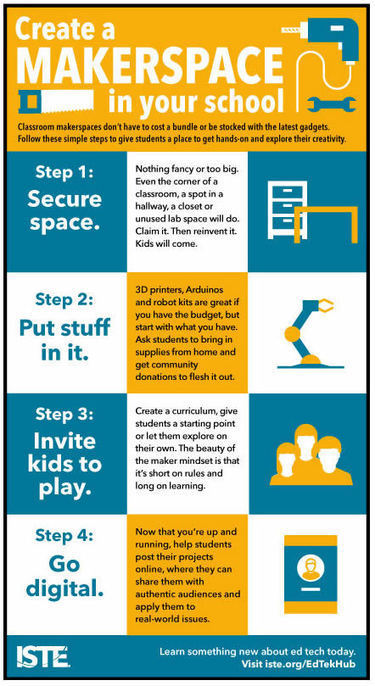
What is needed to start a Makerspace in a classroom or school?
Passion - You need to have passion and a belief in the educational value of maker-style projects.
Space - This can be a whole room or only part of a room.
Supplies - Start small with simple craft materials. Often sending a message out to colleagues and the community asking for donations of materials works well.
Storage - Create a place to store materials when they are not in use and student projects as they are being worked on.
|
|
Scooped by
Kim Flintoff
February 23, 2016 5:49 PM
|
Montclair State University in New Jersey has formally opened its MIX Lab, where students, local businesses and high school students can use the lab's 35 networked MakerBot 3D printers to design and rapidly prototype their ideas and products.
MIX stands for Making and Innovating for X, according to information on the university's site, and the lab is located in the Feliciano School of Business. Its formal opening took place on February 18 with tours and a panel discussion on 3D printing, but it first welcomed students in August when students in the Entrepreneurship, Lean Manufacturing and 3D Design certificate program began using the lab to create their first products.
|
|
Rescooped by
Kim Flintoff
from Into the Driver's Seat
February 22, 2016 8:13 AM
|
|
|
Scooped by
Kim Flintoff
February 18, 2016 8:21 PM
|
Technology has advanced to the point where the general populace is now empowered to design and create our own goods. More than just putting together Ikea furniture, people are now building their own furniture at local tech shops, printing toys out on 3D printers, and connecting via the Internet to collaborate on music. The Internet has opened up a whole new world of creativity that was never available before, creating pockets of niche communities that are informative and proactive. The Maker Movement is powerful, and now more than ever, students have the opportunity to start early and contribute significantly to the world. This is the beginning of a new revolution and teachers are at the forefront.
|
|
Scooped by
Kim Flintoff
February 18, 2016 7:43 PM
|
Is your school looking to develop a STEAM lab or a Maker Space? In this episode, Meredith Martin shows us how you can turn a simple room into the innovation lab of your dreams for pennies on the dollar!
The TechEducator Podcast is a weekly round table discussion about current topics in educational technology. For more information, please visit www.techeducatorpodcast.com.
|
|
Scooped by
Kim Flintoff
February 15, 2016 12:26 PM
|
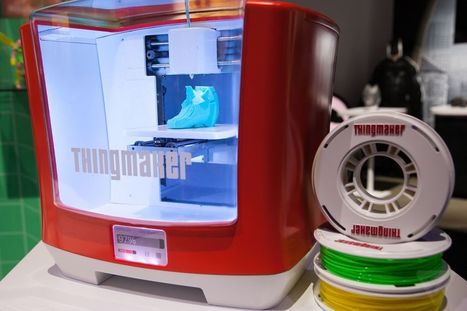
In the 1960s, Mattel's ThingMaker let children create their own toys by pouring liquid plastic into metal molds. Now, Mattel has updated the idea for a new century using 3D printing. The reinvented ThingMaker is a $299.99 3D printer which works with an iOS and Android app to let children (and adults, of course) design new figurines and send them wirelessly from their phone or tablet straight to the printer. According to Toyland, the app comes with dozens of basic blueprints (including rings, necklaces, scorpions, dinosaurs, and skeletons), and users can customize toys by printing new parts that click into basic ball-and-socket joints.
The printer itself is aimed at children aged 13 and up, reports USA Today, and has a few safety features to keep kids from 3D printing themselves any wounds. The device's doors lock automatically when it's in use, and Toyland notes that the printing head retracts when it's not working, keeping curious kids from touching something that's been heating PLA plastic filament into a soft goo. Mattel says the ThingMaker will work with any standard filament, and although it hasn't announced colors or pricing for its own spools, the company was showing off plenty of variety at the New York Toy Fair this weekend. USA Today notes that using an average 1 kg spool of plastic, the ThingMaker should be able to create 20 figurines, 30 pieces of jewelry, or 100 rings.
|
|
Scooped by
Kim Flintoff
February 9, 2016 7:06 PM
|
Libraries are one of the fastest-evolving learning spaces. As many resources move online, and teachers require students to collaborate more and demonstrate their learning, librarians are trying to keep up. Some are even spearheading the changes. Public libraries have led the effort to provide access to 21st century technologies and learning resources, but now university and K-12 libraries are beginning to catch up. Makerspaces are one way a few groundbreaking libraries are trying to provide equal access to exciting technologies and skills.
ESTABLISHED MAKERSPACE North Carolina State University’s librarians have the reputation for being innovators and leaders of change. So when the university built its new James B. Hunt Jr. Library in 2013, it had a very small “makerspace” in what was originally designed to be a storage closet.
|
|
Scooped by
Kim Flintoff
February 7, 2016 1:59 AM
|
The makerspace in one inner-city school is helping infuse hands-on learning into all core classes.
|
|
Scooped by
Kim Flintoff
February 1, 2016 10:56 PM
|
Effective open licensing policy and practice for Australian universities The Open Education Licensing Project
Investigating the copyright and licensing issues around online higher education and developing practical resources to help Australian universities compete globally.
What we are doing
The project will clarify the copyright and licensing issues around MOOCs and other open online resources in the current Australian higher education market and will develop and disseminate practical resources to help Australian universities compete globally.
|
|
Rescooped by
Kim Flintoff
from Daring Ed Tech
February 1, 2016 8:57 PM
|
Guidelines and instructions are not the enemy of makerspaces. Working through guided projects can help students to develop the skills that they need to further explore creatively. It’s true that some students can just figure it out, but most need that gentle push to get them started. While things like LEGOs and K’nex are intuitive, many other activities are not. If you just sat me down in front of an Arduino with no guidance, I wouldn’t have a clue what to do. But after following some example projects, I can start to feel more comfortable with branching out on my own.
The problem comes when all we ever do are guided projects. Sylvia Martinez and Gary Stager warn against the “20 identical birdhouses” style class projects, where there is zero creativity involved. It’s very easy to fall into the trap of focusing too much on standards, rubrics and guided projects and zapping all the fun and creativity out, turning a makerspace into nothing more than another classroom. It’s tempting for many educators to just print out a list of instructions, sit students down in front of a “maker kit” and check their e-mail while students work through the steps one by one. This is obviously not what we want in our makerspaces.
Via John Evans
|