


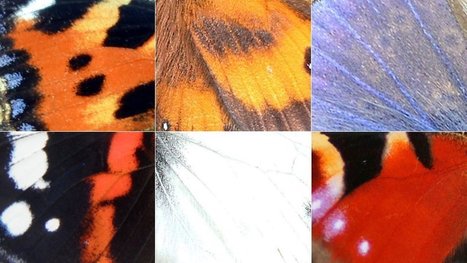
Identifying common garden butterflies by wing colour and markings.

 Your new post is loading...
 Your new post is loading...
Your new post is loading...
 Scoop.it!
Identifying common garden butterflies by wing colour and markings.
Bernadette Cassel's insight:
Identification des papillons de jardin communs d'après la couleur et les motifs des ailes 
Scoop.it!
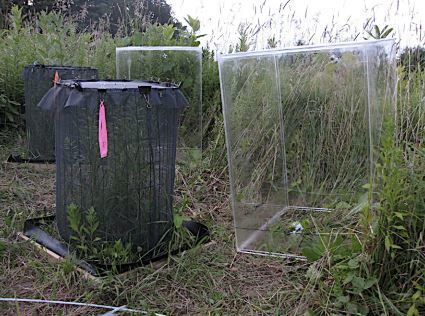
A new study shows that the predator-prey relationship can affect the flow of carbon through an ecosystem. This previously unmeasured influence on the environment may offer a new way of looking at biodiversity management and carbon storage for climate change.
The study, conducted by researchers at the Yale School of Forestry & Environmental Studies, comes out this week in the Proceedings of the National Academy of Sciences. It looks at the relationship between grasshoppers and spiders -- herbivores and predators in the study's food chain -- and how it affects the movement of carbon through a grassland ecosystem.
[...]
Bernadette Cassel's insight:
La relation prédateur-proie peut affecter le flux de carbone dans un écosystème.
→ Trophic cascade alters ecosystem carbon exchange http://www.pnas.org/content/early/2013/06/12/1305191110
Image :
Cages et chambres en plexiglas utilisées dans cette étude, la proie étant une sauterelle (Melanpolus femurrubrum) et le prédateur une araignée (Pisaurina mira)
Scoop.it!
![[2012] Poop, not parasites | Insect Archive | Scoop.it](https://img.scoop.it/KlQosinCUqv7iOGgkbYlGzl72eJkfbmt4t8yenImKBVvK0kTmF0xjctABnaLJIm9)
So a very cool bug photo has been circulating on the web: I've seen it on Tumblr, Facebook, Pinterest and Twitter. It's a pretty darn great photo: Let's zoom in on that a little, shall we? Well, my...
Bernadette Cassel's insight:
"Bouclier fécal" chez une larve de chrysomèle
(Photo of a Cereal Leaf Beetle Larva, by Giles San Martin, used under a Creative Commons License.)
D'autres larves de chrysomèles porteuses d'excréments ici :
→ http://aramel.free.fr/INSECTES11-34.shtml
Scoop.it!
![[Vidéo] Why Male Dark Fishing Spiders Spontaneously Die After Sex | Insect Archive | Scoop.it](https://img.scoop.it/-BDzJPGij56i_kEwpb0Egzl72eJkfbmt4t8yenImKBVvK0kTmF0xjctABnaLJIm9)
It's a unusually cruel fate even in the twisted world of spider sex: When male dark fishing spiders copulate, they die -- death is the unavoidable consequence of the mechanism by which males transfer sperm to females.
Bernadette Cassel's insight:
→ Spontaneous male death and monogyny in the dark fishing spider http://rsbl.royalsocietypublishing.org/content/9/4/20130113
Scoop.it!

Membrane that protects eggs from drying out freed critters from need to stay close to water.
Bernadette Cassel's insight:
→ The extraembryonic serosa protects the insect egg against desiccation http://rspb.royalsocietypublishing.org/content/280/1764/20131082
Scoop.it!

Il s'agit d'un cafard luminescent, une caractéristique physique plus connue chez certains insectes comme les lucioles ou les taupins. Ce spécimen unique a été observé une seule fois en 1939 aux abords du stratovolcan Tungurahua en Equateur. Il n'avait fait l'objet d'aucune classification jusqu'en 2012. Il est probable que cette espèce soit aujourd'hui éteinte puisque le lieu de sa découverte a été détruit par une éruption en 2010.
[...]
Scoop.it!
![[2012] Prominent Scientists Sign Declaration that Animals have Conscious Awareness, Just Like Us | Insect Archive | Scoop.it](https://img.scoop.it/X2RR3MxFxdi9okaVYfD6qjl72eJkfbmt4t8yenImKBVvK0kTmF0xjctABnaLJIm9)
From
ieet

An international group of prominent scientists has signed The Cambridge Declaration of Consciousness in which they are proclaiming their support for the idea that animals are conscious and aware to the degree that humans are — a list of animals...
[...]
The neural substrates of emotions do not appear to be confined to cortical structures. In fact, subcortical neural networks aroused during affective states in humans are also critically important for generating emotional behaviors in animals. Artificial arousal of the same brain regions generates corresponding behavior and feeling states in both humans and non-human animals. Wherever in the brain one evokes instinctual emotional behaviors in non-human animals, many of the ensuing behaviors are consistent with experienced feeling states, including those internal states that are rewarding and punishing. Deep brain stimulation of these systems in humans can also generate similar affective states. Systems associated with affect are concentrated in subcortical regions where neural homologies abound. Young human and nonhuman animals without neocortices retain these brain-mind functions.
Furthermore, neural circuits supporting behavioral/electrophysiological states of attentiveness, sleep and decision making appear to have arisen in evolution as early as the invertebrate radiation, being evident in insects and cephalopod mollusks (e.g., octopus).
Bernadette Cassel's insight:
SUR LE MÊME SUJET :
→ [2010] Une preuve de plus que le poulpe est un animal intelligent ! http://le-terrier-de-meghann.over-blog.com/article-une-preuve-de-plus-que-le-poulpe-est-un-animal-intelligent-49502560.html
SUR INSECT ARCHIVE :
Scoop.it!

Le site officiel du ministère chargé de la santé
Début de la surveillance estivale le 1er mai, mesures mises en œuvre et dispositif de communication.
[...]
Pour toute information complémentaire, un dossier complet avec les outils disponibles pour le grand public et les professionnels de santé figure sur le site internet du ministère de la santé, dossiers dengue et chikungunya et notamment :
Informations sur les zones endémiques et les conseils aux voyageurs : Le site de l’Institut de veille sanitaire Le site du ministère des affaires étrangères
Bernadette Cassel's insight:
SUR VARIÉTÉS ENTOMOLOGIQUES :
Scoop.it!
![Faut-il ouvrir une banque du sperme pour abeilles ? [en anglais] | Insect Archive | Scoop.it](https://img.scoop.it/YoF9AuelEiAbSGtUCxRfijl72eJkfbmt4t8yenImKBVvK0kTmF0xjctABnaLJIm9)
A Sperm Bank for Better BeesOne way to combat colony collapse disorder? Genetically diversify the bee population.
Bernadette Cassel's insight:
(via Passeur de Sciences http://passeurdesciences.blog.lemonde.fr/2013/06/14/la-selection-scientifique-de-la-semaine-no-75/)
Scoop.it!
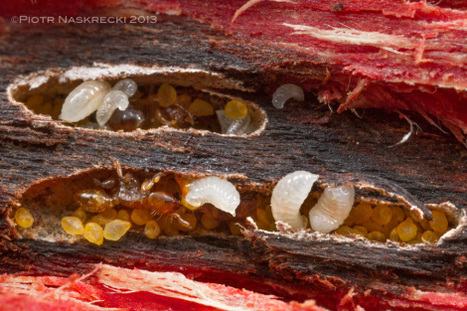
"The best part of traveling with a group of biologists in a place like the Cheringoma Plateau is the impossibility of ever being bored. Not only can you witness hilarious and exotic injuries (where ..." [Image] Opened corridors of the Melissotarsus (probably M. emeryi) colony within the wood of Knobthorn (Acacia nigrescens). The yellow objects are diaspidid scale insects, which the ants raise for their meat. (via Twitter https://twitter.com/ZombieAntGuy/status/342645604457013248)
Scoop.it!
![Dans la lutte contre le paludisme, les biologistes peuvent-ils battre les moustiques ? [en anglais] | Insect Archive | Scoop.it](https://img.scoop.it/nNwWuGuStqg87FSfzfh6ZTl72eJkfbmt4t8yenImKBVvK0kTmF0xjctABnaLJIm9)
Can biology beat the mosquito?
For every advance in malaria prevention, the Machiavellian insect has an answer. But the situation is not hopeless…
Scoop.it!

Bernadette Cassel's insight:
Scoop.it!

From
phys
A new species of scorpion Tityus (Atreus) crassicauda has been discovered from the extraordinarily biodiversity rich region of the Ecuadorian Andes. The intriguing new species is classed as medium sized, but still around the Impressive 5 cm in length. It is distinguished by reddish brown overall coloration, broken by peculiar decoration of 3 longitudinal brown stripes , separated by yellow zones. The study was published in the open access journal Zookeys.
|
Scoop.it!
From
www
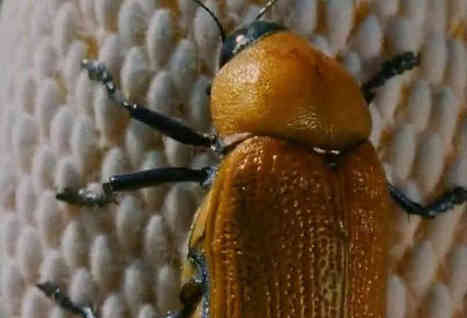
What's that beetle doing to that beer bottle? The beetle dropped down from the sky, grabbed the bottle's bottom, keeps hugging and hugging it, even when being attacked by ants, and it won't — refuses to — let go.
[Julodimorpha bakewelli, Coleoptera Buprestidae]
Bernadette Cassel's insight:
SUR VARIÉTÉS ENTOMOLOGIQUES :
Scoop.it!
When it comes to honey bees, more mates is better. A new study from North Carolina State University, the University of Maryland and the U.S. Department of Agriculture (USDA) shows that genetic diversity is key to survival in honey bee colonies – a colony is less likely to survive if its queen has had a limited number of mates.
“We wanted to determine whether a colony’s genetic diversity has an impact on its survival, and what that impact may be,” says Dr. David Tarpy, an associate professor of entomology at North Carolina State University and lead author of a paper describing the study. “We knew genetic diversity affected survival under controlled conditions, but wanted to see if it held true in the real world. And, if so, how much diversity is needed to significantly improve a colony’s odds of surviving.”
Bernadette Cassel's insight:
La diversité génétique augmente les chances de survie des colonies d'abeilles domestiques
→ Genetic diversity affects colony survivorship in commercial honey bee colonies http://link.springer.com/article/10.1007%2Fs00114-013-1065-y
Scoop.it!
![[Vidéo - 2011] Quel est le prix des abeilles ? | Insect Archive | Scoop.it](https://img.scoop.it/98yEvG11_mQ9fk9ieeBKLjl72eJkfbmt4t8yenImKBVvK0kTmF0xjctABnaLJIm9)
From
www
D’année en année, la diminution du nombre d’abeilles compromet sérieusement la pollinisation et donc la production agricole. Ce service que nous rend la nature a donc un impact économique considérable. Jean Michel Salles, économiste de l’environnement au Laboratoire montpelliérain d'économie théorique et appliquée, s’intéresse aux risques du déclin de la pollinisation sur la production agricole. Cette perte est évaluée en valeur économique. Le chercheur s'interroge sur les conséquences de cette menace, sur les consommateurs.
Scoop.it!
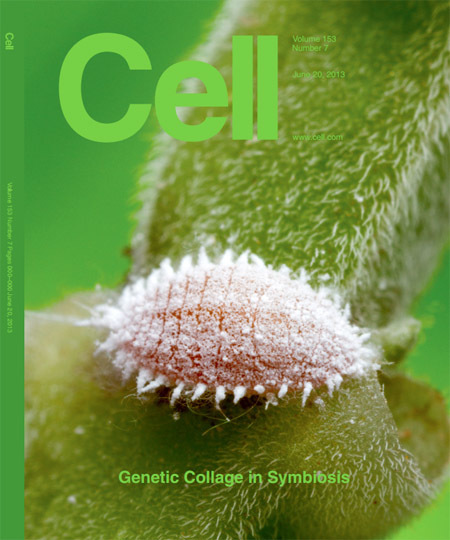
I am pleased to announce one of my photographs is on the cover of the most recent issue of Cell. And not just for any old research story, either. This one involves the citrus mealybug Planococcus citri and a Russian doll progression of microbes that live inside other microbes inside the insect. It’s a real mind-bender about how evolution mixes and matches parts.
Bernadette Cassel's insight:
→ Horizontal Gene Transfer from Diverse Bacteria to an Insect Genome Enables a Tripartite Nested Mealybug Symbiosis http://www.cell.com/retrieve/pii/S0092867413006466
Scoop.it!
INSPECTION ACADEMIQUE DU CHER
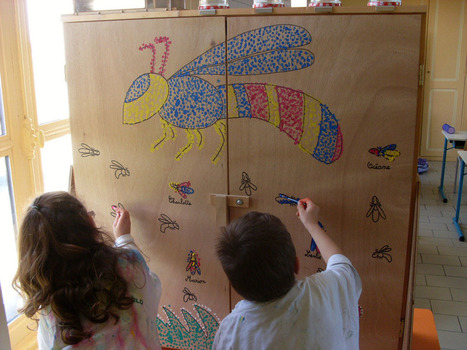
Apiscope : Faire des sciences autrement. Une ruche dans la classe pour observer le comportement des abeilles et l'évolution dans le temps de leur société. C'est l'occasion de mettre en œuvre des démarches d'investigation à partir d'observations réalisées au quotidien. Un fichier pédagogique de mise en œuvre accompagne la ruche.
Mise en commun des ressources et compétences des instituts travaillant ensemble Augmentation exponentielle des demandes d'installations d'Apiscopes dans le département du Cher, la région Centre, en France et à l'international (Moldavie, Slovénie, Espagne, Belgique...)
• Nombre d'élèves et niveau(x) concernés :
Tous les niveaux de la maternelle petite section au master 2.
À ce jour : - primaire : 450 élèves - secondaire : 170 élèves - supérieur : 120 étudiants - hôpital : 20 élèves
[...]
Bernadette Cassel's insight:
Scoop.it!

Laura Trompette : Des neuroscientifiques ont fait une révélation des plus bouleversantes: les animaux auraient bel et bien une conscience, Via Bourdoncle
Scoop.it!

In a new TV series, Sir David Attenborough delves into the mysterious kingdom of bugs to capture never-before-seen footage of Cockroach Wasps, Ogre-Faced Spiders and other creepy crawlies in Africa and Australia.
Scoop.it!
L'IBP est un outil simple et rapide pour évaluer la biodiversité forestière de parcelles boisées et les améliorations possibles.
Scoop.it!
Bernadette Cassel's insight:
SUR VARIÉTÉS ENTOMOLOGIQUES :

agrodoc_ouest's curator insight,
June 12, 2013 8:39 AM
Cette base de données regroupe différents centres documentaires inscrits dans le domaine de le réseau des professionnels de la nature en zone de montagne ou de littoral Source : http://aldebaran.revues.org/6189

DocBiodiv's comment,
June 17, 2013 10:45 AM
Le lien actualisé vers le portail documentaire : bases de données (3 PNR, 7 parcs nationaux, Conservatoire du littoral, Aten) et annuaire des centres de doc du réseau : aten.superdoc.com
Scoop.it!

From
www7
Rubriques et auteurs en séries dans Insectes, depuis le n° 100 Art et insectes - Captures et collections - Eux aussi, ils aiment les insectes - Fiche d'élevage - Fiche pédagogique - Histoires d'entomologistes - Insectes pollinisateurs - Le jardin des insectes - Les insectes du jardin naturel - Les mots de l'entomologie - Les petites bêtes dans l'histoire - Parlez-vous entomo ? - Pour en finir avec les insectes - Traces d'insectes - Un insecte à la page.
Scoop.it!
Walked outside today and found this little guy guiding a roach to his nest. I had heard about these before, but had never seen it until now. I think this is an Emerald Cockroach Wasp (Ampulex compressa), but according to wikipedia they're found mostly "in tropical regions of South Asia, Africa and the Pacific islands" This one was outside my house in Brazil. Anyway, the wasp stings the roach turning it into a zombie of sorts and then grabs it by the antennae to lead it back to it's nest where it lays an egg inside the live roach. [Ampulex compressa, Hymenoptera, Ampulicidae] ___________________________________________________________________ http://ed.ted.com/lessons/parasite-tales-the-jewel-wasp-s-zombie-slave-carl-zimmer
Bernadette Cassel's insight:
SUR ENTOMONEWS From www.gurumed.org - January 10, 2013 12:40 AM :
Scoop.it!

The Viceroy Butterfly (Limenitis archippus) is a North American butterfly with a range from the Northwest Territories along the eastern edges of the Cascade Range and Sierra Nevada mountains, southwards into central Mexico.
[...]
Bernadette Cassel's insight:
→ Vice-roi (papillon) Basilarchia (Limenitis) archippus http://fr.wikipedia.org/wiki/Vice-roi_%28papillon%29
« Le Vice-roi, (Basilarchia (Limenitis) archippus), est un insecte lépidoptère de la famille des Nymphalidae, de la sous-famille des Limenitidinae et du genre Basilarchia. Il se présente comme un mime du Monarque.»
|







l'art ds la nature grd source d'inspiration