



 Your new post is loading...
 Your new post is loading...
Your new post is loading...
 Scoop.it!
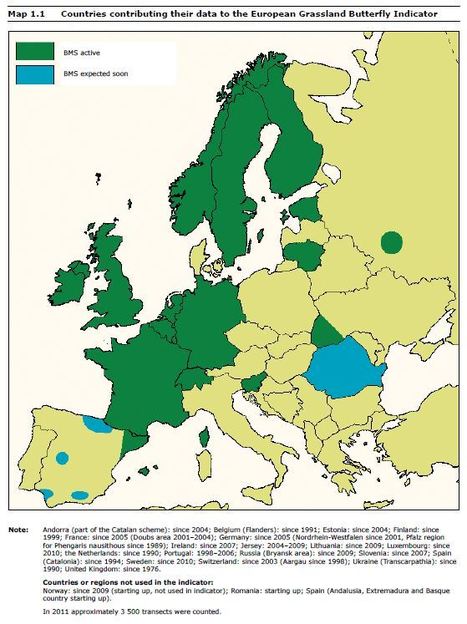
This report presents the European Grassland Butterfly Indicator, based on national Butterfly Monitoring Schemes (BMS) in 19 countries across Europe, most of them in the European Union.
Bernadette Cassel's insight:
→ The European Grassland Butterfly Indicator 1990–2011.pdf [1.3 MB] http://www.eea.europa.eu/publications/the-european-grassland-butterfly-indicator-19902011

Scoop.it!
![Le repas de sang du moustique Anopheles gambiae, vecteur du paludisme, étudié en vision rapprochée [en anglais] | Insect Archive | Scoop.it](https://img.scoop.it/QTbKmmQB2sy6QdlmepjSHjl72eJkfbmt4t8yenImKBVvK0kTmF0xjctABnaLJIm9)
Choumet V, Attout T, Chartier L, Khun H, Sautereau J, et al. (2012) Visualizing Non Infectious and Infectious Anopheles gambiae Blood Feedings in Naive and Saliva-Immunized Mice. PLoS ONE 7(12): e50464. doi:10.1371/journal.pone.0050464
Bernadette Cassel's insight:
Via GuruMeditation
→ Regardez de l’intérieur la piquante tête chercheuse du moustique en quête de sang (Vidéos)
« D’incroyables séquences vidéos de la trompe d’un moustique cherchant une veine, réalisées à l’aide d’un microscope de pointe par Valérie Choumet et ses collègues de l’Institut Pasteur à Paris, révèlent comment un moustique pique et suce le sang... »
Scoop.it!
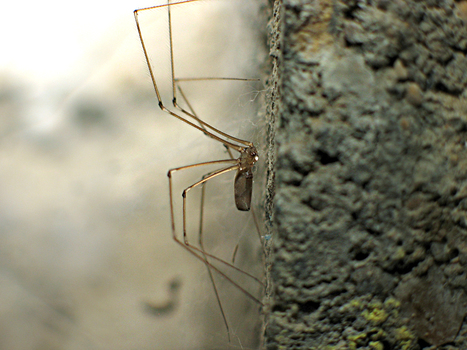
Embranchement : Arthropodes Pholcus phalangioides Le pholque phalangide est très facilement reconnaissable à ses longues pattes grêles et à son corps cylindrique. Il se laisse pendre de sa toile en attendant qu'une proie vienne s'y échouer. Il l'emmaillotera alors rapidement dans du fil de soie.
Malgré son aspect fragile, cette araignée est capable de tuer d'autres araignées plus impressionnantes et massives comme des tégénaires. Elle ne présente cependant aucun danger pour l'Homme, sa petite taille l'empêchant de percer la peau humaine.
Bernadette Cassel's insight:
Curieux de nature - Galerie et blog animaliers
→ Présentation http://www.curieux-de-nature.com/index.php?page=presentation
→ Index des espèces par nom français http://www.curieux-de-nature.com/index.php?page=listeindex
Scoop.it!
(Via agrodoc_ouest sur HORTICULTURE BOTANIQUE http://www.scoop.it/u/agrodoc-ouest)
Bernadette Cassel's insight:
Scoop.it!
From
www

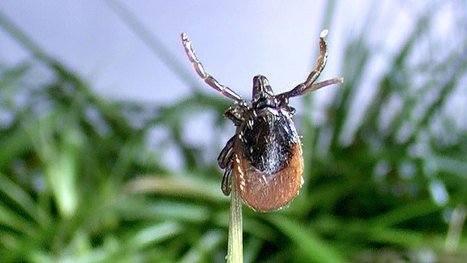
Danger réel ou imaginaire ? La maladie de Lyme, transmise par les tiques, peut se déclencher des années après la morsure initiale. Ses conséquences sont-elles (...)

christine rachel levy's comment,
July 12, 2013 3:05 AM
la bêtise elle est radical...... la maladie de Lyme la nouvelle réponse ......
Scoop.it!
Bernadette Cassel's insight:

Bernadette Cassel's comment,
July 11, 2013 7:34 PM
Oui, c'est un fléau... Mais pour vous, alors, je souhaite un bon été au frais !

Christian Allié's comment,
July 12, 2013 4:33 AM
Merci, je ne fuis pas le soleil pour autant...Nous sommes de vieux amis........Bon été!
Scoop.it!
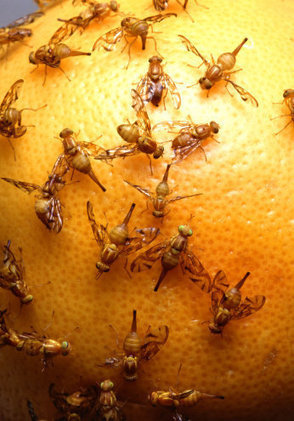
A middle-school experiment using fruit flies and organic foods has won publication in a national scientific journal and spurred a debate about the relative benefits of organic eating.
When Ria Chhabra, a middle school student near Dallas, heard her parents arguing about the value of organic foods, she was inspired to create a science fair project to try to resolve the debate.
Three years later, Ria’s exploration of fruit flies and organic foods has not only raised some provocative questions about the health benefits of organic eating, it has also earned the 16-year-old top honors in a national science competition, publication in a respected scientific journal and university laboratory privileges normally reserved for graduate students.
The research, titled “Organically Grown Food Provides Health Benefits to Drosophila melanogaster,” tracked the effects of organic and conventional diets on the health of fruit flies.
[...]
Bernadette Cassel's insight:
→ Organically Grown Food Provides Health Benefits to Drosophila melanogaster http://www.plosone.org/article/info:doi%2F10.1371%2Fjournal.pone.0052988
Scoop.it!
From
io9
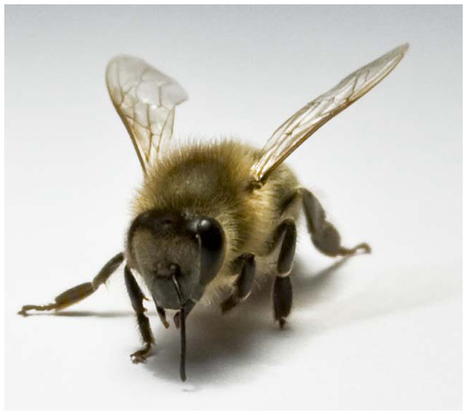
When it comes to greeting their fellow insects, honeybees preferentially use their right antennae. In fact, without their right antennae, the insects may not even be able to tell friend from foe, according to a new study.
Bernadette Cassel's insight:
L'antenne droite joue un rôle prépondérant dans les interactions sociales chez les abeilles. (Image : Une abeille dont l'antenne droite a été sectionnée avec des ciseaux de microchirurgie pour les besoins de l'étude)
L'étude publiée sur Scientific Reports :
→ A right antenna for social behaviour in honeybees http://www.nature.com/srep/2013/130627/srep02045/full/srep02045.html
Scoop.it!
From
phys
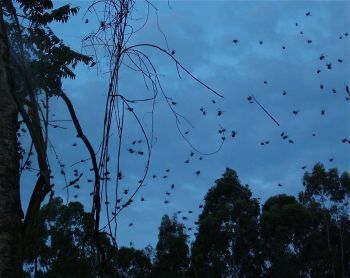
(Phys.org) —A species of spider that, unusually, lives in a colony but hunts alone at night is the subject of a new study by an international team of scientists including University of Sussex biologists.
By Maggie Clune, University of Sussex, 18.06.2013
Bernadette Cassel's insight:
SUR LE MÊME SUJET :
→ Une araignée individualiste mais… partageuse quand il faut éviter les conflits
Scoop.it!
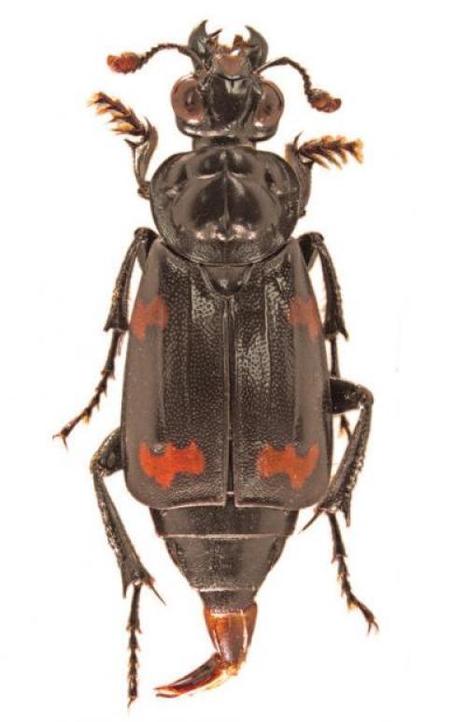
Scientists discovered a new species of burying beetle from the Solomon Islands Archipelago. Nicrophorus efferens was discovered when one of the authors, Tonya Mousseau, decided to look through the local museum collections during a holiday in Hawaii. ___________________________________________________________________ → Découvrez l'histoire fascinante des nécrophores http://nature.ca/discover/treasures/anim/tr1/btl_f.cfm
Scoop.it!
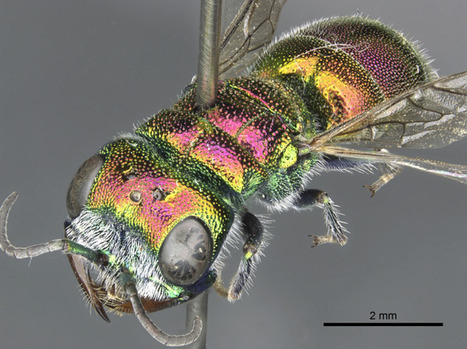
The chrysidids are a large family of wasps, with around 3,000 species. Many are brilliantly metallic, with psychedelic patterns and intensely sculptured exoskeletons. Because they are all so striki...
via Bug Girl's Blog "Shiny, Purple Insects will Blow Your Mind with Awesome" http://membracid.wordpress.com/2013/06/25/shiny-purple-insects-will-blow-your-mind-with-awesome/
Bernadette Cassel's insight:
UN ARTICLE SUR LES GUÊPES-COUCOUS (en français) :
→ Les Hyménoptères par Claire Villemant http://www7.inra.fr/opie-insectes/hymenos.htm
« Les Chrysididés ou Guêpes-coucous (Chrysidoidea) ont des couleurs métalliques. Les femelles sont des cleptoparasites : elles pondent dans les nids d'autres guêpes ou d'abeilles solitaires. Leurs larves sont ectoparasitoïdes des larves de leur hôte ou vivent aux dépens des réserves d'insectes ou d'araignées qu'il a accumulées. Volant autour de l'endroit où il nidifie, la Chryside profite d'un moment d'inattention de son hôte pour pénétrer dans son nid et y déposer son oeuf. Si l'hôte la surprend, elle se roule en boule pour lui échapper. »
|
Scoop.it!
Le syrphe est une mouche de 9 à 12 mm aux allures de petite guêpe. Les anneaux oranges et noirs sur son abdomen la rendent facilement identifiable. Malgré so...
Scoop.it!
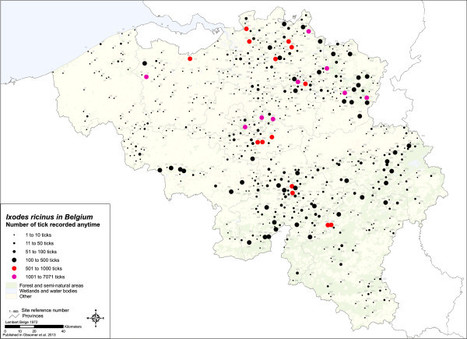
Les maladies à tiques sont en augmentation en Belgique et dans les pays alentours. Néanmoins, il est difficile de connaître l'ampleur du problème car les cas de maladie ne sont pas répertoriés systématiquement. Il existe de nombreuses lacunes dans les connaissances de la situation en Belgique: Où sévissent ces maladies et les tiques qui les transmettent? Quelles sont les personnes, environnements et activités à risque? Quels sont les symptômes et sont-ils différents d'une région à l'autre? Dans ce contexte votre témoignage peut vraiment nous aider - ce formulaire en ligne permet de recueillir les informations détaillées que vous seul(e) possédez. Enquête morsure et symptômes sur personnes
Un article récent décrit les espèces de tiques présentes en Belgique, la possibilité d'être mordu sur tout le territoire dans les zones avec végetation ( y compris les dunes avec végétation, les jardins, etc...). L'article propose également des cartes de distribution des tiques, la listes de pathogènes potentiellement présents dans nos tiques belges et une carte de la distribution des pathogènes déjà trouvés sur le territoire. L'article n'est malheureusement disponible qu'en anglais en libre accès sur le site de Parasites and Vectors mais les cartes offrent une bonne approche visuelle. Référence: Valerie Obsomer, Marc Wirtgen, Annick Linden, Edwin Claerebout, Paul Heyman, Dieter Heylen, Maxime Madder, Jo Maris, Maude Lebrun, Wesley Tack, Laetitia Lempereur, Thierry Hance and Georges Van Impe: Spatial disaggregation of tick occurrence and ecology at a local scale as a preliminary step for spatial surveillance of tick-borne diseases: general framework and health implications in Belgium . Parasites & Vectors 2013, 6:190 Tiques de Belgique et pathogènes associés
[...]
Bernadette Cassel's insight:
→ Tiques, borréliose de Lyme et maladies associées
→ Ne sous-estimez pas le danger que représentent les tiques !!
Scoop.it!
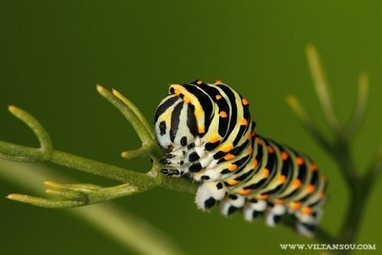
Découvrez ce moment magique où la chenille décide de passer au stade de chrysalide (papillon Machaon : papilio machaon)
« Transformation d'une chenille de papillon Machaon en chrysalide » (cliquer sur l'image)
Scoop.it!
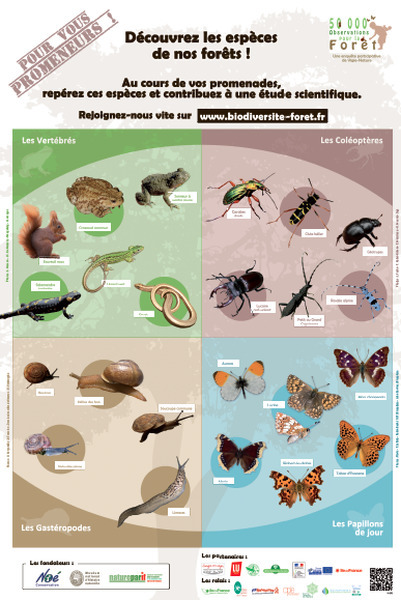
Un appel au public pour mieux comprendre nos forêts
Afin de vous aider à participer à l’opération, différents outils sont disponibles en téléchargement. N'hésitez pas à les imprimer et à les emporter avec vous lors de vos balades en forêt !
• Des cartes postales
Bernadette Cassel's insight:
SUR VARIÉTÉS ENTOMOLOGIQUES :
Scoop.it!

Une micro biodiversité qui nous voudrait plutôt du bien… à explorer, comprendre, s’en émerveiller, en agrandir les connaissances, commençant auprès (...) Via Bourdoncle
Scoop.it!

From
htl
There are more than 1700 different invertebrate species in Britain and Ireland which are dependent on decaying wood in order to complete their life cycles (Alexander, in prep. The invertebrates of living & decaying timber in Britain & Ireland). This represents about 6% of the entire British invertebrate fauna - wood-decay is a major resource! That means more than 1700 different life styles, since each species has very particular requirements. These statistics really bring home just how diverse a habitat wood-decay can be. the aging process of woody plantsthe process of wood decay.
Bernadette Cassel's insight:
(via Twitter https://twitter.com/techarb1/status/354627610942259200)
Il y a plus de 1700 espèces d'invertébrés en Grande-Bretagne et en Irlande qui dépendent du bois en décomposition
Scoop.it!

Unique en France, venez à la rencontre des amphibiens et des invertébrés et découvrez leur diversité incroyable et leur importance écologique.
Bernadette Cassel's insight:
→ Parc et Château de Thoiry, L'Arche des petites bêtes http://www.thoiry.net/sites/default/files/THOIRY_ARCHE_DP_BD.pdf
→ Actu'Zoo Le tour du monde de l'actualité des parcs zoologiques
Scoop.it!

The USA National Phenology Network's Phenology Visualization Tool helps monitor the influence of climate on the phenology of plants, animals, and landscapes in the U.S..
The site allows users to select a plant or animal and view where that species has been reported on a Google Map. It is then possible to view an animation of the species' phenology (phenology refers to recurring plant and animal life cycle stages) through time.
It is also possible to view climate data on the same map. Users can view maximum temperature, minimum temperature and precipitation either by month or annually. If you animate species data through time, with climate visible, you will see the climate data on the background change alongside the phenology data...
Via Elpidio I F Filho
Bernadette Cassel's insight:
L'outil de visualisation de phénologie du Réseau national de phénologie des USA permet de surveiller l'influence du climat sur la phénologie des plantes, des animaux et des paysages aux États-Unis.
(d'après l'article en anglais)
Scoop.it!

Ce diaporama présente des images détaillées d'insectes forestiers que l’on retrouve au Canada. Pour obtenir une image précise de ces insectes, une camera numérique a été montée sur un microscope. Les diverses parties des insectes ont été photographiées et assemblées électroniquement pour donner une image complète, détaillée et nette de l’insecte.
Christian Allié's comment,
July 4, 2013 1:07 PM
Très intéressant, merci!
En forêt tropicale, Gabon pour ce qui me concerne, des arbres "sur pied" sont fréquemment "mulotés" par des larves de longicornes qui creusent des galeries du diamètre d'un doigt, certaines régions et sur des superficies importantes le "mulotage" atteint 80% des arbres tels que l'acajou d'Afrique "Kahaya ivorensis et Kahaya anthoteca" http://en.wikipedia.org/wiki/Khaya_ivorensis ou le Padouk "Pterocarpus soyauxii" D'autres essences sont attaquées également mais dans une moindre proportion.
Scoop.it!

Bernadette Cassel's insight:
Mimétisme batésien chez des orchidées : elles imitent d'autres orchidées pour attirer les pollinisateurs alors que, ne produisant pas de nectar, elles n'ont rien à leur offrir !
(d'après le résumé en anglais)
→ Convergent evolution of floral signals underlies the success of Neotropical orchids http://rspb.royalsocietypublishing.org/content/280/1765/20130960
Scoop.it!

Incredible!
A predatory bird aiming at an apparent moth body will find little more than the empty space between the butterfly’s hindwings, giving our upside-down trickster a chance to escape.
Scoop.it!

June 21-25, 2013
The Evolution Conference
This meeting is the premier annual opportunity for sharing scientific research related to evolution. Symposia presentations, concurrent contributed papers, and poster sessions will be presented by the 1,400 expected participants. [...]
Evolution 2013 meets jointly with the iEvoBio conference, which brings together biologists interested in evolution, systematics, biodiversity, software, and mathematics. The program for iEvoBio can be viewed HERE.
[...]
Bernadette Cassel's insight:
|







→ Cicindela campestris (Cicindèle champêtre) partie 1
http://www.viltansou.com/cicindela-campestris-cicindele-champetre/#!prettyPhoto
À VOIR :
→ Les CICINDELIDES ou « Cicindèles », des larves à l’affût et des adultes coureurs
http://aramel.free.fr/INSECTES11bis-1.shtml