Your new post is loading...

|
Scooped by
Mel Riddile
October 24, 2018 1:23 PM
|
In the office of the Springdale, Md., school, students and their families in crisis would speak with administrators about their challenges. Principals held confidential meetings about staff evaluations and personnel matters. And multiple people — including the principal, two of his children and the girls’ pom and dance team — undressed there in between school and extracurricular activities.
But that “expectation of privacy was determined to be an illusion” after administrators at Flowers discovered a hidden surveillance camera had been running in the office for almost two years, a lawsuit brought by two administrators and a school secretary asserts.
The lawsuit filed last month in federal court in Maryland seeks damages against Prince George’s County Public Schools and its security division, claiming the hidden video camera placed in the office without a warrant has violated their constitutional right “to be free from government intrusion and invasion” into their “private and personal space.”
|
|
Scooped by
Mel Riddile
October 22, 2018 1:25 PM
|
Because most teachers have little formal instruction in how to teach writing—in teacher preparation programs and beyond—they often lack the skills and resources necessary to teach students to write well. They might not have learned how to recognize effective writing (because it can be subjective), how to give effective feedback, or how to balance whole-group and individualized instruction. It also seems that students are doing less long-form writing than ever before. Today's social media use encourages communication with scant punctuation and a combination of emojis and abbreviations, which can add even more challenges to teaching writing.
|
|
Scooped by
Mel Riddile
October 17, 2018 6:40 PM
|
Professional support plays a big role in how teachers view their jobs. Research has suggested that having a mentor can keep teachers in the profession for longer, and that teachers who like their principals rate their school climate more favorably.
A new report attempts to pinpoint the factors that hinder this kind of supportive work environment for educators, and it offers a roadmap toward creating a stronger professional culture.
The report, published by 100Kin10, a national nonprofit seeking to recruit and train 100,000 new science, technology, engineering, and math teachers by 2021, stems from the organization's previous research into the "grand challenges" facing STEM education. Of the 14 "catalysts" 100Kin10 identified—changes that would have the highest impact in attracting teachers to the profession and retaining them—three were related to work culture: making time for professional growth during the school day, providing more opportunities for teacher collaboration, and creating a positive environment for staff.
The group identified these trends by analyzing published research and news reports, and consulting with 100Kin10's partner organizations, which include school districts, teacher-preparation programs, nonprofits, and companies.
The report argues that four main factors preve
|
|
Scooped by
Mel Riddile
October 15, 2018 6:08 PM
|
“But America’s schools don’t merely reflect our nation’s material prosperity. They also reflect our moral poverty. Our schools are simultaneously an embrace and a refusal, revealing exactly who is included and who isn’t. Most of us can say our children are getting a great education. Yet whose children are “ours”? What do they look like? Where do they rest their heads at night? Reform rhetoric about the failures of America’s schools is both overheated and off the mark. Our schools haven’t failed. Most are as good as the schools anyplace else in the world. And in schools where that isn’t the case, the problem isn’t unions or bureaucracies or an absence of choice. The problem is us. The problem is the limit of our embrace. Perhaps, then, a reset is in order. Instead of telling a largely untrue story about a system in decline — a story that absolves us of any personal responsibility — we might begin telling a different story: about a system that works. It works to deliver a high-quality education to those we collectively embrace. And it works in a different way for those we have collectively refused. When a school fails, it is because we have failed.”
|
|
Scooped by
Mel Riddile
October 15, 2018 1:34 PM
|
Ideally, recognition demonstrates genuine appreciation for the employee as a human being, not just his contributions. Feedback is a way to shape future behaviors for improved results.
Both recognition and feedback are important aspects of the leader-team member relationship. When you conflate the two, you create confusion and resentment. Let’s go back to Jim for a moment. If you have two pieces of information to give Jim—one that praises and one that requests a different behavior -- you need to create space between the delivery of the two points.
|
|
Scooped by
Mel Riddile
October 14, 2018 1:18 PM
|
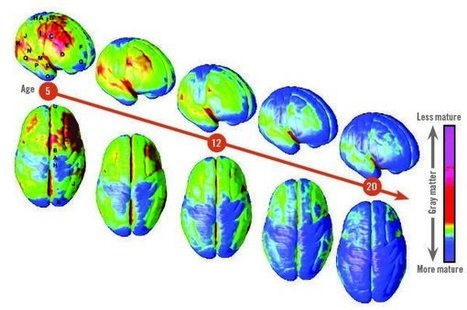
In symposia at International Mind, Brain, and Education Society research conference here last week, and a consensus report funded by the Alliance for Excellent Education released here, cognitive and neuroscientists called for educators to foster school cultures that better support adolescent development.
"For some reason, when we talk about brain development in adolescents, we talk about it like we're terrified: 'Oh my god, their grades in school are dropping, they're driving cars, this is so alarming,' " said Sarah Enos Watamura, an associate professor at the University of Denver who studies the effects of stress on learning and spoke at the conference. "But they're testing their limits, they're doing things for the first time. … That's hard work, and they need a safe space to try out risks."
Adolescence, she said, is coming to be understood as a "second critical window" for developing skills to regulate emotions, making and evaluating decisions, and judging risk and reward. After years of childhood brain development, teenagers' brains focus on making strong connections.
"We need adolescents to hang out in this sensitive period and all that allows to develop … versus rushing them through it," Watamura said.
|
|
Scooped by
Mel Riddile
October 7, 2018 6:27 PM
|
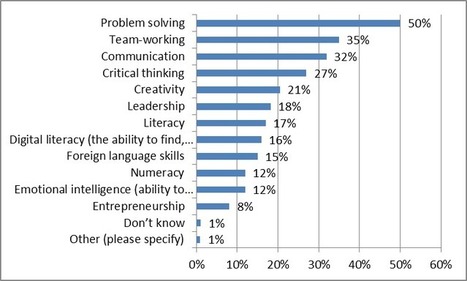
As technology becomes more pervasive, traditional trades disappear and the world of work becomes more globalised, the skills considered to be valuable for the future are shifting.
Problem solving, team working, and communication (commonly known as “21st century skills”) are the most-needed skills in the workplace, according to our recent surveys of business executives, students and teachers. Digital literacy and creativity— and the latter’s close relative, entrepreneurship—are expected to grow more important in the next three years.
|
|
Scooped by
Mel Riddile
October 6, 2018 4:30 PM
|
In the wake of cuts to education funding (and teacher salaries) during the Great Recession, school districts across the country continue to struggle to recruit and retain educators. More than 100,000 classrooms around the country started last school year with a teacher not "fully qualified to teach," and educators say the shortages continue this year. In subjects like mathematics, science, and special education, almost every state is experiencing teacher shortages.
"Teacher shortages have really become an increasing problem since the Great Recession," says Daniel Espinoza, one of the authors of the LPI report. "Jurisdictions reduced teacher workforces at that time and, since then, a collection of factors — low teacher salaries, challenging working conditions — have been driving many people out of the profession and dissuading people from joining."
|
|
Scooped by
Mel Riddile
October 5, 2018 1:39 PM
|
There’s been a lot of handwringing lately about the lack of rigor in high school courses, and critics have blamed educators’ “low expectations.” But they’ve overlooked one powerful strategy that could boost both expectations and performance: teaching students to write about what they’re learning.
|
|
Scooped by
Mel Riddile
October 5, 2018 1:25 PM
|
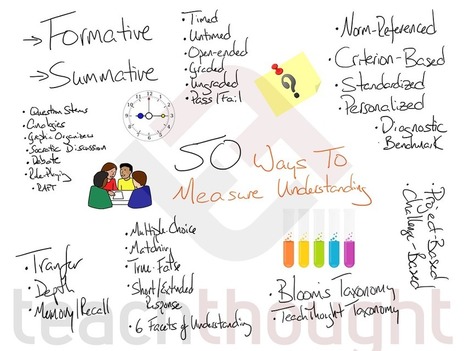
First, Determine The Purpose Of The Assessment
If all students are all going to have their height and weight measured, a common standard makes sense; If students are all going to have their attractiveness measured, any kind of ‘standard’ is creepy.
Measuring knowledge and mastery of competencies and skills isn’t quite as subjective as ‘beauty,’ but isn’t anywhere close to as cut and dry as height and weight. We can give the same test that measure the same thing in the same way for all students and do no damage really—provided we are all on the same page that we’re not measuring understanding but rather measuring performance on a test.
In a perfect world, we’d have countless ways to measure that understanding—all valid, universally understood, engaging to students, etc. In pursuit, I thought it’d make sense to brainstorm different ways to measure understanding. Some will be more or less useful depending on content areas, grade levels, student motivation, etc., not to mention what the purpose of the assessment is.
Do you need a snapshot?
Do you need to measure mastery or growth?
Do you want it to be flexible for a variety of learners or more binary—you either pass or you fail?
Do you want students to be able to return to the assessment periodically or is this a one-shot kind of deal?
Is the assessment for the teacher or the student?
|
|
Scooped by
Mel Riddile
October 3, 2018 2:13 PM
|
More than 44 million students now learn in classrooms with high-speed internet connections, up from just 4 million five years ago, according to a new analysis by the nonprofit broadband advocacy group EducationSuperHighway.
|
|
Scooped by
Mel Riddile
September 30, 2018 5:10 AM
|
What strategy can double student learning gains? According to 250 empirical studies, the answer is formative assessment, defined by Bill Younglove as "the frequent, interactive checking of student progress and understanding in order to identify learning needs and adjust teaching appropriately."
Unlike summative assessment, which evaluates student learning according to a benchmark, formative assessment monitors student understanding so that kids are always aware of their academic strengths and learning gaps. Meanwhile, teachers can improve the effectiveness of their instruction, re-teaching if necessary. "When the cook tastes the soup," writes Robert E. Stake, "that's formative; when the guests taste the soup, that's summative." Formative assessment can be administered as an exam. But if the assessment is not a traditional quiz, it falls within the category of alternative assessment.
|
|
Scooped by
Mel Riddile
September 26, 2018 5:05 PM
|
Check for Understanding is quite possibly the single most important group of techniques in terms of building relationships with students–I had never fully made that connection before and I suspect many other teachers hadn’t either.
I realized this over the course of a meeting with our TLAC Fellows in which we set out to discuss and study building relationships in the classroom- something my team and I are interested in studying because we think it’s an important topic and because we think it’s an oft-misunderstood or misapplied topic.
The first thing we realized was that many teachers focused their relationship building efforts on what happens outside of the core teaching–greeting students in the hallway and asking them about their interests.
Far more important and genuine is something we called relational teaching–using the way you teach to build a trusting relationship. What happens inside the classroom–inside the teaching within the classroom–is the first and foremost driver of relationships. The Fellows were emphatic on this point and on the idea that Check for Understanding, done well, was critical because it constantly communicated a message to each student. We summarized that message as follows:
Your success is important to me
I believe in you
I am highly aware of your progress in this endeavor
I will help you succeed
|
|
|
Scooped by
Mel Riddile
October 24, 2018 9:37 AM
|
Schools are under growing pressure to make sure that students are ready for work or job training, as well as college, when they graduate from high school. But employers say their young hires haven't learned the reading, writing, and verbal-communication skills that are most important to a successful working life.
That gap between reality and expectations begs a boxful of questions about whether there's a preparation problem and, if so, how to solve it.
|
|
Scooped by
Mel Riddile
October 20, 2018 9:08 AM
|
Rigor is increasingly a concern in our schools. We continue to see evidence that our students in all grades are not working at a level that is challenging enough to prepare them for college and careers.
However, we often misunderstand the definition of rigor. Rigor requires creating an environment in which each student is expected to learn at high levels, each student is supported so they can learn at high levels, and each student demonstrates learning at high levels.
The level of challenge in our assessments—which allows students to demonstrate learning at high levels—is crucial. To provide rigorous assignments for our students, we need to assess our level of rigor, revise tasks to raise the rigor and adjust.
|
|
Scooped by
Mel Riddile
October 17, 2018 6:25 PM
|
effective school leadership is among the strongest predictors of teacher retention. How principals engage their teachers matters in terms of whether they will stick around.
"Principals are major sources of support, encouragement, and recognition for a job well done," said Jason Grissom, an associate professor of public policy and education at Vanderbilt University. "There are expectations that principals are coaching teachers, providing them with targeted professional development, in addition to creating their classroom assignments. ... Principals play a large role in setting the culture and climate of the school."
The most recent federal data show that 84 percent of teachers who were teaching during the 2011-12 school year stayed at the same school the following year, with 8 percent moving to a different school, and 8 percent leaving the profession altogether. Among teachers with three or fewer years of experience, 80 percent stayed at the same school the next year.
|
|
Scooped by
Mel Riddile
October 15, 2018 5:34 PM
|
A revolution in genomics is creeping into economics. It allows us to say something we might have suspected, but could never confirm: money trumps genes. “about 27 percent of those who score at the bottom quarter of the genetic index, but are born to high-income fathers, graduate from college. That means they're at least as likely to graduate from college as the highest-scoring low-income students.”
|
|
Scooped by
Mel Riddile
October 14, 2018 1:27 PM
|
Here are some examples organized a round a few rules we’ve come to use:
Start simple: the first few questions should be fun and easy. You build success and have fun. It’s still useful retrieval. Just make sure students use the word in their answer
If someone was adamant about helping the environment, what’s something they might do?
Think of something a child might be forbidden from doing alone?
If a classmate was described as ‘easily influenced‘ would that be a complement? Why or why not?
Get more complex: As you go, combine words, change tenses, increase scenario difficulty, and add writing.
If I said my little brother had an aptitude for disobedience, what kinds of things would you expect him to do?
Could you fret about something and also nurture it? explain.
Is is possible to dread making a sacrifice? Why or why not?
|
|
Scooped by
Mel Riddile
October 8, 2018 2:26 PM
|
I’VE WORKED as hard as any . . . student to get good grades, and it’s unfair that anyone can now get those same grades without the same amount of effort.” That’s what an editor for the school newspaper at Walt Whitman High School wrote two years ago about Montgomery County’s decision to switch to a grading system that made it easier for students to get A’s. The warning about grade inflation went unheeded. Unfortunately, it has now been proven to be prescient.
New data shows that thousands more Montgomery County students are getting A’s in key high school subjects. The percentage of A’s across core math courses, The Post’s Donna St. George reported, nearly doubled from the first semester of 2014-2015 to last school year, while the number of C’s, D’s and E’s dipped. Similar surges in A’s were noted for students taking English, science and Advanced Placement courses.
|
|
Scooped by
Mel Riddile
October 7, 2018 6:07 PM
|
I want to share a technique that has been working for me and my students to build the capacity to read closely and understand deeply.
This lesson was a result of taking a small text (a poem) and applying ideas and understandings from it to a larger text (a novel).
This approach can be transformed and tweaked to suit any grade level and and skill set.
There are three basic components to the lesson:
Teach students to understand the difference between summary and insight
Teach students to back into the text over and over again
Teach students to see what is said without being said
small text — “Those Winter Sundays” by Robert Hayden
larger text — Mudbound by Hillary Jordan
|
|
Scooped by
Mel Riddile
October 5, 2018 1:57 PM
|
Julia Brown was determined to get it right this school year, so she tried something new – a cardboard "I Need" box. It began as a way for her students to ask for help without having to come directly to her. They'd write it on a card and leave it in the box, and she'd get back to them before the week was over.
|
|
Scooped by
Mel Riddile
October 5, 2018 1:33 PM
|
Both reports identify the root of the problem as teachers’ expectations. The Fordham study concludes that teachers need to be educated “about high expectations” and provided with a vision of what excellence looks like—which may not be the same as the work their best students are producing.
The TNTP report concludes that much of the time, teachers are giving assignments that are below grade-level. While more than 80% of the teachers surveyed supported high standards in theory, less than half expected that their students could meet them.
|
|
Scooped by
Mel Riddile
October 5, 2018 12:49 PM
|
Results showed that there was only a weak correlation between student and teacher measures of teacher classroom practices.
Next, the team tested whether student or teacher perceptions of teacher practices predicted students’ grades. They found that both student and teacher reports were significantly related to students’ course performance, with student reports being the better predictor of course grades.
There are many possible explanations for this finding. For example, what students see and feel (students’ perceptions of their teacher’s practice) may matter more for their course performance than positive but invisible teacher beliefs and behaviors (as perceived by teachers). Likewise, teachers could be unintentionally conveying beliefs that nevertheless influence students’ perceptions of them.
Alternatively, there may be methodological reasons for this finding. Teachers were asked to report on their “typical classroom,” which may be biased and fail to capture important variation between their best and worst classroom practices. Students, on the other hand, report on their experience with a teacher within a specific classroom context. The average of students’ reports of their teacher may represent a better summary than a single self-report from a teacher.
|
|
Scooped by
Mel Riddile
October 3, 2018 2:09 PM
|
While employers and educators have been working to infuse more career and technical content into K-12 curricula, studies show some of the most common writing tasks in the work world never find their way into high school English courses, and modern students may be less likely than those in previous generations to learn professional writing on their own.
|
|
Scooped by
Mel Riddile
September 26, 2018 5:49 PM
|
The “plane” of your classroom is the imaginary line that runs the length of the room. It’s the red line in the diagram at left. The “plane” can be anywhere but it’s often about where the first student desks start. It indicates where “your” space ends and where “theirs” begins. Many teachers are hesitant or slow to “Break the Plane”—to move past this imaginary barrier and out among the desks and rows. But of course what you want to do is to intimate that every part of the classrooms is teacher space–or, if you prefer, equally teacher and student space–and to use that space to maximize learning. Teach Like a Champion
|


 Scoop.it!