JavaScript for Line of Business Applications
606.6K views | +9 today
JavaScript for Line of Business Applications
Keeping track of current JavaScript Frameworks that help design your clientside Business Logic Layers.
Curated by Jan Hesse
Beam to my Inbox:
Your new post is loading...

Popular Tags - Filter using the Funnel

Scoop.it!

Learn to refactor your AngularJS code.

Learn to refactor your AngularJS code. | JavaScript for Line of Business Applications | Scoop.it

Mistakes:

Do any of the following sound familiar?

* It’s hard to debug your view, because you have no idea where that Scope member is coming from
* When you inspect a Scope, you double-take because you thought it was the window object
* You at some point needed to access a child Scope member from a parent Scope, so you either either a) used $broadcast/$on to call it, or b) just moved the member into the parent Scope
* It’s unclear what is happening after any given user action, because there are umpteen-hundred events being emitted or broadcast
* There’s at least one service that is 1,000 lines long and is full of just random settings
* You either have one entry point into $http, or $http calls are scattered about controllers


These are all mistakes, and they are easy mistakes to make. The solution to all of these problems is the same: refactor.


Jan Hesse's insight:

by the same author:

13 Steps to AngularJS Modularization:

http://blog.safaribooksonline.com/2014/03/27/13-step-guide-angularjs-modularization/


Writing Tests and Stomping Bugs in AngularJS:

http://blog.safaribooksonline.com/2014/04/01/writing-tests-stomping-bugs-angularjs/

No comment yet.
Scoop.it!

ReactiveElements - Tiny add-on to X-Tag to use React.js like a WebComponent

ReactiveElements - Tiny add-on to X-Tag to use React.js like a WebComponent | JavaScript for Line of Business Applications | Scoop.it
Lightweight Mozilla X-Tag add-on which allows to use React.js components as custom HTML elements.
No comment yet.
Scoop.it!

Static Types are Overrated: Dynamic Duo – Loose Types and Object Extension

Static Types are Overrated: Dynamic Duo – Loose Types and Object Extension | JavaScript for Line of Business Applications | Scoop.it

Type correctness does not guarantee program correctness, but type annotations are still cool, and there are actually lots of great tools for analysis of JavaScript applications.

In this talk, you’ll learn how you can gain a lot more confidence in the correctness of your JavaScript applications, and probably a thing or two about why JavaScript’s dynamic types are actually a huge asset to application developers.

No comment yet.
Scoop.it!

Learn how to make Data Visualizations with D3.js | DashingD3js.com

Learn how to make Data Visualizations with D3.js | DashingD3js.com | JavaScript for Line of Business Applications | Scoop.it
Welcome to DashingD3js.com - a website full of D3 Tutorials, D3 Screencasts and a D3 Newsletter.


* Why Data Visualizations
* Why build Data Visualizations with D3.js
* The Data Visualization Process
* Basic Building Blocks
* D3.js First Steps
* Adding a DOM element
* Adding an SVG element
* Binding Data to DOM Elements
* Using Data Bound to DOM Elements
* Creating SVG Elements Based on Data
* Using the SVG Coordinate Space
* Data Structures D3.js Accepts
* Using JSON to Simplify Code
* SVG Basic Shapes and D3.js
* SVG Paths and D3.js
* Dynamic SVG Coordinate Space
* D3.js Scales
* SVG Group Element and D3.js
* SVG Text Element
* D3.js Axes

Jan Hesse's insight:

for D3 with Angular see: https://www.dashingd3js.com/d3-resources/d3-and-angular

No comment yet.
Scoop.it!

Enter the World of Node.js

Enter the World of Node.js | JavaScript for Line of Business Applications | Scoop.it

Everyone talks about Node.js these days, but you’re not quite sure what it is? Or, do you just want to impress your friends with some nerd knowledge? This article will take you on a quick ride through the world of Node.js!

As previously mentioned, Node ships with a collection of core modules. This section describes three commonly used core modules, but this section is by no means comprehensive.

If you want to use more than the core modules, there is no way around using Node’s Package Manager, or npm. npm installs third party modules from its registry which contains over 64,000 modules. 

No comment yet.
Scoop.it!

Posts are paused for vacation

Posts are paused for vacation | JavaScript for Line of Business Applications | Scoop.it

Guys dont't cry. It's going to be a great sunny trip to Peru for a month. For your daily update consider:

No comment yet.
Scoop.it!

EmberJS with a Separate Rails API

EmberJS with a Separate Rails API | JavaScript for Line of Business Applications | Scoop.it

We built our API and our JavaScript application as two completely separate applications. We had one repo that held a very basic Rails application with Ember on top and another repo that held the API built in Rails.

There are a lot of front end development tools that will allow you to build an EmberJS application using CoffeeScript, Sass and the other tools that we like to use on projects. After evaluating them we settled on using a basic Rails application instead; primarily for simplicity. The project had a short timeline and we didn't want to have to worry about another tool that we were not familiar with. In the future I would love to try building an Ember UI using a front end tool such as Tapas with Ember but we didn't have any complaints with using Rails in this case and it made our stack a bit simpler to use.

For Ember in our Rails app we used the ember-rails gem. It provides a basic folder structure for your Ember application inside the app/assets/javascripts directory. The directory structure is similar to a Rails application as you can see below...


No comment yet.
Scoop.it!

LigerMobile Framework

LigerMobile Framework | JavaScript for Line of Business Applications | Scoop.it

LigerMobile is a lightweight open source framework that helps you develop hybrid apps quickly and easily. If you are looking for a tool to build a hybrid app, create a prototype, or just need a stepping stone to full native app development — this is a great way to begin.

No comment yet.
Scoop.it!

How to employ test driven JavaScript using QUnit

How to employ test driven JavaScript using QUnit | JavaScript for Line of Business Applications | Scoop.it

Test driven development is now widely accepted as a JavaScript workflow, and it’s something we should all embrace because it saves us a great deal of time when coding.

In this article I’ll introduce you to QUnit, a testing framework that will help you spot errors and bugs in your code.

At first, this process may seem complex and tedious. Creating a test for all of your functions does take some time, but it will save you hours of debugging at the end of the project cycle.

Not only that, but you’ll save yourself the blushes we all get when a client emails us about a bug they’ve found.

As a further benefit, you’ll find that this workflow also benefits cross-browser testing, and using this approach you can test in several browsers straight out of the box.

No comment yet.
Scoop.it!

Debugging Bindings in Knockout 3.0

Debugging Bindings in Knockout 3.0 | JavaScript for Line of Business Applications | Scoop.it

Knockout 3.0 introduces a number of improvements in the binding pipeline, including a number of extension points for pre-processing binding values. For those just starting out and even those more experienced with MVVM, debugging bindings is still a key part of the development process. In this post I’ll run through some well known techniques for debugging bindings and touch on some changes that will impact debugging.

No comment yet.
Scoop.it!

Creating Single Page Application using Hot Towel Template

Creating Single Page Application using Hot Towel Template | JavaScript for Line of Business Applications | Scoop.it

Single-Page Applications (SPAs) are Rich, Responsive Web apps that load a single HTML page and dynamically update that page as the user interacts with the app.

This code sample gives the demo application for creating Single Page Application using Hot Towel SPA Template (Knockout, Durandal, Breeze).

This application will be useful for understanding the basics of Single Page Application in some extend. If you follow and create the application your own, it will give great experience on SPA. 


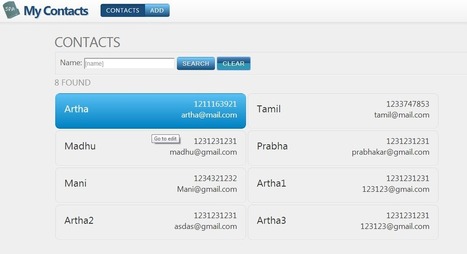
This code sample describes step by step creation of My Contact project using MVC 4 - Hot Towel Single Page Application Template.

I am explaining the step by step creation of My Contact project using MVC 4 Hot Towel SPA and I have written inline comment in the source code for better understanding the code. In this web page I am concentrating on steps for creating this application. 

No comment yet.
Scoop.it!

Simple Todo List App with DozerJS

Simple Todo List App with DozerJS | JavaScript for Line of Business Applications | Scoop.it

One of the great features of DozerJS is that it is extremely simple to work with, even for those new to NodeJS development.

In this post I'm going to walk through creating a basic Todo-List application to demonstrate basic usage and I/O.


1. Install the NPM
2. Start a New Project
3. Generate Modules
4. Build A Model
5. Inspect the API
6. Setup The Controller
7. The Public UI

No comment yet.
Scoop.it!

Now shipping: Principles of Object-Oriented JavaScript

Now shipping: Principles of Object-Oriented JavaScript | JavaScript for Line of Business Applications | Scoop.it

First and foremost, this book is the print edition of my self-published ebook, but with actual copy editing, tech editing, and professional graphics. The topics covered are the same and are mostly covered in the same way (the No Starch version has additional clarifications in some places). As a bonus, there is a No Starch ebook version.

The book itself is about understanding objects in JavaScript. Topics include:

  • The differences between primitive and reference values
  • What makes JavaScript functions so unique
  • The various ways of creating an object
  • The difference between data properties and accessor properties using ECMAScript 5
  • How to define your own constructors
  • How to work with and understand prototypes
  • Various inheritance patterns for types and objects
  • How to create private and privileged object members
  • How to prevent modification of objects using ECMAScript 5 functionality

One of the things I wanted to do with this book was treat ECMAScript 5 as the current version of JavaScript. There are still a lot of books that end up saying things like, “if your browser supports ECMAScript 5, do it this way.” I wanted to look towards a future where ECMAScript 5 is the minimum version everyone uses, and so I chose to do away with those qualifying statements and use ECMAScript 5 terminology exclusively throughout.

No comment yet.
Scoop.it!

Single Page Application performing database CRUD operations using Backbone and ASP.NET WebAPI

Single Page Application performing database CRUD operations using Backbone and ASP.NET WebAPI | JavaScript for Line of Business Applications | Scoop.it

This tutorial is about creating a Single Page Application using Backbone and performing database CRUD (Create, Read, Update and Delete) operations using ASP.NET Web API as a RESTful service.

Contents list of this article:

  1. Short description of Single Page Application.
  2. Short description of Backbone.
  3. Short description of ASP.NET Web API.
  4. Sample Single Page Application using Backbone and Web API.
No comment yet.
Scoop.it!

Twitter Streaming API with Node.js, Socket.io and ReactJS

Twitter Streaming API with Node.js, Socket.io and ReactJS | JavaScript for Line of Business Applications | Scoop.it

I have been working in a prototype using the Twitter Streaming API with Socket.io and ReactJS for the frontend, Node.js in the backend, cool stuff!

I used several articles as a reference, the one using the streaming API using socket.io(but AngularJS and ntwitter npm package), real-time django using node.js and socket.io or a modern python stack for a real time web application.

In the end as I said I used nodejs, the twit package and socket.io in the backend. With all these tools was incredibly easy to have something running fast.

And these are the different parts composing the example, the installation of the different tools is beyond the scope of this article just because I want to focus more in functionality and I don't want the article to be very long.

Anyway if you have a question/criticism here I am. :-)

Jan Hesse's insight:

More ReactJS Intro: http://javaguirre.net/2014/02/09/reactjs-by-example/

No comment yet.
Scoop.it!

Interactive online course for learning Javascript.

Interactive online course for learning Javascript. | JavaScript for Line of Business Applications | Scoop.it

This book will teach you the basics of programming and Javascript. Whether you are an experienced programmer or not, this book is intended for everyone who wishes to learn the JavaScript programming language.

In this first chapter, we'll learn the basics of programming and the Javascript language.

No comment yet.
Scoop.it!

angular-localize - A localization module for AngularJS

angular-localize - A localization module for AngularJS | JavaScript for Line of Business Applications | Scoop.it

By running grunt locales:build you can get a set of JavaScript locale files that can be used to help translate content.

The basic angular-localize directive is used by adding the localize attribute to a tag. The text in the element will be used as the translation key, but you can uselocalize="key" to specify the key instead, which is useful if the final content hasn’t yet been copy edited.

The localize directive also observes data-* attributes and passes them as objects to translation functions, so data can be inserted into text dynamically.

There’s also a localize service for translating text in your JavaScript code, and there’s even a localizeFactory for creating your own attribute-based localize directives.

No comment yet.
Scoop.it!

How Scribblify Delivers a Cross-Platform GUI with Node.js and the Chromium Embedded Framework

How Scribblify Delivers a Cross-Platform GUI with Node.js and the Chromium Embedded Framework | JavaScript for Line of Business Applications | Scoop.it

The Scribblify drawing app with its 10-point touch capability and Google Chrome-based GUI took the grand prize in the Intel® App Innovation Contest 2013 using resources from the Intel® Developer Zone.

No comment yet.
Scoop.it!

Patterns in Polymer: The Greatest Book Ever

Patterns in Polymer: The Greatest Book Ever | JavaScript for Line of Business Applications | Scoop.it

Reusable web components in glorious isolation

Polymer lets you create your own <HTML>tags in complete isolation from what the rest of the web page is doing. The result is rock-solid, reusable code that just works™. Learn how to get the most out of this exciting new platform.


As web application complexity spirals out of control, next generation browser features that cut through the craziness remain out of reach.
What if you could use next generation features today?


aelena's comment, March 4, 2014 5:06 AM
anyone read it? any feedback?
aelena's comment, March 4, 2014 5:10 AM
thanks for commeting... just one more question, Was it something you think can be practical and feasible in a real live environment or is it more of an academic exercise?
Scoop.it!

Rewriting A WebApp With ECMAScript 6

Rewriting A WebApp With ECMAScript 6 | JavaScript for Line of Business Applications | Scoop.it

Today it’s possible for us to author in ES6 and transpile our sources down to ES5 at build-time, regardless of whether we’re using Grunt, Gulp or Broccoli. With projects like Ember and Angular looking to ES6 as part of their roadmaps too (Ember App Kit already supports ES6 modules!), now is a great time to learn how ES6 can be used in practice.

In this guide, we’ll re-write the well known TodoMVC application (implemented withBackbone.js) using ECMAScript 6 language semantics. The implementation is made possible using Google’s Traceur compiler and ES6-Module-Loader.

If you haven’t come across these tools before, Traceur is a JavaScript.next-to-JavaScript-of-today compiler that allows you to use features from the future today and the ES6 Module Loader dynamically loads ES6 modules in Node.js and current browsers. If you’re wondering whether Traceur is ready for production-level apps, Erik Arvidsson recently answered this on their mailing list.

No comment yet.
Scoop.it!

Setting Up GitHub to work with Visual Studio 2013 Step-by-Step

Setting Up GitHub to work with Visual Studio 2013 Step-by-Step | JavaScript for Line of Business Applications | Scoop.it
This post will show you how to setup Visual Studio 2013 to work with Github
No comment yet.
Scoop.it!

Siesta - JavaScript unit testing tool

Siesta - JavaScript unit testing tool | JavaScript for Line of Business Applications | Scoop.it

Siesta is a JavaScript unit testing tool that can help you test any JavaScript code and also perform testing of the DOM and simulate user interactions. The tool can be used together with any type of JavaScript codebase – jQuery, Ext JS, NodeJS, Dojo, YUI etc. Using the API, you can choose from many types of assertions ranging from simple logical JS object comparisons to verifying that an HTML element is visible in the DOM. It comes in two versions: Lite and Standard. With Lite you can easily test your JavaScript in the browser, and with Standard you can also automate your tests (highly recommended).

No comment yet.
Scoop.it!

Prototypal Inheritance With Stamps

A stamp is a factory function which has public properties that specify a delegate prototype, default instance state, and a function that sets up encapsulation for object instances. Stamps utilize three different types of inheritance to create the new object:

  • Delegate prototype – Delegation / Differential Inheritance

  • Instance state – Cloning / Concatenative Inheritance / Mixins

  • Encapsulation – Functional Inheritance

Stampit is a library written to demonstrate how we might use sugar to simplify prototypal OO. It exports a single function.

It demonstrates prototypal inheritance with factories.

No comment yet.
Scoop.it!

Getting started with Broccoli and Ember.js

Broccoli is a new build tool released recently by Jo Liss. Matt and I took the project for a spin last week, and we were impressed by the benefits of using Broccoli. Our task was simple. We wanted to achieve a bootstrapped Ember.js application, similar to what Stefan’s AppKit provides.

To list a few of the features:

  • Ember.js idiomatic application structure with ES6 modules
  • A persistence layer provided by Ember Data (think of it as an ORM for your application)
  • Production, Development (Fixtures) and Test environments support
  • Testing support using QUnit and Ember Testing package
  • Continuous Integration cross-browser ready test runner
  • CoffeScript support
  • Less/SCSS support (we went using Less along with Bootstrap 3)
No comment yet.
Scoop.it!

jGestures: a jQuery plugin for gesture events

A jQuery plugin that enables you to add gesture events such as 'pinch', 'rotate', 'swipe', 'tap' and 'orientationchange' just like native jQuery events. Includes event substitution: a "tapone" event can be triggered by "clicking", a "swipe" by performing a swipe-ish mousegesture.

Brings 27 new events to your bag.

No comment yet.