JavaScript for Line of Business Applications
606.6K views | +7 today
JavaScript for Line of Business Applications
Keeping track of current JavaScript Frameworks that help design your clientside Business Logic Layers.
Curated by Jan Hesse
Beam to my Inbox:
Your new post is loading...

Popular Tags - Filter using the Funnel

Scoop.it!

Reactive UIs with React & Bacon

Reactive UIs with React & Bacon | JavaScript for Line of Business Applications | Scoop.it

Like many great tools, React focuses on one problem: the views in your web application. The rest of the technology stack is left up to you. If you haven’t had a chance to play with React, I highly recommend spending a couple of hours reading up on it.

If, like me, you’re used to building web applications around the MVC design pattern, then your next move is likely to reach for something like Backbone.js.


As it turns out, Backbone is quite a nice fit with React. You can simply switch out your Backbone views with React components. There’s even a nice little mixin.Let’s say that we have two React components: a TextField and Label. They’re both bound to the same Backbone model, so when the text in the text field changes the label updates its text automatically. To make things more interesting the label shows the text in reverse.

No comment yet.
Scoop.it!

Promises and Error Handling

Promises and Error Handling | JavaScript for Line of Business Applications | Scoop.it

We’ve standardized on using promises to manage most of the asynchronous interactions in our JavaScript codebase. In addition to really enjoying the extra expressiveness and aggregation possibilities offered by promises, we’re benefitting greatly from richer error handling. We’ve had some surprises though, and this post explains some things which caught us out and some guidelines we’re following to avoid similar situations in future.

We use the excellent when.js library, however this post should be relevant no matter what implementation you’re using.

No comment yet.
Scoop.it!

Intercooler.JS - The Javascript-optional AJAX library

Intercooler.JS - The Javascript-optional AJAX library | JavaScript for Line of Business Applications | Scoop.it

Intercooler is a Partial View Controller framework that allows you to add AJAX to your application with declarative HTML5-style bindings and REST-ful URLs, giving web applications a richer UX with a minimum of code.

Rather than expecting JSON responses it expects fragments of HTML (i.e. Partial Views), which are then loaded into the DOM directly.

* Scaleable

* Declarative

* Automatic Dependency Detection

* Framework Agnostic

* Bootstrap Friendly

* Open

No comment yet.
Scoop.it!

Contour: Interactive JavaScript Charts for Data Visualization

Contour: Interactive JavaScript Charts for Data Visualization | JavaScript for Line of Business Applications | Scoop.it

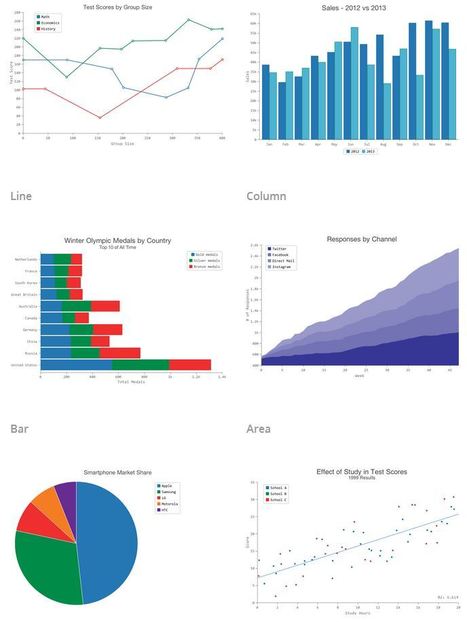
Forio Contour provides a core set of common visualizations that you can see in the gallery, and it's easy to extend if you want to add your own customizations. Plus, it's free and open source.

Forio Contour uses the popular D3 engine and adds a set of intuitive abstractions so you can easily create graphs and charts.

No comment yet.
Scoop.it!

Hubs.tt will save your life by generating TypeScript out of your SignalR Hubs

Hubs.tt will save your life by generating TypeScript out of your SignalR Hubs | JavaScript for Line of Business Applications | Scoop.it

Recently I started playing with SignalR using TypeScript, one of the things that very quickly made it's way into my project is the Hubs.tt T4 template file

Hubs.tt is a "T4 template that creates Typescript type definitions for all your Signalr hubs. If you have C# interface named "I<hubName>Client", a TS interface will be generated for the hub's client too. If you turn on XML documentation in your build, XMLDoc comments will be picked up. 

No comment yet.
Scoop.it!

Posting Data & AngularJS Custom Directives in an ASP.NET MVC application

Posting Data & AngularJS Custom Directives in an ASP.NET MVC application | JavaScript for Line of Business Applications | Scoop.it

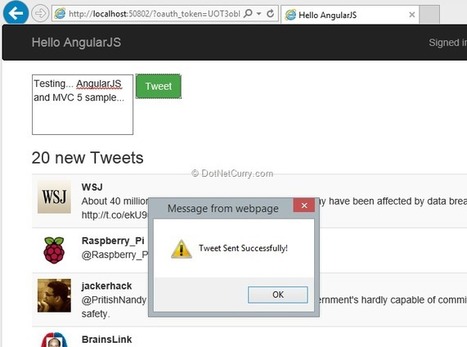
In this article, we will explore how to use AngularJS to Post Data and use AngularJS Custom Directives in an ASP.NET MVC application.

So to post data, we need to simply call the save function on our resource instance. However there is a slight gotcha. The $resource object expects all the functions to post to the same URL. In MVC terms, this means posting to the same action method with different HttpGet/HttpPost/HttpPut etc attributes.

In our code, currently the HomeController uses GetTweets method to get the Data. Now Posting to a URL called GetTweets is semantically icky. So let’s update the Controller method to be called justTweet. So we will do GET, POST, PUT etc. requests to the url /Home/Tweet.

No comment yet.
Scoop.it!

Parallel.js: Parallel computing with Javascript

Parallel.js: Parallel computing with Javascript | JavaScript for Line of Business Applications | Scoop.it
Parallel.js is a library for performing parallel computing in Javascript using web workers.

Parallel.js is a tiny library for multi-core processing in Javascript. It was created to take full advantage of the ever-maturing web-workers API. Javascript is fast, no doubt, but lacks the parallel computing capabilites of its peer languages due to its single-threaded computing model. In a world where the numbers of cores on a CPU are increasing faster than the speed of the cores themselves, isn't it a shame that we can't take advantage of this raw parallelism?

Parallel.js solves that problem by giving you high level access to multicore processing using web workers. It runs in your browser (as long as it supports web workers). Check it out.

No comment yet.
Scoop.it!

Build a RESTful API Using Node and Express 4

Build a RESTful API Using Node and Express 4 | JavaScript for Line of Business Applications | Scoop.it

With the release of Express 4.0 just a few days ago, lots of our Node apps will have some changes in how they handle routing. With the changes in the Express Router, we have more flexibility in how we can define the routes for our applications.

Today we’ll be looking at creating a RESTful API using Node, Express 4 and its Router, and Mongoose to interact with a MongoDB instance. We will also be testing our API using Postman in Chrome.

Let’s look at the API we want to build and what it can do.

No comment yet.
Scoop.it!

jsCache | cross-browser caching of javascripts, css and images in localstorage

jsCache | cross-browser caching of javascripts, css and images in localstorage | JavaScript for Line of Business Applications | Scoop.it
jsCache is a javascript library that enables caching of javascripts, css-stylesheets and images using my localStorage polyfill. This is especially useful when serving your website for mobile phones, which has limited HTTP caching available, but also speeds up your site in an ordinary webbrowser as it saves HTTP requests and loads all files asynchronously.
No comment yet.
Scoop.it!

vis.js | a dynamic, browser-based visualization library

vis.js | a dynamic, browser-based visualization library | JavaScript for Line of Business Applications | Scoop.it

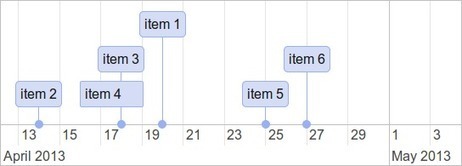
Vis.js is a dynamic, browser based visualization library. The library is designed to be easy to use, to handle large amounts of dynamic data, and to enable manipulation of and interaction with the data. The library consists of the components DataSet, Timeline, and Graph.

No comment yet.
Scoop.it!

Handling DOM events in Backbone.js and working with Collections

Handling DOM events in Backbone.js and working with Collections | JavaScript for Line of Business Applications | Scoop.it
The Backbone.js library allows you to develop responsive web applications with clear separation of Model and View. DOM Events associated with Collection helps to notify the UI elements about Updates and accordingly to display refreshed data

In Backbone, the View (UI) is generally rendered using HTML Templates, and elements declared in this Template are accessible to View, but it might be possible that the HTML page (or MVC view or .aspx) already contains HTML elements and you need to handle the DOM events for these elements. The question then is how to handle them? In the following implementation, we will see that the ‘click’ event for the html button element is handled inside the View object. The method which gets executed for the click event is used to add the model object into the collection and then the collection is rendered using HTML Table.

No comment yet.
Scoop.it!

Using Firebase to sync data with a webpage

Using Firebase to sync data with a webpage | JavaScript for Line of Business Applications | Scoop.it

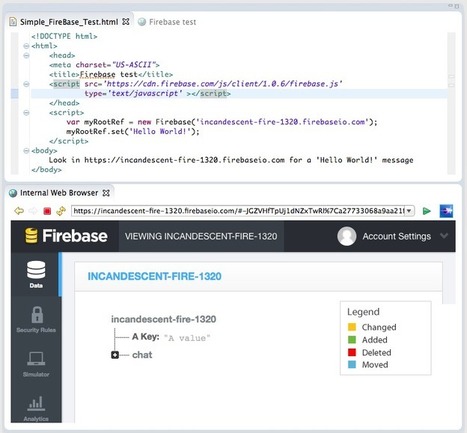
Firebase really seems to fix one of the pain points that I currently have in client-server development, which is how to send/synchronise data across multiple clients (including the server).

I first heard about Firebase from the Wire up a Backend example that can be found at http://angularjs.org, and today I was able to give it a test drive.

1) Creating an Firebase account

2) Firebase tour

3) Creating a simple Html/Javascript page to test it out

4) Setting and Pushing data

5) receiving events

5) Consuming and Sending events using REST API

6) Programatically add new items to the Chat window

6) What about XSS

No comment yet.
Scoop.it!

Ember - Tricks | Code snippets repository for emberjs

Basically, the whole idea is to have a central location solely dedicated to sharing and finding quick code snippets for emberjs.


* Looping over an array in your template
* Linking to a route in your template
* Creating nested routes
* Creating a custom helper with momentjs
* Redirecting a route to another before it is loaded
* Boilerplate for creating a view

No comment yet.
Scoop.it!

A Thrown-to-the-Wolves-Hands-On Introduction to React

A Thrown-to-the-Wolves-Hands-On Introduction to React | JavaScript for Line of Business Applications | Scoop.it

There are some great React overview posts (which I will link to at the bottom of this post), so I wanted to try something a bit different. Having used other MV* frameworks, I wanted to dive right into React and see what it took to get up and running, and how it felt in the trenches getting from ideas to DOM. So, up front, we're going to focus on turning an app concept into a React-based implementation – we'll chat more about the philosophy and opinion behind React at the end. All you need to know for the moment is that React is "a JavaScript library for building user interfaces".

No comment yet.
Scoop.it!

Framework7 - Full Featured HTML Framework For Building iOS7 Apps

Framework7 - Full Featured HTML Framework For Building iOS7 Apps | JavaScript for Line of Business Applications | Scoop.it

Framework7 - is a free and open source HTML mobile framework to develop hybrid mobile apps or web apps with iOS 7 native look and feel. It is also an indispensable prototyping apps tool to show working app prototype as soon as possible in case you need to.

The main approach of the Framework7 is to give you an opportunity to create iOS 7 apps with HTML, CSS and JavaScript easily and clear. Framework7 is full of freedom. It doesn't limit your imagination or offer ways of any solutions somehow. Framework7 gives you freedom!

Framework7 is not compatible with all platforms. It is focused only on iOS 7 to bring the best experience and simplicity.

Framework7 is definitely for you if you decide to build iOS 7 hybrid app (PhoneGap) or web app that looks like and feels as great native iOS 7 apps.

No comment yet.
Scoop.it!

JSDoc vs YUIDoc vs Doxx vs Docco – Choosing a JavaScript documentation generator

JSDoc vs YUIDoc vs Doxx vs Docco – Choosing a JavaScript documentation generator | JavaScript for Line of Business Applications | Scoop.it
Recently, we had to choose a JavaScript document generator tool for documenting APIs of various FusionCharts products. API documentation is different from normal documentation because API documentation is generated directly from the source code by reading the comments written in the source code.
No comment yet.
Scoop.it!

A Detailed Introduction To Custom Elements

A Detailed Introduction To Custom Elements | JavaScript for Line of Business Applications | Scoop.it

Web Components are a suite of connected technologies aimed at making elements reusable across the Web. The lion’s share of the conversation has been around Shadow DOM, but probably the most transformative technology of the suite is Custom Elements, a method of defining your own elements, with their own behavior and properties.

That’s quite an ambiguous description, so the point of this article is to explain what Custom Elements are for, why they’re so transformative and how to use them. Please note, first, that I’ll talk about custom elements (common noun) when discussing the concept and Custom Elements(proper name) when discussing the technology, and secondly, that my humor tends to wear very thin very quickly. Let’s push forward.

No comment yet.
Scoop.it!

Hacking Core Directives in AngularJS

Because Angular is totally modular, you can easily replace any of its parts. Lets look at ngSrc for a case where this technique is useful...

We want to parse a list of Angular expressions from the value of ngSrc and only set src if all of them are defined.
We can use decorators to make ngSrc have this behavior.


No comment yet.
Scoop.it!

Learn version control with Git - free online book and videos!

Learn version control with Git - free online book and videos! | JavaScript for Line of Business Applications | Scoop.it
Aimed at the complete beginner, 'Learn Git' helps you get started with Git - the best version control system currently available. A free online book, videos, and ebooks get you off the ground as quickly as possible.
No comment yet.
Scoop.it!

End to End testing with CasperJS

End to End testing with CasperJS | JavaScript for Line of Business Applications | Scoop.it

In this tutorial, we get in touch with end to end testing in JavaScript. To save time, we take the existing ToDo App written with Backbone.js. We will extend this app by adding a grunt workflow. 

We are using following tools:

* PhantomJS – a commandline webkit browser without a GUI.
* CasperJS – scripting and testing tool build for PhantomJS which adds some nice JavaScript API for filling forms, making screenshots, etc.


No comment yet.
Scoop.it!

Shadow DOM - Why HTML/CSS is broken and how to fix it.

Shadow DOM - Why HTML/CSS is broken and how to fix it. | JavaScript for Line of Business Applications | Scoop.it

SVG, CSS, React and Angular

For a while now I've been working on MathBox 2. I want to have an environment where you take a bunch of mathematical legos, bind them to data models, draw them, and modify them interactively at scale. Preferably in a web browser.

Unfortunately HTML is crufty, CSS is annoying and the DOM's unwieldy. Hence we now have libraries like React. It creates its own virtual DOM just to be able to manipulate the real one—the Agile Bureaucracy design pattern.

The more we can avoid the DOM, the better. But why? And can we fix it?

No comment yet.
Scoop.it!

9 Minimal Frameworks for Front-End JavaScript Development

9 Minimal Frameworks for Front-End JavaScript Development | JavaScript for Line of Business Applications | Scoop.it

Imagine for a second the fact that, five years ago, we already had frameworks like jQuery to play with, and while not as functional and feature rich as today – it was already possible to configure and play with the web in hardly imaginable ways.

Today, there are literally hundreds of thousands of frameworks available to anyone who is brave enough to learn something new. Yes, most of them play very tiny role in the collective evolution of web development, but even that tiny contribution counts.

Front-end is not just about HTML & CSS, it involves creativity just as much as it involves writing code in JavaScript, PHP, Python or any other programming language of your choice.

Have a look at my post on the top web programming languages in 2014 – if you’ve been following the trend, it will not be hard to see that most of those languages have held the top spot for over a decade.

I’m sure you know a lot of this stuff already, but it doesn’t hurt to refresh your memory and bask in a little bit of nostalgia from time to time. If you think that I didn’t mention your favorite framework because I hate you: surprisingly, you’d be right!


* AuraJS
* Kraken
* min.js
* Reactive Coffee
* Responsive
* scaleApp
* skelJS
* Spine
* Stapes.js

No comment yet.
Scoop.it!

How I Setup Angular + Node Projects

How I Setup Angular + Node Projects | JavaScript for Line of Business Applications | Scoop.it

When I first started building apps that used the Angular JS + Express + Mongo + Node setup... the helpful resources on how to do so we're scarce.

Anyhow, depending on the level of interest, I'll continue walking through how I setup everything from accounts to security to payments to SSL. But for now, all this is is setting up the development environment. Just getting all the pieces can often turn into a nightmare, so I wanted to share how I do it. This setup covers the following:

* Making the server nothing more than a REST service
* Keeping all tools and generators easily updated and independent
* Making deployment relatively simple.
* Have unit tests available separately for the front-end. (if you're in to that type of thing)
* Uses the magic of Yeoman and Generators for quick scaffolding.
* Read #5 again. Because Yeoman is that cool.

No comment yet.
Scoop.it!

Getting Started with Backbone.js and Rendering a Collection using View

Getting Started with Backbone.js and Rendering a Collection using View | JavaScript for Line of Business Applications | Scoop.it

In the current era of web application development, Single Page Applications (SPAs) are often demanded by customers. Currently there are lots of different frameworks available for developing web applications, most of these are server side frameworks e.g. ASP.NET MVC. But one of the important aspects for Web development is to provide a Rich user interface with UX (user experience). Thankfully there are several JavaScript client side frameworks available to get this thing done e.g. jQuery, Knockout, Backbone etc. Using these frameworks, a developer can develop Rich and better UX applications.

No comment yet.
Scoop.it!

How to Create Custom HTML Elements

How to Create Custom HTML Elements | JavaScript for Line of Business Applications | Scoop.it

An exciting feature of the HTML specification that’s been getting a bit of hype recently is custom HTML elements. These allow you to create your own HTML elements along with their own JavaScript API. This can be useful when building interfaces with components that are reused throughout an application.

In this blog post you’re going to learn how to create your own HTML elements and define a JavaScript API for them.

* Creating Custom HTML Elements
* Creating a JavaScript API For Your Element
* Extending Existing Elements
* Custom Element Callback Methods
* Custom Elements with Shadow DOM
* Browser Support for Custom HTML Elements
* Final Thoughts
* Useful Links

No comment yet.