


This article explains how authentication is setup in Angular applications. The reader will learn how to log in, log out, and secure routes.


 Your new post is loading...
  Scoop.it! This article explains how authentication is setup in Angular applications. The reader will learn how to log in, log out, and secure routes. 
No comment yet.
Sign up to comment
Scoop.it!

A step-by-step presentaion on Protractor End-to-End Testing for AngularJS
Scoop.it!
Node.js is one of those new technologies, which are attracting more and more developers every day. Mainly, because it's JavaScript driven, a lot of people are interested working with it. In this tutorial, I'll show you how to use AbsurdJS together with Express. Express is one of the popular Node.js frameworks. However, the other instrument is really fresh one and I hope that you will find it useful.
Scoop.it!
Scoop.it!
Tower’s CTO, Andrew Reedy will give a brief overview of how to take advantage of the realtime javascript platform Meteor.js for quickly developing database everywhere, scaleable web applications. He explains how to set up Meteor with Cordova and also Famo.us. Tower is a San Diego based startup and mobile application that connects people inside of residential towers, office buildings, and what they call temporary towers (resorts, cruise ships, conferences.) See how Tower takes advantage of a modern stack including Meteor, MongoDB, Cordova, Redis, ElasticSearch, Docker, and CoreOS to scale their mobile app..
Scoop.it!

From
fr

To those not used to functional programming, Ramda seems to serve no purpose whatsoever. Most of its major capabilities are already covered by libraries like Underscore and LoDash. These folks are right. If you want to keep coding with the same imperative and object-oriented styles you've been using, Ramda does not have much to offer you. However, it does offer a different style of coding, a style that's taken for granted in purely functional programming languages: Ramda makes it simple for you to build complex logic through functional composition. Note that any library with a compose function will allow you do functional composition; the real point here is: "makes it simple". Let's see how that works in Ramda.
Scoop.it!
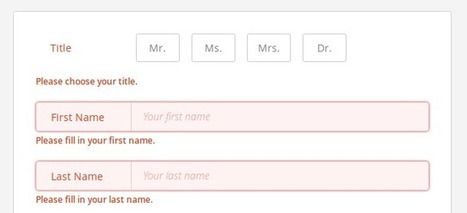
Good input validation is an essential part of any web application. This post covers how you can easily show error messages in your Ember.js forms.
Scoop.it!

Creating desktop applications using HTML5 technologies: Wrapping it Up! (6/6)
Scoop.it!
Today I launch a new series of postings, bringing together two themes I’ve been developing for the past few months: AngularJS and Kendo UI. These technologies go together like peanut butter and chocolate, and both share two characteristics that are critical to this series: The technology is hot, desirable and useful. Part 2: Binding With ng-model and Moustaches
Jan Hesse's insight:
Scoop.it!

Last month Jonathan Creamer wrote an awesome article on Angular and MVC, The state of AngularJS Controllers. The article touches on misconceptions of client-side MVC and true Model and Controller separation. This article is my rethinking of Angular Controllers, and best practices when using them in your team or for yourself.
Scoop.it!

There's been a lot of talk about Reactive Programming lately, but nobody really knows exactly what it is. I'll first talk a little bit about what Reactive Programming is and then we'll dive into practical examples on how to use it with AngularJS. We'll see how beautiful and clean our code can be when we use Reactive code with Angular.
Scoop.it!

From
n12v
Let’s build a temperature converter app in Backbone, React, Angular, Meteor and vanilla JavaScript. Vanilla JS is our baseline. Input values are synchronised using two event handlers, one on each input field.
Jan Hesse's insight:
Scoop.it!

This AngularJS course is built with the intent of exposing you to the best available resources on each Angular topic. Our desire is to present these topics richly, and from a variety of vantage points, in order to afford you a more complete perspective on them.
|
Scoop.it!

Going through the Protractor docs and getting started can still be a daunting task. My goal is to alleviate some of that by sharing my configuration and setup, as well as using the page object pattern for creating an API through which we’ll interact with our web pages. We’ll also be using the jasmine-given library to help clean up our specs.
Scoop.it!

From
github
First off, what are we building? Well, forget the overdone hello world and todo apps, let's build something more - a Bitcoin Calculator! This app details how much you could potentially profit if you invested X amount of dollars in Bitcoins. Through this tutorial, I'll walk you through the basics of designing a web app using Angular. We'll highlight many of the key features of the framework, including templating, two-way data binding, directives, and filters.
Scoop.it!

Last week in Oslo I was lucky enough to attend the fantastic NDC 2014 conference, at which I gave the following talk about using brand-new not-yet-released Knockout.js features, along with Yeoman, Gulp, and Karma to build large single-page web apps in a very modern style (while still retaining backward compatibility all the way to IE 6!). This should be of interest to anyone who uses Knockout or cares about scalable front-end architecture.
Scoop.it!

Developers who are well versed in Ruby on Rails (or other MVC implementations) and start learning Ember.js may find it surprising that, even though there’s shared vocabulary, denoted concepts are sometimes very different. The first and obvious difference comes from the fact both are web frameworks. Rails facilitates the creation of web apps that offer mainly an HTTP interface to interact with. On the other hand, Ember helps create web apps that interface directly with humans (through clicks, taps, key presses, etc). They are both web application frameworks, but the former is server side and the latter client side. A look into their workflows will shed light over the main differences.
Scoop.it!

From
github
Make Meteor's Session object persist its values locally and across page refreshes. Meteor's default implementation loses values whenever the page is refreshed. Uses amplifyjs's store library to save values in the browsers localStorage, falling back to other solutions if it's not available.
Scoop.it!

From
fluxxor
Fluxxor is a set of tools to facilitate building JavaScript data layers using the Flux architecture by reifying many of the core Flux concepts. It works particularly well in conjunction with React as the view layer, and contains a few helpers to make integration with React applications easier. The Flux architecture...
Scoop.it!

Let me introduce you to something called SailsJS, a Node framework built on top of Express. Yes, it’s a framework on top of a framework, like my Sunday pancake stack. This may sound like overkill, but Express is really a microframework in that it only provides very basic functionality for your app. SailsJS adds extended functionality to get your app running off the ground quickly. Getting hungry?
Scoop.it!

Bryan’s article describes Value Objects as “…simple objects whose equality is dependent on their value rather than an identity.” Because JavaScript adheres to the “pass-by-reference” principle for all JavaScript objects, there are no native examples of this in ECMAScript 5 or even Harmony, save for primitives. For example...
Scoop.it!

Last year, I wrote about and recommended some great resources for getting good with andJavaScript. A year is a long time in Internet terms and I figured now was a good time for a refresh. JavaScript continues to explode in terms of adoption and being fully embraced, not only in the browser but also on the server. So it's about time we revisit the list and update it with good places to stay current.
Scoop.it!

AngularJS has been attracting a lot of attention lately and most Angular applications need to have models and communicate to a Rest API. However, AngularJS is not opinionated at all regarding models since they are simple POJSOs (Plain Old JS Objects). The main intention of this talk is to show by example how to create models with fields and behaviour on JS that are gotten from a Rest API very with the help of Restangular, which allows us to handle models relations, extended state and behaviour in a very elegant way. I'm also going to compare this approach to working with $resource.
Scoop.it!

The challenge I faced with AngularJS was getting the menus to automatically update according to changes in parent menu selection. (E.g., changing operating system by region selection). This required some tricky binding to accomplish, which I will demonstrate below. When the application is loaded, it retrieves from a JSON file information about which options belong in which drop-down menus:
Scoop.it!

Facebook's React is an interesting approach to UI programming in the browser that does away with manual DOM manipulation all together, and more closely resembles classic UI programming. Combine this approach with the immutable data structures of Clojurescript, and we're really getting somewhere. In this talk I will explore the path to fully functional UI programming in the browser through React, Clojurescript, Om (React for Clojurescript) and other tools.
|




