JavaScript for Line of Business Applications
606.5K views | +16 today
JavaScript for Line of Business Applications
Keeping track of current JavaScript Frameworks that help design your clientside Business Logic Layers.
Curated by Jan Hesse
Beam to my Inbox:
Your new post is loading...
Popular Tags - Filter using the Funnel

Scoop.it!

introduction to unit test for AngularJS

introduction to unit test for AngularJS | JavaScript for Line of Business Applications | Scoop.it

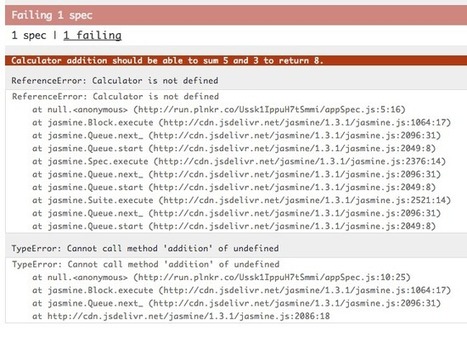
Jasmine is like writing English. It is something easy to read and understand (which is waay cool). Jasmine spec files are normally wrapped on a describe block which receives a string to define what are we describing. They are used to group tests. We can see how we have another describe block which is nested in the previous one with the addition as parameter. See how are we grouping the tests?

No comment yet.
Scoop.it!

A Thorough Guide to Ember Data

A Thorough Guide to Ember Data | JavaScript for Line of Business Applications | Scoop.it
Ember Data streamlines development workflow and minimizes code churn. This guide introduces Ember Data, demonstrating the value it can provide to you as a developer.

In this article, we’ll introduce the most salient features of Ember Data and demonstrate how it helps minimize code churn, through a focus on a real world example.

No comment yet.
Scoop.it!

Build responsive webapps using total.js and Knockout.js

Total.js follows the model-view-controller convention to much success. Simply place the relevant code in models/views/controllers folders and you’re good to go.

There is also the option to build your own modules by writing custom code which can hook into different events in the web application lifecycle.

There’s no lack of Javascript web frameworks, and like any technology toolbox it’s important to use the right tool for the job. While I’ve only just scratched the surface of the framework, I would highly recommend total.js to beginners and experts alike.

No comment yet.
Scoop.it!

Build a Single Page Application with Angular, Node & Mongo

Build a Single Page Application with Angular, Node & Mongo | JavaScript for Line of Business Applications | Scoop.it

Last weekend, I decided to build a single page application to wisely split expenses between friends made during road trips, parties and so on. The frontend uses AngularJS and Gulp for compiling the Less sources. The backend is a Nodejs RESTful API associated to a MongoDB instance. Split.ly must be registration free, easy to use and kind of sexy for the end user.

No comment yet.
Scoop.it!

Best Learning Resources for Meteor.js

Best Learning Resources for Meteor.js | JavaScript for Line of Business Applications | Scoop.it

It’s been over a year that I compiled a list of the best resources to learn the JavaScript framework Meteor.js and back then it was hard to come by any good reading material on the subject. Fortunately, this has changed quite a bit recently, which is why I decided to give this list a complete makeover. Since there has been a lot of change on the road to 1.0 some previously listed resources became outdated, so they were removed from this compilation. But you probably came here to get some inspiration on how to learn Meteor, so don’t let me waste any more of your precious time and get right to the point.

No comment yet.
Scoop.it!

Introducing Orbit.js

Orbit is a new standalone library for coordinating access to data sources and keeping their contents synchronized.

Jan Hesse's insight:

https://github.com/orbitjs/orbit.js

No comment yet.
Scoop.it!

ASP.NET MVC Bundling/minification with angularjs and Typescript

ASP.NET MVC Bundling/minification with angularjs and Typescript | JavaScript for Line of Business Applications | Scoop.it

‘P@Yogesh’ takes a look at how you can minifiy your Angular Code, and introduce type safety using TypeScript, along with sharing some of the common gotchas which cause problems

No comment yet.
Scoop.it!

Techniques for authentication in AngularJS applications

Techniques for authentication in AngularJS applications | JavaScript for Line of Business Applications | Scoop.it
A collection of ideas for authentication & access control
No comment yet.
Scoop.it!

Get Hands-on with Protractor in 3 Steps

Get Hands-on with Protractor in 3 Steps | JavaScript for Line of Business Applications | Scoop.it

Theory only helps till a point with test automation (as with a lot of development practices). So in this article we're going to follow a practical approach to use Protractor. Following these 3 steps below, will give you sufficient hands-on practice to proceed further with Protractor.

No comment yet.
Scoop.it!

Working With Data in Sails.js

Working With Data in Sails.js | JavaScript for Line of Business Applications | Scoop.it

Sails.js is an up and coming Node.js framework, with a focus on freedom and smart defaults. In this article we'll take a look at some of the data features Sails provides out-of-the-box, for easily making complex apps.

Sails was created for production, it's not trying to feed you a new syntax or platform, it's a solid base, meant for creating 'client-work' with speed. The contrast may be subtle, but there are a few distinct differences.

No comment yet.
Scoop.it!

Edge.js - RUN NODE.JS AND .NET IN-PROCESS

Edge.js - RUN NODE.JS AND .NET IN-PROCESS | JavaScript for Line of Business Applications | Scoop.it

A SOFTWARE PLAY IN TWO ACTS

{ Act I }
WHERE NODE.JS SCRIPTS .NET IN-PROCESS
ON WINDOWS, MAC OS, AND LINUX (NEW!)
{ Act II }
WHERE .NET SCRIPTS NODE.JS IN-PROCESS (NEW!)

No comment yet.
Scoop.it!

Testing with Angular.JS

Testing with Angular.JS | JavaScript for Line of Business Applications | Scoop.it

This talk is split in two parts: unit testing and E2E testing (we'll get to the difference between those in a minute). There will be drinks in between.

Each part is roughly: an introduction with a simple test scenario, how to get the tools up and running and then a bunch of tips & tricks for when it gets difficult.

You'll need to supply your own drinks if you're reading this at home.

No comment yet.
Scoop.it!

Protractor Tipps

Protractor: How to click a select option that has a given value

Protractor: How to select a dropdown option to avoid ElementNotVisibleError

Protractor: How to avoid UnexpectedAlertOpenError

No comment yet.
Scoop.it!

Hello Meteor - a journey to the core of meteor

Hello Meteor - a journey to the core of meteor | JavaScript for Line of Business Applications | Scoop.it

As I continue to create more applications with Meteor, there are some details about the framework that I wanted to learn more about in order to become a better meteor developer. I went looking to have my questions answered and here is what I found...

No comment yet.
Scoop.it!

Bring Fun Back to JS: Step-by-Step Refactoring Toward Ember

Bring Fun Back to JS: Step-by-Step Refactoring Toward Ember | JavaScript for Line of Business Applications | Scoop.it
You just wanted to add some nice interactive functionality to your Rails app. But then one jQuery plugin turns to three, add a dash of statefulness, some error handling, and suddenly you can’t sleep at night. We’ll walk through using Ember Components to test-drive a refactor until your front-end code is understandable, usable, and extensible. …
No comment yet.
Scoop.it!

Authentication with AngularJS and a Node.js REST api

Authentication with AngularJS and a Node.js REST api | JavaScript for Line of Business Applications | Scoop.it

The goal of this project is to learn how to build an authentication and authorization mecanism with AngularJS and a RESTful api running on a Node.js server. We can’t use cookies or sessions like an ordinary web application. So, we will use a token mecanism to authenticate our users.

When a user sends his credentials, the Node.js server checks that they are correct and answers with a unique token built with the user informations. The AngularJS application stores the token in the user’ SessionStorage and adds an Authorization header containing the token in every requests made after that. If the endpoint is restricted to authenticated users, the server checks the validity of the token and returns the data if the token is valid or a status code 401 otherwise. In addition to that, the AngularJS application checks if the user is logged in and if he can access the requested route. Otherwise, the user is redirected to the login page.

No comment yet.
Scoop.it!

Designing Javascript APIs

We at Filepicker.io spend a lot of time thinking about APIs. With the release of our Version 1.0 javascript API, we thought about best practices for javascript API design, and wanted to share them so that when we use your API, it’ll be just as awesome as when you use ours.

Rules of your Javascript API


* Rule 0: Never make breaking changes to your API. Unless you must.
* Rule 1: Provide wood and nails, and a complete house for your API
* Rule 2: Have nouns, verbs, and a complete bipartite graph
* Rule 3: When dealing with APIs fail fast, or better, not at all
* Rule 4: If the API is hard to use, it’s not good enough

No comment yet.
Scoop.it!

Introduction to Orbit.js and the integration library Ember-Orbit

Autonomous Web Applications with Ember.js and Orbit.js
No comment yet.
Scoop.it!

Cucumber.js browser runner

Browser runner for cucumber.js library This runner is a wrapper around cucumber.js library which is responsible for running a tests written in Gherkin

No comment yet.
Scoop.it!

ki - a functional programming language

ki - a functional programming language | JavaScript for Line of Business Applications | Scoop.it

ki is a functional programming language that expands into JavaScript through a very thin layer of sweet.js macros. It is designed to complement JavaScript, enriching it with functional programming idioms and immutable data structures. ki can be used to write entire applications, individual components (e.g. state management) or just functional one-liners.

ki syntax and semantics are heavily inspired by Clojure. Thanks to mori, ki incorporates ClojureScript’s persistent data structures and related API.

No comment yet.
Scoop.it!

Techniques for authentication in AngularJS applications

Techniques for authentication in AngularJS applications | JavaScript for Line of Business Applications | Scoop.it
A collection of ideas for authentication & access control
No comment yet.
Scoop.it!

Single Page ToDo Application With Backbone.js

Single Page ToDo Application With Backbone.js | JavaScript for Line of Business Applications | Scoop.it
Join me as I walk you through creating models, collections, views, events, and a router to build a single page web application in Backbone.js. | Difficulty: Beginner; Length: Medium; Tags: Web Development, BackboneJS, JavaScript & AJAX, HTML & CSS
No comment yet.
Scoop.it!

Knockout-Animate.js

Knockout-Animate.js | JavaScript for Line of Business Applications | Scoop.it

Knockout-Animate.js is a small collection of knockout.js binding handlers that allows you to quickly enhance your website or web application with subtle CSS3 animations. This library is great for showing/hiding elements in a fancy way.

No comment yet.
Scoop.it!

Boilerplate for AngularJS + Sails.js

Boilerplate for AngularJS + Sails.js | JavaScript for Line of Business Applications | Scoop.it

Modern web applications has separated front- and backend sides to use. This boilerplate present one way to make your application which have fully separated back- and frontend sides.

Main goals of this boilerplate
  • Separate back- and frontend development
  • Light frontend application
  • Authenticate with backend (possible multiple ways: local, github, twitter, etc.)
  • Power of AngularJS + WebSockets
  • Simple examples how to use these
No comment yet.
Scoop.it!

Pub/Sub JavaScript Object

Pub/Sub JavaScript Object | JavaScript for Line of Business Applications | Scoop.it

There are three keys to effective AJAX-driven websites: event delegation, History management, and effective app-wide communication with pub/sub. This blog employs of all of these techniques, and I thought I'd share the simplest of them: a tiny pub/sub module I use on this site.

If you've not used pub/sub before, the gist is that you publish to a topic and anyone can subscribe, much like the way a radio works: a radio station broadcasts (publishes) and anyone can listen (subscribes). This is excellent for highly modular web applications; it's a license to globally communicate without attaching to any specific object.

No comment yet.