JavaScript for Line of Business Applications
606.5K views | +6 today
JavaScript for Line of Business Applications
Keeping track of current JavaScript Frameworks that help design your clientside Business Logic Layers.
Curated by Jan Hesse
Beam to my Inbox:
Your new post is loading...

Popular Tags - Filter using the Funnel

Scoop.it!

Lazy Iterables in JavaScript

Lazy Iterables in JavaScript | JavaScript for Line of Business Applications | Scoop.it

Iteration for functions and objects has been around for many, many decades. For simple linear collections like arrays, linked lists, stacks, and queues, functional iterators are the simplest and easiest way to implement iterators.

In programs involving large collections of objects, it can be handy to implement iterators as objects, rather than functions. The mechanics of iterating can then be factored using the same tools that are used to factor the mechanics of all other objects in the system.

Fortunately, an iterator object is almost as simple as an iterator function. Instead of having a function that you call to get the next element, you have an object with a.next() method.

No comment yet.
Scoop.it!

Getting started with Meteor.js

Getting started with Meteor.js | JavaScript for Line of Business Applications | Scoop.it

What does an aspiring web developer need to know to develop a Meteor app? Below is a list of languages, frameworks, libraries, packages & more ;) .

The lists that follow are purposely ordered, unless noted. This article does not explain why you need to learn each item (that is up to you to figure out). Instead this article's purpose is to provide a quick roadmap or "thousand mile" view of the technologies a Meteor Dev works with daily.

When you are in the weeds of learning new things it feels good knowing you have a map to reference and measure your progress against.

No comment yet.
Scoop.it!

Component-Based Directives in AngularJS

Component-Based Directives in AngularJS | JavaScript for Line of Business Applications | Scoop.it

Matias explores how to craft reusable, portable and well-tested directives that embrace HTML while empowering us to make the most of our AngularJS applications.


Contents:

1 Component-Based Directives in AngularJS
2 Robust & Flexible Component-Directives in AngularJS
3 Unit Testing Component-based directives
4 Refactoring Components
5 Going Further
6 Please Follow!

Scoop.it!

Publish/subscribe with Postgres and Node.js

Publish/subscribe with Postgres and Node.js | JavaScript for Line of Business Applications | Scoop.it

To solve realtime one needs to add a push to the pull. A message queue system like RabbitMQ excels at that, but adding an extra dependency to an application adds complexity and might scare you of. The alternative many would point to is Redis, but you may not be aware that your current database might have a publish/subscribe system built in to it.

If you use Postgres it does.

No comment yet.
Scoop.it!

Fetch is the new XHR

Fetch is the new XHR | JavaScript for Line of Business Applications | Scoop.it
Fetch is a simpler way of getting resources in Javascript compared to XHR. This post is just a brain dump of how to use fetch to make requests.

The Fetch API is available in service workers today and in the global space (a.k.a in the normal Chrome window)

No comment yet.
Scoop.it!

First Impressions using React Native

First Impressions using React Native | JavaScript for Line of Business Applications | Scoop.it

React Native is the technology takes everything that's great about React.js and applies it to native apps. You write JavaScript components using a set of builtin primitives that are backed by actual native iOS or Android components.

No comment yet.
Scoop.it!

MetaES introduction

MetaES introduction | JavaScript for Line of Business Applications | Scoop.it

MetaES is a metacircular interpreter written in JavaScript at EcmaScript 5.1 standard, so it can run on pretty any environment that supports ES5, for example modern browsers (both with mobile), nodejs, rhino, nashorn and other ECMAScript interpreters. 
For parsing JavaScript it uses esprima.

No comment yet.
Scoop.it!

Kendo UI Mobile Guide

Kendo UI Mobile Guide | JavaScript for Line of Business Applications | Scoop.it
This is an opinionated guide prescribing the ideal usage of Kendo UI mobile widgets and application tools for building web platform sites or applications to be run on phones and tablets.
No comment yet.
Scoop.it!

The Art of AngularJS in 2015

AngularJS is one of today's hottest JavaScript MVC Frameworks. In this session, we'll explore many concepts it brings to the world of client-side development: dependency injection, directives, filters, routing and two-way data binding. We'll also look at its recommended testing tools and build systems. Finally, you'll learn about my experience developing several real-world applications using AngularJS, HTML5 and Bootstrap.

No comment yet.
Scoop.it!

New string features in ECMAScript 6

New string features in ECMAScript 6 | JavaScript for Line of Business Applications | Scoop.it

The blog post covers new features of strings in ECMAScript 6 (ES6).

Contents:

1. Unicode code point escapes
2. String interpolation, multi-line string literals and raw string literals
3. Iterating over strings
4. Checking for containment and repeating strings
5. All new methods
6. Further reading


No comment yet.
Scoop.it!

Architecting Ember.js in Production 2015

Architecting Ember.js in Production 2015 Instructor/Speaker: Bryan Crotaz Video source via: Ember London
No comment yet.
Scoop.it!

Meteoric - Meteor + Ionic

Meteoric - Meteor + Ionic | JavaScript for Line of Business Applications | Scoop.it

Build Meteor apps with Ionic… No Angular required!

Ionic is arguably the most comprehensive, polished, cross-platform mobile framework available. But unfortunately a large portion of its functionality comes from Angular directives. I'm not a fan of trying to force-fit Angular into Meteor, so I wanted to see if I could rewrite Ionic specifically for Meteor.

No comment yet.
Scoop.it!

TypeScript AMD with RequireJS Tutorial

TypeScript AMD with RequireJS Tutorial | JavaScript for Line of Business Applications | Scoop.it

In this TypeScript RequireJS tutorial I will show you how to setup AMD classes, setup your config file and how to use RequireJS plugins with TypeScript.

No comment yet.
Scoop.it!

Emberjs authentication from scratch without using add-ons

Emberjs authentication from scratch without using add-ons | JavaScript for Line of Business Applications | Scoop.it

This is a follow-up of my last blog post 3 patterns for authentication in Emberjs.

Contents:

1. The Session Service Object
2. The Authenticated Route
3. The Session-Manager component
4. The Login Route
5. The Application Route
6. The User object

No comment yet.
Scoop.it!

Make Code Reusable with AngularJS Services

Make Code Reusable with AngularJS Services | JavaScript for Line of Business Applications | Scoop.it

While AngularJS certainly is an opinionated framework, it also gives developers a lot of freedom when it comes to application architecture. In many cases this can be a positive thing, but it can also lead to applications getting built in ways that aren’t the most maintainable.

Services in Angular give us a way to abstract certain parts of our application logic out into reusable objects or functions. They can be injected as dependencies across all parts of the application, including controllers, directives, filters, and even other services. Creating and using services effectively requires that they be generalized enough to be easily reused in many different areas of the app.

No comment yet.
Scoop.it!

Geospatial SPA using JavaScript only

Geospatial SPA using JavaScript only | JavaScript for Line of Business Applications | Scoop.it

I started this project in my own free time, having an affection for geospatial data. The application itself was inspiried by the amazing online Google+ Photo Editor. This tool not only allows you to view your photos, but also allows you to see additional metadata associated with your photos. The metadata is in a format called EXIF (Exchangeable Image File Format), a standard that specifies the metadata that images should contain when a photo is taken using either a digital camera (including DSLRs) or a smartphone. This information includes details of the camera, settings of the camera at the time the photo was created (for example, aperture and shutter speed), and - my favourite piece of information - GPS data, which is the latitude and longitude of the place where the photo was taken.

Scoop.it!

JavaScript Fetch API in action

JavaScript Fetch API in action | JavaScript for Line of Business Applications | Scoop.it
JavaScript Fetch API usage examples, how to use fetch() natively in JavaScript
No comment yet.
Scoop.it!

Effective translation workflow

Effective translation workflow | JavaScript for Line of Business Applications | Scoop.it

CLI tool for effectively update translation keys, edit translations 

and open translation interface with support for MessageFormat.

L10ns supports ICU's Messageformat for handling plural,
genus context, ordinal, number and date formatting.

No comment yet.
Scoop.it!

60fps on the mobile web - Introducing React Canvas

60fps on the mobile web - Introducing React Canvas | JavaScript for Line of Business Applications | Scoop.it

In order to optimize scrolling performance, we knew that we needed to keep paint times below 16ms and limit reflows and repaints. This is especially important during animations. To avoid painting during animations there are two properties you can safely animate: CSS transform and opacity. But that really limits your options.

What if you want to animate the width of an element?

How about a frame-by-frame scrolling animation?

These types of animations have always suffered from jank on the web, particularly on mobile devices, for one simple reason:

The DOM is too slow.

It’s not just slow, it’s really slow. If you touch the DOM in any way during an animation you’ve already blown through your 16ms frame budget.

Jan Hesse's insight:

https://github.com/flipboard/react-canvas

No comment yet.
Scoop.it!

nines - A web performance tool aimed to help developers find critical performance issues

nines - A web performance tool aimed to help developers find critical performance issues | JavaScript for Line of Business Applications | Scoop.it

Nines is a tool that helps developers pinpoint critical performance issues using performance statistics from the Navigation Timing API, Resource Timing API, median page load speeds for all users that have visited the page, and an assesment of the page using WebPageTest.org.

There are five sections of the performance bar, located and fixed at the bottom of the screen. Current refers to your performance statistics and Page Median refers to the median page load speed of the statistics gathered in the database. Click on Page Median to see median results from individual countries. Each of those columns as three numbers seperated by /'s. The first number refers to the backend load time, the second number refers to the frontend load time, and the third number is the total load time for that page.

No comment yet.
Scoop.it!

An introduction to visual programming using NoFlo

An introduction to visual programming using NoFlo | JavaScript for Line of Business Applications | Scoop.it

So what actually is NoFlo? And why would you want to use it?

It has inspired me and filled me with a kind of excitement and energy that I've not felt for a long time. More specifically, the concept that NoFlo is created on has the potential to change the way you approach programming, forever. I'm deadly serious.

In the following series of posts I will dig into NoFlo, take a look at what can be done with it and show you how to use it. But first, let's unwrap this magical concept that NoFlo is based upon.

No comment yet.
Scoop.it!

Asm.js: The JavaScript Compile Target

Asm.js: The JavaScript Compile Target | JavaScript for Line of Business Applications | Scoop.it

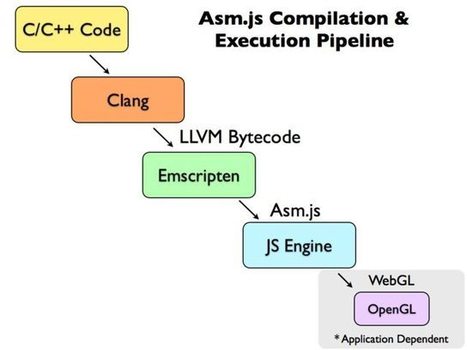
Getting a C++ game engine running in JavaScript, using WebGL for rendering, is a massive feat and is largely due to the toolchain that Mozilla has developed to make it all possible.

Since the release of the Unreal Engine 3 port to Asm.js I’ve been watching the response on Twitter, blogs, and elsewhere and while some developers are grasping the interesting confluence of open technologies that’ve made this advancement happen I’ve also seen a lot of confusion: Is Asm.js a plugin? Does Asm.js make my regular JavaScript fast? Does this work in all browsers? I feel that Asm.js, and related technologies, are incredibly important and I want to try and explain the technology so that developers know what’s happened and how they will benefit. In addition to my brief exploration into this subject I’ve also asked David Herman(Senior Researcher at Mozilla Research) a number of questions regarding Asm.js and how all the pieces fit together.

No comment yet.
Scoop.it!

AngularJS, Ember.js and Backbone.js: A comparison of resources

AngularJS, Ember.js and Backbone.js: A comparison of resources | JavaScript for Line of Business Applications | Scoop.it
See in this article a brief, but complete, comparison among those three important and great JavaScript frameworks, which can impact directly in some choices for your project and company.

Contents:

  • Introduction
  • History of Frameworks
  • Architectural Diagrams
  • Features
  • Size
  • Getting Started with Frameworks
  • Template Support
  • Data Binding
  • Router
  • Views
No comment yet.
Scoop.it!

Getting Started with Foundation for Apps

Getting Started with Foundation for Apps | JavaScript for Line of Business Applications | Scoop.it

As much as we all love CSS and Javascript frameworks, like Foundation for Websites, we know that these frameworks were built to be the base of a Website and the Web has changed. Since we have more Apps and fewer Websites being built these frameworks just aren’t enough anymore. They weren’t built to handle full-blown one page apps and so they have their issues when it comes to that.

Then came Foundation for Apps that intends to fill the void we currently have in these frameworks by adding a completely new grid and harvesting the power of Angular to make our job a whole lot easier.

No comment yet.
Scoop.it!

New Meteor Platform: a single reactive JavaScript codebase Solution

Matt Debergalis - The new Meteor platform: web and native mobile from a single reactive JavaScript codebase

No comment yet.