


JavaScript for Line of Business Applications
606.5K views |
+2 today

Keeping track of current JavaScript Frameworks that help design your clientside Business Logic Layers.
Curated by
Jan Hesse
 Your new post is loading...
  Scoop.it! 
Creating realtime web applications has been possible for a while now, however up until recently it’s been kind of a pain and required a big engineering effort. I think this is largely because the tools haven’t provided exactly what we needed to do realtime in a simple and painless way. Luckily this has all changed, now it’s pretty easy to build realtime applications and it’s my goal to prove that to you in this episode. The best way to prove this is by showing you, so we’ll build a simple single page application the uses realtime features from top to bottom.  Scoop.it! 
All Components of the most popular front-end framework, rebuilt for React.
Scoop.it!

This article demonstrates how to combine React.js with Java and Spring Boot in order to pre-render fully-fledged MVC-frontends on the JVM server without even thinking about Node.js.
Scoop.it!

Radium is a set of tools to manage inline styles on React elements. It gives you powerful styling capabilities without CSS. We're also working on implementing Bootstrap in Radium.
Scoop.it!

JavaScript is a disgusting language. But I love it! It’s riddled with awful parts, was put together in 10 days, and now we have to suffer for the next 20 years (it turns 20 in a few months). However, it’s also the duct tape of the internet, and it works just about anywhere that there is a browser. It’s also perhaps the most misunderstood language. At hackathons, I see tons of students trying to get started with JavaScript, as they are trying to write web apps or cross platform mobile ones, and they often get caught on simple things. For that reason, I’ve put together a JavaScript study guide.
Scoop.it!

From
gon

I've been using Grunt and Gulp for some time now. However, I've realized lately that with a simple package.json I can do the same, but more manteinable and with less code. In this post, I'll explain how we can do it!!
Scoop.it!

In this article Ravi Kiran describes Object.observe, a feature part of the ECMAScript 7 specifications, that allows for native two-way binding.
Scoop.it!

Features of the SPA in this Article: Angular.js for client side development – Single Page Application (SPA)
Scoop.it!
We've come a long way down the JavaScript road. Gone are the days of 'just hack it' for the web - architecting even a small project in JavaScript can be a challenge. Thankfully, there are several frameworks to help you; the most popular currently is AngularJS.
Scoop.it!
It will be a simple blogging application where the user can sign in or sign up and publish a blog post. This tutorial assumes you have basic knowledge of AngularJS, but it shouldn't be tough to pick up the topics along the way.
Scoop.it!

turbo-react applies only the differences between two HTML pages when navigating with links rather than create a new document, which enables CSS transitions between pages without needing a server.
Scoop.it!

I've spent a good deal of the past year working with React. I've written, refactored, and re-written many components in that time, and I've seen some best practices and anti-patterns emerge. Contents: * Use the PureRenderMixin * Use Prop Types
|
Scoop.it!
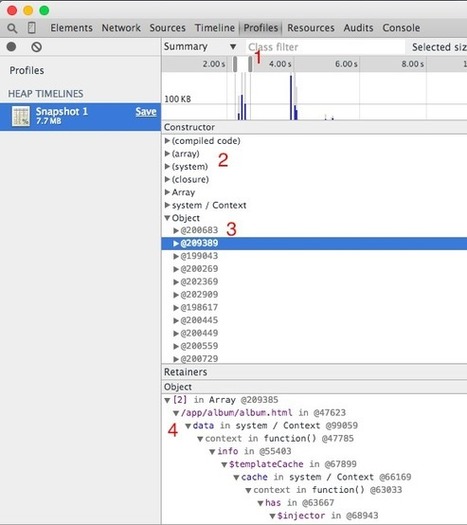
Dealing with memory leaks in JavaScript applications can be a complex process. In this article I'm going to show you how to identify whether you have memory leaks, analyse them and ultimately resolve them. I'm using an AngularJS application to demonstrate the concepts and approaches, but much of this material applies to any JavaScript application. Contents:

Rick's curator insight,
July 17, 2015 9:45 AM
Resolving memory leaks can dramatically increase the performance of your application.
Scoop.it!

From
www
neft.io is a JavaScript Framework that has been made for easier and faster developing applications and 2d games. It runs in a browser, a server and truly natively on iOS, Android, Windows Phone, OS X, Linux, Windows and more (60 FPSs). This website has been written in the neft.io. JavaScript interpreters are really fast, but we recognized that DOM and CSS are the problem. We wrote light and really fast virtual-DOM. For you, nothing changed here: your HTML document is still valid. In neft you'll use CSS-like syntax. It's super fast in a browser (we use hardware accelerated transformations) and extremely responsive on a mobile. As we said, we take native serious. We don't wrap your application into a browser using e.g. the PhoneGap, because we don't use CSS. No extra modifications are required for the native apps. We support iOS, Android, Windows Phone, BlackBerry 10, Windows, Linux, OS X, Sailfish OS and more by the Qt technology.
Scoop.it!

From
teropa
Managing the synchronization of app state and the user interface has long been a major source of complexity in UI development, and by now we have several different approaches to dealing with it. This article explores a few of them: Ember's data binding, Angular's dirty checking, React's virtual DOM, and its relationship to immutable data structures. Where things start to get more challenging is when we start talking about data changing over time. This can happen when the user interacts with the UI, or when something else happens in the world that updates the data. The UI needs to reflect this change. Furthermore, because rebuilding DOM trees is expensive, we'd like to do as little work as possible to get that updated data on the screen.
Scoop.it!

This sixth edition of JavaScript introduces a lot of new language features, it might even be the most feature packed revision to date in terms of language additions, and that is with some of the features scheduled, like comprehensions and rest and spread properties being delayed to the next edition. These features are also backwards compatible, in the sense that they are mostly syntatic sugar and can be de-sugared to older versions of the language, meaning we can use them right now with a compiler like babel
Scoop.it!

Two ECMAScript 6 features enable an intriguing new style of asynchronous JavaScript code: promises and generators. This blog post explains this new style and presents a way of using it without promises. Before ECMAScript 6, you couldn’t pause and resume the execution of code, but you could simulate it, by putting console.log(result) into a callback, a so-calledcontinuation.
Scoop.it!

From
medium
In this post I am going to introduce you to some of these features used inES6 Fiddle. I recommend you to play with them and get a feeling of what’s to come. These are the features that are being covered:
Let’s get started! You can follow this post with ES6 Fiddle side by side.
Scoop.it!
Sails makes it easy to build custom, enterprise-grade Node.js apps. It is designed to emulate the familiar MVC pattern of frameworks like Ruby on Rails, but with support for the requirements of modern apps: data-driven APIs with a scalable, service-oriented architecture. It's especially good for building chat, realtime dashboards, or multiplayer games; but you can use it for any web application project - top to bottom.
Scoop.it!

Backbone.js is popular JavaScript library, used heavy to create single-page web applications. The library was constructed using RESTful JSON interface and model–view–presenter (MVP) pattern. The creator of Backbone.js is Jeremy Ashkenas – author of underscore.js and CoffeeScript.
Scoop.it!

From
viget
Data visualization has become a more frequent element of our work at Viget. Be it simple pie charts or beautiful maps displaying jersey sales, visually representing data in a compelling way is a great device for storytelling and provides rich fuel for social sharing. Yet making these illustrations fast, shareable, and accessible has its challenges. Although browsers are powerful, tightly coupling the rendering process to them greatly complicates the generation of images that can be shared or saved for presentations.
Scoop.it!

Awesome-Ionic - A curated list of amazingly awesome Ionic libraries, resources and solutions.
Scoop.it!

From
github
This repository defines a Meteor package that automatically integrates the React rendering framework on both the client and the server, to complement or replace the default Handlebars templating system. The React core is officially agnostic about how you fetch and update your data, so it is far from obvious which approach is the best. This package provides one answer to that question (use Meteor!), and I hope you will find it a compelling combination.
Scoop.it!

If you haven't used React at all, you're in the right place. If you have used React, but you've run into some confusing edges, you're still in the right place. This guide covers all the basics as well as some of the confusing gotchas.
|





