JavaScript for Line of Business Applications
606.5K views | +2 today
JavaScript for Line of Business Applications
Keeping track of current JavaScript Frameworks that help design your clientside Business Logic Layers.
Curated by Jan Hesse
Beam to my Inbox:
Your new post is loading...

Popular Tags - Filter using the Funnel

Scoop.it!

Learn to Build Modern Web Apps with MEAN

Learn to Build Modern Web Apps with MEAN | JavaScript for Line of Business Applications | Scoop.it

The goal of this tutorial is to guide you through the creation of a Reddit/Hacker News clone using the MEAN stack. By completing this tutorial, you will gain a basic understanding of the MEAN stack including building a REST interface with Express.js on top of Node.js and using that interface to perform CRUD operations on a database via an AngularJS frontend.

No comment yet.
Scoop.it!

Communication between Angular Controller and Directive

Communication between Angular Controller and Directive | JavaScript for Line of Business Applications | Scoop.it

Implementing bidirectional communication between angular controllers and directives using isolated scopes.

Since I had issues finding a good explanation on how to tie together a controller and a directive with isolated scope I decided to create my own blog post on this subject. This repo contains a runnable example of the solution. It contains a Spring Boot Web Application that can be started to act as a HTTP server but all the interesting stuff is in the src/main/webapp folder.

No comment yet.
Scoop.it!

Creating a One-To-Many Relationship with Sails.js, Mongo and SANE-CLI

Creating a One-To-Many Relationship with Sails.js, Mongo and SANE-CLI | JavaScript for Line of Business Applications | Scoop.it

n a previous post I explained the basics of SANE and created a simple application. In this post I'll be going one step further and adding a relationship between two tables, using Sails.js, Mongo and Ember.

Relatonships occur when one foreign key references the primary key of another. Since we'll be using a nosql data store we'll be using document references instead. We'll set the schema using Sails.js so don't worry too much about that for now.

No comment yet.
Scoop.it!

Emberjs - Communication Between Components

Emberjs - Communication Between Components | JavaScript for Line of Business Applications | Scoop.it

A child component calling a parent is fairly straight forward and is well laid out but what about when a parent component wants to call its children?

What do we do if we have a parent that wants its chidren to do something like to zoom to an element or something that is not a reaction to some state mutation? The official ember guidance is you should use the actions up and data down paradigm where you push data changes down to the child components but there are occasions when this does not fit.

Jan Hesse's insight:

Follow-Up:

http://www.thesoftwaresimpleton.com/blog/2015/04/27/event-bus/

No comment yet.
Scoop.it!

Learn Meteor.js From Scratch: Build a Polling App

Learn Meteor.js From Scratch: Build a Polling App | JavaScript for Line of Business Applications | Scoop.it
What is Meteor? Meteor.js is an open-source platform built on Node and MongoDB. It’s not just a framework, it’s more than that. Is it comparable to Angular? Angular handles just the frontend parts of application. Meteor is more of a platform than Angular. It is both server and client-side code and handles a lot of […]
No comment yet.
Scoop.it!

I React To The Future With Isomorphic Apps

I React To The Future With Isomorphic Apps | JavaScript for Line of Business Applications | Scoop.it

Find out why isomorphic apps might just give us the best of both worlds: using JavaScript in both places, and delivering to the user a good experience by sending down something they can see quickly and then building on that with client-side...

Jinto Jose's curator insight, May 2, 2015 10:43 PM

Isomorphic apps are a great opportunity for JS developers

Scoop.it!

Node.js v.s. Play Framework

Node.js v.s. Play Framework lecture by Yevgeniy(Jim) Brikman at ScalaMatsuri on 9/6/2014 http://scalamatsuri.org/en/
No comment yet.
Scoop.it!

The Isomorphic Express Boilerplate

The Isomorphic Express Boilerplate | JavaScript for Line of Business Applications | Scoop.it

Isomorphic means that it's designed to run a lot of the same code on both the client and the server. Typically that includes a lot of rendering and domain logic. (Not to be confused with isomorphisms from category theory / functional programming. That's a totally different thing.)

There are many advantages to building apps this way, but the primary advantages are:

  • Cross-functional teams. Since everything is written in JavaScript, it's easier to build teams who know how to work on both the client and server sides of the app.
  • Write once, run everywhere. With the exception of a few library substitutions and browser polyfills, the code is shared, which means you have to write about half the code you'd write working on a non-isomorphic app.
  • More productive developers. Since the app is more consistent across the stack, there's no context switching when you need to maintain application behavior on both sides of the stack. Write the behavior once, and you're done. Context switching slows developers down significantly.
No comment yet.
Scoop.it!

Alternative persistence patterns with ember.js

Alternative persistence patterns with ember.js | JavaScript for Line of Business Applications | Scoop.it

One of the topics I've been afraid to blog about is how I do persistence in my ember apps. In large part because I view the ember community as family and don't want to make those who work on ember-data feel like the project is not valuable. I personally know a great deal of people who love the project, and you won't find me complaining about it in this post. Instead I intend to show an alternative view of the world that has worked well for my team the past 10+ months.

No comment yet.
Scoop.it!

Ui5Strap - Bootstrap based SAPUI5 / OpenUI5 App Development Toolkit

Ui5Strap - Bootstrap based SAPUI5 / OpenUI5 App Development Toolkit | JavaScript for Line of Business Applications | Scoop.it

Build SAPUI5 / OpenUI5 Enterprise Apps with Bootstrap.

Transform your existing Bootstrap Themes into reusable Controls andThemes. The default Bootstrap Components are already provided by the Ui5Strap Library. The simplified UI5 HTML Syntax lets you create complex Views without hassling around with the CSS.

Combine predefined Actions to create custom App Behaviour, by using HTML and JSON only. And if you are familar with JavaScript, you can still write you own Controllers and Modules like in other OpenUI5 Apps.

No comment yet.
Scoop.it!

Announcing Globalize 1.0

Announcing Globalize 1.0 | JavaScript for Line of Business Applications | Scoop.it

An always up-to-date, modular and simple i18n library
Allow me to skip the details and jump to the fun part. Below is what you get with Globalize today, which provides number formatting and parsing, date and time formatting and parsing, currency formatting, message formatting (ICU message format pattern with gender and pluralization support).

Jan Hesse's insight:

http://rxaviers.github.io/javascript-globalization/

No comment yet.
Scoop.it!

Testing JavaScript

Testing JavaScript | JavaScript for Line of Business Applications | Scoop.it

My team at Opower has gone through several evolutions of our testing philosophy. Although I now feel confident that we are now testing the right set of contracts, we’ve made some mistakes along the way. I’d like to share those lessons learned with you.

No comment yet.
Scoop.it!

Some Thoughts On Gluing React Native and Meteor

I spent some time running through the React Native tutorial and studying the APIs. It’s a great tutorial because it shows you how to get data from a RESTful API and update a React Native view. One thing that seems understated is that you can use NPM packages.

My first reaction was to try an build a app that uses the DDP NPM package to connect it to Meteor. Unfortunately the DDP NPM package didn’t work because there’s not a built in interface for websockets (yet). I ended up using an alternative approach and used the React Native bridge to connect to Objective DDP.

No comment yet.
Scoop.it!

Craft Conference Presentations on InfoQ

Craft Conference Presentations on InfoQ | JavaScript for Line of Business Applications | Scoop.it

CRAFT is about software craftsmanship, which tools, methods, practices should be part of the toolbox of a modern developer and company, and it is a compass on new technologies, trends. You can learn from the best speakers and practitioners in our community.

No comment yet.
Scoop.it!

Feature-Oriented Active Modeller

FOAM is composed of tools to help you quickly write an app that loads and runs fast, on desktop and mobile.

Our main goal is to do as much as possible with each chunk of code. The fastest, most secure, and least buggy code in your app is the code that isn’t there.

FOAM is a meta-programming framework. It is very declarative and reactive, because that’s a very high-level way of expressing how the app should work.

No comment yet.
Scoop.it!

Meteor-PostgreSQL

Meteor-PostgreSQL | JavaScript for Line of Business Applications | Scoop.it

Although our project was ambitious, we wanted to use whatever meteor packages that were available to us in order to best integrate with the Meteor environment, and to save time by not having to reinvent the wheel. At the onset we considered several approaches which were ultimately not chosen for certain reasons. These include:

  • Using minimongo as client side db - ultimately this would be trying to fit a square peg in a round hole by making relational data non-relational.
  • Implementing oplog capabilities for PostgreSQL - Ultimately this would have been an entirely different project with an entirely different scope.
  • Reducing the scope - Other implementations of SQL in Meteor had focused on achieving one way reactivity (server to client), and so we felt it would simplify our task if we chose to abandon goals of database everywhere or latency compensation. Ultimately this was not a concession we were willing to make.

Throughout the start of the project our approach was refined, and ultimately we landed on the following:

No comment yet.
Scoop.it!

Building pure JavaScript applications (Meteor.js)

Building pure JavaScript applications (Meteor.js) | JavaScript for Line of Business Applications | Scoop.it

I know many PHP and Node.js frameworks but none of them is as simple as Meteor. Even front-end developer can write full-stack application in Meteor. You just need to know JavaScript, MongoDB, HTML, CSS and you will be able to build Meteor app.

Meteor's code does not look like code of classic Node.js framework. It's an abstraction of Node.js and it's more beautiful.

For example client code consists of helpers, events, sessions and templates...

No comment yet.
Scoop.it!

Enterprise Grade JavaScript Web Components inspired from Flex and Silverlight

Enterprise Grade JavaScript Web Components inspired from Flex and Silverlight | JavaScript for Line of Business Applications | Scoop.it

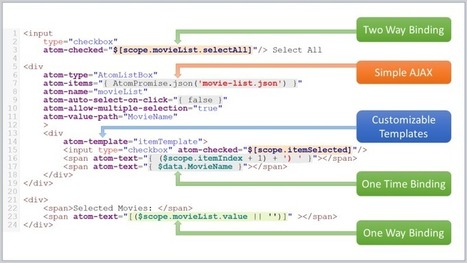
AtomsPreCompiler compiles atoms markup into valid HTML5 by breaking up inline expressions into generated JavaScript. This pre-compiled document runs in strict mode without using eval without compromising speed.

Jan Hesse's insight:

http://atomsjs.neurospeech.com

No comment yet.
Scoop.it!

How To Handle User Authentication With AngularJS

How To Handle User Authentication With AngularJS | JavaScript for Line of Business Applications | Scoop.it

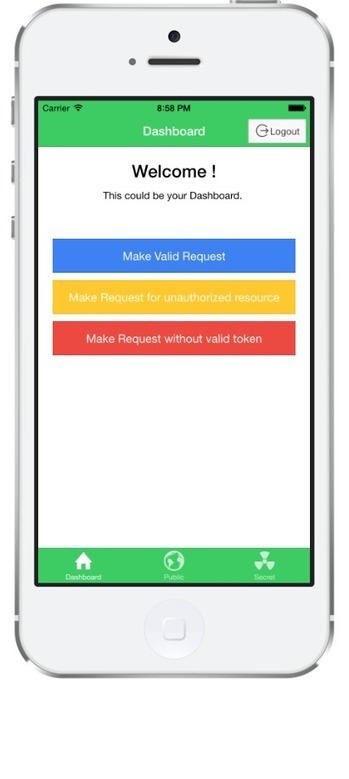
Implementing a login and user authentication system for your AngularJS app seems to be one of the hardest problems people encounter. My article on a simple login with Ionic and AngularJS is the far most viewed article on this blog, every day! As the mentioned article only describes a basic system for a very low level security, this article will highlight everything you need for a complete user authentication and login inside your AngularJS app!


In particular this means, this article will show you how to:

  • Log in a user and store the user session (Token based auth!)
  • Protect your routes based on authentication status and role of the user
  • Notice when an unauthorised request was made and a new login is required
No comment yet.
Scoop.it!

How to use JSON web token authentication with Sails.js

How to use JSON web token authentication with Sails.js | JavaScript for Line of Business Applications | Scoop.it
Using JSON webtoken authentication for consuming rest-api from your Single Page Application is pretty common these days. In this post I'll be helping you to use it in your Sails.js App. Well'll be using simplest user name and password...
No comment yet.
Scoop.it!

Testing AngularJS with Protractor and Karma

Testing AngularJS with Protractor and Karma | JavaScript for Line of Business Applications | Scoop.it
Let's look at how to test an AngularJS application with Protractor and Karma!

Part 1 - In the first part we’ll look at unit tests, which ensure that small, isolated pieces of code (e.g., a unit) behave as expected.
Part 2 - In part two we’ll address E2E tests, which verify that all the pieces of code (units) fit together by simulating the user experience through browser automation.

Jan Hesse's insight:

Part 2:

http://mherman.org/blog/2015/04/26/testing-angularjs-with-protractor-and-karma-part-2/

No comment yet.
Scoop.it!

Patterns of JavaScript UI Widget Instantiation

Patterns of JavaScript UI Widget Instantiation | JavaScript for Line of Business Applications | Scoop.it

Choosing which pattern will create and run a widget in an application has become a rather complicated enterprise. Picking the “right one” is almost always a subjective decision.

Some widget vendors offer just a single approach, while others offer multiple ways to get the job done. Which should you use? I won’t presume to know which is best for you and will dispense with the notion of writing an article prescribing the ideal pattern to adopt. “Ideal,” in this context, is almost always relative to talent, time, and trade-offs. I like to call these the three t’s of development decision making.

What I intend to offer in this article is more of an overview, not a recommendation. I merely want to showcase some of the common patterns used by widget vendors so that the unaware developer can familiarize themselves with the options.

No comment yet.
Scoop.it!

Angular vs. Knockout: Similarities and Fundamental Differences

Angular vs. Knockout: Similarities and Fundamental Differences | JavaScript for Line of Business Applications | Scoop.it
AngularJS and KnockoutJS are JavaScript libraries helping to create rich and responsive web UI interactions. While both connect parts of the UI to data models using declarative bindings, they are not the same. Learn what differentiates the two.
No comment yet.
Scoop.it!

The unofficial Meteor FAQ

The unofficial Meteor FAQ | JavaScript for Line of Business Applications | Scoop.it

Just answering some common questions that aren’t answered on the meteor site.


Contents:

  • Customizing Meteor
  • Reactivity and Rendering
  • Animation
  • Subscriptions and Methods
  • Deployment
  • Best practices
  • Troubleshooting errors
No comment yet.
Scoop.it!

jsblocks - Better JavaScript MV-ish Framework

jsblocks - Better JavaScript MV-ish Framework | JavaScript for Line of Business Applications | Scoop.it
From simple user interfaces to complex single-page applications using faster, server-side rendered and easy to learn framework

Model-View-Controller, Model-View-Collection, Model-View-ViewModel, Model-View-Whatever, Hierarchical Model-View-Controller or nothing at all - jsblocks got you covered. A Model-View-Collection layer stands on top of the main DOM syncing core. The MVC layer is extremely powerful and enables easy creation of complex applications. The MVC layer is also modular so you could remove it if you don't need the extra functionality and make your code base lighter.

No comment yet.