JavaScript for Line of Business Applications
606.4K views | +29 today
JavaScript for Line of Business Applications
Keeping track of current JavaScript Frameworks that help design your clientside Business Logic Layers.
Curated by Jan Hesse
Beam to my Inbox:
Your new post is loading...

Popular Tags - Filter using the Funnel

Scoop.it!

OOP In JavaScript: What You NEED to Know

OOP In JavaScript: What You NEED to Know | JavaScript for Line of Business Applications | Scoop.it

The main principle with Object Oriented Programming (OOP) is the use of Classes (Functions in JavaScript) to create objects, and that objects are implemented in a manner that allows them to adopt Inheritance, Polymorphism, and Encapsulation. We are only concerned with Inheritance and Encapsulation, since only these are applicable for OOP in JavaScript. Essentially, objects can encapsulate functionalities and inherit methods and properties.

The rest of this article will focus on using objects in JavaScript in an object oriented manner—with inheritance and encapsulation—to easily reuse code in our applications and abstract functionalities away into specialized objects. We will focusonly on the best two techniques [1] for implementing OOP in JavaScript.

No comment yet.
Scoop.it!

Everything you need to understand to start with AngularJS

Everything you need to understand to start with AngularJS | JavaScript for Line of Business Applications | Scoop.it

2012 was the year of the rise of the Javascript MVC frameworks and librairies with countless of those frameworks that were released or that went under the spotlight. Among others, you must have heard about Backbone.js, Ember.js but my personal favorite is AngularJS. AngularJS is a Javascript MVC framework created by Google to build properly architectured and maintenable web applications.

No comment yet.
Scoop.it!

Ember.js - Web Applications Done Right

Ember.js - Web Applications Done Right | JavaScript for Line of Business Applications | Scoop.it
This article explains the Ember.js application development model and shows how to use it to build your first client-side JavaScript web application with the framework.

Via Saleh Souzanchi
No comment yet.
Scoop.it!

What Breeze can do for You

What Breeze can do for You | JavaScript for Line of Business Applications | Scoop.it
Breeze.js is a client side JavaScript library that manages rich data. Before Breeze existed, I wrote a SPA and it had 20 JavaScript files and modules for data management that total about 1550+ lines of code. I wrote all of this code to do a fraction of what Breeze does. It was painful to write and every time I added a new entity or CRUD method it got much bigger. I rewrote this logic using Breeze and ended up with 2 files (datacontext.js and model.js) and had 350+ lines of code, more functionality, and every time I add a new entity the code increases by just a few lines. That’s 1/4 the code, about 1/4 the time, and a more value. Does that interest you?
No comment yet.
Scoop.it!

Designing Better JavaScript APIs

Designing Better JavaScript APIs | JavaScript for Line of Business Applications | Scoop.it
This article focuses on how to make your code accessible to other developers and how to design JavaScript APIs that developers will love using.


TABLE OF CONTENTS

* Fluent Interface

* Consistency

* Handling Arguments

* Extensibility

* Hooks

* Generating Accessors

* The Reference Horror

* The Continuation Problem

* Handling Errors

* Going Asynchronous

* Debugging Fluent Interfaces

* Documenting APIs

* Conclusion

No comment yet.
Scoop.it!

Single page apps in depth (new free book)

This free book is what I wanted when I started working with single page apps. It's not an API reference on a particular framework, rather, the focus is on discussing patterns, implementation choices and decent practices.

I'm taking a "code and concepts" approach to the topic - the best way to learn how to use something is to understand how it is implemented. My ambition here is to decompose the problem of writing a web app, take a fresh look at it and hopefully make better decisions the next time you make one.

* Introduction

* Writing maintainable code

* Implementation alternatives: a look at the options

* Meditations on Models & Collections

* Views - templating, behavior and event consumption


No comment yet.
Scoop.it!

Understanding RequireJS for Effective JavaScript Module Loading

Understanding RequireJS for Effective JavaScript Module Loading | JavaScript for Line of Business Applications | Scoop.it
Modular programming is used to break large applications into smaller blocks of manageable code. Module based coding eases the effort for maintenance and increases reusability.
No comment yet.
Scoop.it!

Fun with AngularJS! | Devgirls Weblog

Fun with AngularJS! | Devgirls Weblog | JavaScript for Line of Business Applications | Scoop.it

Recently AngularJS, an MVC style JavaScript framework fromGoogle, has been gaining more momentum. I’ve been curious about it for awhile and when I read this article recently, I decided it was finally time to give it a whirl. I was pleasantly surprised with what I found. I first watched these two videos by John Lindquist which I highly recommend as a starting point to get your feet wet. They are short and totally worth the time:

* Simple ToDo’s App

* Simple Twitter Search App


Part of the reason I personally may have been hooked initially could be due to my Adobe Flex background. There’s a reminiscent feel with AngularJS to Flex in the two-way binding, HTML extension etc so I could see how a lot of Flex developers might feel at home with this framework. The framework is built on the idea that declarative programming should be used for building the UI and imperative programming for your business logic. With AngularJS you can do quite a bit with a small amount of code due to the built-in features that will be explained further in this post. It also relies on dependency injection throughout as well as the separation of the model/view/controller.

No comment yet.
Scoop.it!

How Browsers Work: Behind the scenes of modern web browsers - HTML5 Rocks

How Browsers Work: Behind the scenes of modern web browsers - HTML5 Rocks | JavaScript for Line of Business Applications | Scoop.it

This comprehensive primer on the internal operations of WebKit and Gecko is the result of much research done by Israeli developer Tali Garsiel. Over a few years, she reviewed all the published data about browser internals (see Resources) and spent a lot of time reading web browser source code.

As a web developer, learning the internals of browser operations helps you make better decisions and know the justifications behind development best practices. While this is a rather lengthy document, we recommend you spend some time digging in; we guarantee you'll be glad you did.

No comment yet.
Scoop.it!

Order of Event Handling in jQuery

Order of Event Handling in jQuery | JavaScript for Line of Business Applications | Scoop.it
Front-end engineers often run into bugs that have to do with the order of events being fired. For example, a click on an “OK” button is supposed to close the popup, trigger an action, and report the action’s status.
No comment yet.
Scoop.it!

Modularizing AngularJS Applications

Modularizing AngularJS Applications | JavaScript for Line of Business Applications | Scoop.it

This is a preview-quality chapter of our continuously deployed eBook on AngularJS for .NET developers.

When talking about modularizing applications built on AngularJS, there are two independent elements to talk about: splitting the code into logical modules on one hand, and into multiple physical files on the other hand.

No comment yet.
Scoop.it!

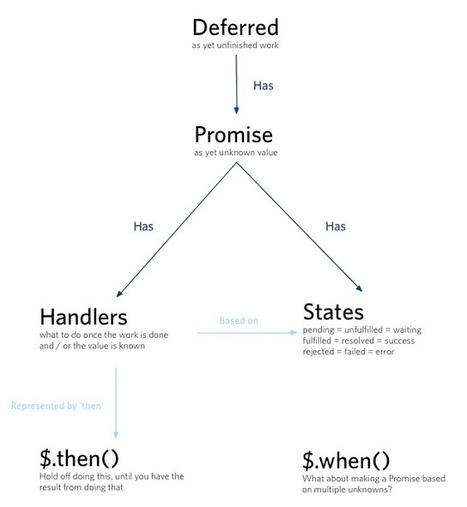
Promise & Deferred objects in JavaScript Pt.1: Theory and Semantics.

Promise & Deferred objects in JavaScript Pt.1: Theory and Semantics. | JavaScript for Line of Business Applications | Scoop.it

There's nothing inherently wrong with callbacks, but depending on which environment we are programming in there are a number of options available for managing asynchronous events. In this post my goal is to examine one set of available tools: promise objects and deferred objects. In part I, we will cover theory and semantics and in part 2 we will look at the use.


Via @cwebbdesign
@cwebbdesign's curator insight, April 15, 2013 1:40 AM

An in-depth look at the semantics of promises in JavaScript and a comparison of the performance of different implementations.

Scoop.it!

Web services overview | SOAP, REST, OData | Developing the future

Web services overview | SOAP, REST, OData | Developing the future | JavaScript for Line of Business Applications | Scoop.it
A brief introduction to web services - difference between SOAP, REST, JSON, XML, Atom, AtomPub, OData.
No comment yet.
Scoop.it!

The BackboneJS Way of Thinking

The BackboneJS Way of Thinking | JavaScript for Line of Business Applications | Scoop.it

So you are frustrated tackling BackboneJS and wondering why it isn’t solving your problems as you had expected it to, after hearing about its glorious penetration in many high profile projects. Well, join the club, you are not alone. Here I’ll share my expectations when I imported BackboneJS for the first time in my project and my learning that I gained after weeks of trial and error and frustration.

Backbone is like a hammer, if you do not know what you are trying to build, the hammer will not build it for you. It does give you some powerful functions, but the burden of creating a strategy for your front-end falls on your own shoulders. But worry not, here are some ideas that might help you create your strategy.

No comment yet.
Scoop.it!

The Big Glossary of Open Source JavaScript and Web Frameworks with Cool Names

The Big Glossary of Open Source JavaScript and Web Frameworks with Cool Names | JavaScript for Line of Business Applications | Scoop.it

It's getting to the point where there are so many cool open source projects that I can't keep up. When you add in the currently battle royale of JavaScript projects that are basically just hip sounding words with ".js" added to the end, it's a little overwhelming. Seriously, just pick a word out of the dictionary at random and that's the name of an up and coming JavaScript library.

Jan Hesse's insight:

also watch the comments for even more cool libraries

No comment yet.
Scoop.it!

Building Web Applications with Ember.js

Building Web Applications with Ember.js | JavaScript for Line of Business Applications | Scoop.it
Ember.js is a framework for building front-end applications using JavaScript, yes, but what does it mean to build an interactive web app in Ember? In this talk, Yehuda Katz shows us how Ember can be used to build fast and responsive apps, and shares some nifty aspects of Ember you might not know about. Yehuda covers big picture concepts in Ember, builds an app live, and finally shares some insights on future proofing your site.
No comment yet.
Scoop.it!

Integrating DISQUS to your SPA

In a normal web site, integration of DISQUS to your pages is easy, you sign up for DISQUS, get the JavaScript Universal Code for web sites, add it where you want your discussion thread to show up in your page. When web page loads, DISQUS loads the required Javascript and adds it to the section of your page. By default DISQUS will use the page url as the key to the discussion and manages unique thread ids for your posts and replies within that.

Now with this model we have a problem, in a SPA, there is no “pages” its all one “single” page with routes (by some convention) managing the loading of various views. So if you simply paste DISQUS code where you want the discussion to show up in your SPA view html page, result will be disappointing! At least it was for me the first time. Again to my defense, it was late in the night and I was not thinking clearly. When the page ran, it did not load anything…blank! Problem is that if you add a JS snippet to your view code, its not going to work in a SPA architecture.

No comment yet.
Scoop.it!

Code Organization in Large AngularJS and JavaScript Applications

Many developers struggle with how to organize an application's code base once it grows in size. I've seen this recently in AngularJS and JavaScript applications but historically it's been a problem across all technologies including many Java and Flex apps I've worked on in the past.

The general trend is an obsession with organizing things by type. It bears a striking resemblance to the way people organize their clothing.

No comment yet.
Scoop.it!

Which one of angular.js and ember.js is the better choice?

Which one of angular.js and ember.js is the better choice? | JavaScript for Line of Business Applications | Scoop.it
Tom Dale's answer: As one of the authors of Ember.js, I frequently get asked: "Should I use Angular or Ember?"

I think the answer to that question has a lot more to do with what kind of application are you building?
No comment yet.
Scoop.it!

We've Open-sourced Rendr - Airbnb Engineering

We've Open-sourced Rendr - Airbnb Engineering | JavaScript for Line of Business Applications | Scoop.it

We first introduced Rendr, our library for running Backbone.js apps seamlessly on both the client and the server, in a blog post a few months ago.  We originally built Rendr to power our mobile web app, and in the post we explained our approach and showed some sample code. 

We’ve been blown away by the response from the community.  With 80,000 hits to the original blog post and a constant stream of questions and comments on Twitter, it quickly became clear that we’d found ourselves in the middle of a JavaScript Zeitgeist.  Many developers shared the same pain points with the traditional client-side MVC approach: poor pageload performance, lack of SEO, duplication of application logic, and context switching between languages.

The number one question we received went something like this: “When will u release Rendr???”

Jan Hesse's insight:

to underline again: serverside Backbone, so M[precompiled V]C if you will

No comment yet.
Scoop.it!

Google JavaScript Style Guide

Every major open-source project has its own style guide: a set of conventions (sometimes arbitrary) about how to write code for that project. It is much easier to understand a large codebase when all the code in it is in a consistent style.

“Style” covers a lot of ground, from “use camelCase for variable names” to “never use global variables” to “never use exceptions.” This project holds the style guidelines we use for Google code. If you are modifying a project that originated at Google, you may be pointed to this page to see the style guides that apply to that project.

Click here to edit the title

No comment yet.
Scoop.it!

Asynchronous Programming in JavaScript with “Promises”

Asynchronous patterns are becoming more common and more important to moving web programming forward. They can be challenging to work with in JavaScript. To make asynchronous (or async) patterns easier, JavaScript libraries (like jQuery and Dojo) have added an abstraction called promises (or sometimes deferreds). With these libraries, developers can use promises in any browser with good ECMAScript 5 support. In this post, we’ll explore how to use promises in your web applications using XMLHttpRequest2 (XHR2) as a specific example.

No comment yet.
Scoop.it!

Doing without jQuery

JavaScript equivalent to jQuery basics

... because loading 92Ko of jQuery to use less than 2% of it kind of sucks. Mostly inspired by Doing without jQuery and From jQuery to JavaScript: A Reference.

* Selectors

* Attributes

* Styles

* Events

* Others

No comment yet.
Scoop.it!

Getting Into Ember.js: Part 3

Getting Into Ember.js: Part 3 | JavaScript for Line of Business Applications | Scoop.it

I hope that you're starting to see that Ember.js is a powerful, yet opinionated, framework. We've only scratched its surface; there's more to learn before we can build something truly useful! We’ll continue using the Ember Starter Kit. In this portion of the series, we’ll review accessing and managing data within Ember.

No comment yet.
Scoop.it!

Promise & Deferred Objects in JavaScript Pt.2: in Practice

In part 1 of this post, I spent a lot of time looking at the theory of promises and deferreds: what promises are and how they behave. Now it's time to actually explore some ways to use promises and deferreds in JavaScript and dive into some best practices. I'll start with some basic uses and examples of promises and then will dive into a number of specifics pertaining to using promises in jQuery.


Via @cwebbdesign
@cwebbdesign's curator insight, April 15, 2013 1:42 AM

In-depth examination of using promises, jQuery's .then() and sequencing tasks in JavaScript.