


One skill that’s essential for any professional JavaScript developer is the ability to write testable code. This book shows you what writing and maintaining testable JavaScript for the client- or server-side actually entails, whether you’...


 Your new post is loading...
  Scoop.it! One skill that’s essential for any professional JavaScript developer is the ability to write testable code. This book shows you what writing and maintaining testable JavaScript for the client- or server-side actually entails, whether you’... 
No comment yet.
Sign up to comment
Scoop.it!
Excella Consultings's Doguhan Uluca discusses delivering a responsive and modern Web client based on emerging technologies in an MVVM architecture, such as Breeze, Knockout, Require with Javascript unit testing and Automated Acceptance Testing.
Scoop.it!
Throughout my time writing Javascript code, I've come to realize that while I love the language to bits, it is a little difficult to understand. A lot of people have attributed this to its (admittedly not so great) design, or its obvious deviations from the paths well worn by other languages. Either way, understanding a few simple truths can go a long way with JS. What follows is the condensed and written version of the introductory class on JavaScript that I give at training programs and user groups.
Scoop.it!
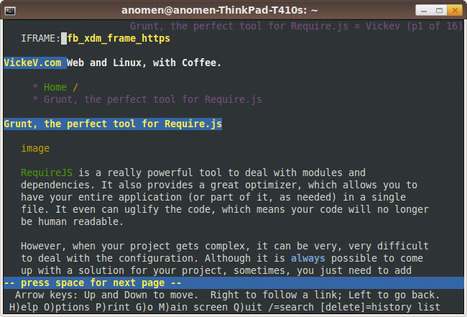
From
vickev

Google provides a way to index your Single Page Application (SPA), built with Angular.js, Backbone.js, or other Javascript framework (ember.js, knockout.js, and others). In this article, we will first see together how it proceeds, the amount of work that the webmaster has to do, and then we will come up with an automatic solution. All along this article, I will introduce tools and examples of this website, vickev.com (which is built with Angular.js and Node.js), to prove the relevance of the method.
Scoop.it!
While the JavaScript weekly mailing list still points to 90s style articles about the old JavaScript Internet Explorer 5 was supporting too, the current world has different real problems to consider. * Reserved Words As Properties * Object.defineProperty() *Is* Available * Function.prototype get caller() {return WTF} * Function.prototype.bind() * Avoid __proto__ * Better Than Zepto * A Swap Oriented __proto__ Attempt * JSON.stringify(object, *replacer*)
Scoop.it!

From
tech
Routing is arguably the most important part of any web application. Good routes give you many advantages. If great routes are so important, then why has Microsoft given so little guidance as to how to proceed. There has to be a better way? What if there was an opinionated way to add specific routes to your application? It would insure that each controller action in your ASP.Net MVC application was routed uniquely and gave you all the advantages mentioned above. In addition, it would give you the freedom to add any routes you needed. Well luckily there is Ruby On Rails' resource routing... well something like it for ASP.Net MVC. Say Hello to RestfulRouting!
Scoop.it!

Tutorial 4: "Putting the web back into web app"
Tutorial 3: "‘Fixing’ the application cache with an iframe"
Tutorial 2: "Supporting both IndexedDB and WebSQL on a cross platform web app"
Tutorial 1: "How to make an offline HTML5 web app, FT style"
Jan Hesse's insight:
Explains how parts of the FinancialTimes WebApp was made.
Scoop.it!

Backbone.js is quickly becoming the most popular framework for building modular client-side JavaScript applications. This is largely due to its low barrier to entry; getting started with it is super-simple. However, unlike Ember.js, Backbone, being so minimal, also leaves a lot up to the developer to figure out. So, once you start getting into more advanced applications, it’s no longer so simple. Backbone.Marionette was created to alleviate a lot ofthe growing pains of Backbone development. Backbone.Marionette “make[s] your Backbone.js apps dance with a composite application architecture!,” according to its author.
Scoop.it!

JavaScript does not come with dedicated means for managing private data for an object. This post describes five techniques for working around that limitation: * Instance of a constructor – private data in environment of constructor * Singleton object – private data in environment of object-wrapping IIFE * Any object – private data in properties with marked names * Any object – private data in properties with reified names * Single method – private data in environment of method-wrapping IIFE
The following sections explain each technique in more detail. Required knowledge: While everything is explained relatively slowly, you should probably be familiar with environments and IIFEs [1] and with inheritance and constructors [2].
Scoop.it!
A long time ago, in a galaxy far, far away, JavaScript was a hated language. In fact, "hated" is an understatement; JavaScript was a despised language.
Scoop.it!
We've all been there. You're at a tech meetup and someone is all like "Yeah I built this thing out of Cake, Celery and Varnish" and you've no idea if they're talking about web frameworks or some kind of horrific dessert. Well wonder no longer!
Scoop.it!

The use of JavaScript has exploded over time. Now it is practically unheard of for a website not to utilize JavaScript to some extent. As a web developer who has concentrated on back-end coding in C# and front-end look and feel via HTML and CSS, my skills in JavaScript evolved over time instead of by conscious effort. While this is not uncommon, it can allow for some bad habits to be formed. This set of best practices is my way of taking a step back and addressing JavaScript as a first-class language, with both good parts and bad parts. My concentration will be on just JavaScript, regardless of where it is run. However, you will see references in here to the browser and to Visual Studio. This is simply because that is where I live, not because either are necessary for these best practices to apply. And so, without further ado, let's jump right in and see just how far down this rabbit hole goes.
Scoop.it!

Omni.js is a framework designed to integrate with Backbone.js in order to make writing real-time web apps extremely simple. Simply define models, collections, and events on the server side, and the server will automatically feed the client with all of the information that it has permission to see. Then the client can modify any information, and if it has write permission, the server will propagate the data to all other clients who have read permission.
|
Scoop.it!

The purpose of this JavaScript Training Course, as the name implies, is to cover the details of the JavaScript language. The reason we need this is that JavaScript is a core language for web development, and it is mostly misunderstood. There are many powerful features in JavaScript that many developers are not aware of. Also, learning the core concepts of the language will make libraries such as jQuery easy to understand. We use JavaScript on the client side of our web development to make calculations, create menus, and validate user data before the form is submitted to the server. These are few of the JavaScript features. We will be using Firefox and its tools to test and debug the JavaScript code.
Jan Hesse's insight:
for beginners: 32 chapters all with video explanations
Scoop.it!
A presentation I gave at ALT.NET Melbourne on February 26 2013
Scoop.it!
This Saturday I was doing my first Backbone.js class. It went really fine, except one fact. I wanted to show the aspects of creating Single Pages Application running on Backbone. Started the application from scratch, we had to spend a lot of time writing some infrastructure code before we even jump to Backbone. So, after the class I decided to create some boilerplate project, so next time we would just clone it from github and start to work. That's how the backbone-express-spa born.
Scoop.it!

One of the goals of the allong.es library is to provide easy-to-use tools for writing JavaScript and CoffeeScript programs using functional composition. To pick an example out of thin air, this snippet shows how to write a method that usesmaybe to ensure that it doesn’t do anything if you pass in null or undefined, and that uses Fluent to ensure that it always returns the receiver, jQuery-style: User.prototype.setName = fluent( maybe( function (name) { this.name = name; }));
Scoop.it!

When developing applications using just jQuery, the piece missing is a way to structure and organize your code. It’s very easy to create a JavaScript app that ends up a tangled mess of jQuery selectors and callbacks, all desperately trying to keep data in sync between the HTML for your UI, the logic in your JavaScript, and calls to your API for data. Without something to help tame the mess, you’re likely to string together a set of independant plugins and libraries to make up the functionality or build everything yourself from scratch and have to maintain it yourself. Backbone solves this problem for you, providing a way to cleanly organize code, separating responsibilities into recognizable pieces that are easy to maintain. In Developing Backbone.js Applications, I and a number of other experienced authors will show you how to improve your web application structure using the popular JavaScript library, Backbone.js
Scoop.it!

We tend to think of Randori as a way to write applications using a combination of pieces. First, there is a JavaScript framework. The framework is, at its heart, a dependency injection and management framework ensuring multiple disparate pieces of an application are appropriately loaded and injected on demand throughout the applications lifecycle. Second, there is a cross compiler. This cross compiler converts the object oriented business logic to compatible JavaScript. Right now there are cross compilers available for C# and ActionScript 3. Third, there is an SDK, which is effectively a group of definitions for the web browser and other common libraries, allowing us to interact with APIs written in JavaScript APIs from your OO language.
Scoop.it!
This time around, we’ll discuss the module system that is included in Backbone.Marionette. Modules are accessible through the Application, but modules are a very large topic and deserve an article dedicated to them. The JavaScript language doesn’t currently have any built-in methods for defining modules (the next version should change that), but many libraries have arisen to provide support for defining and loading modules. Marionette’s module system, sadly, doesn’t provide support for loading modules from other files, but it does offer some functionality that other module systems do not have, such as the ability to start and stop a module. We’ll cover more of that later. Right now, we will just start with defining a module.
Scoop.it!

Breeze.js is a client side JavaScript library that manages rich data. Before Breeze existed, I wrote a SPA and it had 20 JavaScript files and modules for data management that total about 1550+ lines of code. I wrote all of this code to do a fraction of what Breeze does. It was painful to write and every time I added a new entity or CRUD method it got much bigger. I rewrote this logic using Breeze and ended up with 2 files (datacontext.js and model.js) and had 350+ lines of code, more functionality, and every time I add a new entity the code increases by just a few lines. That’s 1/4 the code, about 1/4 the time, and a more value. Does that interest you?
Scoop.it!
Welcome to this JavaScript course.
Scoop.it!

The birds knew how to program for the most part, but they never had a common terminology that they all understood to represent common scenarios they kept encountering. Then one day a Big Brother Bird came along and documented a set of common Design Patterns and them names and descriptions so they could all be on the same page when talking about architecture. Big Brother Bird ended up writing these patterns in a popular piece that became known as the Gang of Foul book.
Scoop.it!

A quickly reference to the best practices of JavaScript, code patterns and tutorials links over the web
Scoop.it!

In this article, I will discuss one of the best coding practices in JavaScript that is known as Module Pattern. Module Pattern is very common in the JavaScript world with its great importance. It helps us to write clean object oriented JavaScript. Module Pattern restricts the developer to create multiple Global Variables. It is always a good practice to have less number of global variables for good performance of web application. Hence this pattern increases the performance of your website, at the same time it gives the well maintainable object oriented programing practice.
|




