


book recommendations, video tutorials etc.

JavaScript for Line of Business Applications
606.5K views |
+14 today

Keeping track of current JavaScript Frameworks that help design your clientside Business Logic Layers.
Curated by
Jan Hesse
 Your new post is loading...
  Scoop.it! 
In this article I have tried to capture the common design and coding mistakes JavaScript developers tend to make. The intended audience for this article is JavaScript beginners with a few years of programming experience.  Scoop.it! 
AngularJS, the Superheroic JavaScript MVV Framework, simplifies many of the challenges associated with developing single-page web applications. AngularJS is a full-featured framework, but we are just going to look at its most conceptually unique feature: directives. Directives are used to add new syntax and behavior to the DOM. Angular ships with its own set of directives, but also gives us the ability to create our own. Using directives, we can extract complex and repetitive parts of our user interface into easily reusable building blocks.
Scoop.it!

Bower is a package manager for the web.
Scoop.it!

As you know from the documentation, you aren’t limited to the default bindings that come withKnockout JS. When you find yourself wishing Knockout had a binding that did something specific for your projects, you can build one. Following from the last two posts, we want to build a binding that connects to the DOM element’s click event but has the boolean and array handling features of the checked binding. The binding functionality we just described would be considered a “one-way binding”. When the user interacts with the UI our binding would update the view model, but data changes in our view model won’t update the UI. Knockout also supports “two-way bindings” – and that’s where Knockout’s real power is – but we’ll leave that discussion for another post. Knockout bindings are powerful and can be complex, so for this post we’ll only look at the code we need to fulfill the goals we just defined for the custom binding.
Scoop.it!
Angular is great at 2-way data bindings between the DOM and models in memory. What if you'd also like to persist your models on a server? Join us to hear guest speaker Anant Narayanan (@anantn) of Firebase discuss how their integration with Angular makes it a breeze to synchronize data between the DOM and a server-side JSON store.
Scoop.it!

Although AngularJS is packed with powerful directives out of the box, often times we want to create our own reusable functionality. In this post, we'll focus on how to tackle the seemingly complex process of creating directives. We'll start with building simple directives and explain the process throughout the post. To start making your own directive, let's first understand what directives actually are. Directives, in AngularJS are, at their core functions that get run when the DOM is compiled by the compiler. Using this powerful concept, AngularJS enables us to create new directives that we can encapsulate and simplify DOM manipulation. We can create directives that modify or even create totally new behavior in HTML.
Scoop.it!

See how to use a $resource service in AngularJS to post data to an ASP.NET MVC Controller.
So to post data, we need to simply call the save function on our resource instance. However there is a slight gotcha. The $resource object expects all the functions to post to the same URL. In ASP.NET MVC terms, this means posting to the same action method with different HttpGet/HttpPost/HttpPut etc attributes.
Scoop.it!

Durandal stitches together Knockout, Sammy, and RequireJS to make it easier to use these technologies together. In this blog entry, I want to provide a brief walkthrough of using Durandal to create a simple Single Page App. I am going to demonstrate how you can create a simple Movies App which contains (virtual) pages for viewing a list of movies, adding new movies, and viewing movie details. The goal of this blog entry is to give you a sense of what it is like to build apps with Durandal.
Scoop.it!

Using Model associations in Sencha Touch and ExtJS components can be tricky. Especially when loading store data from a REST backend the associations that are defined on the model are not instantiated and usable in components. This article demonstrates the use of our BaseModel class which fixes this problem and makes using model associations a breeze. Luckily the data layer of Sencha Touch (and ExtJS) allows us to structure the application’s data very robustly. There are however a couple of things that can be a bit involved when working with associated data in Sencha Touch and ExtJS. This means that, in a typical application, the application’s controllers handle most model relationship functionalities. We think model associations are a crucial part of the data layer and should be transparently handled by the Model layer itself once it is properly set up.
Scoop.it!

A short introduction and overview of Web Components - what is this new HTML5 technology, why it's needed for development, and how it helps website builders.
Scoop.it!

Today, there was an online event called “Hello Polymer” in which Polymer team members Eric Bidelman, Alex Komoroske and Matthew McNulty talked about the framework. This blog post summarizes what happened.
Scoop.it!

Minified.js is a client-side JavaScript library, comparable to jQuery and MooTools in scope. Its features include DOM manipulation, animation, events, cookies and HTTP requests. Minified Util offers utilities for lists and maps, functions, promises, string and number formatting, date handling and internationalization. Its scope and size can be compared to Underscore, but it omits the more obscure functional helpers and replaces them with date and string helpers. Minified App will be a MVC-oriented library for single-page applications and complex multi-page apps. The scope will be somewhat similar to Backbone or Angular.js, but with a Plain-Old-JSON-Object (POJO) principles and a template/binding concept that is closely tied to the page's DOM and is well prepared for HTML5 templates. It is built upon the other two modules.
|
Scoop.it!

Ext JS has been getting more flexible with each release. You can do many more things with it these days than you used to be able to, but there has been a performance cost associated with that. In many cases this performance degradation is down to the way the framework is being used, as opposed to a fundamental problem with the framework itself. There’s a whole bunch of things that you can do to dramatically speed up the performance of an app you’re not happy with, and Nige “Animal” White took us through them this morning.
Scoop.it!
I’ve been working with Backbone for approximately a month now. I’m a fan of using a structured coding practice to untangle your objects and the DOM. I needed to fetching more than one collection at the same time and call a callback when all of the fetches were finished.
Scoop.it!

implementing real time notifications similar to twitter, stackoverflow..etc using Knockout JS and SignalR. In this post, we will implement real time notification when any new post or comment is added and display it on notification click using Knockout JS and SignalR. You might think .. Why notification? Why not to display in real time? If we display it in real time, It will irritate users. Suppose you are reading a post middle of the page, suddenly few new posts appear on top then the post you are reading go down and you have to scroll down to find where it is. That’s why in twitter or Stackoverflow,the notification is used when any new post is arrived and you can check them on notification click. We will implement the same thing for both posts and comments.
Scoop.it!

With KnockoutJS, it’s easy to bind two different elements to a single observable. But it’s a little more complicated if you want to find a single element to two different observables. The solution is to make one binding in markup and the second one with code (or just do both bindings in code).
Scoop.it!
Spectacular is a BDD framework for CoffeeScript and JavaScript whose attempt to bring the power of RSpec to JavaScript. Spectacular tries to favor the best practices used for writing better RSpec tests in its design. Features, the short tour: * Conditioned Specs
Scoop.it!

Everyone has seen scroll based animations right? You know, the ones where you start scrolling down the webpage and animations start triggering around depending on how much you have scrolled. Now, sometimes we want to trigger an animation, but we don't want to make theentire page to rely on the scroll... maybe, just a little part of it. However, we can't trigger the animation until the user is viewing the part we want to animate, or else the animation will do all its magic without no audience. How do we do it?
Scoop.it!

Sometimes you need database functionality but want to avoid the constraints that come with installing a full-blown solution. Maybe you are writing a Node service or web application that needs to be easily packageable, such as a continuous integration server. Maybe you’re writing a desktop application with Node Webkit, and don’t want to ask your users to install an external database. That’s when you needNeDB. NeDB is a lightweight database written entirely in Javascript, and that implements the well-known and loved MongoDB API. It is packaged as a Node module that be used with a simple require and can be used as an in-memory only or persistent datastore. You can think of it as SQLite for MongoDB projects.
Scoop.it!

Once upon a time, JavaScript was a hated language. But that was long ago. Today, the ecosystem is incredibly vibrant and mature — so much to the point that it can seem as if, each new week, yet another framework is released! At the top of the pack is Ember, a beautiful platform for building large, modern JavaScript applications. In this free course, Tuts+ Premium instructor José Mota will teach you the ins and outs of the framework. * Introduction
Scoop.it!

An increasingly popular trend lately is to have the client handle rendering of your content. So, long server side rendering has been replaced with some fancy JavaScript libraries.
Scoop.it!

Both of these frameworks define a reference architecture for developing single page web applications, providing developers with the means to: * declaratively construct a user interface from constituent components,
Irrespective of the two frameworks being evaluated here, we think the criteria discussed here are equally applicable to any web application development framework. Even if you aren’t evaluating Sencha’s frameworks or AngularJS, we hope the questions posed above will be useful as you explore the vast ecosystem of the web platform.
Jan Hesse's insight:
Comparing: * Architecture * Components * Ecosystem * Testability * Community * Licensing
Scoop.it!
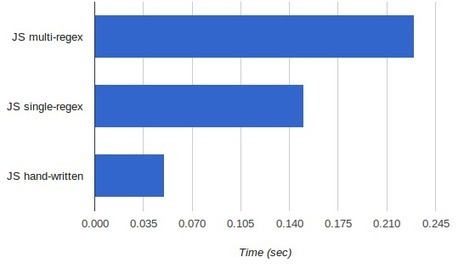
However, in the real world you’ll find that most lexers (particularly lexers for real programming languages) are not written that way. They are carefully hand-written to go over the input and dispatch to the appropriate token handling code depending on the first character encountered. This technique makes more sense for complex languages because it’s much more flexible than regexes (for instance, representing nested comments with regexes is a big challenge). But I was curious also about its performance implications. So I hacked together a hand-written lexer for exactly the same language used in the previous benchmark and also exercised it on the same large file to make sure the results are correct. Its runtime, however, surprised me. Here’s the runtime of lexing a large-ish document (smaller is better):
Scoop.it!

The gist of the application is to allow users to sign up and be able to share financial tips. I will document my journey along for others who are thinking of travelling down the same road, starting with my choice of technologies, this being my first attempt at building up the whole architecture from the ground up and since I am a front end developer and I wanted to leverage that experience to build a mobile app instead of going native. When deciding on the initial approach to building the app, I initially thought about using Sencha Touch. I had tried Titanium before but had found it unwieldy although I like the whole integrated IDE to production setup. I work with ExtJS on a daily basis so I figured Sencha Touch would be a natural complement but after working with AngularJS, I really did want to keep getting better at it and not have to duplicate my learning by both doing Angular and Sencha Touch at the same time so i settled on PhoneGap.

Shebrisbane's comment,
December 6, 2017 1:25 AM
Nice post thenks for sharing. if anyone want best cooking tips and advice then read shebrisbane magazine.
http://www.shebrisbane.com.au/category/travel-travel/
Shebrisbane's comment,
December 6, 2017 1:25 AM
Nice post thenks for sharing. if anyone want best cooking tips and advice then read shebrisbane magazine.
http://www.shebrisbane.com.au/category/travel-travel/ |




