JavaScript for Line of Business Applications
606.5K views | +16 today
JavaScript for Line of Business Applications
Keeping track of current JavaScript Frameworks that help design your clientside Business Logic Layers.
Curated by Jan Hesse
Beam to my Inbox:
Your new post is loading...

Popular Tags - Filter using the Funnel

Scoop.it!

Useful GitHub patterns

Useful GitHub patterns | JavaScript for Line of Business Applications | Scoop.it

Both my day job and my open-source work involve constant use of git and GitHub. These are some useful patterns that I’ve found myself using regularly.

1. the peel-off PR
2. the optimistic branch
3. the heads-up PR
4. the sneaky commit
5. the roger roger comment
6. the creepin’ commit
7. the forced branch
8. the reformat peel-off
9. the prototype PR


No comment yet.
Scoop.it!

AngularJS tips'n'tricks part 1

AngularJS tips'n'tricks part 1 | JavaScript for Line of Business Applications | Scoop.it

In the past few months we learned a lot of new AngularJS stuff. Here is a first bunch of tricks, please comment and help us improve theses exemples if your tricks are even more awesome :)

* Scopes
* Directives
* Watch an object or a list
* Two way data binding attribute without explicit scope declaration.
* Use a callback function with arguments in your directive
* Custom transclusion
* Announcer/Notifier pattern

No comment yet.
Scoop.it!

Using AngularJS with a Rails backend

Using AngularJS with a Rails backend | JavaScript for Line of Business Applications | Scoop.it

While it is possible to include AngularJS as part of the rails assets, I think it is better to setup the angular code base on a standalone folder, leaving the rails app as a (more or less) isolated backend.

During development, you need to run both rails and the grunt server. The grunt server takes care of serving the assets (yes, it can serve coffeescript if you like that) and doing the live reloads.

We simulate that the whole environment is a single web application by running a proxy inside the grunt server. At some point during the production deploy process we'll be consolidating the whole angular app as a set of static assets in rails' public/ folder.

Here's a diagram of the stack during development:

No comment yet.
Scoop.it!

Don't let Ember.js swallow errors in your promises

Are you finding that errors occurring in your promise handlers are being swallowed silently by Ember.js ? I had written some code that looked like this:The problem was that I was calling this.getXXX while in the scope of the then() function, which is globally scoped. This was easily fixed by passing a reference to controller scope, but normally these kind of mistakes are logged to the console.

Heres a code snippet that you can add to your Ember.js application to make sure these errors get logged to the console.

No comment yet.
Scoop.it!

Real-Time Messaging for Meteor With Meteor Streams

Real-Time Messaging for Meteor With Meteor Streams | JavaScript for Line of Business Applications | Scoop.it

This is 2013. If you are going to build a webapp, you must add real-time capabilities to the app. It is the standard. Meteor does a pretty good job at helping you to quickly build and make apps real-time. But meteor is tightly coupled with MongoDB and it is the only way to add real-time capabilities. Sometimes, this is overkill.


MongoDB is a perfect match for Meteor. But we don’t need to use MongoDB for all our real-time activities. For some problems, messaging based solutions work really well. It’s the same problem that pubnub andreal-time.co are also addressing.

No comment yet.
Scoop.it!

The basics of using ui-router with AngularJS

The basics of using ui-router with AngularJS | JavaScript for Line of Business Applications | Scoop.it

URL routing is a popular approach to matching the contents of a URL to specific functionality within a web application. URL routes programatically present specific content to users based on the URL that they are visiting. It is a popular approach that has proven to be very effective.

Something that might not be obvious is that URL routing is also a finite state machine. When you configure the routing for an app, you are laying out the various states the application can be in, and informing the application what to display and do when a specific route is encountered.

AngularJS supplies URL routing by default. It is adequate, but also has some limitations.

No comment yet.
Scoop.it!

Javascript object oriented programming - good approaches

Javascript object oriented programming - good approaches | JavaScript for Line of Business Applications | Scoop.it

I am trying to explain how to replace things like inheritance with prototypal approach. Making modular, component based code in most straightforward way - without unnecessary abstraction and complex...

No comment yet.
Scoop.it!

Open source service like Parse or Firebase?

Is there a open source / standalone / self hosted service like Parse or Firebase, preferably using Node.js. I really like the concept of a systems that manages data synchronization between all my apps (mobile, web, desktop). I think these are great services, but I'd really like to have full control over my backend stack and data.

jaredwilli's comment, July 23, 2013 6:32 PM
I find Firebase to be great myself, however they have much work to do still to make it really seamless and pain free.
Scoop.it!

Backbone patterns

Here, I try to document the good practices that our team has learned along the way building Backbone applications.

* Model patterns

* View patterns

* General patterns

* Conventions

* Anti-patterns

No comment yet.
Scoop.it!

Building WebRTC Filesharing with PubShare

Building WebRTC Filesharing with PubShare | JavaScript for Line of Business Applications | Scoop.it
A couple of weeks ago, we announced our WebRTC SDK, expanding our ever-growing list of PubNub supported SDKs. This API makes incorporating WebRTC into a PubNub
No comment yet.
Scoop.it!

SEO in JS Web Apps

JavaScript and search engines have always had a tricky relationship, and SEO is often used as an argument against single page applications. I’m aiming to put some of those misconceptions to rest in this article and show you that it’s perfectly possible to create a pure JavaScript web application and still have good SEO.

No comment yet.
Scoop.it!

On the Bleeding Edge: Advanced AngularJS Form Validation

On the Bleeding Edge: Advanced AngularJS Form Validation | JavaScript for Line of Business Applications | Scoop.it

We’ve been using AngularJS for the past few months and in general it has been really great. There has definitely been a learning curve, but the best part of the design is that it really encourages you to extend it properly. Whenever you try to hack something, it just feels wrong and you are forced to look at your problem from a different perspective. The benefit is the resulting solution is usually much more modular and portable.

Scoop.it!

Web Workers are slower and that’s OK.

Web Workers are slower and that’s OK. | JavaScript for Line of Business Applications | Scoop.it

Workers in JavaScript are for running things in parallel, everyone knows that parallelism is how you make stuff Fast these days, therefore I can write a version of map that distributes the workload over 4 workers and it will be 4 times as fast as the regular map right?

Sorry to burst your bubble but no you probably can’t.  While your 4 worker version is going to be faster than one with 1 or 2 workers It’s going to be a lot slower than the native map method (which in fairness is going to be much slower than doing a for loop, but that’s a whole different thing).

No comment yet.
Scoop.it!

AngularJS tips'n'tricks part 2

AngularJS tips'n'tricks part 2 | JavaScript for Line of Business Applications | Scoop.it

Here’s a new batch of AngularJS tips and gotchas:

* Access an element scope from outside
* Unwatch an expression
* Group elements in a select
* Filter falsy values
* Filter on objects
* ng-repeat with duplicate items
* Directive : parse attribute without watching it
* Data-binding to a boolean
* Includes onload
* Express testing
* Service decorators

No comment yet.
Scoop.it!

MEAN (Mongo, Express, Angular, Node) stack Boilerplate

MEAN (Mongo, Express, Angular, Node) stack Boilerplate | JavaScript for Line of Business Applications | Scoop.it

MEAN is a Simple, Scalable and Easy approach to javascript based web development

MEAN is a boilerplate that provides a nice starting point for MongoDB, Node.js, Express, and AngularJS based applications.
It is designed to give you quick and organized way to start developing of MEAN based web apps with useful modules like mongoose and passport pre-bundled and configured.
We mainly try to take care of the connection points between existing popular frameworks and solve common integration problems.

No comment yet.
Scoop.it!

KnockoutJS and SEO

KnockoutJS and SEO | JavaScript for Line of Business Applications | Scoop.it
The easiest way to create and share beautiful presentations. (As I dive into Knockout.js and Angular.js, there’s a very interesting presentation about SEO.
No comment yet.
Scoop.it!

Memoizations, accessories & private variable in javascript

I think, I started this post over five times at least. Unless you have read this piece from a week ago, you know that I’m not a fan of huge JavaScript structure in my web application. However, it happens that I need something more robust when dealing with some part of the UX, specially, some moving parts that don’t require a round trip to the server.

When this happens, I usually follow an object-oriented approach with CoffeeScript. Here I will use JavaScript.

No comment yet.
Scoop.it!

Backbone.js Testing

Backbone.js Testing | JavaScript for Line of Business Applications | Scoop.it
Apps, suites, and examples for Backbone.js Testing.

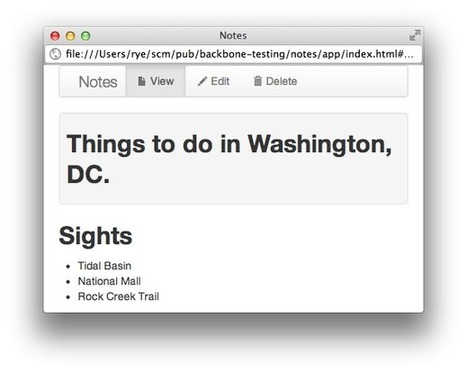
This site provides materials and resources for developing and testing Backbone.js web applications. All of the application and test examples for the book Backbone.js Testing can be found here, grouped by chapter. We also provide a reference Backbone.js application - Notes - for creating and viewing notes, which we use throughout the examples in the book.
The core set of Backbone.js application technologies we cover includes:
* jQuery
* Underscore.js
* Backbone.js
We write a test infrastructure built on the following (fantastic) test libraries.
* Mocha
* Chai
* Sinon.JS

No comment yet.
Scoop.it!

Server Sent Events with Aura and Node.js

Server Sent Events with Aura and Node.js | JavaScript for Line of Business Applications | Scoop.it

Recently, I uncovered a relatively fresh and unique HTML5 feature: Server Sent Events (SSE). Here are the main design characteristics:

* Everything happens over the HTTP, no special protocol required
* Keeps an open HTTP/S connection to the server
* Communication is unidirectional (read only by the client)
* Different event sources/channels can be fed down the same connection
* Auto reconnection and event IDs come for free as part of the implementation. The auto reconnection is ideal for flaky connections, like mobile devices.

If you are familiar with Websockets, you should understand that they are the superior implementation for scalable bidirectional push communication, and not a competing technology for SSE. SSE can be viewed as more of a "lightweight" alternative, for when using WebSockets is not a viable option, most likely due to server limitations. There are some pros and cons of using SSE over WebSockets.

No comment yet.
Scoop.it!

JavaScript Testing Framework - Jasmine - a quick study

JavaScript Testing Framework - Jasmine - a quick study | JavaScript for Line of Business Applications | Scoop.it

Now-a-days various JavaScript based applications are being increasingly popular. So there are requirements to testJavaScript code in automated way are being evident in all aspects of development work.

Some  points to understand within Jasmine -

1.  Jasmine is a javascript testing framework which is suited for behaviour driven development

2. ‘describe’ is a keyword in test suite for jasmine tests

...

No comment yet.
Scoop.it!

JavaScript is cool

JavaScript is cool | JavaScript for Line of Business Applications | Scoop.it

I'm writing a lot of JavaScript these days. Sometimes it's really crazy what you can do with that language. I have bunch of tools in my arsenal and I wanted to document them somehow. Writing an article is a good option. By tools I mean patterns, piece of logic or just syntax shortcuts. However, this article is not exactly about design patterns, but it uses some of them. It's just about few ideas, which I came into during my daily scripting:

* Let's modulize
* Extending modules
* Beauty
* Communication
* Resolving dependencies
* Conclusion

No comment yet.
Scoop.it!

How to lexically scope like a boss

How to lexically scope like a boss | JavaScript for Line of Business Applications | Scoop.it

Lexical scoping (scoping accordinng to location in source code) is probably one of the most powerful features a programming language can have. Today, I’m going to show you how to use lexical scoping to create powerful abstractions. I will begin by introducing the concept of scope. From there I will introduce a few rules for figuring out the scope of your variables in javascript and then introduce the concept of a closure and how it will make you positivly badass at Javascript.

No comment yet.
Scoop.it!

ExtJS 4 MVC Architecture Mind Map

ExtJS 4 MVC Architecture Mind Map | JavaScript for Line of Business Applications | Scoop.it

I saw a few mental maps on the web and I though it would be useful to do one about the ExtJS 4 MVC architecture, since there are some people that are struggling with it.
The mind map is on my slideshare, so you can download the pdf from there!

No comment yet.
Scoop.it!

Reactive UI Programming with KnockoutJs and RxJs

Reactive UI Programming with KnockoutJs and RxJs | JavaScript for Line of Business Applications | Scoop.it

When writing a complex single page web application, you find yourself dealing with ALOT of asynchronous activities. The user is busy clicking on UI elements and typing in text boxes. Asynchronous requests and responses are flitting back and forth between the server and client. Perhaps you’ve even got asynchronous messages coming from web workers.

Managing all of this asynchronous information and maintaining the correct state can be a real challenge. Luckily there are a number of libraries out there to simplify the task.

Jan Hesse's insight:

FollowUps:

http://palladiumblog.wordpress.com/2013/02/25/reactive-ui-programming-part-1-converting-between-ko-and-rxjs/

http://palladiumblog.wordpress.com/2013/03/03/reactive-ui-programming-part-2-trail-by/

No comment yet.
Scoop.it!

Communist! A JavaScript Library for workers

A JavaScript library all about workers. Workers should make your life easier not harder and with communistjs launching a new worker is as simple as calling a function, and it works the same across all (modern) browsers.

No comment yet.